
By Open Chronicle News Desk
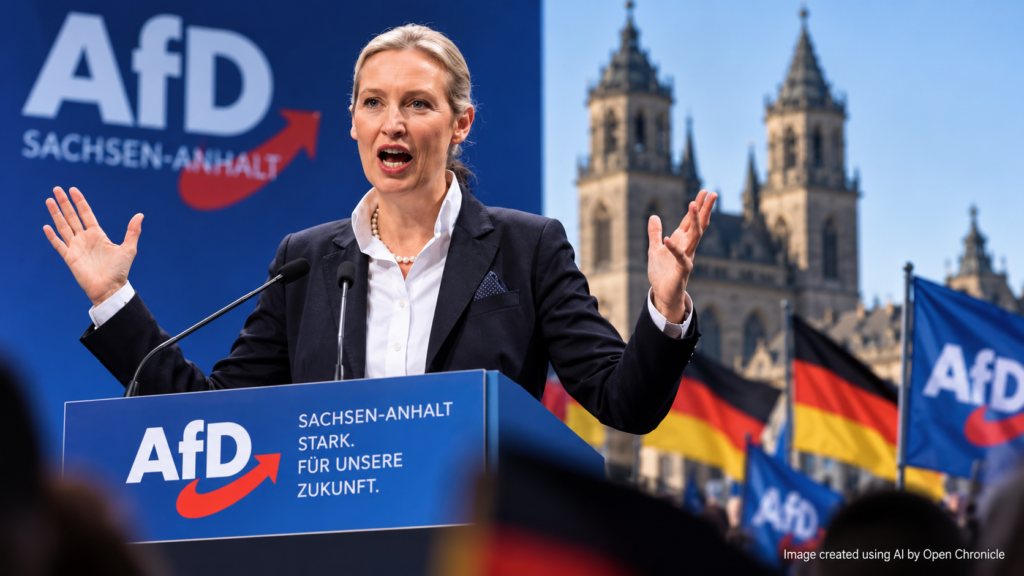
Germany’s Alternative for Germany is heading for a commanding victory in the Saxony-Anhalt state election, according to exit polls, potentially delivering the far right its most significant electoral breakthrough since the party was founded 13 years ago.
Initial projections put the AfD at around 44 percent of the vote, dramatically ahead of Chancellor Friedrich Merz’s Christian Democratic Union, which is projected at approximately 18.5 percent. The Left Party is expected to finish third with roughly 9 percent.
The scale of the result represents a major shift in the politics of the eastern German state, where the CDU has led the government for 24 years. It also places renewed pressure on the political barrier established by Germany’s mainstream parties against cooperation with the AfD.
What remains uncertain is whether the AfD’s victory will translate into control of the state government.
AfD falls just short of projected majority
The AfD entered the election seeking an absolute majority that would allow it to govern without coalition partners.
Early projections suggest it could secure around 39 seats in the state parliament, approximately three short of the number required to govern alone.
That makes the performance of Germany’s smaller parties particularly important. Their ability to cross the electoral threshold and enter parliament could ultimately determine the distribution of seats and whether the AfD has any realistic route to power.
One party that could become significant in the negotiations is the left-wing populist Sahra Wagenknecht Alliance, known as BSW.
Germany’s established mainstream parties have maintained a political “firewall” against the AfD, refusing to enter coalitions or formal cooperation with it. Unless that position changes, an AfD result short of an outright majority could leave Saxony Anhalt facing difficult negotiations over its next government.
Siegmund declares that AfD has ‘written history’
Ulrich Siegmund, the AfD’s candidate for state governor, celebrated the projected result as a historic moment.
“We have written history,” he told German broadcaster ARD, arguing that voters had delivered a message that “things cannot carry on like this.”
Siegmund also targeted Chancellor Merz, describing him as “a very good campaigner for us” because of what he characterized as the chancellor’s unpopularity.
For the AfD, winning its first state government would represent a much larger breakthrough than its previous successes at local level.
The party secured its first leadership of a county administration in neighboring Thuringia in 2023. Taking control of one of Germany’s 16 state governments would give it substantially greater political authority and provide a platform from which to strengthen its claim that it can eventually govern nationally.
A major setback for Merz and the CDU
The projected result is particularly damaging for the CDU.
Saxony Anhalt has been governed by the center-right party for more than two decades, making an AfD victory there especially symbolic.
A result of around 18.5 percent would also underline the scale of the CDU’s decline in the state and could intensify questions about Merz’s political leadership.
The election had already become a national test because of the AfD’s rapid growth in eastern Germany and the difficulties faced by established parties in containing its support.
A victory of the magnitude indicated by the exit polls would ensure that debate over the AfD’s role in German politics extends well beyond Saxony-Anhalt.
Why control of a German state matters
Germany’s federal structure gives its 16 states substantial political authority.
State governments exercise significant responsibilities in areas including education and internal security. They also participate in national policymaking through the Bundesrat, the upper chamber representing Germany’s states.
An AfD led administration would therefore allow the party to turn parts of its political program into government policy rather than operating primarily as an opposition movement.
In Saxony-Anhalt, the party has proposed allowing home schooling, which is currently prohibited under Germany’s education system.
It also wants schools to be prevented from officially displaying the rainbow flag in support of LGBTQ+ rights.
Other elements of its political platform reach beyond the powers available to a state government.
The AfD opposes German taxpayer money being provided to Ukraine and favors lifting sanctions against Russia. Decisions on sanctions and Germany’s broader foreign policy, however, are made at federal and European levels rather than by individual states.
Germany’s firewall faces another test
The immediate political question is now whether Germany’s longstanding strategy of isolating the AfD can withstand another major electoral advance.
Mainstream parties have repeatedly argued that cooperation with the AfD would normalize a political movement they regard as incompatible with their democratic and constitutional principles.
But as the party’s share of the vote increases, forming governments without it becomes increasingly complicated.
Saxony Anhalt could provide one of the clearest examples yet of that dilemma.
If the AfD finishes with approximately 44 percent but remains below an absolute majority, rival parties may have to construct a governing arrangement despite collectively suffering a decisive electoral defeat.
That could produce prolonged negotiations and potentially an unstable government.
From regional breakthrough to national ambitions
For the AfD leadership, the importance of Saxony-Anhalt extends far beyond the state itself.
The party has increasingly presented its successes in eastern Germany as evidence that the political isolation imposed by other parties cannot be sustained indefinitely.
Winning more than twice the projected CDU vote would reinforce that argument.
A first AfD led state administration would also allow the party to demonstrate whether it can translate opposition politics into practical government, something that could influence voters elsewhere in Germany.
The result therefore represents more than another strong showing for the far right in eastern Germany.
If the exit polls are confirmed, the AfD will have achieved one of the biggest victories in its history, the CDU will have suffered a severe defeat in a state it has governed for 24 years, and Germany will once again confront a question that is becoming increasingly difficult for its established parties to avoid: what happens to the political firewall when the party outside it becomes the largest force in the electorate?