
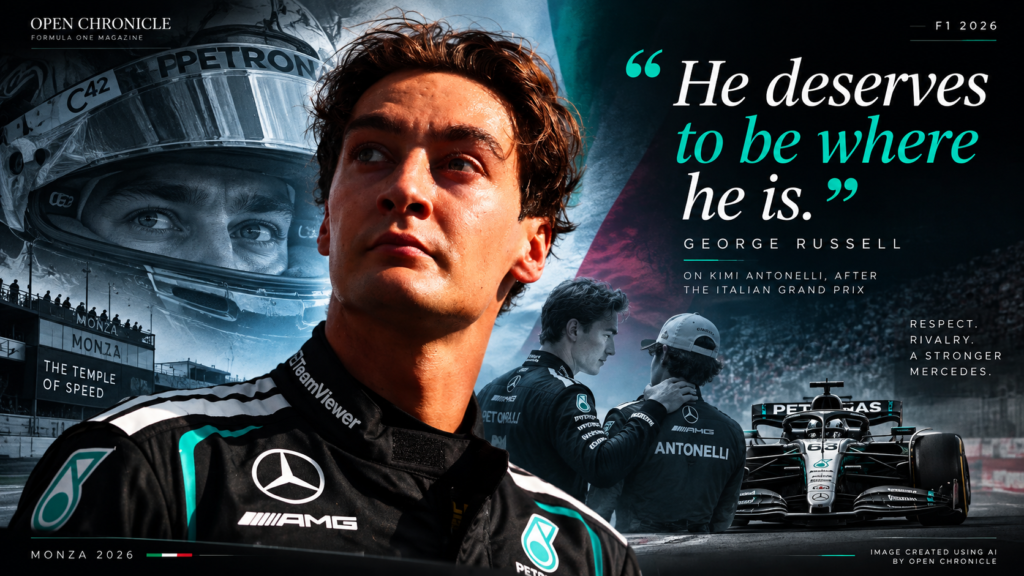
George Russell admits Kimi Antonelli’s recovery from 19th to victory at Monza was “incredibly impressive” and says his Mercedes teammate deserves his commanding position at the top of the 2026 Formula One World Championship. Rather than focus on the 66 point deficit, Russell says his objective is now simple: win races.
By Open Chronicle Formula One Magazine
George Russell left Monza disappointed to have lost the Italian Grand Prix, but with no hesitation in recognising the quality of the driver who defeated him.
Kimi Antonelli’s extraordinary recovery from 19th on the grid to victory transformed what had appeared to be a damage limitation weekend into another major step towards the 2026 Formula One World Championship.
For Russell, who started from the front row and led significant portions of the race, the outcome was inevitably frustrating.
But his assessment of Antonelli was unequivocal.
“My huge congratulations to Kimi. On the face of it, starting where he started and finishing with the victory is incredibly impressive.”
The significance of those words extends beyond a teammate congratulating another after a Grand Prix.
Russell is Antonelli’s closest championship rival.
And after Monza, the gap between them is 66 points.
Russell Had the Early Advantage
Their Italian Grand Prix weekends could hardly have begun from more contrasting positions.
Russell qualified second and shared the front row with surprise pole sitter Pierre Gasly.
Antonelli had qualified seventh but a penalty associated with power unit components sent the Italian championship leader down to 19th on the starting grid.
For Russell, it represented an opportunity.
For Antonelli, it appeared to be an afternoon about limiting losses.
The opening stages initially supported that scenario.
Gasly defended the lead at the start, but Russell quickly used the performance of the Mercedes to move ahead of the Alpine and take control of the race.
Antonelli, meanwhile, began cutting through the field almost immediately.
The Italian gained five positions on the opening lap alone.
Then came Charles Leclerc’s heavy accident and the red flag.
The interruption altered the strategic complexion of the Grand Prix, but it did nothing to slow Antonelli’s progress.
By the early stages after the restart, he was already among the leading cars.
Russell noticed.
“When I saw he was fifth after the first few laps, I realised he was in the fight.”
That realisation proved correct.
Antonelli was not simply recovering points.
He was coming for the victory.
Teammates Become Rivals
Antonelli continued advancing after the restart.
He passed the cars separating him from the leaders, caught Max Verstappen and overtook the Red Bull before reaching Russell.
The Mercedes drivers then found themselves fighting directly for first place.
Antonelli took the lead on lap 18 after attacking Russell around the outside into Turn 1.
Russell responded.
What followed was one of the defining sequences of the Italian Grand Prix, with the two Mercedes drivers repeatedly contesting the lead while Verstappen remained close enough to punish either driver for a mistake.
Russell eventually reasserted himself at the front.
Then the strategic picture changed again.
The Decision on Lap 28
Lance Stroll’s retirement brought out the Virtual Safety Car on lap 28.
Mercedes now faced a critical decision.
Antonelli stopped and switched to a fresh set of medium tyres.
Russell stayed out on his hard tyres.
The team had effectively divided its two drivers onto different strategic paths.
For Russell, the decision would become central to the outcome of the Grand Prix.
With the benefit of hindsight, stopping under the Virtual Safety Car appears the obvious alternative.
Russell acknowledged as much, while also explaining why the decision was less straightforward from inside the cockpit.
“In hindsight, it is easy to say I should have pitted rather than stayed out. At that moment, I felt I was managing to keep myself in the fight, but I think that was exactly why the team wanted us on different strategies.”
It was an important distinction.
Mercedes was not simply choosing between two tyre compounds.
With both cars fighting for victory, splitting the strategies reduced the risk of committing both drivers to the same tactical outcome.
Antonelli’s strategy ultimately proved stronger.
Antonelli Comes Back Again
Fresh medium tyres gave Antonelli the platform for another recovery.
He worked his way forward and began reducing Russell’s advantage.
The remarkable element was that this was effectively Antonelli’s second charge towards the lead during the same Grand Prix.
He had already travelled from 19th through the field and reached first place during the opening half of the race.
The Virtual Safety Car and subsequent pit stop required him to rebuild his position again.
He did.
By the closing stages, the two Mercedes cars were together once more.
Antonelli attacked on lap 49, but the attempt became untidy as both drivers went deep under braking and the Italian crossed the gravel.
For a moment, Russell had breathing space.
It did not last.
Antonelli closed again.
With three laps remaining, he completed the decisive pass and took the lead for the final time.
Russell could not respond.
Antonelli crossed the line first and completed the afternoon by recording the fastest lap on the final tour.
Russell finished second.
“I’m disappointed I couldn’t get the victory, but it is what it is.”
A Defeat With Championship Consequences
For Russell, the disappointment was about more than losing a Grand Prix.
Monza had presented one of his clearest opportunities to reduce Antonelli’s championship advantage.
Before the race, Antonelli held a 59 point lead.
Russell started from the front row.
Antonelli started 19th.
Yet by the end of the afternoon, the championship leader had not merely protected his advantage.
He had increased it.
Antonelli now leads Russell by 66 points.
That represents a significant psychological and mathematical shift as Formula One moves into the final ten Grands Prix of the season.
Russell nevertheless resisted framing every remaining weekend around the championship deficit.
“We are where we are. He has been driving incredibly this season. He deserves to lead the championship and he has a comfortable advantage.”
For a driver still mathematically at the heart of the title contest, it was a striking acknowledgement.
“I’m Not Even Going to Think About the Championship”
Russell’s response to the championship situation is to simplify his objective.
He cannot control Antonelli’s results.
He cannot recover 66 points in a single weekend.
What he can do is attempt to win the next Grand Prix.
And then the one after that.
“I’m not even going to think about the championship fight or a comeback. I’m just going to every race with the aim of winning it.”
That approach makes sense.
Russell’s championship situation no longer rewards conservatism.
Finishing second behind Antonelli, as he did at Monza, strengthens Mercedes but does little for Russell’s own title prospects.
He needs victories.
More importantly, he needs races in which other drivers finish between himself and Antonelli.
“I’m not going to put any pressure on myself in that respect. I just need to try to win more races.”
The championship may eventually come back towards him.
But Russell does not intend to race while constantly calculating when that might happen.
The Mercedes Paradox
Monza also exposed what could become one of the most fascinating tensions of the final part of the season.
Mercedes has the championship leader.
Mercedes also has his principal challenger.
From a constructor perspective, the Italian Grand Prix was almost perfect.
A one two finish delivered a major haul of points.
From the drivers’ championship perspective, however, every Mercedes one two with Antonelli ahead makes Russell’s task harder.
That creates a delicate competitive balance.
At Monza, Mercedes allowed its drivers to race while keeping their strategies separate.
There was no artificial reversal of the final order.
Antonelli had to catch Russell and pass him on track.
Russell’s comments afterwards suggest he accepts that outcome.
That matters.
The championship could become considerably more complicated if the two Mercedes drivers continue to meet at the front over the final ten rounds.
Respect Between Rivals
Formula One title fights can change relationships.
Pressure increases. Strategic decisions become more contentious. Every lost point assumes greater importance.
Russell’s comments after Monza therefore carry particular significance.
He did not blame Antonelli.
He did not diminish the recovery by pointing towards the red flag or Virtual Safety Car.
And he did not suggest that the championship lead misrepresents their respective performances.
Instead, he acknowledged what the season has increasingly demonstrated.
Antonelli has earned his position.
“He is in the best position and he deserves to be where he is.”
That may be the most important sentence Russell delivered after Monza.
Because it came from the driver with the greatest reason to believe otherwise.
From Teammate to Benchmark
Antonelli’s season has now reached the point where individual victories are becoming part of a larger championship narrative.
Monza strengthened that narrative considerably.
This was not a victory produced by pole position and clean air.
It came from 19th.
It required overtaking.
It required adapting to a red flag.
It required recovering after the Virtual Safety Car changed the strategic order.
It required defeating Verstappen.
And ultimately it required beating Russell, his teammate and closest championship rival, in direct combat.
For Russell, there is no complicated answer to what comes next.
Win.
Then win again.
Antonelli holds the points advantage and the momentum. Russell still possesses the machinery to fight him and ten Grands Prix remain.
But Monza demonstrated how difficult reversing this championship may be.
On a weekend when Antonelli appeared vulnerable, Russell started second and the Italian started 19th.
By Sunday evening, Antonelli was standing on the top step of the podium.
And even his closest rival had to acknowledge the conclusion.
He deserves to be there.