
By Open Chronicle with agencies
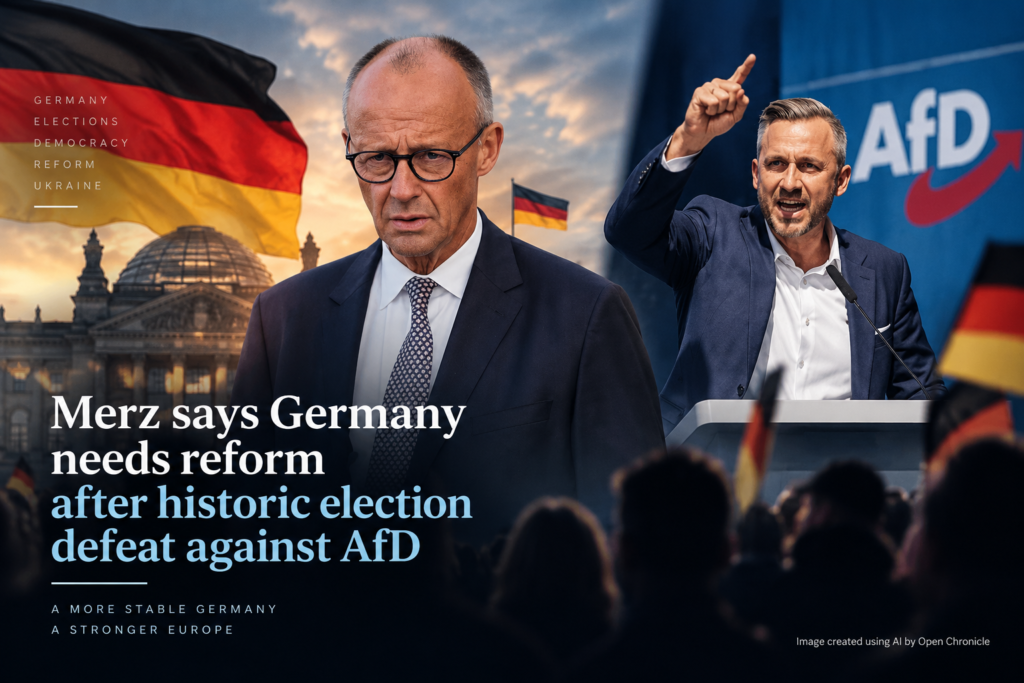
German Chancellor Friedrich Merz has called for deeper reforms after the Alternative for Germany secured a historic victory in Saxony Anhalt, while insisting that the result will not alter Berlin’s support for Ukraine or its commitment to Germany’s democratic institutions.
The AfD won nearly 44% of the vote in the eastern state, inflicting one of the most serious electoral defeats in decades on Merz’s Christian Democratic Union. Although the party emerged comfortably ahead of its rivals, it fell short of the absolute majority needed to govern alone.
Speaking after the result, Merz acknowledged the scale of the setback and argued that voters had delivered a clear demand for political change.
“That is what we need to deliver on now; it is what I want to deliver on, and that is the stance I am taking into talks with our coalition partner,” the chancellor said.
At the same time, Merz sought to reassure Germans and international partners that the electoral breakthrough would not destabilise the country’s constitutional system.
“Our institutions are resilient and stable. Our Basic Law protects and guarantees this order,” he said.
“This message is also directed at our friends in Europe and across the globe.”
AfD victory transforms Germany’s political landscape
The Saxony Anhalt result represents a major milestone for the AfD and another indication of the growing political divide between eastern and western Germany.
The party secured almost 44% of the vote and 39 of the state parliament’s 83 seats. That leaves it three seats short of the 42 required for an outright majority.
The result nevertheless gives the AfD unprecedented political strength at state level and increases pressure on the other parties over the long standing political barrier against cooperation with it.
During the campaign, the AfD capitalised on frustration with established parties and promoted tougher immigration policies, an end to German military support for Ukraine and renewed relations with Moscow.
The party has also promised policies intended to strengthen national identity and address public concerns about security and migration.
The AfD’s Saxony Anhalt organisation has been classified as right wing extremist by the state branch of Germany’s domestic intelligence service. The party rejects the classification and argues that accusations of extremism are used to discredit its voters.
Merz refuses to change course on Ukraine
One of the most immediate questions following the election was whether the AfD’s success could increase pressure on Berlin to reconsider its support for Ukraine.
Merz rejected that possibility.
The chancellor argued that Russia continues to represent a direct challenge to European security and suggested that Moscow would welcome the AfD’s electoral advance.
“2,500 kilometres east of here, people are especially delighted with this election result in the eastern German state of Saxony Anhalt,” Merz said, referring to Russia.
“I will not deviate by even a millimetre from my fundamental conviction that we must defend our freedom, especially now, against Russia.”
Merz warned that ending assistance to Kyiv would not bring greater security to Germany or Europe.
“If we stop supporting Ukraine, the situation will not improve by tomorrow; it will only get worse,” he said.
According to the chancellor, Russia’s challenge extends beyond the battlefield in Ukraine and concerns the wider political and security order that has shaped Europe for decades.
“The Russian leadership aims to destabilise the system of values underpinning what we once called ‘the West’, a system of values that is non negotiable.”
Russia and immigration shaped the campaign
Foreign policy played an unusually important role in the state election.
According to figures cited from broadcaster ARD, “peace in Europe” was the second most important factor influencing voters in Saxony Anhalt.
Both the AfD and the left wing populist BSW have called for Germany to end its support for Ukraine, lift sanctions against Russia and restore economic relations with Moscow.
Both parties also argue that sanctions have damaged Germany by cutting businesses off from relatively inexpensive Russian energy supplies that previously supported significant parts of the country’s industrial economy.
Immigration was another central issue.
The AfD has advocated substantially tougher migration policies and deportations while portraying the established parties as incapable of addressing public concerns about migration, security and economic pressure.
The BSW also supports a more restrictive approach to immigration, arguing that large scale migration can weaken workers’ rights and place additional pressure on public services.
Could the AfD find a path to power?
Despite its commanding victory, the AfD cannot currently govern Saxony Anhalt alone.
With 39 seats, it needs additional parliamentary support to elect a state premier and establish an administration.
Mainstream German parties have maintained their refusal to cooperate with the AfD. The BSW, however, has shown greater openness to engaging with the party on individual issues, particularly where their positions on Russia, Ukraine and migration overlap.
How the new state parliament is organised could therefore become a significant test of Germany’s political firewall against the AfD.
Any attempt by the party to attract individual conservative lawmakers would also place enormous pressure on the CDU.
A warning for Merz
The result represents a serious political setback for the chancellor.
The CDU had governed Saxony Anhalt for 24 years, making the scale of its defeat particularly significant.
Merz nevertheless defended the reform programme pursued by his government and indicated that he intends to continue pressing for changes rather than abandon his agenda in response to the election.
The result also revealed important demographic divisions.
According to voter breakdowns cited after the election, around 50% of male voters backed the AfD, compared with 39% of women. The party also performed particularly strongly among voters facing greater economic insecurity and those with lower levels of formal education.
Saxony Anhalt accounts for only a relatively small proportion of Germany’s population, but the political significance of the result reaches far beyond the state.
AfD national co leader Alice Weidel described the victory as a milestone and said the party would aim for at least 40% of the vote at Germany’s next federal election, scheduled for 2029.
Concern spreads beyond Germany
The result has also attracted attention elsewhere in Europe.
Political figures on the nationalist right welcomed the AfD’s advance as evidence of a broader shift in European politics. Other governments and political leaders reacted with concern.
French Finance Minister Roland Lescure described the result as a “very, very worrying signal.”
“This shows that we face a major challenge in the face of a populist wave which is spreading around the world today and which we must resist,” he said.
For Merz, the challenge is now twofold. His government must respond to the domestic frustrations that helped propel the AfD to its strongest state election result while maintaining the foreign policy and democratic principles that the chancellor says remain non negotiable.
The Saxony Anhalt election may have taken place in one of Germany’s smaller states, but its consequences could reshape the country’s political debate well before voters return to the polls nationally in 2029.