
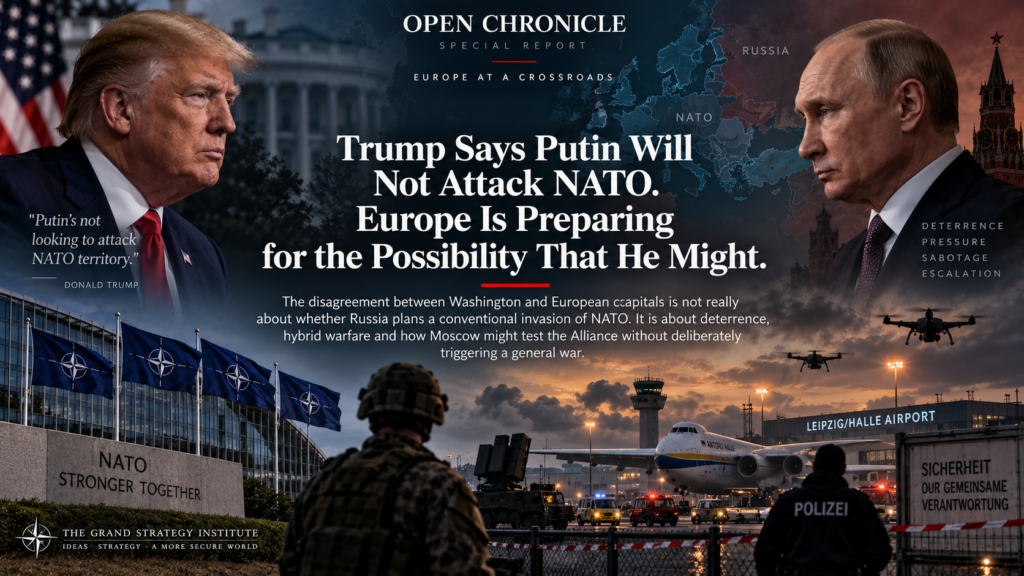
The disagreement between Washington and European capitals is not really about whether Russia plans a conventional invasion of NATO. It is about deterrence, hybrid warfare and how Moscow might test the Alliance without deliberately triggering a general war.
By The Grand Strategy Institute Research Division
Grand Strategy Analysis | 7 September 2026
Donald Trump believes Vladimir Putin does not intend to attack NATO.
Many European security officials are increasingly unwilling to build their defence policy around that assumption.
The difference appears stark. Speaking after Germany formally attributed an attempted explosive drone attack at Leipzig/Halle Airport to Russia, the U.S. president dismissed fears that Moscow was preparing to attack NATO territory.
“I speak to him. I know him very well. Putin’s not looking to attack NATO territory,” Trump said.
Trump’s assessment cannot simply be dismissed as strategically incoherent. A deliberate, large-scale Russian conventional invasion of NATO would expose Moscow to the military resources of an alliance containing three nuclear powers and would create the possibility of collective defence under Article 5. For a Russian leadership that has repeatedly demonstrated an awareness of escalation risk, such an operation would carry extraordinary dangers.
But Europe’s concern rests on a different proposition.
The relevant question may not be whether Russia intends to send armoured formations across NATO’s borders in a general invasion.
It may be whether Moscow believes it can operate below, around or briefly across the threshold of collective defence without provoking a unified NATO military response.
That distinction changes the entire strategic problem.
The debate between Trump and Europe’s security establishment therefore presents a false binary if reduced to a choice between “Russia will attack NATO” and “Russia will not attack NATO.”
Both positions can contain elements of truth.
Russia may have no rational interest in initiating a general war with NATO while simultaneously possessing strong incentives to probe the Alliance, weaken its cohesion, conduct sabotage, exploit political ambiguity and test whether collective defence remains credible.
The danger is not necessarily an invasion of Europe.
The danger is miscalculated coercion.
Leipzig Changes the Context
The immediate background to Trump’s remarks is important.
On the night of 4 to 5 August, a drone carrying an explosive device was discovered inside the security perimeter of Leipzig/Halle Airport. German authorities said it was found close to Ukrainian Antonov cargo aircraft. Saxony’s state criminal police and prosecutors immediately opened an investigation into what authorities described as a serious security incident.
Subsequent investigations reportedly uncovered additional drones and explosives. German reporting indicated that investigators believed a Ukrainian Antonov cargo aircraft used for transporting military equipment may have been the intended target.
On 1 September, Berlin went considerably further.
The German government formally blamed Russia.
Interior Minister Alexander Dobrindt said evidence gathered by German security services and European partners pointed clearly toward Russian involvement. Germany cited the drone configuration, explosives and detonation technology as consistent with methods observed in previous Russian hybrid operations and in the war against Ukraine. Moscow has denied the accusation.
Germany responded by closing the Russian consulate in Bonn and the Russian House cultural centre in Berlin.
Russia retaliated on 7 September by announcing the closure of Germany’s consulate-general in St Petersburg and ordering Goethe-Institut operations in Russia to cease.
The significance of Leipzig therefore extends beyond the physical damage that might have occurred.
If Germany’s attribution is correct, the incident represents precisely the type of security challenge that complicates Trump’s argument.
It was not a Russian conventional attack on Germany.
It did not involve Russian tanks crossing NATO territory.
It did not resemble the opening phase of a traditional invasion.
Yet Berlin considers it a Russian state-directed operation involving explosives against critical infrastructure on NATO territory.
This is the strategic grey zone in which the future of European security may increasingly be contested.
Trump May Be Right About the Wrong War
There is a strong strategic case for believing that Moscow does not want a conventional war with NATO.
Russia understands the Alliance’s aggregate military and economic power.
It understands American nuclear capabilities.
It understands British and French nuclear forces.
It understands that a deliberate invasion could mobilise European societies far beyond anything achieved by the war in Ukraine.
And it understands that escalation between nuclear powers contains risks that cannot be completely controlled.
Political realism therefore provides substantial support for one part of Trump’s assessment.
States generally seek to preserve themselves.
Nuclear deterrence makes deliberate great-power war exceptionally dangerous.
Russian leaders have powerful incentives to avoid a conflict that could threaten the survival of the Russian state itself.
But this argument contains an important limitation.
Deterrence against total war does not necessarily deter limited aggression.
Indeed, nuclear weapons can sometimes produce the opposite effect.
Because both sides fear catastrophic escalation, they may become more willing to tolerate lower levels of confrontation.
Cyberattacks.
Sabotage.
Covert operations.
Electronic warfare.
Disinformation.
Infrastructure disruption.
Proxy operations.
Airspace violations.
Unattributed drone attacks.
Political interference.
Each can impose costs without necessarily creating the political conditions required for military retaliation.
This phenomenon is sometimes described as the stability-instability paradox.
Strategic nuclear stability can coexist with intense competition at lower levels of conflict.
The fact that Russia does not want World War III therefore tells us surprisingly little about whether it might be willing to conduct aggressive operations against NATO states below the threshold of World War III.
Europe Is Already Experiencing the Grey Zone
This is where European and American threat perceptions increasingly diverge.
From Washington, the principal question can appear to be whether Russia would rationally attack the world’s most powerful military alliance.
From Warsaw, Tallinn, Riga, Vilnius, Helsinki or Berlin, the question looks different.
European governments have spent years dealing with suspected sabotage, cyber operations, GPS interference, disinformation campaigns, espionage, infrastructure incidents and other activities attributed to Russia.
European defence and intelligence officials now increasingly describe these activities not as disconnected incidents but as components of a sustained Russian hybrid campaign. Following Leipzig, several officials have argued that NATO’s response to such operations remains insufficiently deterrent.
This creates an uncomfortable conceptual problem.
When does sabotage become warfare?
If an intelligence service recruits an intermediary to burn a warehouse, is that an act of war?
What if the warehouse contains weapons destined for Ukraine?
What if a cyberattack disables a hospital?
What if an explosive drone destroys a military cargo aircraft at a civilian airport?
What if people are killed?
NATO was designed primarily around a comparatively clear model of armed aggression.
Hybrid warfare deliberately attacks that clarity.
Its strategic purpose is often not simply destruction.
It is ambiguity.
Article 5 Is Powerful Precisely Because Nobody Wants to Test It
Article 5 of the North Atlantic Treaty is frequently described as NATO’s automatic war guarantee.
The reality is more nuanced.
An armed attack against one ally is considered an attack against all, but each ally takes “such action as it deems necessary,” including the use of armed force.
This flexibility was intentional.
It strengthens deterrence while preserving political decision-making.
But ambiguity can also invite testing.
Former German foreign intelligence chief Bruno Kahl articulated this danger clearly in 2024. He warned that Moscow might eventually attempt a limited operation designed not primarily to seize large amounts of territory, but to determine whether NATO would actually treat a small incursion as an attack against the entire Alliance.
Kahl specifically discussed scenarios involving a limited intervention in the Baltic region under the claimed protection of Russian minorities or a small territorial operation elsewhere on NATO’s periphery. His broader warning was that Russian decision-makers might seek to test whether Article 5’s political credibility matched its formal language.
That is a fundamentally different scenario from a Russian invasion of Europe.
And it is strategically much more plausible.
The Real Nightmare Is Not Russian Tanks Heading for Berlin
The most dangerous scenario for NATO is unlikely to begin with hundreds of thousands of Russian troops crossing several Alliance borders.
Such an attack would remove ambiguity.
It would unite NATO politically.
It would activate enormous military preparations.
It would make American disengagement extraordinarily difficult.
A more sophisticated challenge would be limited.
Imagine an incident in which Russian forces occupied a very small area of NATO territory amid claims of local unrest, minority protection, border confusion or some manufactured security emergency.
The territorial significance could be militarily trivial.
The political significance would be enormous.
NATO would immediately face a question upon which the Alliance’s existence ultimately depends:
Will its members accept the risks of escalation with a nuclear power over a limited piece of allied territory?
If the answer were unequivocally yes, Russian coercion would fail.
If the answer became politically contested, Moscow could achieve something vastly more important than the territory itself.
It could demonstrate that Article 5 was conditional.
That would transform European security.
The Suwałki Gap Is Important, but Not Because Russia Needs It
The Suwałki Gap is frequently invoked in discussions of NATO vulnerability.
The narrow territory connecting Poland and Lithuania lies between Belarus and Russia’s Kaliningrad region and provides the principal land connection between the Baltic states and the rest of NATO territory.
In a major Russia-NATO war, it would be strategically important.
But treating the Suwałki Gap solely as a potential Russian invasion corridor misses the larger issue.
Russia does not need to occupy the corridor to create strategic pressure.
Military exercises, electronic interference, border incidents, airspace violations, sabotage, infrastructure disruption and coercive deployments can all force NATO to allocate resources and demonstrate readiness.
The strategic value lies in its sensitivity.
A geographically vulnerable area can be exploited without being conquered.
Nuclear Deterrence Still Works. That Is Not Enough.
The claim that mutually assured destruction no longer matters is too strong.
Nuclear deterrence remains one of the most powerful constraints on direct conflict between Russia and NATO.
Moscow’s behaviour since the invasion of Ukraine itself provides evidence.
Despite extraordinarily large quantities of Western weapons, intelligence and financial assistance flowing to Kyiv, Russia has generally avoided deliberately conducting conventional military attacks against NATO territory that would unmistakably trigger a collective military response.
The United States and European powers have likewise imposed constraints on their involvement to avoid direct NATO-Russia war.
Those patterns matter.
They demonstrate that escalation management remains operative.
But nuclear deterrence is not a magical barrier separating peace from war.
It creates a ceiling.
Competition continues underneath it.
The strategic challenge is therefore not that mutually assured destruction has ceased functioning.
It is that MAD is designed to deter catastrophic escalation, while much of contemporary Russian-Western competition occurs far below that level.
Europe cannot rely on nuclear deterrence to prevent every act of sabotage.
Nor should every act of sabotage produce a nuclear confrontation.
The difficult territory lies between those extremes.
Putin’s Intentions Are the Wrong Variable
There is another weakness in framing the debate around whether Trump correctly understands Putin.
Personal knowledge of an adversary can be useful in diplomacy.
It is not a substitute for strategic planning.
NATO defence policy cannot depend on a single assessment of Vladimir Putin’s current intentions.
Intentions change.
Leaders change.
Governments miscalculate.
Military opportunities emerge.
Domestic political pressures alter incentives.
Wars produce unexpected developments.
A sound defence policy therefore evaluates capability, opportunity and possible intention, rather than intention alone.
This is one of the oldest principles of strategic planning.
Europe does not need to conclude that Putin has secretly decided to invade NATO in order to justify stronger defences.
It needs only to conclude that Russia could eventually possess the capability to conduct limited aggression and that the consequences of being unprepared would be unacceptable.
Preparation is not prediction.
That distinction is essential.
Capability Is Also Not Intent
Europe must avoid the opposite analytical error.
Military capability does not prove aggressive intention.
A Russian force capable of attacking NATO is not necessarily a Russian force preparing to attack NATO.
Defence planning routinely considers worst-case scenarios because the consequences of ignoring them can be catastrophic.
But worst-case planning should not become worst-case prediction.
This distinction matters because threat inflation has costs.
If every Russian military development is interpreted as evidence of an inevitable NATO war, Europe can create a security environment in which diplomacy becomes politically suspect, arms competition accelerates and routine military activity is increasingly interpreted through an escalation lens.
Security dilemmas are real.
One state’s defensive preparation can look offensive to another.
Russian narratives about NATO enlargement have long exploited precisely this argument, although Moscow’s invasion of Ukraine has dramatically weakened European willingness to accept Russian assurances about its intentions.
The challenge for European policy is therefore to prepare seriously without treating war as predetermined.
Russia’s Own Rhetoric Matters, but It Requires Context
Statements by senior Russian officials threatening European states cannot simply be ignored.
They contribute to the threat environment.
They can influence military calculations.
They can also serve coercive purposes without indicating an operational decision to attack.
Dmitry Medvedev’s increasingly aggressive public rhetoric is a prominent example.
Russian warnings that facilities associated with long-range strike systems could become military targets similarly deserve attention.
But rhetoric must be distinguished from strategy.
Governments use threats to deter adversaries, influence public opinion, fracture coalitions and create uncertainty.
The analytical question is therefore not simply whether Russian officials make threatening statements.
It is whether those statements correspond with changes in military posture, force generation, logistics, mobilisation, targeting doctrine and operational preparation.
Grand strategy requires separating signalling from preparation.
Confusing the two can produce either complacency or panic.
Europe’s Rearmament Is Rational Even If Trump Is Right
This is perhaps the most important point in the entire debate.
Trump could be correct that Putin does not currently intend to attack NATO.
European rearmament could still be strategically rational.
These positions are not contradictory.
Europe faces a deteriorated security environment regardless of whether Moscow intends conventional aggression.
Russia has demonstrated its willingness to use large-scale military force in Europe.
The war in Ukraine has generated an enormous military-industrial mobilisation.
Hybrid operations have become an increasingly serious security concern.
The United States is simultaneously signalling that Europeans must assume greater responsibility for their own defence.
The rational European response is therefore to increase military capability.
Not because war is inevitable.
Because stronger capability makes war less attractive.
That is deterrence.
The purpose of European rearmament should not be to prepare psychologically for an unavoidable Russia-NATO war.
It should be to ensure that Moscow never concludes such a war, even a limited one, could produce acceptable gains.
The American Commitment Is Part of the Deterrence Equation
Here the Trump administration itself becomes part of the strategic calculation.
NATO deterrence does not depend solely on weapons.
It depends on credibility.
Russia must believe that aggression against one ally would produce an unacceptable response from the Alliance.
American military power remains central to that calculation.
If Moscow becomes uncertain about whether Washington would defend a small European ally during an ambiguous crisis, the deterrence equation changes even if America’s physical military capabilities remain identical.
This is why rhetoric concerning Article 5 matters.
Strategic ambiguity can sometimes strengthen deterrence.
But alliance ambiguity can weaken it when the adversary begins to believe political divisions might prevent collective action.
Europe’s concern is therefore not simply that Trump underestimates Putin.
It is that repeated public scepticism about European security commitments could influence Putin’s own assessment of risk.
Deterrence exists inside the adversary’s mind.
The crucial question is what Moscow believes NATO will do.
Hybrid Warfare Is Ultimately a Test of Political Cohesion
Russia’s greatest potential advantage against NATO is not military superiority.
It does not possess it.
Its opportunity lies instead in political fragmentation.
Thirty-two allies possess different histories, threat perceptions, military capabilities, economic relationships and domestic political environments.
A conventional invasion would tend to erase those differences.
An ambiguous incident can amplify them.
Was it Russia?
Was it an intelligence operation?
Was the proxy genuinely controlled by Moscow?
Does sabotage constitute an armed attack?
Should NATO respond militarily?
Would sanctions be enough?
Should cyber retaliation follow?
What if escalation threatens a wider war?
Every ambiguous incident creates political questions before it creates military ones.
That is why hybrid warfare is particularly well suited to challenging alliances.
Its battlefield is collective decision-making.
Leipzig Is a Warning About the Threshold
The Leipzig incident should therefore be understood carefully.
Germany has formally attributed the attempted attack to Russia. Russia denies responsibility. Berlin has responded diplomatically and politically rather than militarily.
This is not evidence that a Russian conventional attack on NATO is imminent.
It is evidence of something strategically different.
The boundary between peace and conflict in Europe has become increasingly blurred.
If state-directed explosive sabotage can occur against infrastructure on NATO territory without constituting the type of armed attack traditionally associated with Article 5, then Moscow potentially possesses a considerable operational space below the Alliance’s conventional response threshold.
NATO’s challenge is to shrink that space without making every covert incident a pathway to general war.
That requires calibrated deterrence.
What Europe Should Actually Prepare For
Europe’s defence debate should move away from the simplistic question of whether Russian tanks are coming.
The more relevant scenarios are broader.
Europe should strengthen protection of airports, ports, energy infrastructure, undersea cables, defence factories, rail networks and military logistics.
Counter-drone capability needs to extend beyond the battlefield.
Intelligence cooperation must become faster.
Attribution mechanisms need improvement.
Governments require agreed response ladders for sabotage and cyber operations.
Military mobility across Europe must improve.
Air and missile defence needs expansion.
Conventional forces must be capable of rapidly reinforcing NATO’s eastern flank.
Defence industrial capacity must support prolonged crises rather than short campaigns.
And governments need resilient communications capable of maintaining public confidence during ambiguous security incidents.
This is not preparation exclusively for invasion.
It is preparation for sustained strategic competition.
Dialogue and Deterrence Are Not Opposites
One part of the realist argument deserves particular attention.
Direct communication between Washington, Moscow and European capitals remains essential.
Deterrence without communication creates danger.
Military forces operating in proximity need mechanisms for avoiding accidental escalation.
Governments need channels through which red lines can be communicated.
Arms-control discussions remain valuable even between adversaries.
Crisis-management mechanisms become more important, not less, as political relations deteriorate.
Trump’s instinct that dialogue with Putin can reduce risk therefore has strategic merit.
The mistake would be to treat dialogue as an alternative to deterrence.
It is a complement.
The strongest security architecture combines credible military capability with functioning political communication.
Deterrence without diplomacy risks miscalculation. Diplomacy without deterrence risks coercion.
Europe requires both.
GSI Strategic Assessment
The Grand Strategy Institute assesses that neither of the extreme interpretations dominating the current debate provides an adequate framework for understanding the Russia-NATO risk.
A deliberate Russian conventional invasion of NATO territory remains a low-probability, exceptionally high-consequence scenario.
The combination of NATO’s aggregate conventional power, American involvement, British and French nuclear forces and the possibility of uncontrolled escalation creates formidable deterrent barriers.
In that narrow sense, Trump’s confidence has a rational strategic foundation.
There is presently insufficient evidence to conclude that Moscow has decided to initiate a general conventional war against NATO.
But this does not make Europe’s security concerns exaggerated or irrational.
The more immediate threat lies below the level of general war.
Germany’s attribution of the Leipzig attempted drone attack to Russia illustrates the problem. If Berlin’s assessment is correct, Moscow was prepared to support or conduct an explosive operation against a target located inside a NATO member state while remaining below the threshold of overt conventional attack.
This suggests that the central European security challenge is increasingly one of threshold management.
Russia has incentives to discover how much pressure it can apply without producing unified NATO retaliation.
NATO has incentives to demonstrate that aggression below the conventional-war threshold will still impose predictable costs.
Neither side wants nuclear war.
That does not eliminate competition.
It defines the boundaries within which competition occurs.
The greatest danger is therefore neither inevitable Russian invasion nor imaginary European hysteria.
It is a sequence of increasingly aggressive actions in which Moscow believes NATO will tolerate one more provocation, while NATO governments believe Russia understands one more warning.
At some point, one side may be wrong.
That is how deterrence fails.
Key Judgements
- There is no compelling public evidence that Russia has decided to launch a conventional war against NATO. Trump’s assessment that Moscow has strong reasons to avoid such a conflict is consistent with the logic of nuclear and conventional deterrence.
- This does not mean NATO territory is insulated from Russian hostile activity. Germany has formally attributed the attempted explosive drone operation at Leipzig/Halle Airport to Russia, an allegation Moscow denies.
- The central distinction is between general war and sub-threshold aggression. Russia can rationally seek to avoid the former while conducting the latter.
- Nuclear deterrence remains effective but incomplete. It strongly discourages catastrophic direct conflict while leaving substantial space for sabotage, cyber operations, coercion and other forms of hybrid warfare.
- A limited test of NATO cohesion is strategically more plausible than a large-scale invasion. Former BND chief Bruno Kahl has previously warned that Moscow could seek to challenge Article 5 through a limited operation rather than territorial conquest on a massive scale.
- European rearmament is rational even if Moscow currently has no intention of attacking NATO. Defence planning must consider future capability and possible changes in intention, not merely present political assurances.
- European governments should avoid treating capability as proof of intent. Preparing for a contingency is different from predicting that it will occur.
- The credibility of American commitment remains a critical component of deterrence. Moscow’s perception of Washington’s willingness to defend European allies may matter as much as America’s physical military capabilities.
- Hybrid warfare targets political cohesion as much as physical infrastructure. Ambiguous attacks force NATO governments to debate attribution, proportionality and the threshold for collective response.
- Leipzig represents a threshold problem rather than evidence of imminent conventional invasion. Its significance lies in demonstrating how potentially lethal activity can occur inside NATO territory without fitting the traditional model of interstate armed attack.
- Europe needs both stronger deterrence and continued communication with Moscow. These are complementary rather than contradictory strategies.
- The principal escalation risk is miscalculation. A Russian leadership that underestimates NATO’s willingness to respond, or a NATO leadership that misreads Russian red lines, could transform a limited confrontation into a much larger crisis.
Conclusion
Donald Trump and Europe’s security establishment may be arguing about two different wars.
Trump is asking whether Vladimir Putin wants a conventional military confrontation with NATO.
There are powerful reasons to believe that he does not.
European governments are increasingly asking whether Russia is willing to conduct hostile operations against NATO states while carefully remaining below the threshold that would guarantee a collective military response.
There are increasingly powerful reasons to take that possibility seriously.
The distinction reconciles much of the apparent contradiction.
Russia does not need to want a war with NATO to represent a serious security threat to NATO.
Nor does European preparation for possible Russian aggression mean that such aggression is inevitable.
The strategic objective should be precisely the opposite.
Europe should become sufficiently resilient, militarily capable and politically cohesive that Moscow concludes there is no profitable level at which NATO can be tested.
At the same time, Washington and European capitals should preserve channels of communication with Moscow so that deterrence does not become an uncontrolled escalation mechanism.
The future of European security will therefore depend less on determining whether Trump or Europe’s most alarmed voices are completely correct.
It will depend on recognising the space between their positions.
The greatest danger is not that Russia has already decided to attack NATO. It is that Moscow may one day conclude that it can test NATO without actually going to war with it.
If that calculation ever appears rational in the Kremlin, deterrence will already have begun to fail.
The Grand Strategy Institute
Continue Exploring Strategic Analysis
Return to The Grand Strategy Institute for strategic assessments, long-form analysis and research examining geopolitics, military affairs, international security, emerging technologies and the changing international order.
← Back to The Grand Strategy Institute