
By Open Chronicle with agencies
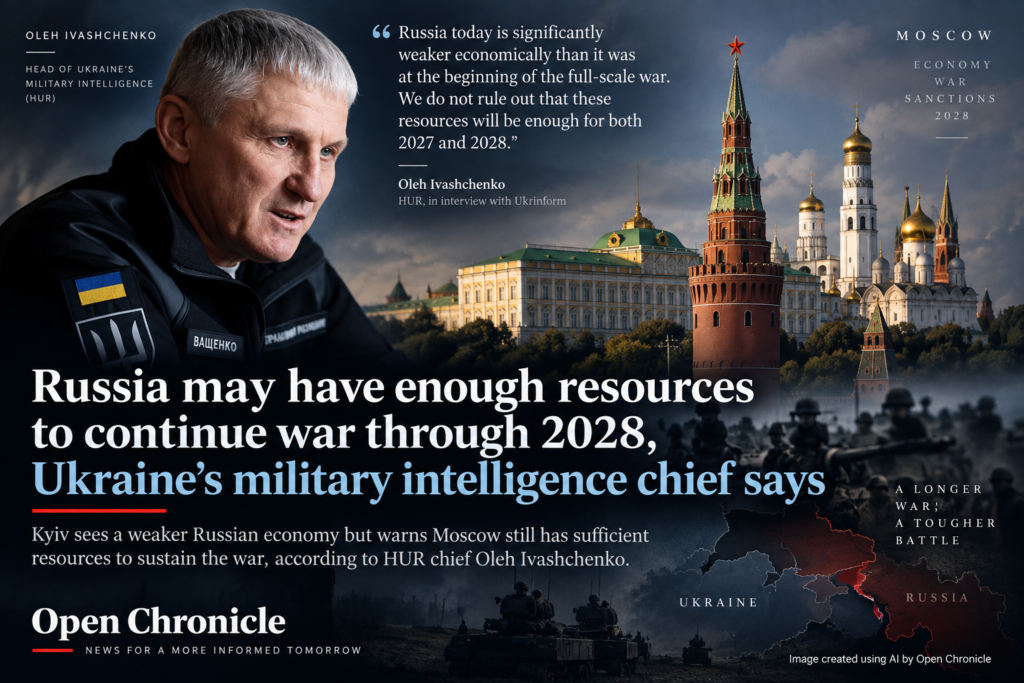
Russia’s economy has weakened considerably since the beginning of its full scale invasion of Ukraine, but Moscow may still possess enough financial, industrial and military resources to sustain the conflict through 2028, according to the head of Ukraine’s military intelligence.
Oleh Ivashchenko, chief of Ukraine’s Defence Intelligence agency, HUR, said Russia is facing mounting economic pressures, including labour shortages, a widening federal budget deficit and growing difficulties within its banking sector.
“Russia today is significantly weaker economically than it was at the beginning of the full scale war,” Ivashchenko said in an interview with Ukrinform published on September 7.
Despite those pressures, he cautioned against assuming that Russia is approaching the point where economic difficulties alone will force Moscow to end the war.
“We do not rule out that these resources will be enough for both 2027 and 2028,” he said.
Russia’s war economy remains resilient
More than four years after Moscow launched its full scale invasion, the Russian economy has increasingly been reorganised around the demands of the war.
Defence production, military procurement and support for Russia’s armed forces have absorbed significant state resources, while sanctions imposed by Ukraine’s Western partners have sought to restrict Moscow’s access to capital, technology and industrial components.
Ivashchenko argued that the cumulative pressure is having an effect. However, he said Russia continues to find ways of obtaining critical materials and technology through international supply networks.
According to the intelligence chief, Ukrainian authorities have identified countries being used to supply Russia with electronic components, machine tools and specialised chemicals.
Shell companies have also emerged as intermediaries, allowing goods to be imported through third countries before eventually reaching Russian industries connected to the war effort.
For Kyiv, disrupting those networks has therefore become an increasingly important element of the wider conflict.
“Sanctions must actually work,” Ivashchenko said.
Sanctions enforcement becomes central to Kyiv’s strategy
Ukraine has repeatedly argued that imposing sanctions is only part of the challenge. Effective enforcement, particularly against companies and intermediaries helping Russia circumvent restrictions, is increasingly seen as essential.
Advanced electronics, manufacturing equipment and specialised industrial materials remain particularly important because they can contribute to the production and maintenance of missiles, drones, aircraft and other military systems.
Ivashchenko said continued cooperation between Ukraine and its international partners would be necessary to reduce Russia’s ability to finance and supply its armed forces.
That strategy involves identifying procurement networks, restricting access to technology and targeting companies used to circumvent existing sanctions.
The objective is not necessarily to cause an immediate collapse of Russia’s war economy. Instead, Kyiv hopes to gradually increase the economic and industrial cost of sustaining military operations.
Long range strikes target Russia’s ability to wage war
Ivashchenko also linked Ukraine’s campaign of long range strikes inside Russia to the same broader strategy.
Ukraine has increasingly targeted military facilities, energy infrastructure and other sites associated with Russia’s ability to produce weapons and supply forces operating in Ukraine.
According to Ivashchenko, those operations should not simply be interpreted as demonstrations of Ukraine’s growing long range strike capabilities.
“The task is to reduce the enemy’s ability to produce weapons, supply its troops and continue this war,” he said.
The campaign therefore combines military operations with economic pressure.
Strikes against infrastructure can disrupt production and logistics, while sanctions and export restrictions can make damaged equipment or industrial systems more difficult and expensive to replace.
A war of economic endurance
Ivashchenko’s assessment highlights one of the central questions surrounding the future of the conflict: how long Russia can continue sustaining the financial and industrial demands of a prolonged war.
Economic weakness does not automatically translate into an immediate loss of military capability. Governments engaged in major conflicts can redirect resources, increase borrowing, prioritise defence industries and accept declining living standards for considerable periods.
For Ukraine, this means that expectations of Russia being forced out of the war purely through economic exhaustion may prove premature.
If Moscow retains sufficient resources to continue fighting through 2027 and potentially 2028, the conflict could increasingly become a contest of endurance involving battlefield manpower, industrial production, foreign military assistance, technological access and economic resilience.
Ivashchenko’s comments also underline why Kyiv considers Western sanctions enforcement and restrictions on technology transfers part of the battlefield itself.
Ukraine’s strategy increasingly appears designed around several mutually reinforcing forms of pressure: military operations against Russian forces, long range strikes against infrastructure supporting the war, sanctions against the Russian economy and international efforts to disrupt the supply chains that keep Russia’s defence industry functioning.
Whether those measures can significantly shorten Moscow’s ability to sustain the conflict remains uncertain. But Ukraine’s intelligence leadership is warning that, without sustained pressure, Russia may still have the resources necessary to keep fighting for several more years.