
By Open Chronicle News Desk
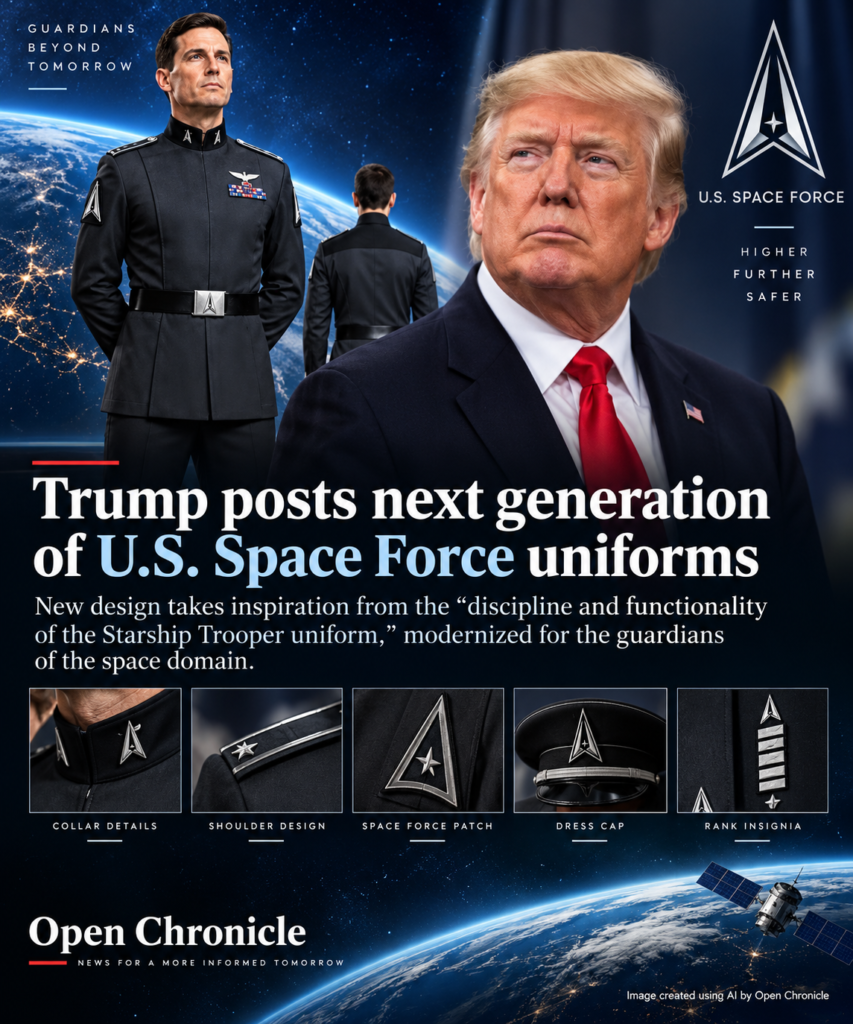
President Donald Trump has unveiled a new generation of uniforms for the U.S. Space Force, presenting a darker and more futuristic visual identity for America’s youngest military service as Washington expands its ambitions in space.
Trump revealed images of the proposed uniforms in a post on Truth Social, describing a design intended to combine military discipline with a distinctive aesthetic for the Guardians responsible for America’s space operations.
The concept draws inspiration from the disciplined and functional appearance associated with the uniforms in Starship Troopers, while adapting the design for a real military service operating in an increasingly important strategic domain.
A darker identity for the Space Force
The new uniform adopts a considerably darker color palette than traditional U.S. military dress.
According to details accompanying the design, the colors include space gray, midnight black, silver gray and satin black.
The main jacket is dark and structured, accompanied by a black belt and gray buckle displaying the Space Force insignia. Images released with Trump’s announcement also show details of the collar, shoulders, patches, rank insignia and dress cap.
Together, the elements appear designed to establish a recognizable visual identity separate from the Air Force, from which the Space Force was created in 2019.
The approach reflects a broader challenge faced by the service since its establishment. Beyond developing new operational capabilities, the Space Force has had to create its own culture, traditions, ranks, symbols and uniforms.
Science fiction comparisons quickly emerge
The futuristic appearance immediately attracted comparisons on social media with some of science fiction’s most recognizable military organizations.
Users compared the uniforms with costumes from Star Trek, Star Wars and other fictional portrayals of military forces operating in space.
The influence of science fiction on perceptions of the Space Force has followed the service since its creation. Many technologies central to modern military space operations, including satellite surveillance, missile warning networks and orbital communications, were once primarily associated with speculative fiction.
The reality of Space Force operations, however, is considerably more grounded.
Guardians operate and protect satellite networks, provide missile warning and tracking, support military communications and navigation, monitor objects in orbit and help defend American and allied space infrastructure.
Space Force enters a new phase
The uniform announcement comes as the Space Force continues to expand.
Created during Trump’s first administration, the service has become increasingly important as the United States, China and Russia develop military capabilities connected to space.
Modern warfare depends heavily on orbital infrastructure. Satellites provide communications, navigation, intelligence, surveillance, missile warning and targeting information to forces operating around the world.
Protecting those systems has therefore become a central element of American defense planning.
Potential adversaries are simultaneously developing capabilities capable of disrupting or destroying satellites, including electronic warfare systems, cyber capabilities, anti satellite weapons and technologies designed to operate close to other spacecraft.
That changing environment has transformed space from primarily a support domain into an increasingly contested area of military competition.
Trump’s ambitions extend beyond Earth orbit
The administration has also linked the expansion of America’s space capabilities to broader national ambitions beyond Earth’s immediate orbit.
Trump has repeatedly spoken about returning Americans to the Moon and expanding the country’s presence farther into space.
Those ambitions combine civilian exploration, technological development and national security considerations as the United States competes with China in what could become a new era of lunar exploration.
China is developing its own ambitious lunar program, while both countries are investing in technologies that could eventually support sustained operations on and around the Moon.
For the Space Force, that raises longer term questions about how far America’s military responsibilities in space could eventually extend.
More than a uniform change
Military uniforms are designed not only for functionality but also to communicate institutional identity.
For a service established only seven years ago, developing that identity remains particularly important.
The Army, Navy, Marine Corps and Air Force have traditions extending across decades or centuries. The Space Force is effectively building those traditions in real time.
Its new uniform therefore represents something larger than a change in military clothing. It is another step in establishing the Space Force as a distinct branch with its own culture and visual language.
The science fiction comparisons will inevitably continue. Yet behind the futuristic appearance lies a serious strategic transformation.
As competition in orbit intensifies and military forces become increasingly dependent on satellites, the Guardians wearing those uniforms could find themselves operating at the center of one of the most consequential military domains of the 21st century.