
By Open Chronicle News Desk
American special operations forces, warships and military aircraft are participating in an expanding campaign against suspected drug trafficking networks in Ecuador and the eastern Pacific, bringing the United States into direct combat operations in South America while raising significant questions about congressional authorization and the limits of presidential war powers.
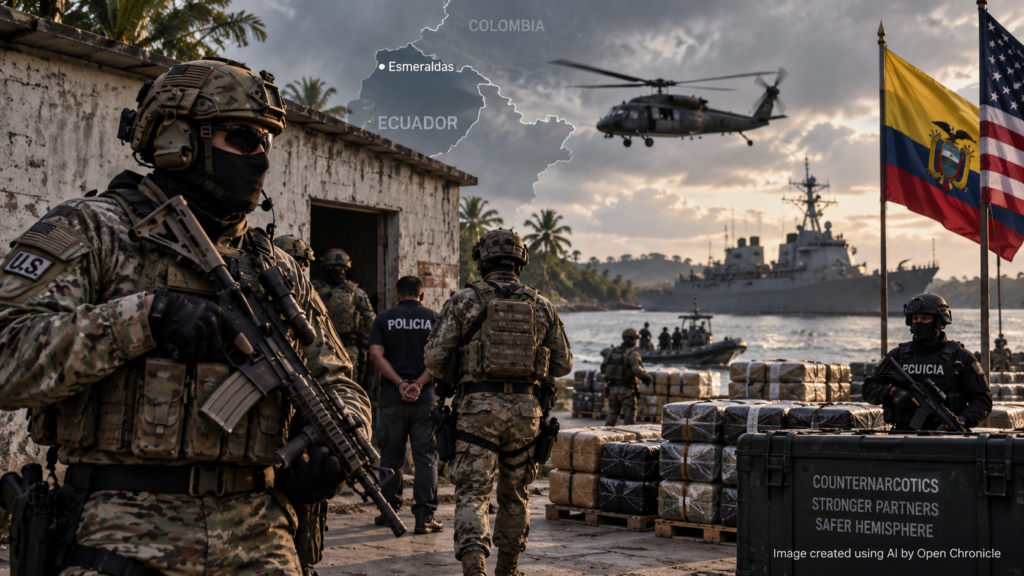
U.S. Green Berets are operating alongside Ecuadorian forces in the northern province of Esmeraldas, near the Colombian border. Ecuadorian officials have described the mission as a joint campaign against “narcoterrorism.”
The full scope of the operation remains unclear. Neither Washington nor Quito has publicly identified all the organizations being targeted, disclosed how many American personnel are deployed or provided a comprehensive description of their activities.
The provincial governor of Esmeraldas has said American forces have been operating there “for some time” and could remain for as long as necessary.
From security assistance to lethal operations
The deployment represents more than conventional military training or counternarcotics assistance.
On March 6, U.S. and Ecuadorian forces carried out what U.S. Southern Command described as “lethal kinetic operations” against a location near Ecuador’s border with Colombia.
Three days later, the White House formally informed Congress that American forces had assisted in planning and executing the operation.
President Donald Trump cited his constitutional authority as commander in chief and chief executive.
The campaign has since expanded.
Two U.S. warships and three Black Hawk helicopters have joined operations supporting Ecuador. Ecuador’s defence minister has said the additional capabilities could triple the country’s maritime interdiction capacity.
The United States is therefore providing not only intelligence and training but also substantial operational military capabilities.
Green Berets operating in Esmeraldas
Esmeraldas has become one of the principal areas of cooperation.
Located along Ecuador’s Pacific coast and bordering Colombia, the province occupies a strategically important position along routes used by transnational criminal organizations to move cocaine toward international markets.
American special operations personnel are now working with Ecuadorian forces in the region.
Ecuador has also established arrangements allowing U.S. military personnel and contractors to enter the country without visas for periods of up to 180 days. Existing agreements provide legal protections for American personnel while operating in Ecuador.
President Daniel Noboa’s government has sought greater American assistance as Ecuador confronts an extraordinary increase in organized crime, assassinations and violence linked to competing trafficking networks.
For Quito, closer military cooperation with Washington forms part of an attempt to regain control over territory and infrastructure increasingly contested by criminal organizations.
U.S. forces sinking vessels in the Pacific
The campaign extends beyond Ecuadorian territory.
Since late August, American forces have intercepted and sunk vessels in the eastern Pacific that U.S. Southern Command says were being used as floating refueling stations by drug trafficking organizations.
Three vessels were reportedly destroyed during earlier operations.
On September 5, U.S. forces conducted another interdiction involving what SOUTHCOM described as a multi vessel refueling operation.
People aboard the principal vessel were transferred to Ecuadorian authorities before American forces sank that vessel and associated support craft.
The operations suggest Washington is attempting to disrupt the logistical infrastructure supporting maritime trafficking rather than limiting its campaign to individual drug shipments.
Part of a much larger American campaign
The Ecuador mission is part of a broader military effort that has developed across the Caribbean and eastern Pacific.
According to the information provided, American forces have conducted 68 lethal strikes against vessels suspected of involvement in drug trafficking since September 2025, killing at least 227 people.
Those figures underline the extent to which the American response to narcotics trafficking has shifted toward direct military force.
However, the U.S. government has released limited public evidence concerning the identities of many of those killed or the cargo allegedly carried aboard the targeted vessels.
That lack of transparency has intensified demands for greater congressional scrutiny.
The constitutional debate
The expanding operation is generating a fundamental argument over presidential authority.
Critics contend that the administration has effectively initiated a sustained military campaign without obtaining specific authorization from Congress.
Under the U.S. constitutional system, Congress possesses the power to declare war and authorize military force, while the president serves as commander in chief of forces once they are employed.
Presidents have long asserted authority to conduct limited military operations without prior congressional approval, particularly when protecting Americans or responding to immediate threats.
The Ecuador campaign presents a different question because it appears to involve a planned and continuing series of combat operations rather than an emergency response to an attack on the United States.
The administration’s legal justification for the broader campaign will therefore face scrutiny over whether existing presidential powers are sufficient for an open ended operation against transnational criminal organizations.
Ecuador’s invitation does not settle the U.S. debate
Ecuador has requested American assistance, an important distinction from military interventions conducted without the consent of the country where operations take place.
That consent addresses a major international sovereignty question.
It does not, however, automatically resolve the separate question of what authority the U.S. president possesses under American law.
Critics of the operation argue that a foreign government’s invitation cannot provide constitutional authority that they believe must come from Congress.
The dispute therefore concerns not whether Ecuador wants American forces present, but whether Washington followed the necessary domestic process before committing those forces to combat.
Does the “narcoterrorist” label change anything?
The Trump administration’s increasing use of the term “narcoterrorist” also carries important political and legal implications.
Drug trafficking organizations can possess military style weapons, control territory, intimidate governments and carry out extreme violence. Some operate across multiple countries and increasingly resemble armed insurgent organizations.
But designating an organization as terrorist does not necessarily constitute congressional authorization to wage war against it.
Congress has not passed a new Authorization for Use of Military Force specifically covering the organizations reportedly being targeted in Ecuador and the eastern Pacific.
That distinction could become central if lawmakers challenge the administration’s legal basis for continuing the operation.
Congress faces growing pressure
Some lawmakers have already demanded more information about American operations in Ecuador.
Questions include which organizations are being targeted, how many U.S. personnel are deployed, what rules govern the use of lethal force, how long the mission is expected to continue and what conditions would constitute success.
Congress could also choose to debate a specific authorization for military force.
Such legislation could identify authorized targets, establish geographical boundaries, impose reporting requirements, determine funding and establish a timetable or conditions for ending the mission.
Yet months after the administration formally notified lawmakers about the March operation, Congress has neither explicitly authorized the wider campaign nor forced it to end.
That leaves American forces operating in an increasingly consequential legal and political grey area.
A new front in America’s fight against cartels
The policy question extends beyond constitutional procedure.
Ecuador is confronting a genuine security crisis, while cocaine trafficking networks operate across national borders and possess enormous financial and coercive power.
Washington must therefore decide whether these organizations should primarily be confronted through intelligence cooperation, policing and criminal prosecution, or whether some now constitute threats serious enough to justify sustained military action.
Those approaches carry profoundly different consequences.
Military intervention can provide capabilities unavailable to civilian law enforcement, including surveillance, special operations forces, naval interdiction and rapid strike capacity. But transforming counternarcotics operations into armed conflict also raises questions about civilian casualties, intelligence standards, detention, accountability and the geographic limits of future operations.
If military force becomes an accepted tool against cartels in Ecuador, similar arguments could eventually be made for operations elsewhere in Latin America.
A campaign the American public barely knows
Perhaps the most striking feature of the Ecuador operation is how little public attention it has received despite its apparent scale.
Green Berets are working alongside Ecuadorian forces. American warships and helicopters have joined the campaign. U.S. forces have conducted lethal operations and sunk vessels in the eastern Pacific.
Yet there has been no national debate comparable to the significance of committing American troops to sustained combat operations.
Whether the campaign ultimately proves strategically effective is a separate question from whether it received sufficient democratic scrutiny before it began.
Ecuador’s security crisis provides a powerful argument for international assistance. It also presents Washington with a larger decision about how far the United States should go in militarizing its struggle against transnational organized crime.
That decision could establish precedents reaching far beyond Ecuador.
As American forces conduct combat operations in South America and at sea, Congress faces an increasingly difficult question: whether it will formally authorize, restrict or end a military campaign that has already begun.