
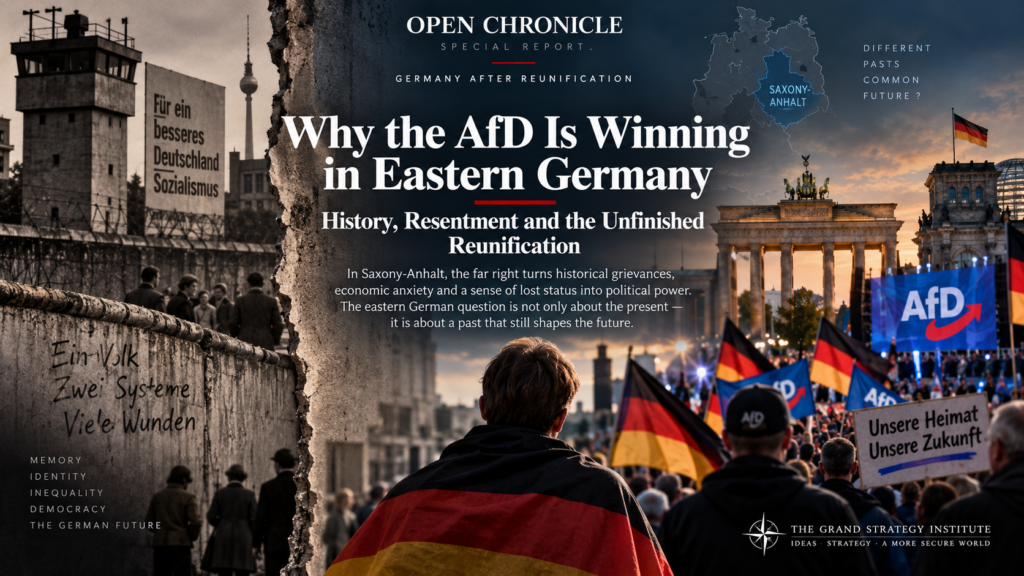
Saxony-Anhalt’s historic vote for the far right cannot be explained by immigration alone. The deeper story lies in the unfinished political and psychological legacy of East Germany, the experience of reunification, distrust of institutions, economic insecurity and a persistent sense among many eastern voters that history happened to them rather than with them.
By The Grand Strategy Institute Research Division
Grand Strategy Analysis | 8 September 2026
The Alternative for Germany has just achieved the strongest result ever recorded by the party in a German state election.
In Saxony-Anhalt, the AfD won 43.8 percent of the vote and 39 of the 83 seats in the regional parliament, more than doubling its previous support and leaving Chancellor Friedrich Merz’s Christian Democrats far behind on roughly 17 percent. It fell short of an absolute majority, and whether it can form a government remains uncertain because most other parties continue to reject cooperation with it. But the political significance is already unmistakable.
This was not simply another strong election for a protest party.
It was a demonstration that in parts of eastern Germany, the AfD has moved beyond protest politics and become the principal political vehicle through which a large section of the electorate expresses identity, grievance and opposition to the post-reunification political order.
That distinction matters.
Explaining the AfD purely through immigration, economic frustration or dissatisfaction with Berlin captures only part of the phenomenon.
The deeper question is why these grievances have become especially powerful in the former German Democratic Republic.
The answer lies partly in economics.
It lies partly in demography.
It lies partly in migration.
But it also lies in memory.
And memory, especially when connected to humiliation, loss of status and unresolved historical identity, can remain politically active for generations.
The extraordinary result in Saxony-Anhalt therefore raises a broader strategic question for Germany:
What happens when political reunification succeeds institutionally but remains incomplete psychologically?
Saxony-Anhalt Was a Revolt Against Berlin
The immediate political explanation for the AfD victory is straightforward.
The election became a referendum on the federal government.
According to polling reported after the vote, 87 percent of Saxony-Anhalt voters were dissatisfied with the federal government. Cost-of-living pressures, pension insecurity, economic anxiety and anger at Chancellor Friedrich Merz’s reform agenda contributed heavily to the result.
The CDU, which had previously dominated the state, suffered a collapse.
The AfD benefited from support among workers, younger voters and men, while successfully portraying itself as the only party prepared to challenge the political establishment.
Its regional leader, Ulrich Siegmund, explicitly presented the result as the beginning of a broader political transformation culminating in the 2029 federal election.
That much resembles populist movements elsewhere in Europe.
What distinguishes eastern Germany is the historical structure underneath the protest.
Saxony-Anhalt is not simply an economically dissatisfied region.
It is part of a society that experienced two authoritarian systems, the catastrophic collapse of one state and the absorption of another political and economic system within a single lifetime.
That history shapes how political change is interpreted.
Reunification Was Also a Revolution in Status
German reunification is usually described as one of the great successes of post-Cold War Europe.
In many respects, it was.
East Germany received enormous financial transfers.
Infrastructure was modernised.
Living standards rose dramatically.
Political freedoms expanded.
Citizens gained access to travel, consumption, education and political participation that had been denied under the GDR.
Yet economic convergence never automatically meant social convergence.
The shock of reunification involved more than replacing one economic system with another.
For millions of East Germans, it represented the rapid disappearance of an entire social world.
Institutions vanished.
Workplaces closed.
Professional qualifications were re-evaluated.
State-owned industries were privatised or dismantled.
Western managers, academics, officials and business leaders frequently assumed senior positions.
People who had regarded themselves as ordinary citizens of a sovereign state suddenly found that much of what constituted their professional biography was treated as belonging to a failed system.
This produced something economic statistics struggle to measure:
status displacement.
A person may become materially better off while simultaneously feeling socially diminished.
That contradiction helps explain why debates about eastern Germany remain so emotionally charged more than three decades after reunification.
Anna Funder and the Politics of Memory
Australian writer Anna Funder, whose Stasiland documented the lives of people who resisted or suffered under the East German security state, offered a striking interpretation of this phenomenon in an interview published this week.
Funder argues that resentment in the former GDR cannot be understood solely through present-day economic inequality.
She describes a lingering identity in which criticism of the East can still be interpreted as criticism by the West.
In her account, some former East Germans continue to frame historical debates through an “us and them” distinction: the East as a community that was defeated, judged and misunderstood, and the West as the side that wrote the history of reunification.
Her argument is provocative because it shifts the discussion from economics to psychology.
Funder’s central claim is that some eastern voters are attracted to radical political movements because they feel wronged.
Not necessarily impoverished.
Wronged.
That distinction is analytically useful.
Economic deprivation can be addressed through higher incomes.
Perceived humiliation is much harder to repair.
The GDR Did Not Disappear From Memory When It Disappeared From the Map
Nostalgia for East Germany is often described with the German term Ostalgie.
But nostalgia does not necessarily mean that people want the dictatorship restored.
For many, it means something subtler.
It is nostalgia for youth.
For social familiarity.
For stable employment.
For neighbourhoods and social networks.
For a world in which one’s cultural references were normal rather than provincial.
For a political identity that disappeared almost overnight.
This distinction is essential.
People can remember happy childhoods inside authoritarian systems.
The fact that a dictatorship restricted liberty does not mean every personal memory associated with life inside it must be negative.
That creates a political vulnerability.
When democratic narratives about the GDR focus exclusively on repression, some former citizens hear something different:
They hear that their own lives were illegitimate.
Funder rejects romanticisation of the regime. Her work emphasises surveillance, coercion and the extraordinary courage of ordinary people who resisted the Stasi. Yet she also identifies the political consequences of the failure to integrate those experiences into a shared post-reunification memory.
The result can be defensive nostalgia.
And defensive nostalgia is politically exploitable.
The Forgotten Victims Problem
One of Funder’s strongest arguments concerns those who resisted the East German dictatorship.
The democratic German state inherited a difficult moral responsibility after 1990.
It had to integrate former officials of the GDR while also compensating victims of political repression.
That process was uneven.
Funder argues that many people who refused cooperation with the Stasi, lost educational opportunities, were imprisoned or endured psychological repression never received the social recognition they deserved.
At the same time, many former regime officials possessed qualifications, career records and networks that helped them adapt economically after reunification.
The moral irony is obvious.
Some of those who compromised with the dictatorship adapted successfully to capitalism.
Some of those who resisted it entered reunified Germany economically disadvantaged.
Whether every individual example supports that broad pattern is a matter for historical research. But politically, perceptions matter almost as much as aggregate outcomes.
If people conclude that courage was not rewarded and collaboration was not meaningfully punished, democratic transition can acquire an element of moral incompleteness.
That can contribute to cynicism.
And cynicism is fertile ground for anti-system politics.
From the PDS to the AfD: The Ideology Changed, the Protest Survived
The most interesting part of Funder’s interpretation concerns the political migration of eastern protest.
For many years after reunification, resentment toward the new political order was expressed primarily through the left.
The Party of Democratic Socialism, the successor to the former ruling Socialist Unity Party, became a powerful vehicle for eastern identity and opposition to the economic consequences of reunification.
Later, much of this political tradition flowed into Die Linke.
Today, however, the AfD has become the dominant anti-establishment force across much of eastern Germany.
At first glance, the transition appears ideological.
Former communist regions shifting toward the far right seems contradictory.
But the continuity may be less ideological than emotional.
The common factor is opposition to the establishment.
Suspicion of elites.
Distrust of institutions.
Hostility to decisions perceived as imposed from outside.
Scepticism toward Western foreign policy.
Resistance to migration.
And a belief that the political system does not represent people like them.
The ideological poles changed.
The politics of grievance remained.
This helps explain why the AfD and the left-wing populist BSW can share positions on issues that appear unrelated in conventional left-right terms, including immigration, Russia and support for Ukraine. The BSW may now even become critical to government formation in Saxony-Anhalt after entering the Landtag and signalling willingness to speak with the AfD.
This is not classical ideological convergence.
It is anti-system convergence.
Resentment Is More Powerful Than Poverty
One of the greatest analytical mistakes in discussing eastern Germany is to assume that AfD voters simply vote according to income.
The economic picture is more complicated.
The gap between eastern and western Germany remains real in several areas, including accumulated wealth, corporate headquarters, senior management representation and wages.
But eastern Germany has also undergone extraordinary physical and economic modernisation.
Roads, railways, urban centres and public infrastructure were rebuilt on a vast scale.
Some eastern regions now possess infrastructure newer than comparable parts of western Germany.
Yet political dissatisfaction remains intense.
This tells us something important.
People do not evaluate politics exclusively through absolute living standards.
They compare themselves with others.
They compare expectations with outcomes.
They compare status with recognition.
And they compare their own biography with the national story being told about them.
A society can therefore become richer while remaining resentful.
In political terms, relative status may matter more than absolute prosperity.
Why Immigration Became the Ideal Political Symbol
The AfD did not create eastern German resentment.
It gave it a target.
Migration performs a particularly powerful function in populist politics because it converts diffuse frustration into a visible political issue.
Economic change is complicated.
Demographic decline is complicated.
Industrial restructuring is complicated.
Globalisation is complicated.
The legacy of reunification is extraordinarily complicated.
Immigration is politically simpler.
It offers a direct narrative:
You were ignored.
Others received priority.
The establishment does not protect you.
Your culture is changing without your consent.
This narrative can succeed even in regions where the absolute number of immigrants is comparatively low.
Indeed, direct exposure is not always necessary.
Migration can become a symbolic issue through national media, social platforms and political campaigning.
The voter is not necessarily reacting to the immigrant living next door.
The voter may be reacting to a wider perception of losing control.
That makes immigration a vehicle through which deeper anxieties about sovereignty, recognition and identity are expressed.
The AfD Has Turned Eastern Identity Into Political Identity
This may be the party’s most important achievement.
The AfD has learned to frame eastern Germany not merely as a location but as a political community.
Its message repeatedly suggests that eastern Germans possess experiences and interests that Berlin’s political establishment either misunderstands or deliberately ignores.
This is extremely powerful because it allows policy disagreements to become questions of identity.
Criticism of the AfD can then be reframed as criticism of eastern voters themselves.
Attempts to isolate the party can be presented as another example of western elites deciding which eastern political preferences are legitimate.
The strategy transforms the post-reunification grievance narrative into an electoral weapon.
Saxony-Anhalt demonstrated how effective that weapon has become.
Russia Is Part of the Story
The East German relationship with Russia also deserves particular attention.
The AfD strongly favours restoring political and economic relations with Moscow, reducing German support for Ukraine and reversing aspects of Germany’s post-2022 security policy.
This position is considerably more popular in eastern Germany than in much of the west.
There are several explanations.
Historical familiarity matters.
Soviet forces were physically present across East Germany for decades.
Russian language education was widespread.
Economic relationships with the Soviet Union formed part of everyday GDR life.
After reunification, inexpensive Russian energy also became associated with German industrial prosperity.
None of this means eastern Germans collectively support Moscow.
Nor should cultural familiarity with Russia be confused with endorsement of Russian policy.
But it means Russia occupies a different place in historical memory.
Reuters reporting ahead of the Saxony-Anhalt election found precisely this divide: many eastern voters view Russia less as an inherently hostile power and more as a familiar historical actor with which Germany should restore pragmatic relations.
That makes the AfD’s Russia policy more than foreign policy.
It is connected to eastern identity.
But the Soviet Past Does Not Automatically Produce Pro-Russian Politics
Here Funder’s argument requires qualification.
It would be too simple to say that eastern Germans are more sympathetic to Russia because they once lived under Soviet domination.
Historical experience can produce opposite political reactions.
For some people, experience with Soviet power generates hostility toward Moscow.
For others, it creates familiarity.
For still others, present-day attitudes are primarily shaped by economic interests, opposition to American power or distrust of Berlin rather than nostalgia for the USSR.
The explanatory variable is therefore not merely “the Soviet past.”
It is how the Soviet past has been remembered and incorporated into political identity.
That difference matters.
The Nazi Past and East Germany’s Antifascist Myth
Funder also raises a much deeper historical argument.
West Germany and East Germany developed radically different narratives about the Nazi past.
The Federal Republic gradually constructed a political culture around responsibility for Nazism and the Holocaust, although that process itself took decades and was frequently contested.
The GDR constructed a different foundational story.
It defined itself as the antifascist German state.
Fascism, according to the official Marxist-Leninist interpretation, had emerged from capitalism and monopoly power.
The new socialist state therefore represented the historical opposite of fascism.
This narrative allowed East Germany to portray itself less as the successor to Nazi Germany than as one of its victims and conquerors.
The political utility was enormous.
But the psychological consequence was potentially significant.
If fascism belonged primarily to the capitalist West, East Germans could avoid part of the collective moral confrontation that transformed West German political culture.
Funder argues that this incomplete confrontation contributed to later political vulnerability.
The argument deserves serious attention.
But it should not be overstated.
East Germany did conduct extensive official antifascist education and memorialisation.
The problem was not that Nazism was ignored.
It was that memory was ideologically organised.
The regime’s antifascism simultaneously condemned Nazism and protected the GDR from a fuller discussion of individual complicity, antisemitism and social responsibility.
Thus the issue was not absence of memory.
It was state-controlled memory.
Two Dictatorships, Two Incomplete Reckonings
Eastern Germany therefore carries an unusual historical burden.
The population passed from National Socialism into Soviet occupation and then into an authoritarian communist state.
After 1990, democratic Germany had to integrate those historical experiences while simultaneously conducting rapid political and economic transformation.
That is an extraordinary demand on collective memory.
One lesson should be clear.
Democratic societies cannot assume that authoritarian experiences disappear when institutions change.
Political culture is inherited.
Distrust can be inherited.
Patterns of adaptation can be inherited.
Silences can be inherited.
And narratives of victimhood can be inherited.
The AfD has become highly effective at mobilising these inherited tensions.
The AfD Is Not Simply a Product of the GDR
There is nevertheless an important analytical boundary.
It would be wrong to portray AfD support as an inevitable consequence of communist rule.
Millions of former East Germans reject the party.
The peaceful revolution of 1989 itself was driven by East Germans demanding political freedom.
Eastern Germany produced some of the most courageous democratic opposition movements in modern European history.
The AfD’s success therefore cannot be explained as evidence that eastern Germans failed to become democratic.
Nor is far-right populism unique to former communist societies.
France, Italy, Austria, the Netherlands and other Western European democracies have all experienced powerful nationalist movements without any GDR legacy.
The eastern German story explains the particular form of the AfD’s strength.
It does not explain European populism as a whole.
There Is Also a Present-Day Germany
History alone cannot explain a 2026 election.
The AfD’s victory also reflects very contemporary failures.
Germany has endured years of weak economic performance.
Energy costs remain politically sensitive.
Industrial employment faces structural pressure.
Housing and migration have become contentious.
Trust in the federal government is low.
Demographic ageing places pressure on pensions and public services.
The Merz government is proposing reforms that many voters associate with reduced social protection.
In Saxony-Anhalt, these concerns became politically explosive. Reuters described the result as a warning not merely about identity politics but about living costs, pensions and economic insecurity.
The AfD therefore succeeds because historical grievance and contemporary dissatisfaction reinforce one another.
History provides the language.
Present conditions provide the urgency.
The Firewall Is Becoming a Strategic Problem
Germany’s mainstream parties have maintained a political Brandmauer, or firewall, refusing coalition cooperation with the AfD.
The principle reflects Germany’s historical sensitivity to far-right politics and concerns over the party’s radicalisation.
In Saxony-Anhalt, the regional domestic intelligence service classifies the AfD organisation as confirmed right-wing extremist.
But the electoral arithmetic is making the firewall increasingly difficult to manage.
When a party wins almost 44 percent of the vote, excluding it from government may remain constitutionally and politically possible.
But the narrative consequences become more complicated.
The AfD can portray exclusion as proof that the political establishment does not respect its voters.
This does not mean mainstream parties should abandon the firewall.
It means exclusion by itself cannot be the strategy.
A democratic system cannot defeat a movement supported by more than four voters in ten merely by demonstrating that it finds the movement unacceptable.
It must understand why those voters arrived there.
Democracy Has a Recognition Problem
This brings us back to Funder’s most interesting insight.
Some eastern German voters may feel politically injured even where material conditions have improved.
Democratic governments frequently respond to such complaints with statistics.
More investment.
Higher incomes.
Better roads.
Lower unemployment.
Greater transfers.
These facts matter.
But they do not answer the emotional argument.
A voter saying “we were treated as second-class citizens after reunification” is not necessarily making an empirical claim about infrastructure spending.
The voter is making a claim about recognition.
Political systems struggle with recognition because it cannot easily be distributed through budgets.
Recognition requires representation.
Historical acknowledgement.
Institutional inclusion.
Cultural respect.
And a national story in which people see themselves as participants rather than objects.
The Generational Paradox
One of the most striking features of eastern German radicalisation is that younger voters who never experienced the GDR can still inherit eastern political identity.
This demonstrates how political memory works.
Identity is not transmitted only through personal experience.
It travels through families.
Communities.
Regional narratives.
Schools.
Economic structures.
Media.
Stories about parents and grandparents.
A 25-year-old Saxony-Anhalt voter was born long after reunification.
Yet that voter can still grow up hearing that western Germans received the best jobs, that local industries were destroyed, that Berlin does not understand the East, that Russia is unfairly demonised or that migration policy ignores local concerns.
The original historical experience becomes an inherited political frame.
That makes the East-West divide more durable than simple generational replacement would suggest.
The Economic Risk of Political Radicalisation
The AfD’s victory also creates a strategic economic problem.
Germany needs investment.
It needs skilled immigration.
It needs industrial modernisation.
It needs technological development.
And eastern states need these things especially strongly because of demographic ageing and population decline.
The AfD’s economic and migration agenda can conflict with those requirements.
Reuters Breakingviews noted that the party’s combination of anti-immigration politics, sympathy toward Russia, Euroscepticism and scepticism toward industrial policy may create long-term economic risks even as Germany’s economy begins recovering.
This creates another political paradox.
The regions most attracted to policies aimed at protecting them from globalisation may be among those most dependent on investment, exports and labour mobility.
Populism can therefore become self-reinforcing.
Economic dissatisfaction produces political radicalisation.
Political radicalisation discourages investment.
Reduced investment generates further dissatisfaction.
Breaking that cycle requires more than messaging.
The Strategic Consequence for Germany
The Saxony-Anhalt result is not merely a regional political event.
It affects Germany’s capacity to act strategically.
Germany is attempting simultaneously to rearm, support Ukraine, restructure its economy, manage migration, modernise infrastructure and assume greater responsibility inside NATO and the European Union.
All of these policies require political consensus.
A national political system increasingly divided between an establishment coalition and a large anti-establishment opposition will find long-term strategy harder to sustain.
This is especially relevant to foreign policy.
The AfD advocates closer relations with Russia, less support for Ukraine and a fundamental revision of Germany’s European orientation.
Its success therefore affects not merely domestic governance but the geopolitical direction of Europe’s largest economy.
Saxony-Anhalt is small.
The political signal is not.
GSI Strategic Assessment
The Grand Strategy Institute assesses that the AfD’s historic result in Saxony-Anhalt should be understood as the intersection of four different crises.
The first is an economic crisis of confidence.
Many voters believe Germany’s political establishment has failed to provide prosperity, security and credible reform.
The second is a crisis of political representation.
A large part of the eastern electorate believes mainstream parties do not represent its values or experiences.
The third is a crisis of historical integration.
Reunification created one German state but did not completely create one German political memory.
The fourth is a crisis of recognition.
Many eastern Germans continue to perceive themselves as subjects of a transformation designed elsewhere and administered by others.
Anna Funder’s interpretation is valuable because it highlights this final dimension.
Material convergence does not automatically eliminate political resentment.
Indeed, resentment can survive prosperity when it becomes linked to identity.
But historical grievance should not become a deterministic explanation.
The AfD’s rise is also produced by current political choices, present-day economic conditions, migration politics, distrust in federal institutions and the weakness of its competitors.
The former GDR created political terrain.
The AfD learned how to cultivate it.
That is a more accurate formulation than suggesting East Germany simply produced the far right.
Key Judgements
- The AfD’s victory in Saxony-Anhalt is historically significant. It secured 43.8 percent of the vote and 39 of 83 Landtag seats, its strongest state result to date.
- The election was also a major rejection of the federal government. Polling found overwhelming dissatisfaction with Chancellor Friedrich Merz’s administration.
- Economic explanations are necessary but insufficient. Cost of living, pensions, weak growth and employment insecurity matter, but they interact with a deeper eastern German politics of identity and recognition.
- Reunification produced substantial material convergence without eliminating perceived status inequality. People can become economically better off while continuing to feel politically or culturally subordinate.
- Anna Funder’s concept of eastern resentment helps explain why improvements in infrastructure and living standards have not dissolved political grievance. Her argument should be treated as an interpretive framework rather than a complete causal explanation.
- The political continuity from the PDS and Die Linke to the AfD is not primarily ideological. The common element is anti-establishment politics, distrust of elites and opposition to the dominant post-reunification consensus.
- Migration has become the most effective political symbol for wider anxieties over sovereignty, identity and loss of control.
- Eastern Germany’s relationship with Russia is shaped partly by different historical memories and political experiences from those in western Germany. This helps the AfD’s pro-Russian orientation resonate in parts of the former GDR.
- The GDR’s official antifascist doctrine did not eliminate confrontation with Nazism, but it shaped that confrontation through an ideological narrative that externalised significant responsibility toward the capitalist West.
- AfD support should not be reduced to an authoritarian legacy. Eastern Germany also produced the democratic revolution of 1989, and millions of eastern Germans reject the party.
- The mainstream political firewall may prevent the AfD from governing but cannot by itself reduce AfD support. Exclusion without political renewal risks strengthening the party’s anti-establishment narrative.
- The result has national strategic consequences. A stronger AfD could complicate German policy toward Ukraine, Russia, European integration, migration and defence.
- The central democratic challenge is not simply redistribution but recognition. Germany must address the belief among parts of the eastern electorate that reunification created political equality without complete social equality.
- The AfD has succeeded because it transformed eastern grievance into eastern political identity.
Conclusion
The fall of the Berlin Wall unified German territory.
It did not instantly unify German memory.
Thirty-six years later, the political consequences of that distinction are becoming impossible to ignore.
The AfD’s victory in Saxony-Anhalt is not evidence that eastern Germans are inherently authoritarian, nor that nostalgia for the GDR inevitably produces far-right politics.
It reveals something more complicated.
Economic transformation can succeed while leaving social wounds.
Democracy can deliver prosperity without delivering recognition.
A dictatorship can disappear while the identities formed inside it survive.
A country can be legally unified while its citizens continue to remember the meaning of that unification differently.
Anna Funder’s Stasiland remains relevant because it asks what happens to ordinary people when a political system disappears and another takes its place.
The question now extends beyond the former GDR itself.
What happens when the people who experienced that transformation believe their suffering, their compromises, their courage or simply their ordinary lives were misunderstood by the society that replaced it?
The AfD has supplied one answer.
It tells those voters that their resentment is justified, that the political establishment betrayed them, that outsiders are responsible for their problems and that the post-reunification consensus itself should be challenged.
That message is now powerful enough to win almost half the vote in a German state.
Germany’s response cannot consist simply of telling those voters that they are wrong.
Nor can it legitimise racism, authoritarianism or historical revisionism in the name of understanding grievance.
The democratic challenge is harder.
It must separate legitimate grievances from the radical political project that exploits them.
It must recognise historical wounds without romanticising the dictatorship that helped create them.
And it must construct a German identity in which eastern experience is neither idealised nor treated as an embarrassing prehistory to reunification.
The strategic problem revealed by Saxony-Anhalt is therefore larger than the AfD. It is whether Germany can complete the social and political reunification that began in 1990 before resentment becomes a permanent organising principle of its democracy.
The Grand Strategy Institute
Continue Exploring Strategic Analysis
Return to The Grand Strategy Institute for strategic assessments, long-form analysis and research examining geopolitics, military affairs, international security, emerging technologies and the changing international order.
← Back to The Grand Strategy Institute