
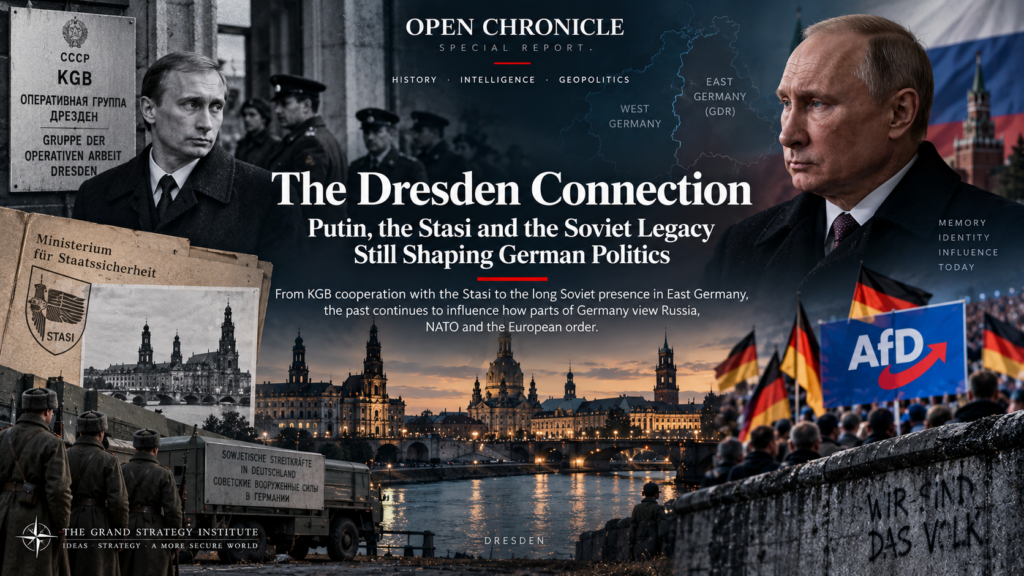
Vladimir Putin’s KGB years in East Germany belonged to a much larger Soviet system of intelligence cooperation, military presence and political control. More than three decades after reunification, parts of that historical experience still influence how eastern Germany views Russia, NATO and the European order.
By The Grand Strategy Institute Research Division
Grand Strategy Analysis | September 2026
When Vladimir Putin arrived in Dresden in 1985 as an officer of the Soviet KGB, the German Democratic Republic appeared to be one of Moscow’s most secure strategic possessions.
The Berlin Wall still divided Europe. Hundreds of thousands of Soviet military personnel were stationed across East Germany. The Socialist Unity Party controlled political life. The Ministry for State Security, better known as the Stasi, maintained one of the most extensive surveillance systems in the communist world.
The KGB and the Stasi operated as closely connected security institutions inside the Soviet bloc.
Four years later, that world began to collapse.
Putin witnessed it from Dresden.
In December 1989, protesters occupied the local Stasi headquarters and subsequently approached the nearby KGB compound. Putin later recalled contacting the Soviet military command for protection and receiving the message that troops could not move without instructions from Moscow, while Moscow remained silent.
The episode has become an almost irresistible biographical symbol.
The future Russian president stood inside a Soviet intelligence installation while the political order Moscow had constructed in Eastern Europe disintegrated around him.
But the significance of Putin’s Dresden years extends beyond biography.
East Germany was the product of more than four decades of Soviet political influence, military presence and security cooperation. Millions of Germans lived their entire lives inside that system. Hundreds of thousands of Soviet citizens lived in the GDR at any given time through military deployments and associated communities. The Stasi and KGB exchanged intelligence and cooperated institutionally. Political education presented the Soviet Union as East Germany’s indispensable ally.
Then the entire system disappeared.
The Soviet Union vanished.
The GDR vanished.
The Stasi vanished.
The Soviet military eventually left Germany.
But historical experience does not disappear simply because the institutions that created it cease to exist.
More than three decades after reunification, Germany continues to exhibit striking regional differences in attitudes toward Russia, NATO, Ukraine and the political establishment. The Alternative for Germany has become particularly powerful in the former GDR, while political movements advocating reduced confrontation with Moscow have repeatedly found greater resonance there than in much of western Germany.
The temptation is to draw a straight line between these phenomena.
That would be a mistake.
The KGB did not create today’s AfD electorate. Soviet troops stationed in East Germany do not provide a sufficient explanation for contemporary pro-Russian sentiment. And Putin’s years in Dresden do not constitute evidence of some uninterrupted intelligence operation stretching from the Cold War into modern German politics.
The historical connection is more subtle.
It concerns strategic memory.
Putin and millions of eastern Germans experienced the collapse of the same political order from radically different positions.
For Putin, it was the retreat of Soviet power.
For East Germans, it was the disappearance of their country.
For western Germans, it was national reunification and the triumph of liberal democracy.
Those different memories continue to collide inside contemporary European politics.
East Germany Was Born Inside the Soviet Strategic System
To understand Putin’s Dresden experience, it is necessary to begin before Putin.
The GDR was established in 1949 from the Soviet occupation zone created after Nazi Germany’s defeat.
Between 1945 and 1949, the Soviet Military Administration in Germany exercised enormous authority over political and economic reconstruction in its occupation zone. The Socialist Unity Party emerged as the dominant political organisation, while institutions were reshaped according to Soviet political requirements.
East Germany subsequently became one of the Soviet Union’s most strategically important allies.
Its geographical position was exceptional.
The GDR stood directly against NATO’s central European frontier. West Berlin remained an isolated Western enclave deep inside East German territory. Soviet and NATO armies confronted one another across Germany.
The country was therefore simultaneously an allied state, a military glacis and the forward geographical position of Soviet power in Europe.
The Soviet military presence reflected that importance.
What became the Group of Soviet Forces in Germany was one of the most formidable Soviet deployments outside the USSR.
Even as the Cold War approached its end, the scale remained extraordinary. When German reunification occurred, hundreds of thousands of Soviet troops remained stationed in the former GDR. Including civilian employees and family members, the Soviet community associated with the deployment numbered considerably more.
Their final withdrawal was not completed until 1994.
For nearly half a century, therefore, Soviet power in eastern Germany was not abstract.
It had barracks.
Airfields.
Tanks.
Schools.
Military towns.
Intelligence stations.
Families.
Supply networks.
And an enormous physical presence in everyday East German geography.
The Stasi Was Part of a Larger Security Architecture
The Stasi is often remembered as an exclusively East German institution.
That is incomplete.
The Ministry for State Security was deeply embedded in the broader Soviet security architecture.
Its origins were inseparable from Soviet influence over the creation of the East German state, and cooperation with Soviet intelligence continued throughout the GDR’s existence.
The relationship evolved over time. The Stasi developed considerable operational capability and autonomy rather than functioning merely as a subordinate branch of the KGB.
But the two services remained closely connected.
The Bundesarchiv documentation of the Stasi records describes extensive cooperation between the Ministry for State Security and Soviet security institutions. Agreements formalised information exchange and cooperation, while Soviet liaison personnel worked alongside their East German counterparts.
This matters because it changes how Putin’s presence in Dresden should be understood.
He was not simply a Soviet intelligence officer posted to a friendly foreign country.
He was operating inside a shared Warsaw Pact security ecosystem.
Putin Arrives in Dresden
Putin was sent to Dresden in 1985.
He was in his early thirties and had already served in the KGB for approximately a decade.
Dresden was not Berlin.
It was not the principal theatre of Soviet intelligence confrontation with the West, and Putin was not one of the KGB’s most senior officers.
This is important because Putin’s later political prominence has encouraged mythology about his intelligence career.
His Dresden assignment should neither be trivialised nor exaggerated.
He worked from the KGB’s regional office on Angelikastrasse, close to the Stasi’s Dresden district headquarters.
His responsibilities reportedly included intelligence gathering, maintaining contacts and identifying individuals who might prove useful to Soviet intelligence.
The Federal Agency for Civic Education has described the Dresden operation as including the acquisition of economic information and development of networks useful to Moscow.
The broader purpose was conventional intelligence work: understanding adversaries, acquiring information and cultivating human sources.
Putin eventually reached the rank of lieutenant colonel before returning to the Soviet Union.
The Stasi Card and What It Actually Proves
One particularly interesting piece of evidence emerged decades later.
German archives contain a Stasi identification card issued to Vladimir Putin.
It would be easy to interpret this dramatically.
Putin was a member of the Stasi.
The archival evidence does not support that conclusion.
The Bundesarchiv has specifically cautioned against it.
The identification document was consistent with the normal practice applied to KGB liaison officers working with the East German security service. It allowed access to Stasi facilities without requiring repeated administrative checks.
Its importance lies elsewhere.
The card provides physical evidence of the institutional proximity between the Soviet and East German security services.
Putin could enter Stasi facilities because KGB and Stasi cooperation was routine enough to require such arrangements.
That is historically significant without requiring a conspiracy theory.
The Intelligence Culture Putin Experienced
The institutional environment surrounding Putin in Dresden matters because intelligence services teach particular ways of understanding politics.
The KGB did not view political conflict simply through elections, diplomacy or public opinion.
It thought in terms of networks.
Influence.
Recruitment.
Vulnerability.
Information.
Counterintelligence.
Ideological reliability.
Deception.
Political movements could be instruments.
Economic relationships could provide leverage.
Personal weaknesses could create opportunities.
Information could shape political behaviour without military force.
None of this was unique to Soviet intelligence. Intelligence agencies everywhere seek leverage, recruit sources and manipulate information.
But the KGB existed inside an authoritarian political system in which intelligence activity, regime security and political control were deeply interconnected.
The Stasi operated according to similar principles.
The world Putin encountered in East Germany therefore offered a particular lesson about power:
Political systems are not maintained by military force alone. They are maintained by information, networks, institutions and control over perceptions.
That lesson would remain relevant long after the Cold War.
The Soviet Presence Was Much Larger Than the KGB
Focusing exclusively on intelligence services, however, risks missing the scale of the historical phenomenon.
The Soviet Union was physically present throughout the GDR.
Generations of Soviet soldiers served there.
Officers brought families.
Children attended schools.
Military settlements developed their own internal societies.
East Germans encountered Soviet citizens through work, local commerce, cultural programmes, personal relationships and unofficial exchanges.
But these communities were never completely integrated.
Military facilities could be highly segregated from surrounding German communities.
Official rhetoric celebrated Soviet-East German friendship while everyday relationships ranged from genuine affection to suspicion, resentment and indifference.
The historical memory is therefore contradictory.
For some East Germans, Russians were occupiers.
For others, allies.
For others, neighbours.
For others, simply the soldiers stationed beyond the perimeter fence.
The Soviet presence created familiarity without necessarily creating affection.
That distinction becomes important when examining eastern German attitudes toward Russia today.
1953 Revealed Who Ultimately Guaranteed the Regime
The relationship between Soviet military power and the East German state became unmistakable during the uprising of June 1953.
Worker protests expanded into a broader political challenge to the communist regime.
Soviet forces intervened.
Tanks entered East German cities, martial law was imposed in several areas and the uprising was suppressed.
The lesson was clear.
The GDR possessed its own institutions.
But the ultimate guarantor of the political order was Soviet power.
For East Germans who experienced 1953, this created one historical memory of Moscow.
For later generations raised under official narratives of German-Soviet friendship, another could develop.
Both memories belonged to the same society.
That helps explain why attitudes toward Russia in eastern Germany have never been uniform.
The Wall Made Soviet Power Permanent
The construction of the Berlin Wall in 1961 further stabilised the East German system.
The Wall prevented mass emigration to the West and transformed the political geography of Germany.
It also reinforced a larger strategic reality.
The division of Germany was embedded inside the division of Europe.
The GDR’s existence depended upon the Soviet-led European order.
West Germany became increasingly integrated into NATO and the Western economic system.
East Germany became integrated into the Warsaw Pact and Comecon.
Two German societies developed under different security systems, different economic structures and different political cultures.
By the time Putin arrived in Dresden, this division had existed for an entire generation.
Then it collapsed in four years.
Putin Witnesses the Collapse
The events of 1989 are central to understanding why Dresden occupies such an important place in Putin’s political biography.
The communist regimes of Eastern Europe were collapsing.
Hungary opened its border.
Poland underwent political transformation.
East Germans fled through neighbouring countries.
Mass demonstrations spread.
On 9 November, the Berlin Wall opened.
The Stasi itself began losing control.
In Dresden, demonstrators eventually entered the district Stasi headquarters in December 1989.
The nearby KGB installation suddenly appeared vulnerable.
Putin later described attempting to secure military protection.
According to the account he subsequently gave, the response was that Soviet troops could not act without orders from Moscow.
And Moscow was silent.
Whether every dramatic detail of Putin’s later retelling should be treated as exact historical reconstruction is less important than what the story came to represent for him.
The state at the centre of his professional world had stopped exercising power.
Its institutions existed.
Its weapons existed.
Its soldiers existed.
But the political will connecting them had disappeared.
For an intelligence officer trained to understand power through the capacity of the state to act, the lesson could hardly have been more profound.
Moscow Was Silent
Few phrases associated with Putin’s early biography carry greater symbolic weight.
“Moscow was silent.”
It encapsulates a recurring theme in Putin’s later political worldview: the danger of state weakness.
Putin has repeatedly described the collapse of the Soviet Union as a geopolitical catastrophe, although that often-quoted statement is sometimes stripped of the broader context in which he also acknowledged the impossibility of simply recreating the USSR.
What matters strategically is his persistent emphasis on sovereignty, state capacity, political control and the dangers produced by institutional collapse.
Dresden should not be treated as the single psychological explanation for Putinism.
No serious analysis can reduce decades of Russian political development to one evening outside a KGB building.
But Dresden belongs to a sequence of formative experiences.
The collapse of Soviet influence in Eastern Europe.
German reunification.
The dissolution of the Warsaw Pact.
The disappearance of the Soviet Union.
The economic and political disorder of 1990s Russia.
NATO enlargement.
Seen from this perspective, Dresden was not simply where Putin worked.
It was one of the places where he witnessed the retreat of Soviet power.
The Same Collapse Looked Completely Different to East Germans
This is where the historical story divides.
For Putin, 1989 represented the erosion of Soviet geopolitical power.
For millions of East Germans, it represented liberation from dictatorship.
These are not equivalent experiences.
East German demonstrators demanded political rights, freedom of movement and democratic reform.
The Stasi represented repression.
The Berlin Wall represented confinement.
The collapse of the GDR opened the possibility of political freedom and eventually national reunification.
Yet even liberation can contain social dislocation.
The disappearance of East Germany did not simply remove a political regime.
It dismantled an entire economic and institutional system.
Enterprises closed.
Careers disappeared.
Professional qualifications were reassessed.
Western institutions replaced eastern ones.
Large numbers of people moved west.
Demographic structures changed.
And many eastern Germans came to believe that reunification was less a merger between equal societies than the absorption of one by the other.
That perception remains politically important.
Reunification Produced Winners, Losers and Memories
Economically, reunification transformed eastern Germany.
The Federal Republic transferred enormous resources eastward.
Infrastructure was modernised.
Cities were reconstructed.
Environmental damage was addressed.
Living standards increased dramatically.
Yet convergence was incomplete.
Differences remained in wealth, wages, corporate ownership, demographics and representation in elite institutions.
More importantly, material improvement did not necessarily eliminate feelings of lost status.
This is a recurring error in political analysis.
Governments frequently assume that economic transfers automatically produce political legitimacy.
They do not.
Human beings judge their position not merely by what they possess but by how they believe they are regarded.
A citizen can become wealthier and simultaneously feel less respected.
A region can receive investment and simultaneously believe its history has been dismissed.
This is the psychological territory in which Ostalgie, anti-establishment politics and eastern identity developed after reunification.
Russia Occupies a Different Place in Eastern Memory
One of the most persistent political differences between eastern and western Germany concerns Russia.
The divide should not be exaggerated. Eastern Germany is politically diverse, and millions of eastern Germans strongly oppose Russian policy.
Nevertheless, polling and electoral behaviour have repeatedly demonstrated greater scepticism toward confrontation with Moscow in parts of the former GDR.
Recent reporting surrounding the Saxony-Anhalt election again highlighted this divide.
Some eastern voters view Russia through a historical frame different from that prevalent in western Germany.
For some, Russia remains associated with dictatorship and Soviet occupation.
For others, it represents a country with which Germans lived alongside for decades.
For others, the current confrontation with Moscow is interpreted through distrust of NATO, the United States or Berlin rather than affection for Russia itself.
These distinctions matter.
Pro-Russian sentiment and anti-Western sentiment are not always the same phenomenon.
Sometimes they overlap.
Sometimes opposition to German policy toward Russia is primarily an expression of opposition to the German political establishment.
From the Post-Communist Left to the AfD
After reunification, the political expression of eastern grievance initially appeared strongly on the left.
The Party of Democratic Socialism emerged from the former ruling Socialist Unity Party and established itself as an important eastern political force.
It later became part of Die Linke.
Its appeal was not reducible to nostalgia for communism.
It represented social groups that believed reunification had disadvantaged them, challenged privatisation, defended eastern social experiences and opposed aspects of the Western foreign policy consensus.
Decades later, much of the most powerful anti-establishment energy in eastern Germany has moved to the right.
The AfD now dominates in several areas where the post-communist left was once exceptionally strong.
This does not mean communist voters simply became fascists.
Such an interpretation would be historically crude.
The deeper continuity is political alienation.
Distrust of elites.
Hostility toward Berlin.
Scepticism toward American geopolitical leadership.
Opposition to immigration.
Suspicion of mainstream media.
Resistance to policies perceived as externally imposed.
And, increasingly, demands for a different relationship with Russia.
The ideological vehicle changed.
Some of the geography of grievance remained.
The AfD and the Russian Question
The AfD has recognised the political potential of this historical landscape.
Its foreign policy rhetoric challenges much of the post-2022 German consensus toward Moscow.
Leading AfD figures have advocated improved relations with Russia, criticised sanctions and questioned continued German support for Ukraine.
In eastern Germany, these positions interact with broader dissatisfaction concerning energy costs, economic insecurity and the federal government.
Russia consequently becomes more than a foreign policy issue.
It becomes part of an argument about Germany itself.
Should Germany remain firmly embedded in a transatlantic strategy centred on NATO and strategic confrontation with Moscow?
Or should it seek greater geopolitical autonomy and rebuild economic relations with Russia?
The AfD presents the second option as a rejection of an establishment supposedly subordinate to Washington and Brussels.
This narrative is particularly potent where scepticism toward the post-reunification political order already exists.
Putin Understands This Political Geography
Here the Dresden connection becomes strategically interesting again.
Few contemporary foreign leaders possess Putin’s personal familiarity with eastern Germany.
He lived there.
He spoke German.
He worked with East German institutions.
He observed the political culture of the GDR.
He witnessed its collapse.
He later watched reunified Germany become one of the principal powers inside an expanding NATO and European Union.
It would be unjustified to infer from this that Putin personally directs every Russian influence operation toward eastern German opinion or that his Dresden experience provides some secret blueprint for manipulating Germany.
But Russian strategy has consistently demonstrated awareness of political divisions inside Western societies.
Where scepticism toward sanctions exists, Moscow has incentives to amplify it.
Where hostility toward NATO exists, Moscow has incentives to reinforce it.
Where historical memory creates sympathy toward Russia, Moscow can appeal to it.
Where resentment toward Berlin or Brussels exists, Russian narratives can present Moscow as the alternative to Western establishment power.
This is not uniquely Russian behaviour.
States routinely exploit divisions inside adversarial coalitions.
What makes Germany unusual is the historical depth of the divisions available for exploitation.
Influence Is Not Control
This distinction must remain central.
Russian influence does not mean Russian control.
A German who opposes sanctions is not therefore a Kremlin agent.
An AfD voter who wants negotiations with Moscow is not necessarily manipulated by Russia.
An eastern German who remembers Soviet citizens positively is not endorsing Putin’s foreign policy.
Democratic analysis becomes dangerous when political disagreement is automatically treated as foreign subversion.
That approach would reproduce precisely the conspiratorial mentality that democratic institutions should resist.
Foreign influence works most effectively when it attaches itself to real domestic grievances.
It rarely creates political divisions from nothing.
It identifies them.
Amplifies them.
Connects them.
And attempts to make them strategically useful.
Understanding this distinction is essential for European resilience.
Germany Now Contains Two Strategic Memories of Russia
The contemporary German debate increasingly reflects two different historical memories.
One emphasises Russia as a security threat.
It points to Soviet domination of Eastern Europe, the suppression of uprisings, Russian military power, the invasion of Ukraine, hybrid operations and Moscow’s challenge to the European security order.
The other emphasises coexistence.
It remembers Ostpolitik, economic interdependence, Russian energy, the peaceful Soviet withdrawal from Germany and decades in which cooperation with Moscow appeared both possible and profitable.
Neither memory belongs exclusively to East or West.
But they are distributed unevenly.
Germany’s strategic problem is that policy toward Russia increasingly activates these competing historical narratives.
Support for Ukraine becomes a debate about German identity.
NATO becomes a debate about sovereignty.
Sanctions become a debate about economic fairness.
Russia becomes a debate about whether Germany’s interests are identical to those of the United States.
Foreign policy becomes domestic memory politics.
The European Consequences
Germany is not merely another European state.
It is Europe’s largest economy and one of the central political powers of the European Union.
Its strategic orientation affects the entire continent.
If Germany remains committed to rearmament, NATO deterrence and long-term support for Ukraine, Europe’s capacity to balance Russian power increases significantly.
If German politics becomes increasingly divided over those commitments, European strategy becomes less predictable.
This is why developments in Saxony-Anhalt, Thuringia or Saxony matter far beyond regional German politics.
A political transformation beginning in eastern Germany could eventually affect federal coalition arithmetic.
That could influence sanctions.
Defence expenditure.
Military assistance to Ukraine.
NATO policy.
EU enlargement.
Relations with Washington.
And ultimately the European approach toward Russia.
The Soviet political order disappeared from eastern Germany more than three decades ago.
Yet the territory it once occupied has again become strategically relevant to Europe’s relationship with Moscow.
The Paradox of Putin’s Germany
There is an extraordinary historical irony here.
Putin witnessed the failure of Soviet power in East Germany.
Today, some of the strongest opposition to Germany’s confrontation with Putin’s Russia comes from the territory where Soviet power once existed most visibly.
That does not mean history has come full circle.
The political systems are fundamentally different.
The GDR was an authoritarian state integrated into a Soviet alliance.
Modern eastern Germany is part of a democratic federal republic, NATO and the European Union.
Its citizens vote freely.
The AfD succeeds through elections, not Soviet occupation.
These distinctions are fundamental.
But geography has memory.
Political attitudes develop within historical environments.
And foreign powers can exploit historical narratives long after the political systems that created them disappear.
GSI Strategic Assessment
The Grand Strategy Institute assesses that the relationship between Putin’s KGB service in Dresden, the Soviet presence in the GDR and contemporary German politics should be understood through historical continuity without deterministic causation.
There is no credible basis for claiming that modern eastern German political behaviour is the direct product of KGB or Stasi influence.
Nor is there evidence that the AfD’s contemporary electoral strength can be explained primarily through Soviet political conditioning.
The meaningful connection operates at a different level.
First, the GDR belonged to an integrated Soviet political, military and intelligence system.
The relationship between the Stasi and KGB was institutional and extensive. Putin served inside that system rather than merely observing it from outside.
Second, Soviet presence in East Germany was social as well as military.
Decades of interaction created memories of Russia fundamentally different from those produced by the Cold War in many Western societies.
Third, 1989 created radically different historical experiences.
For Putin, it represented the retreat of Soviet geopolitical power.
For democratic East German opposition, it represented liberation.
For many ordinary East Germans, it simultaneously produced freedom and profound economic and social disruption.
Fourth, reunification did not erase eastern political identity.
Material convergence occurred much faster than convergence in historical memory, institutional representation and perceptions of status.
Fifth, Russia can exploit these differences but did not create them.
The distinction between amplification and manufacture is essential to understanding modern influence operations.
Sixth, the political consequences are now European.
As parties sceptical of Germany’s current Russia policy gain strength, the historical memory of the former GDR increasingly intersects with debates over Ukraine, NATO, European rearmament and the future relationship between Europe and Moscow.
This produces a remarkable strategic symmetry.
Putin’s political worldview was partly formed by witnessing the collapse of Soviet power in Eastern Europe.
Some of the political pressures now constraining Europe’s response to Putin’s Russia emerge from societies shaped by the consequences of that same collapse.
The two phenomena are not causally identical.
But they originate in the same historical rupture.
1989 ended the Cold War order. It did not end the political life of its memories.
Key Judgements
- Vladimir Putin’s Dresden assignment placed him directly inside the Soviet-East German security architecture. His work as a KGB officer occurred alongside institutional cooperation with the Stasi.
- The Stasi identification card issued to Putin does not demonstrate that he was a Stasi officer. German archival authorities describe such access documentation as normal practice for KGB liaison personnel.
- Soviet influence over East Germany extended far beyond intelligence cooperation. The GDR existed within a Soviet-led political and military system, with a massive Soviet military presence remaining until after reunification.
- The Soviet population associated with the military deployment created decades of direct contact between Soviet citizens and East Germans, although interaction ranged from friendship and familiarity to segregation and resentment.
- Putin’s experience of 1989 is strategically important but should not be used as a monocausal explanation for his later worldview. Dresden belongs within a broader experience of Soviet decline, state collapse and geopolitical retreat.
- East Germans experienced the same historical rupture differently. The fall of the GDR meant political liberation but also institutional disappearance, economic restructuring and widespread status disruption.
- Contemporary eastern German attitudes toward Russia cannot be reduced to Soviet nostalgia. They combine historical memory, economic interests, anti-establishment politics, scepticism toward NATO and the United States, and contemporary dissatisfaction.
- The AfD did not inherit the ideology of the GDR. The more important continuity is the geography of political alienation and distrust toward established institutions.
- Russia has strategic incentives to exploit existing German divisions over Ukraine, sanctions, NATO and relations with Moscow. Exploiting domestic grievances is fundamentally different from creating them.
- Political disagreement with German policy toward Russia should not automatically be characterised as Russian influence. Such simplification weakens rather than strengthens democratic analysis.
- Germany increasingly contains competing strategic memories of Russia: Russia as historical security threat and Russia as a power with which coexistence and economic cooperation are possible.
- These divisions now have European strategic consequences. German domestic politics can influence the sustainability of European support for Ukraine, NATO deterrence, sanctions and defence spending.
- The deepest connection between Putin’s Dresden experience and contemporary eastern German politics is 1989 itself. Both emerged from the collapse of the same political order but interpreted that collapse through fundamentally different historical experiences.
- The Soviet Union left Germany physically in 1994. Its political geography did not disappear with the last Russian soldier.
Conclusion
In 1985, Vladimir Putin arrived in a country that no longer exists.
He worked for an intelligence service that no longer exists.
He cooperated with institutions belonging to a political system that no longer exists.
He lived under a European security architecture that no longer exists.
Yet the consequences of that vanished world remain remarkably present.
The GDR shaped the lives of millions of Germans.
The Soviet military presence shaped the geography and political culture of eastern Germany for decades.
The Stasi and KGB constructed networks of cooperation that reveal how deeply East Germany belonged to the Soviet strategic system.
Then, within a few extraordinary years, the entire structure collapsed.
Putin returned to a Soviet Union that itself disappeared shortly afterwards.
East Germans entered a reunited Federal Republic.
Soviet soldiers eventually returned home.
NATO expanded eastward.
The European Union expanded eastward.
Germany became the central economic power of a Europe increasingly organised around institutions Moscow had once regarded as adversarial.
Today, Putin looks west toward a Germany whose eastern regions he once knew from inside the Soviet security system.
And Germany looks east toward a Russian president whose understanding of European power was partly shaped by watching Moscow lose control of precisely that territory.
This does not create a secret historical chain connecting the KGB to contemporary German elections.
The reality is more consequential because it requires no conspiracy.
Both Putin’s Russia and eastern Germany carry political memories created by the collapse of the same European order.
Putin’s lesson from that collapse emphasised state weakness, geopolitical retreat and the dangers of losing strategic control.
For many East Germans, the lesson was liberation, but for others it was accompanied by lost status, economic disruption and a lingering belief that their country and experience were absorbed rather than integrated.
Those memories now meet again in debates over Russia, Ukraine, NATO, the AfD and Europe’s security future.
The Soviet Union has disappeared.
The Stasi has disappeared.
The GDR has disappeared.
But strategic history does not disappear when institutions do.
It survives in identities, political geography, threat perceptions and competing interpretations of the past.
The most important legacy of Putin’s Dresden years may therefore not be what the KGB did in East Germany. It is that Putin and today’s eastern Germans witnessed the destruction of the same political world, remembered its meaning differently, and now confront one another across a European order still struggling with the consequences of its collapse.
The Grand Strategy Institute
Continue Exploring Strategic Analysis
Return to The Grand Strategy Institute for strategic assessments, long-form analysis and research examining geopolitics, military affairs, international security, emerging technologies and the changing international order.
← Back to The Grand Strategy Institute