
By Open Chronicle with agencies
Houthi forces have reportedly reached Yemen’s strategic port of Mocha following a major advance along the country’s western coast, potentially bringing the Iran aligned movement closer to consolidating control over territory overlooking one of the world’s most important maritime routes.
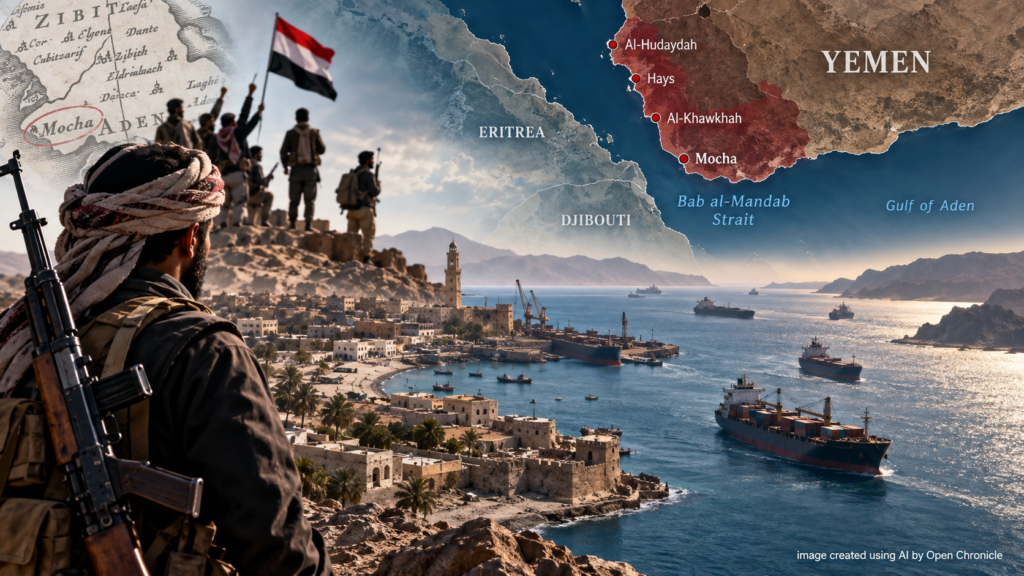
Yemeni media reported on Thursday that Houthi forces had taken control of the Hays and Al Khawkhah districts in southern Al Hudaydah province before advancing toward Mocha in neighbouring Taiz province.
The developments have not yet been confirmed by government forces, making the precise situation on the ground uncertain. If confirmed, however, the advance would represent a significant shift in the military balance along Yemen’s Red Sea coastline.
Houthi forces push south along the coast
The privately owned Yemeni outlet Al Masdar Online reported that Houthi forces had captured Hays and Al Khawkhah, as well as substantial areas across several districts of western Taiz.
Hays has long been an important frontline because of its position between southern Al Hudaydah and the roads leading toward Mocha and the Bab al Mandab Strait.
According to the report, Houthi forces subsequently advanced as far as Mocha after government troops withdrew south toward Lahej province.
Government aligned forces had not immediately commented on the reported withdrawal or confirmed that Houthi fighters had entered the port.
Images circulating on social media also purported to show Houthi fighters after the capture of Hays and Al Khawkhah. Their authenticity could not immediately be independently established.
Why Mocha matters
The significance of the advance extends far beyond Yemen’s internal conflict.
Mocha sits close to the Bab al Mandab Strait, the narrow maritime passage connecting the Red Sea with the Gulf of Aden and ultimately the Indian Ocean.
Ships travelling between Asia and Europe through the Suez Canal must normally pass through these waters, making Bab al Mandab one of the critical chokepoints of international trade and energy transportation.
Control of territory surrounding Mocha therefore has both military and strategic implications. Forces positioned along this section of Yemen’s coast can potentially influence supply routes inside the country while operating close to international shipping lanes.
That becomes particularly important as the Houthis have repeatedly demonstrated their ability to threaten commercial and military vessels in the Red Sea.
Pressure on government supply lines
The latest Houthi offensive appears to be aimed partly at disrupting roads and logistical routes connecting Taiz and Al Hudaydah.
According to reporting from the region, Houthi forces have been increasing pressure on these routes while advancing toward coastal positions and attempting to isolate Mocha.
Government aligned National Resistance Forces responded on Thursday by announcing the establishment of a command centre south of Mocha following Houthi advances across several western fronts.
The government media office in Al Hudaydah also said military units operating around Hays and western Taiz were being reorganized.
Those measures suggest government aligned forces are attempting to establish a new defensive line as the battlefield shifts southward.
Houthis could consolidate Al Hudaydah
The reported capture of Hays and Al Khawkhah would also carry important consequences farther north.
National Resistance Forces had previously been deployed in both districts. If Houthi control is confirmed, the movement would effectively have established control across Al Hudaydah province.
Al Hudaydah and its Red Sea coastline have been among the most strategically contested areas of Yemen’s long war because of their ports, transportation routes and proximity to international shipping.
A consolidated Houthi position there, combined with pressure toward Mocha, would strengthen the group’s position along a substantial section of Yemen’s western coastline.
Bab al-Mandab becomes increasingly important
The advance comes at an especially sensitive moment for regional maritime security.
The Bab al Mandab Strait is already central to concerns surrounding Houthi attacks against shipping in the Red Sea. Any expansion of Houthi controlled territory closer to Mocha could provide the movement with additional strategic depth near the waterway.
The development does not itself mean that the Houthis control Bab al Mandab. The strait is bordered by Yemen on one side and Djibouti and Eritrea on the African side, while international naval forces operate throughout the region.
Nevertheless, control of more territory approaching the strait could strengthen the Houthis’ ability to operate along Yemen’s southwestern coast.
Yemen enters its broadest escalation in years
The latest fighting is part of what has become Yemen’s most extensive military escalation since 2022.
A United Nations sponsored truce that year substantially reduced large scale fighting, although it never produced a comprehensive political settlement. The subsequent peace process stalled, and major military confrontations resumed in July.
The current offensive demonstrates how rapidly Yemen’s territorial balance can change once frontlines that remained relatively stable for years begin moving again.
It also raises the prospect of renewed fighting across several provinces as government aligned forces attempt to prevent further Houthi advances toward southern Yemen.
A conflict more than a decade old
Yemen’s war traces its current phase to September 2014, when the Houthis seized the capital, Sanaa, and expanded their control across several provinces.
A Saudi led coalition intervened in March 2015 in support of Yemen’s internationally recognized government, transforming the conflict into one of the Middle East’s most consequential wars.
Years of fighting fractured Yemen politically and militarily, leaving the Houthis in control of Sanaa and much of the country’s populated northwest while internationally recognized government institutions and allied factions maintained control across significant areas of the south and east.
The reported advance toward Mocha now threatens to alter that territorial picture again.
If Houthi control of Hays, Al Khawkhah and positions around Mocha is confirmed, the consequences will extend beyond the Yemeni battlefield. The movement would have strengthened its position along the Red Sea coast at precisely the moment when security around Bab al Mandab has become a central concern for global shipping and the wider Middle East.