
By Open Chronicle News Desk
September 10, 2026
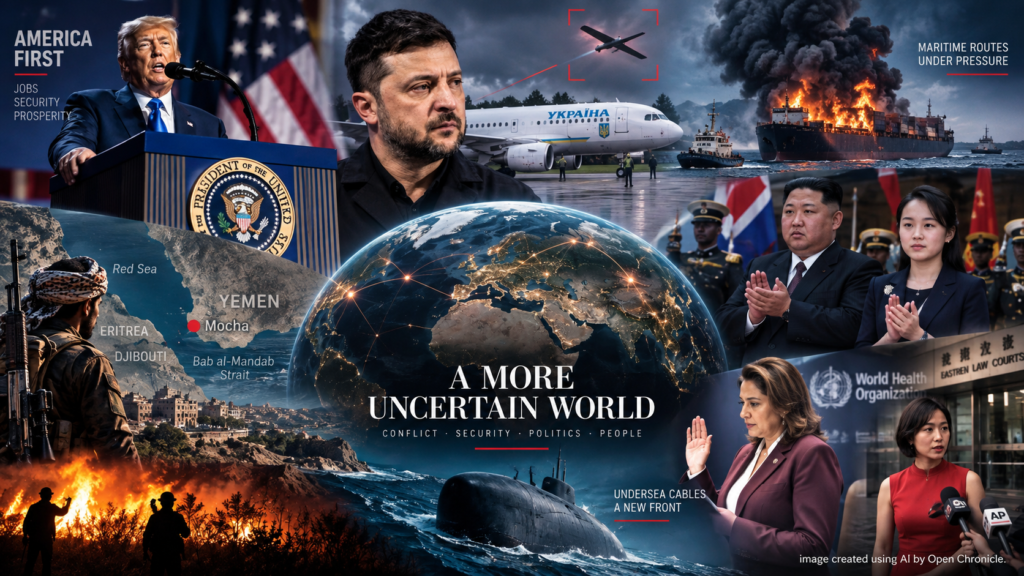
A dramatic Republican campaign promise in the United States, a drone incident that delayed Ukrainian President Volodymyr Zelensky’s departure from Moldova, deadly maritime disasters in China and the Philippines, and growing concern over Russian activity around NATO’s undersea infrastructure are among the major international stories developing on Thursday.
Americas
Trump promises $5,000 to every US adult if Republicans retain Congress
President Donald Trump has promised a $5,000 “Trump dividend” to every adult American citizen if Republicans retain control of both the House of Representatives and Senate in the November midterm elections.
Trump made the announcement during the Republican midterm convention in Dallas, telling voters that Republican victory would produce a direct financial benefit. He said the money would have to be spent inside the United States.
The proposal could cost more than $1 trillion and Trump provided few details about how it would be financed or implemented. Congressional authorization would almost certainly be required. Some reporting calculated alternative values of the proposed benefit, including $6,320, but Trump’s stated pledge at the convention was $5,000.
The promise comes as Republicans attempt to mobilize voters ahead of the November 3 elections amid concerns over inflation, energy prices and the continuing Iran war. The original news feed also shows the proliferation of competing headlines around the proposal, ranging from $5,000 to $6,320.
Fetterman makes surprise appearance at Republican convention
Democratic Senator John Fetterman made an unusual video appearance at the Republican convention in Dallas, introducing Republican Pennsylvania Senator Dave McCormick and describing himself as a “common-sense Democrat.”
Fetterman said he would reject political extremes and socialism while praising McCormick as a friend. The appearance underlined his increasingly independent position within the Democratic Party, particularly on Israel, Iran and some domestic political issues.
Europe and Ukraine
Zelensky flight delayed after Russian drone enters Moldovan airspace
A flight carrying Ukrainian President Volodymyr Zelensky from Moldova was delayed after a Russian drone entered Moldovan airspace, although Ukrainian and Moldovan officials have played down suggestions that his aircraft narrowly escaped being hit.
Norwegian Prime Minister Jonas Gahr Støre said Zelensky’s aircraft was “almost hit” by a drone as it prepared to depart Moldova. However, a Ukrainian presidential source later described that characterization as exaggerated.
Moldovan government spokesperson Dumitru Ciorici said the country’s airspace was temporarily closed after a Russian drone entered from Ukraine. Three departing and four arriving flights were delayed, including Zelensky’s aircraft. The drone later came down and exploded roughly 160 kilometres from Chisinau International Airport.
Zelensky was travelling to Oslo for the funeral of King Harald V before continuing his diplomatic trip to Canada.
NATO allies reportedly disrupted Russian undersea operation
Britain, Norway and the United States reportedly intercepted a Russian operation near Svalbard earlier this year involving deep sea systems and strategically important submarine communications cables.
According to Western officials cited by Reuters, Russia’s GUGI undersea warfare directorate used deep sea submersibles to simulate deploying technology designed to disable critical cables. NATO forces tracked and confronted the vessels, preventing the exercise from being completed. Moscow has consistently rejected Western accusations that it is planning sabotage against NATO countries.
The incident is particularly significant because two approximately 1,400 kilometre fibre optic cables connect Svalbard with mainland Norway and carry large quantities of satellite data. The original news feed highlighted the alleged sabotage operation as one of the morning’s major European security stories.
Middle East
White House advisers reportedly warn Iran war could last years
Senior White House officials have reportedly warned Trump that the conflict with Iran could continue through the remainder of his presidency, potentially extending into January 2029.
The Wall Street Journal reported that Vice President JD Vance, Secretary of State Marco Rubio and other senior officials discussed the possibility that Tehran could continue resisting American military and economic pressure despite sanctions, naval operations and attacks on Iranian assets.
The reported assessment contrasts sharply with Trump’s public prediction that the war will end shortly after the November midterm elections.
The warning comes as the conflict enters its seventh month and fighting increasingly affects oil tankers, military installations and shipping around the Strait of Hormuz.
Houthi advance transforms Yemen’s western front
Houthi forces have reportedly captured Mocha following rapid advances through western Yemen, dramatically changing the military situation along the Red Sea coast.
Multiple reports on Thursday described Houthi advances through Hays and Al Khawkhah toward Mocha, one of Yemen’s most strategically important ports because of its proximity to the Bab al Mandab Strait. The developing news feed showed reports of Mocha’s capture alongside the formation of a new government aligned command centre south of the city.
The development could have implications well beyond Yemen. Bab al Mandab connects the Red Sea and Gulf of Aden and forms part of the maritime route linking Asia and Europe through the Suez Canal.
Asia Pacific
Five dead and more than 80 missing after Philippine ferry fire
At least five people have died and more than 80 remained missing after the passenger ferry MV June Aster caught fire near Coron in Palawan.
The vessel was carrying 134 people, including 117 passengers and 17 crew members. The Philippine Coast Guard said 43 people had been rescued as of Thursday morning while an extensive search operation continued.
The ferry had departed Manila and was approaching Coron when the blaze erupted on Wednesday evening. Authorities are investigating the cause.
At least 20 killed in fire aboard cargo ship in China
At least 20 people were killed and five remained missing after a fire aboard the Liberian flagged cargo vessel Ocean Melody at a shipyard in Qingdao, according to Chinese state media.
The ship was undergoing repairs at Beihai Shipbuilding when the fire erupted. Forty two people were reportedly aboard. Twelve were evacuated safely and five injured people were reported in stable condition.
Chinese President Xi Jinping and Premier Li Qiang ordered authorities to intensify efforts to locate the missing and investigate the disaster.
Japan deploys forces to fight Indonesia’s Borneo wildfires
Japan has sent military personnel, helicopters and equipment to Indonesia to assist in combating severe wildfires that have produced hazardous haze across parts of Southeast Asia.
The deployment includes the JS Kunisaki, CH-47 helicopters and around 300 personnel. Japan’s Defence Ministry confirmed that the ship arrived at Kijing Port on Thursday and said helicopter firefighting operations would begin once preparations were completed.
The mission is Japan’s first overseas firefighting deployment involving the Self Defense Forces and comes as prolonged dry conditions and El Niño intensify Indonesia’s fire season.
South Korea investigates reports Kim Jong Un may have a son
South Korea’s National Intelligence Service is examining reports that North Korean leader Kim Jong Un may have an older son, but intelligence officials continue to regard his publicly visible daughter Kim Ju Ae as the most likely potential successor.
Ju Ae has appeared increasingly often alongside her father at military ceremonies, missile events and other major state occasions.
South Korean intelligence reportedly believes that even if Kim has a son, there is currently no evidence that the boy occupies a position suggesting he is being prepared to inherit power.
Saima Wazed resigns from WHO regional leadership
Saima Wazed, daughter of ousted Bangladeshi Prime Minister Sheikh Hasina, has resigned as the World Health Organization’s Southeast Asia regional director following investigations involving allegations of fraud and forgery.
Wazed, who had been on unpaid administrative leave, denies the allegations. The investigations involve both Bangladesh’s Anti Corruption Commission and the WHO.
In her resignation letter, Wazed said she had lost confidence in the WHO leadership and could no longer effectively perform the position to which she had been elected.
Hong Kong court rules against Dow Jones in union rights case
A Hong Kong court convicted Dow Jones Publishing Co. (Asia), publisher of The Wall Street Journal, of improperly attempting to prevent former reporter Selina Cheng from taking a leadership position in the Hong Kong Journalists Association.
The court concluded that requiring Cheng to obtain company approval before standing for the union position infringed her rights. However, it acquitted the company of dismissing her because of her union activity, accepting its argument that her job had been eliminated through redundancy.
Dow Jones said it disagreed with the ruling. The case has attracted attention because of wider concerns surrounding press and labour freedoms in Hong Kong.
A day dominated by security, war and maritime risk
Thursday’s developments reveal several interconnected pressures on the international system. The wars in Ukraine and Iran are increasingly affecting aviation, shipping and critical infrastructure far beyond the immediate battlefield, while Yemen’s rapidly changing front threatens another crucial global maritime corridor.
At the same time, disasters in the Philippines and China have again focused attention on maritime safety, while the United States enters an increasingly intense midterm campaign in which Trump is tying major economic promises directly to Republican electoral victory.
From the Arctic seabed to Bab al Mandab and the waters around Palawan, some of today’s most consequential stories share a common feature: infrastructure and transportation routes that once attracted relatively little public attention are becoming central to global security.