
By Open Chronicle History Desk
On the morning of September 11, 2001, nineteen al-Qaeda terrorists hijacked four commercial passenger aircraft in the United States.
Two were flown into the towers of the World Trade Center in New York City. A third struck the Pentagon outside Washington, D.C. The fourth, United Airlines Flight 93, crashed into a field near Shanksville, Pennsylvania, after passengers and crew attempted to regain control of the aircraft.
Within less than two hours, both towers of the World Trade Center had collapsed.
Nearly 3,000 people were killed, including passengers and crew aboard the aircraft, office workers, visitors, firefighters, police officers and other emergency personnel.
The attacks became the deadliest terrorist attack in history and one of the defining events of the early twenty-first century.
Their consequences reached far beyond New York, Washington and Pennsylvania.
September 11 transformed American national security, triggered the United States-led War on Terror, contributed directly to wars in Afghanistan and Iraq, reshaped intelligence and surveillance systems, altered aviation security and influenced international politics for more than two decades.
There was a world before September 11.
And there was a world after it.
A Clear Tuesday Morning
Tuesday, September 11 began as an ordinary working day.
The weather over New York was clear.
Thousands of employees arrived at the World Trade Center complex in Lower Manhattan. The Twin Towers — each 110 stories high — had been defining features of the city’s skyline for almost three decades.
Across the northeastern United States, passengers boarded morning flights bound for California.
Four of those aircraft would never reach their destinations.
The attackers deliberately selected long-distance flights carrying substantial quantities of fuel.
Shortly after departure, the hijackings began.
American Airlines Flight 11
American Airlines Flight 11 departed Boston’s Logan International Airport for Los Angeles.
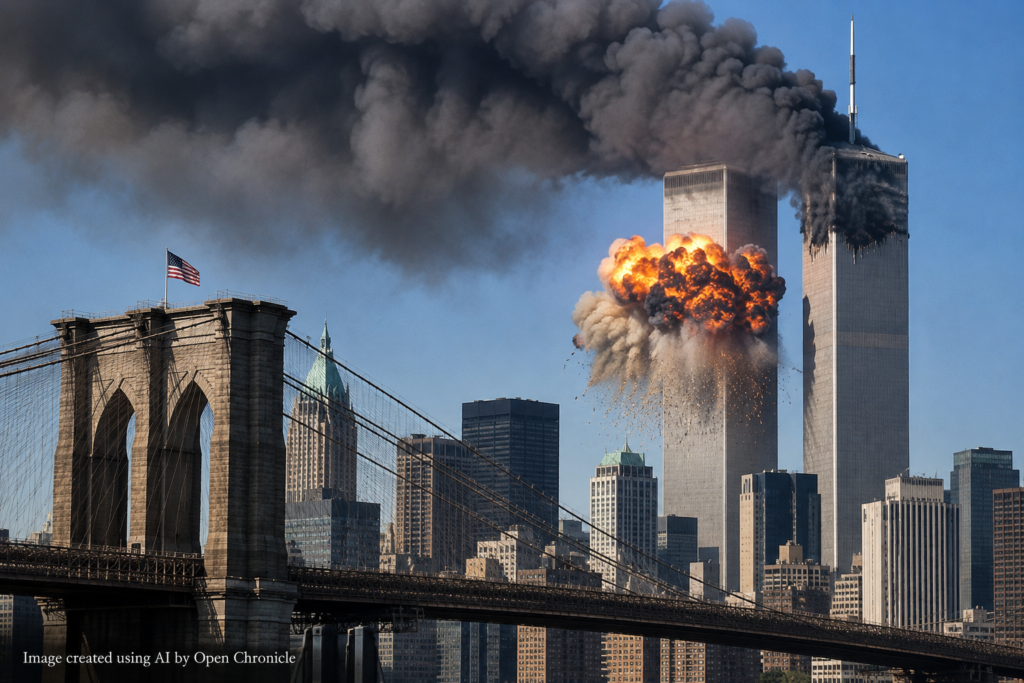
At 8:46 a.m., the Boeing 767 crashed into the North Tower of the World Trade Center.
The aircraft struck between approximately the 93rd and 99th floors.
The impact created a massive explosion and ignited fires across several floors.
At first, confusion dominated television coverage.
Some observers believed a terrible aviation accident had occurred.
Emergency services rushed towards Lower Manhattan.
Firefighters began climbing the North Tower.
Police established emergency operations around the complex.
Thousands of people attempted to evacuate.
Seventeen minutes later, the nature of the event became unmistakable.
United Airlines Flight 175
United Airlines Flight 175 had also departed Boston for Los Angeles.
At 9:03 a.m., it crashed into the South Tower.
Millions of people saw the impact live on television.
There could no longer be any plausible explanation involving an accidental collision.
The United States was under attack.
Television networks around the world interrupted normal programming.
Within minutes, images of smoke pouring from the towers were being broadcast internationally.
The World Trade Center had become the centre of a rapidly developing national emergency.
Inside the Towers
The experiences of people inside the buildings varied dramatically depending on where they were located.
Thousands below the impact zones began evacuating through stairwells.
Office workers helped colleagues descend.
Emergency personnel moved in the opposite direction.
Firefighters climbed upwards carrying heavy equipment while civilians moved towards the exits.
Conditions deteriorated rapidly.
Smoke spread.
Communications became difficult.
Elevators were damaged or unusable.
For many people trapped above the impact zones, escape routes had been destroyed.
Calls to relatives and emergency operators captured the human reality unfolding inside the towers.
Outside, firefighters, police officers, paramedics and civilians struggled to understand the scale of the disaster.
But another hijacked aircraft was approaching Washington.
The Pentagon
American Airlines Flight 77 departed Washington Dulles International Airport for Los Angeles.
The aircraft was hijacked and turned back towards Washington.
At 9:37 a.m., it struck the western side of the Pentagon, headquarters of the United States Department of Defense.
The impact killed everyone aboard the aircraft and 125 people inside the building.
Smoke rose over the American capital.
Three hijacked aircraft had now struck three major targets.
Authorities did not yet know how many other aircraft might have been hijacked.
The Federal Aviation Administration took an unprecedented step.
American airspace was effectively shut down.
Thousands of aircraft were ordered to land.
Flight 93
The fourth hijacked aircraft was United Airlines Flight 93.
It departed Newark, New Jersey, bound for San Francisco.
Because its departure had been delayed, passengers eventually learned through telephone calls that other hijacked aircraft had already struck the World Trade Center.
They understood that their aircraft was probably part of the same attack.
Passengers and crew decided to resist.
A struggle began as they attempted to regain control of the cockpit.
At 10:03 a.m., Flight 93 crashed into a field near Shanksville, Pennsylvania.
Everyone aboard was killed.
Investigators concluded that the hijackers probably intended to strike a target in Washington, with the United States Capitol or possibly the White House among the likely objectives.
The actions of the passengers and crew prevented the aircraft from reaching its intended target.
The South Tower Falls
While events unfolded elsewhere, the situation in New York had become catastrophic.
At 9:59 a.m., the South Tower collapsed.
It had been struck less than an hour earlier.
The enormous building descended in seconds, sending a massive cloud of dust and debris through Lower Manhattan.
Streets disappeared beneath the cloud.
People fled.
Emergency personnel who had entered the building were caught in the collapse.
Television audiences around the world watched in disbelief.
The seemingly permanent skyline of New York was changing before their eyes.
The North Tower
The North Tower remained standing for another 29 minutes.
Firefighters continued emergency operations.
Civilians continued attempting to escape.
At 10:28 a.m., the North Tower collapsed.
The Twin Towers were gone.
The destruction extended across the World Trade Center complex and surrounding neighbourhood.
Buildings were severely damaged.
Fires continued burning.
Rescue workers immediately began searching for survivors.
What had started at 8:46 that morning had transformed Lower Manhattan into a disaster zone in less than two hours.
The Human Cost
The scale of the loss became clearer only gradually.
2,977 victims were killed in the attacks, excluding the nineteen hijackers.
They came from more than 90 countries.
Among them were hundreds of firefighters, police officers and other emergency workers.
The New York City Fire Department lost 343 members.
The New York City Police Department lost 23 officers, while the Port Authority Police Department lost 37 officers.
Entire companies lost large numbers of employees.
Families across the United States and around the world waited desperately for information.
Photographs of missing people appeared throughout New York.
Hospitals prepared for enormous numbers of casualties, only to discover that far fewer survivors emerged from the collapsed towers than many had hoped.
Ground Zero
The World Trade Center site became known simply as Ground Zero.
Rescue operations continued around the clock.
Firefighters, police officers, construction workers, engineers, medical personnel and volunteers searched through enormous quantities of twisted steel, concrete and debris.
Initially there remained hope of finding survivors.
As days passed, the operation increasingly became one of recovery.
Fires beneath the ruins continued for weeks.
Workers faced hazardous dust and toxic material.
The health consequences would continue for years.
Thousands of responders, survivors and residents later developed illnesses associated with exposure to contaminants released during and after the collapse.
September 11 therefore did not stop claiming victims when the attacks ended.
Who Carried Out the Attacks?
The attacks were organised by al-Qaeda, the jihadist terrorist organisation led by Osama bin Laden.
The network had previously carried out attacks against American targets, including the 1998 bombings of U.S. embassies in Kenya and Tanzania.
American intelligence agencies had been tracking the organisation.
But the United States failed to identify and disrupt the September 11 plot before it was executed.
The attacks subsequently produced intense examination of failures in intelligence sharing, aviation security, border controls and government coordination.
The 9/11 Commission, established in 2002, later conducted an extensive investigation into the circumstances leading to the attacks and the government’s response.
America Responds
That evening, President George W. Bush addressed the nation from the White House.
The attacks, he said, would not break the United States.
American authorities immediately began identifying those responsible.
But the response would extend far beyond a criminal investigation.
The United States increasingly conceptualised the attacks as an act of war.
Congress authorised the president to use military force against those responsible for the attacks and those who harboured them.
NATO took an unprecedented step.
For the first time in its history, the alliance invoked the principle underlying Article 5 — that an attack against one member could be regarded as an attack against all.
The international consequences of September 11 had begun.
The War in Afghanistan
Al-Qaeda’s leadership was based largely in Afghanistan, where the Taliban government provided sanctuary to the organisation.
The United States demanded that the Taliban hand over al-Qaeda leaders and dismantle terrorist infrastructure.
When those demands were not met to Washington’s satisfaction, military action followed.
On October 7, 2001, American and British forces began operations against Taliban and al-Qaeda targets.
The Taliban government rapidly lost control of Afghanistan’s major cities.
But the conflict did not end.
Taliban forces reorganised into an insurgency.
The United States and its allies remained militarily involved in Afghanistan for nearly twenty years.
The war became America’s longest.
Osama bin Laden
Bin Laden escaped the initial campaign.
For almost a decade he remained the world’s most wanted terrorist.
American intelligence eventually located him in a compound in Abbottabad, Pakistan.
On May 2, 2011, U.S. Navy SEALs carried out a raid authorised by President Barack Obama.
Bin Laden was killed.
His death closed one chapter of the September 11 story.
It did not end the conflicts or political transformations the attacks had unleashed.
The Iraq War
The aftermath of September 11 also shaped the political environment surrounding the 2003 invasion of Iraq.
The administration of George W. Bush argued that Saddam Hussein’s government possessed weapons of mass destruction and represented a serious security threat.
No operational relationship making Iraq responsible for the September 11 attacks was established, and the 9/11 Commission found no evidence that Iraq had cooperated with al-Qaeda in carrying out the attacks.
Nevertheless, the fear and strategic thinking produced by September 11 profoundly influenced American foreign policy.
U.S.-led forces invaded Iraq in March 2003.
Saddam Hussein’s government collapsed rapidly.
The occupation and insurgency that followed destabilised Iraq and contributed to profound regional consequences.
The War on Terror
September 11 produced what became known as the War on Terror.
It was not a conventional war against a single country.
Instead, the United States and its allies developed a global strategy targeting terrorist organisations, financing networks and governments accused of supporting them.
Military operations expanded.
Intelligence cooperation intensified.
Drone warfare became increasingly important.
Special operations forces carried out missions across multiple countries.
Detention practices and interrogation methods became subjects of major legal and ethical controversy.
The detention facility at Guantánamo Bay became one of the most visible symbols of those debates.
The Surveillance State
Domestic security changed as well.
Congress passed the USA PATRIOT Act in October 2001.
The legislation expanded government powers in areas including surveillance, intelligence gathering and investigations related to terrorism.
Supporters argued that security agencies required new tools to confront networks operating across borders and communications systems.
Critics warned that expanded surveillance threatened civil liberties and privacy.
The tension between liberty and security became one of the defining political debates of the post-9/11 era.
It intensified further as digital technology transformed the amount of information governments and corporations could collect.
Airports Changed Forever
Perhaps the most immediately visible legacy of September 11 appeared at airports.
Before 2001, commercial aviation security operated very differently.
The attacks exposed vulnerabilities in cockpit access, passenger screening and airport security procedures.
The United States created the Transportation Security Administration.
Cockpit doors were strengthened.
Screening procedures became substantially more restrictive.
Passenger identification requirements increased.
Restrictions on items carried aboard aircraft expanded.
Similar changes appeared internationally.
For billions of travellers, the experience of flying was permanently altered.
A Global Political Transformation
The consequences extended far beyond American borders.
Governments revised counterterrorism legislation.
Intelligence agencies increased cooperation.
Financial systems became more closely monitored for terrorist financing.
Military doctrines changed.
Security became a central organising principle of international politics.
At the same time, Muslim communities in the United States and elsewhere experienced increased discrimination, suspicion and hate crimes.
Political debates surrounding immigration, religion, interventionism and national identity intensified.
September 11 influenced not merely military strategy but social and political life.
Afghanistan, Twenty Years Later
In 2021, the United States withdrew its remaining military forces from Afghanistan.
The Taliban rapidly regained control of the country.
On August 15, 2021, Taliban fighters entered Kabul.
The Afghan government collapsed.
American evacuation operations concluded later that month.
The images produced a painful historical symmetry.
A war launched in response to September 11 had lasted almost exactly twenty years.
Its ending generated renewed debate over what the intervention had accomplished, what it had cost and whether the enormous human and financial sacrifices had achieved lasting strategic objectives.
Rebuilding Ground Zero
New York eventually rebuilt the World Trade Center site.
At its centre now stands the National September 11 Memorial.
Two enormous reflecting pools occupy the footprints of the former Twin Towers.
The names of those killed in the attacks of 2001 and the 1993 World Trade Center bombing are inscribed around them.
Nearby stands One World Trade Center, completed as the principal building of the reconstructed complex.
At 1,776 feet in architectural height, its measurement deliberately references the year of American independence.
The rebuilt site combines commercial life, architecture and remembrance.
Memory
Every year on September 11, the names of the victims are read aloud at the World Trade Center site.
Families gather.
Bells mark the moments when the aircraft struck and the towers fell.
Ceremonies are also held at the Pentagon and the Flight 93 National Memorial in Pennsylvania.
As time passes, the nature of historical memory changes.
A growing proportion of the world’s population was born after 2001.
For them, September 11 is not a personal memory.
It is history.
That transition makes careful historical interpretation increasingly important.
Before and After
Few individual dates create such an obvious dividing line in contemporary history.
Before September 11, the United States stood as the dominant global power following the end of the Cold War.
The Soviet Union had disappeared.
Many Western policymakers believed the post-Cold War international system might become progressively more stable.
The attacks shattered that confidence.
Terrorism became a central national security priority.
Wars followed.
Government institutions changed.
Borders tightened.
Surveillance expanded.
Foreign policy shifted.
The political vocabulary of the early twenty-first century became filled with terms such as homeland security, counterterrorism, regime change, insurgency and radicalisation.
Why September 11 Matters
The historical importance of September 11 lies not only in the horror of what happened that morning.
It lies also in everything that followed.
Nearly 3,000 people went to work, boarded aircraft, responded to emergencies or simply began an ordinary Tuesday and never returned home.
Their deaths transformed families and communities.
But the attacks also altered decisions made by governments thousands of kilometres away.
They contributed to wars lasting decades.
They reshaped intelligence agencies and security institutions.
They changed airports.
They influenced elections.
They affected relations between states.
They altered debates over privacy and government power.
They changed the strategic landscape of the Middle East and South Asia.
Some consequences were immediate.
Others are still unfolding.
September 11, 2001
The most haunting aspect of the morning may be how quickly ordinary life disappeared.
At 8:45 a.m., the New York skyline looked familiar.
One minute later, it did not.
By 10:30, both towers had fallen.
The Pentagon had been struck.
Flight 93 lay destroyed in Pennsylvania.
Thousands were dead or missing.
And the United States had entered a new historical era.
More than two decades later, debates continue over the decisions taken in response to the attacks and the world those decisions helped create.
But beneath geopolitics, wars and policy lies the essential human reality of the day.
Thousands of individual lives ended.
Thousands more people ran towards danger to help strangers.
Passengers aboard Flight 93 resisted their hijackers.
Firefighters climbed stairways while others descended.
Police officers, paramedics, civilians and volunteers responded amid circumstances almost impossible to comprehend.
That is why September 11, 2001 occupies such a profound place in modern history.
It was a terrorist attack.
It was a human tragedy.
And it became a turning point whose consequences reshaped the opening decades of the twenty-first century.