
By Open Chronicle News Desk
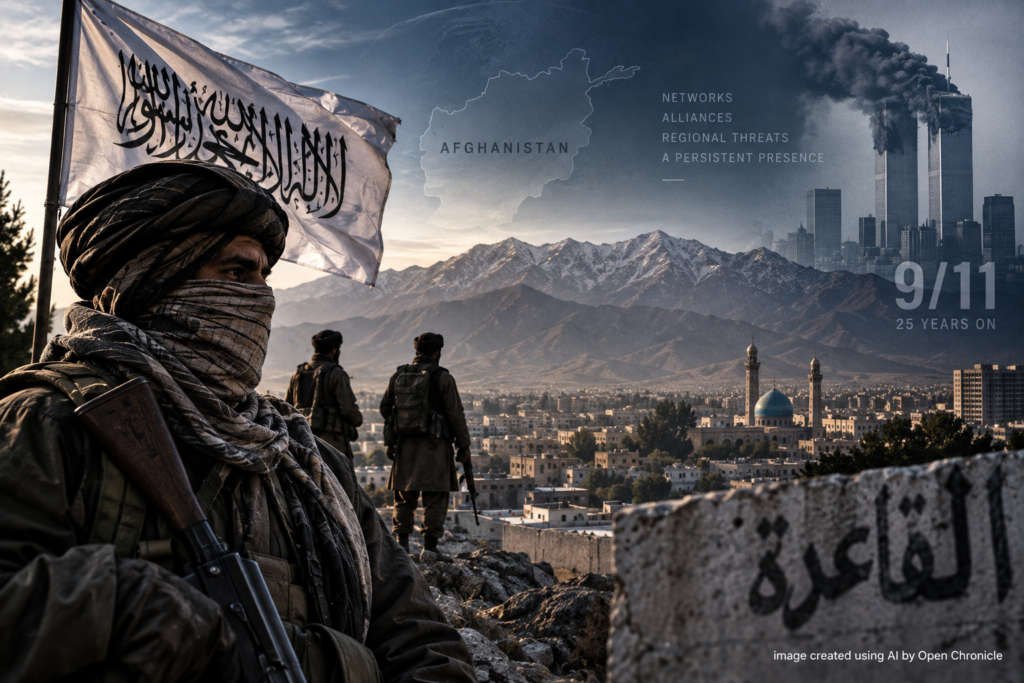
Twenty-five years after the September 11 attacks transformed global security and launched the United States into its longest war, al-Qaeda remains diminished from the organization that once planned attacks from Afghanistan, but it has not disappeared.
The United States killed Osama bin Laden, dismantled much of al-Qaeda’s original leadership and spent two decades fighting in Afghanistan. Yet recent United Nations monitoring cited in assessments of the country points to a continuing al-Qaeda presence under Taliban rule, alongside support for Tehrik-e Taliban Pakistan and networks associated with al-Qaeda in the Indian Subcontinent.
The central question in 2026 is therefore different from the one Washington confronted after September 11, 2001. Al-Qaeda no longer resembles the concentrated organization that existed before the US invasion of Afghanistan. Instead, it has survived by decentralizing, maintaining regional relationships and operating with a considerably lower international profile.
That makes measuring the threat more complicated.
Twenty-five years after September 11
Nearly 3,000 people were killed in the September 11 attacks, which triggered the US-led War on Terror and the invasion of Afghanistan.
The Taliban government was overthrown after refusing US demands surrounding al-Qaeda and bin Laden, beginning a conflict that would continue for almost two decades.
American and allied operations subsequently inflicted severe losses on al-Qaeda. Bin Laden was killed by US forces in Abbottabad, Pakistan, in 2011, while numerous senior commanders were killed or captured during years of counterterrorism operations.
But military pressure did not eliminate the wider movement.
Al-Qaeda increasingly evolved away from a highly centralized organization, relying instead on regional affiliates and networks operating across Africa, the Middle East and Asia.
The US withdrawal from Afghanistan in August 2021 and the Taliban’s return to Kabul consequently revived one of the central concerns of the post-9/11 era: whether Afghanistan could once again provide an environment in which transnational militant organizations could survive and rebuild.
UN monitoring points to continuing presence
Recent assessments by the United Nations Analytical Support and Sanctions Monitoring Team indicate that al-Qaeda continues to maintain a presence in Afghanistan.
According to an August 10 report cited in the source material, the organization’s status and strength in the country remained broadly unchanged.
The assessment also warned that numerous militant organizations retain the ability to operate in Afghanistan, creating an enduring security concern for neighbouring states and Central Asia.
That picture contrasts with repeated Taliban assertions that Afghan territory is not being used by foreign terrorist organizations.
The debate is partly about what constitutes a safe haven. A group does not necessarily need to control large training camps or territory openly to maintain personnel, communications, financial networks or relationships with allied organizations.
Al-Qaeda support for TTP
One of the most significant findings concerns Tehrik-e Taliban Pakistan, or TTP, which is fighting an insurgency against the Pakistani state.
According to the UN assessment, al-Qaeda has provided ideological guidance, training and other support to the TTP.
The report said al-Qaeda’s official media organization, As-Sahab Media Foundation, issued a statement on April 28 supporting the Afghan Taliban and, for the first time, the TTP’s operations against Pakistan.
Such links are particularly concerning for Islamabad, which has repeatedly argued that militants operating from Afghan territory pose a direct threat to Pakistani security.
The Taliban government has rejected accusations that it permits Afghanistan to be used as a base for attacks against other countries.
AQIS operates through dispersed networks
Al-Qaeda in the Indian Subcontinent, known as AQIS, presents another dimension of the threat.
According to the UN assessment cited in the source material, AQIS has developed from a fragmented organization into a regional militant entity with logistical and financial structures operating through decentralized cells rather than large formations.
The report further stated that AQIS leaders remained in Kabul and had received Afghan identity documents, or tazkiras.
If accurate, those findings would raise significant questions about the relationship between AQIS members and elements of the Taliban authorities.
The Taliban rejects claims that it shelters foreign terrorist organizations.
Zawahiri’s death exposed an uncomfortable reality
One event has continued to shape international scrutiny of those denials.
Ayman al-Zawahiri, bin Laden’s successor as al-Qaeda leader, was killed by a US drone strike in Kabul in July 2022, less than a year after the Taliban returned to power.
His presence in the Afghan capital demonstrated that a figure at the highest level of al-Qaeda had been able to reside in Kabul after the Western withdrawal.
For analysts who believe al-Qaeda retains significant freedom of movement in Afghanistan, Zawahiri’s presence remains one of the strongest pieces of evidence challenging Taliban assurances.
Kamal Alam, an Afghanistan specialist and former nonresident senior fellow at the Atlantic Council, argued that al-Qaeda’s presence in Afghanistan is now at its highest level since the Taliban returned to power.
He cautioned that the broader issue extends beyond al-Qaeda itself, pointing to interconnected militant organizations with regional and international links.
Has al-Qaeda become stronger, or simply quieter?
Experts remain divided over what the continuing presence means.
Washington-area analyst Alex Mishra argued that al-Qaeda now has a broader territorial presence across three continents than at any time since its creation.
His assessment emphasizes the distinction between centralized operational strength and geographical reach. An organization can lose much of its original leadership while expanding its influence through affiliates and associated movements.
Former Pakistani diplomat Asif Durrani offered a markedly different interpretation, describing al-Qaeda as an organization that has “lost its teeth and appeal.”
Durrani argued that ISIS, also known as Daesh, has displaced al-Qaeda as the more prominent jihadist threat.
That disagreement illustrates one of the difficulties facing intelligence services 25 years after September 11. Al-Qaeda’s reduced visibility can be interpreted either as evidence of decline or as a deliberate strategy designed to avoid the concentrated international pressure that devastated its original leadership.
Atlanta-based geopolitical analyst Erik Lehmkuhle argued for the latter interpretation, describing al-Qaeda as pursuing a strategy of “operational patience” in the environment created by the Taliban’s return.
There is, however, uncertainty about al-Qaeda’s current capability and intent to conduct major external attacks. A persistent presence should not automatically be equated with the operational capacity the organization possessed before 9/11.
Taliban rejects accusations of a terrorist sanctuary
Taliban chief spokesman Zabiullah Mujahid strongly rejected the suggestion that Afghanistan is again becoming a haven for foreign militant organizations.
He also disputed Afghan responsibility for the conditions that enabled the September 11 attacks, arguing that the plotters received training, housing and logistical support outside Afghanistan.
“There was no such arrangement or infrastructure in Afghanistan at that time,” Mujahid said.
He maintained that today’s Taliban government does not permit foreign armed factions to operate inside Afghanistan and characterized allegations of terrorist safe havens as foreign propaganda.
Without specifically naming al-Qaeda, Mujahid suggested that such organizations have greater opportunities to operate in some Arab countries, although he did not identify them.
Those assertions remain in direct tension with UN monitoring findings describing the continued presence of al-Qaeda and other militant networks inside Afghanistan.
The unfinished legal legacy of 9/11
Twenty-five years after the attacks, another central chapter of September 11 remains unresolved.
Khalid Sheikh Mohammed, whom US authorities accuse of being the principal architect of the plot, remains at Guantanamo Bay without having faced a completed trial.
Captured in Pakistan in 2003 and transferred to Guantanamo in 2006, Mohammed has spent more than two decades in US detention.
His trial, alongside three co-defendants, is currently scheduled to begin on June 5, 2028, almost 27 years after the attacks.
The extraordinary delay reflects the legal legacy of the post-9/11 detention and interrogation system.
Statements obtained following years of CIA detention and interrogation became a central issue in the proceedings. Prosecutors recently chose not to appeal a ruling excluding some statements, preserving the timetable for the planned 2028 trial.
Counterextremism analyst Andy Vermaut described the failure to complete the prosecution after a quarter of a century as one of the major unresolved problems of the post-9/11 system. He argued that torture, including waterboarding, and subsequent disputes over the admissibility of evidence severely complicated the case.
A different threat from 2001
Al-Qaeda in 2026 is not al-Qaeda in 2001.
Its founding leadership has largely disappeared. Its centralized command structure has been severely weakened, and its capacity to organize another attack on the scale of September 11 from Afghanistan remains uncertain.
But survival itself is significant.
The organization adapted to two decades of sustained military and intelligence pressure by dispersing its networks and embedding itself within regional conflicts and allied organizations.
Afghanistan therefore remains important, although for reasons more complicated than the training camps and centralized leadership structures that characterized the country before September 11.
The deeper concern is the ecosystem surrounding al-Qaeda: AQIS, the TTP and other armed organizations capable of exchanging expertise, ideology, financing and personnel across borders.
Twenty-five years after 9/11, the legacy of the attacks is consequently marked by a striking contradiction. The organization responsible was profoundly weakened, its founder was killed and the government that sheltered it was overthrown. Yet after two decades of war, the Taliban returned to Kabul, al-Qaeda survived, and international monitors are still debating the extent to which Afghanistan could provide space for militant networks to endure.
The threat has changed. The question of whether it has truly been defeated remains unresolved.