
By Open Chronicle with agencies
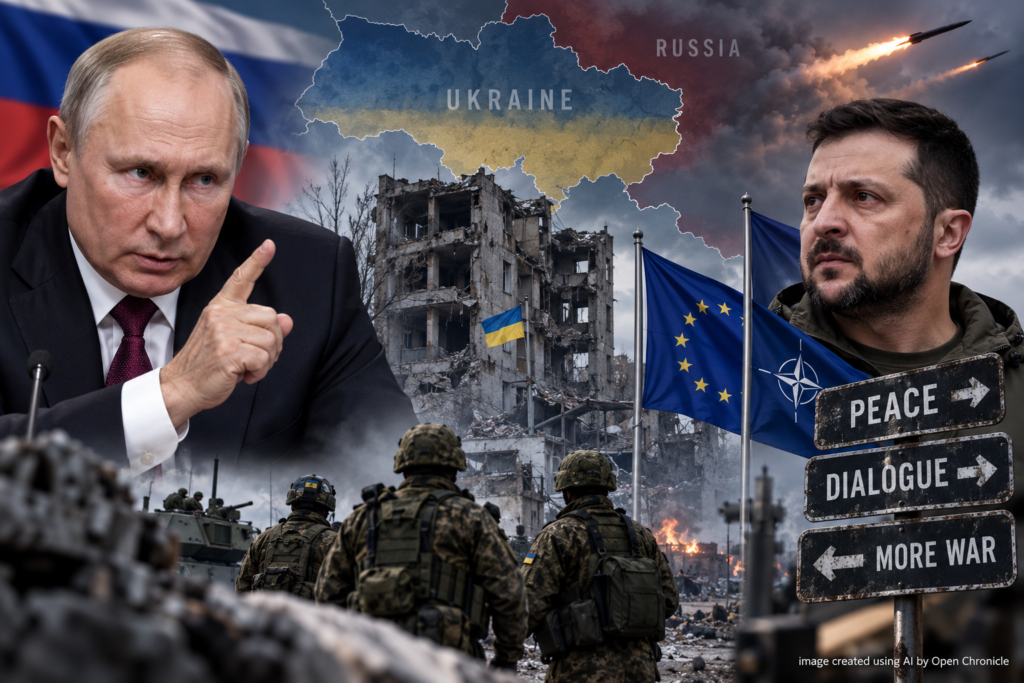
Russian President Vladimir Putin has warned European governments that deploying troops to Ukraine would amount to direct war with Russia, delivering one of Moscow’s clearest warnings yet as European capitals debate possible security arrangements for Ukraine.
Speaking to reporters during the BRICS summit in India, Putin said discussions about sending European forces into Ukraine crossed a fundamental line for Moscow.
“Now they’re talking about how they’re considering sending troops into Ukraine. That means a war with Russia,” Putin said.
His warning came as Russian forces intensified attacks across Ukraine, with local authorities reporting at least eight civilian deaths and dozens of injuries in strikes across several regions.
Moscow rejects European troop presence
Several European governments have discussed the possibility of contributing troops to a future peacekeeping or reassurance force in Ukraine if a negotiated settlement is reached.
The proposals remain under discussion and would depend heavily on the terms of any eventual ceasefire or peace agreement. Moscow, however, has repeatedly rejected the presence of forces from NATO countries on Ukrainian territory.
Putin simultaneously dismissed suggestions that Russia represented a broader military threat to Europe.
“We do not threaten, nor do we intend to threaten, European countries,” he said.
Those assurances are viewed with deep skepticism in several European capitals, particularly among countries bordering Russia, Belarus and Ukraine.
Polish Prime Minister Donald Tusk warned this week that recent incidents near Ukraine’s borders with Poland and Moldova could provide an indication of the type of pressure European countries might increasingly face.
According to Tusk, two people were killed when Russian drones struck the Starokozache crossing between Ukraine and Moldova on Tuesday night. A separate threat near a Polish Ukrainian border crossing the following night was avoided through cooperation between Warsaw and Kyiv.
Russian attacks intensify across Ukraine
Putin’s comments came against the backdrop of another deadly wave of Russian strikes.
In Zaporizhzhia, two people were killed and another wounded after drones struck a residential area overnight, regional governor Ivan Fedorov said.
Officials in Kryvyi Rih reported one person killed and three wounded.
Odesa and the surrounding region experienced what regional governor Oleh Kiper described as a “massive attack,” with 35 people reported injured. A residential high rise was among the buildings struck, with its upper floors heavily damaged.
Three more people were killed when vehicles were hit by drones in Kramatorsk, in the partially occupied Donetsk region, according to local authorities.
Officials also reported two deaths following a Russian strike on a grocery store in the Zhytomyr region.
Russia has increasingly used combinations of missiles and drones against Ukrainian cities and infrastructure, placing additional pressure on the country’s air defence network.
Ukraine has accused Moscow of deliberately targeting its energy system ahead of winter in an effort to weaken civilian morale. Russia has maintained that its attacks are directed at targets connected to Ukraine’s military capabilities.
Ukraine strikes targets inside Russia
Ukraine has continued its own campaign against facilities deep inside Russian territory.
President Volodymyr Zelenskyy said Ukrainian forces had struck two chemical industry facilities, one in the Samara region and another in Perm.
Russian regional authorities did not immediately confirm the reported damage. Independent Russian outlet Astra reported drone attacks involving chemical plants in both regions.
Ukraine has increasingly relied on domestically developed long range drones to strike military installations, energy infrastructure and industrial facilities that Kyiv says contribute to Russia’s war effort.
The expanding geographical reach of such operations has added another dimension to a conflict increasingly fought far beyond the front lines.
Zelenskyy says he could meet Putin at G20
Despite the continuing fighting, Zelenskyy has again raised the possibility of direct talks with Putin.
In an interview with Deutsche Welle, the Ukrainian president said he would meet the Russian leader if both were invited to the Group of 20 summit scheduled for December in Miami.
Putin’s foreign policy adviser Yuri Ushakov said the possibility of the Russian president attending the summit had not yet been discussed.
The Kremlin has previously said Zelenskyy could travel to Moscow for direct talks, an offer rejected by Kyiv.
“If he really wants to meet with Putin, Putin has already said that he could fly to Moscow,” Kremlin spokesman Dmitry Peskov said.
Russian Foreign Minister Sergey Lavrov reiterated that Moscow was prepared to negotiate, while making clear that Russia would not halt military operations while talks were underway.
That position remains one of the central obstacles to attempts to transform diplomatic contacts into a ceasefire.
Trump pushes for an agreement
US President Donald Trump has continued efforts to encourage negotiations following another conversation with Putin this week.
Trump described the call as a “great conversation” and repeated his belief that the Russian president wants an agreement ending the conflict.
“He is wanting to make a deal,” Trump said. “And if Zelenskyy is wanting to make a deal, that would be very nice.”
Asked what was preventing an agreement, Trump pointed to the personal hostility between the Russian and Ukrainian presidents.
“The holdup is two people that hate each other,” he said.
Yet the dispute extends far beyond relations between the two leaders. Territory, security guarantees, Ukraine’s future military alignment, sanctions, Russian troop deployments and the possibility of foreign forces inside Ukraine remain fundamental areas of disagreement.
European security moves closer to the centre of the war
Putin’s latest warning highlights how the debate is increasingly shifting from the immediate battlefield to the shape of Ukraine’s long term security.
Kyiv argues that any settlement must contain credible guarantees strong enough to prevent another Russian attack. Some European governments see a multinational military presence as one potential component of those guarantees.
Moscow views the prospect very differently, regarding the deployment of forces from NATO countries as a direct security threat.
Putin’s declaration that European troops in Ukraine would mean “war with Russia” therefore raises the stakes surrounding any future peacekeeping proposal.
With Russian strikes continuing, Ukrainian attacks reaching deeper into Russia and diplomatic efforts yet to produce a ceasefire, the question of who would guarantee a future settlement is becoming almost as contentious as the negotiations needed to reach one.