
By Open Chronicle History Desk
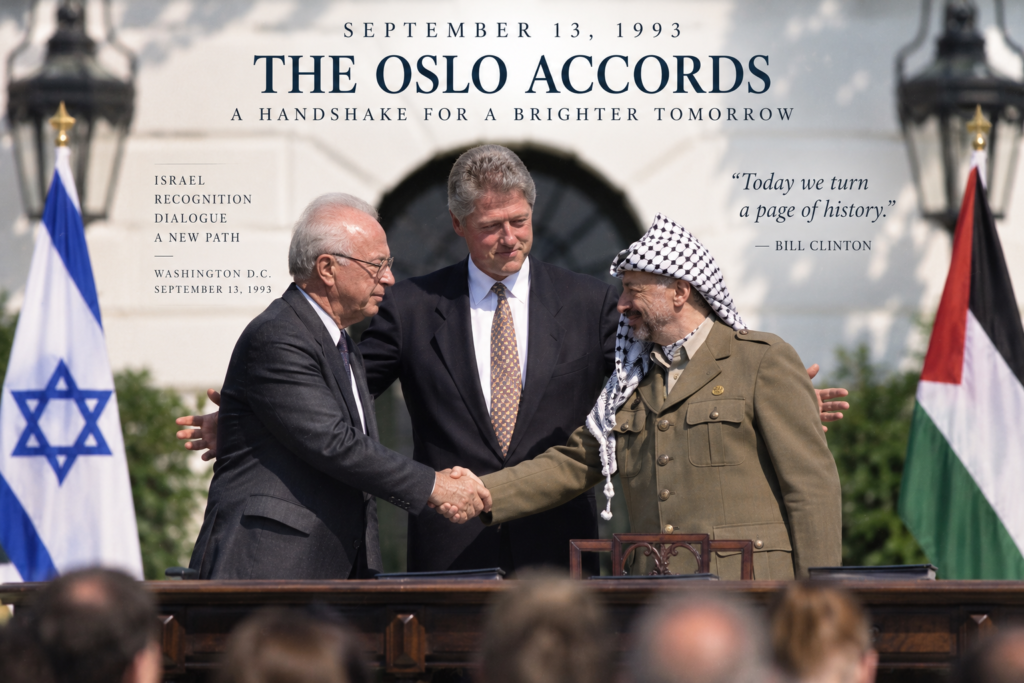
On September 13, 1993, one of the most remarkable political scenes of the late twentieth century unfolded on the South Lawn of the White House.
Israeli Prime Minister Yitzhak Rabin and Palestine Liberation Organization chairman Yasser Arafat stood before an international audience after decades in which Israelis and Palestinians had confronted one another through war, occupation, terrorism, uprising and political hostility.
Between them stood American President Bill Clinton.
Then Rabin and Arafat shook hands.
The image travelled around the world.
For millions of people, it appeared to capture something that had long seemed almost impossible: the possibility that Israelis and Palestinians might finally negotiate a political settlement.
The ceremony marked the signing of the Declaration of Principles on Interim Self-Government Arrangements, commonly associated with the Oslo Accords.
The agreement did not create a Palestinian state.
It did not settle the status of Jerusalem.
It did not resolve the question of Israeli settlements.
It did not determine permanent borders.
It did not solve the refugee question.
Instead, Oslo established a process.
Israel and the Palestine Liberation Organization recognised one another politically, while a framework was created for limited Palestinian self-government in parts of the occupied territories and negotiations towards a permanent settlement.
It was an extraordinary diplomatic breakthrough.
It was also dangerously incomplete.
The history of September 13, 1993 is therefore simultaneously a history of hope and a history of unresolved questions.
A Conflict Older Than Oslo
The Israeli-Palestinian conflict did not begin in 1993, nor can its origins be reduced to a single event.
During the late nineteenth and early twentieth centuries, the region then known as Palestine formed part of the Ottoman Empire.
Most of its population was Arabic-speaking, while Jewish communities also lived there.
At the same time, Zionism emerged as a modern political movement advocating the establishment of a Jewish national home, increasingly focused on Palestine.
Jewish immigration grew, particularly as European antisemitism and persecution intensified.
Arab inhabitants of Palestine developed their own political and national aspirations.
Two national movements increasingly claimed rights in the same territory.
The British Mandate
The First World War transformed the region.
The Ottoman Empire collapsed.
Britain took control of Palestine under a League of Nations mandate.
In 1917, the British government had issued the Balfour Declaration, supporting the establishment in Palestine of a national home for the Jewish people while also referring to the rights of existing non-Jewish communities.
Reconciling those objectives became increasingly difficult.
Jewish immigration expanded.
Arab opposition intensified.
Violence erupted repeatedly during the mandate period.
Britain eventually concluded that it could not resolve the conflict.
The issue moved to the newly created United Nations.
Partition
In 1947, the United Nations General Assembly recommended partitioning Palestine into separate Jewish and Arab states, with Jerusalem placed under a special international regime.
Jewish leaders accepted partition in principle.
Arab leaders rejected it, arguing that the plan was unjust to Palestine’s Arab majority and allocated too much territory to the proposed Jewish state.
Violence escalated.
On May 14, 1948, Israel declared independence.
Neighbouring Arab states entered the war.
The conflict transformed the political map of the region.
1948 and the Palestinian Refugees
Israel survived the war and controlled more territory than had been allocated to the Jewish state under the UN partition proposal.
For Israelis, the war became remembered as the War of Independence.
For Palestinians, it became associated with the Nakba, Arabic for catastrophe.
Hundreds of thousands of Palestinians fled or were expelled from their homes during the conflict.
Many became refugees in neighbouring countries or in the territories that remained outside Israeli control.
The refugee question became one of the central unresolved issues of the conflict.
No Palestinian state emerged from the 1948 war.
The West Bank came under Jordanian control.
The Gaza Strip came under Egyptian administration.
The PLO
In 1964, the Palestine Liberation Organization, or PLO, was established.
Its objective was Palestinian national liberation.
Over time, Yasser Arafat and his Fatah movement became dominant within the organisation.
The PLO initially rejected Israel’s legitimacy and included armed struggle among its methods.
Israeli governments regarded it as a terrorist organisation.
For many Palestinians, however, the PLO became the principal international representative of Palestinian national aspirations.
For decades, direct political recognition between Israel and the PLO seemed almost inconceivable.
The Six-Day War
The regional landscape changed dramatically in June 1967.
During the Six-Day War, Israel captured the West Bank and East Jerusalem from Jordan, the Gaza Strip and Sinai Peninsula from Egypt, and the Golan Heights from Syria.
Israel now controlled territories containing large Palestinian populations.
The consequences were profound.
The conflict was no longer only about the consequences of 1948.
It increasingly centred on Israeli occupation of territories captured in 1967 and the future political status of the Palestinians living there.
Occupation
Israel established military rule over the West Bank and Gaza.
Israeli settlements were subsequently created and expanded in occupied territory.
Palestinians experienced restrictions associated with military occupation, while Israel argued that territorial control was connected to vital security concerns.
Different Israeli governments pursued different policies, but the settlement project grew.
The territorial reality became increasingly complicated.
Any future peace agreement would have to address land, security, settlements, Jerusalem and Palestinian political rights.
Those questions would eventually arrive at the negotiating table.
But only after decades of violence.
War and Diplomacy
The broader Arab-Israeli conflict produced additional wars.
In 1973, Egypt and Syria attacked Israeli forces in the Sinai and Golan Heights during the Yom Kippur War.
The conflict demonstrated that continued military confrontation carried enormous risks.
Diplomacy eventually produced a historic breakthrough between Israel and Egypt.
Egyptian President Anwar Sadat travelled to Jerusalem.
Negotiations mediated by American President Jimmy Carter led to the Camp David Accords.
Israel and Egypt signed a peace treaty in 1979.
The agreement demonstrated that seemingly irreconcilable enemies could negotiate.
But the Palestinian question remained unresolved.
The First Intifada
In December 1987, a Palestinian uprising began in the occupied territories.
It became known as the First Intifada.
Demonstrations, strikes, civil disobedience, stone throwing and violent confrontations spread across the West Bank and Gaza.
Israeli forces responded with military and policing measures.
The uprising changed international perceptions of the conflict.
The image was no longer primarily one of Israel confronting neighbouring Arab armies.
The world increasingly saw Palestinians living under Israeli occupation confronting Israeli forces directly.
The political status quo was becoming harder to sustain.
The PLO Changes Course
The Palestinian leadership was also changing its diplomatic strategy.
During the late 1980s, the PLO moved towards accepting a political settlement based broadly on the territories occupied in 1967.
Arafat increasingly signalled acceptance of Israel’s existence and support for negotiations.
The transformation was controversial within the Palestinian movement.
Some factions rejected compromise.
But the possibility of political engagement was emerging.
Then the international system itself changed.
The Cold War Ends
The collapse of the Soviet Union transformed global politics.
The United States emerged from the Cold War with unprecedented diplomatic influence.
The 1991 Gulf War also altered the Middle Eastern balance.
Washington believed there was an opportunity to restart Arab-Israeli diplomacy.
President George H. W. Bush and Secretary of State James Baker pushed the parties towards negotiations.
The result was the Madrid Peace Conference of 1991.
Israel participated.
Representatives connected to the Palestinian population of the occupied territories participated as part of a joint Jordanian-Palestinian delegation.
But Israel still refused formal negotiations with the PLO.
Public negotiations moved slowly.
Elsewhere, however, something extraordinary was beginning.
A Secret Channel in Norway
Away from television cameras and official diplomatic structures, Israeli and Palestinian representatives began meeting secretly in Norway.
The talks were initially informal and highly sensitive.
Norwegian facilitators helped create an environment in which representatives could speak more freely than in the formal negotiating process.
The location mattered.
Oslo was far removed from the immediate pressures of Jerusalem, Gaza, the West Bank and Washington.
Participants ate together.
They discussed fundamental political assumptions.
Gradually, personal relationships developed.
Positions that had previously been communicated through hostile public statements could now be explored face to face.
Why Secret Negotiations Worked
Official diplomacy often requires representatives to defend established positions publicly.
Secret diplomacy can sometimes create more flexibility.
Participants can test ideas without immediately committing their governments.
They can explore compromises.
They can retreat from proposals without public humiliation.
That did not mean the Oslo negotiations were easy.
The differences remained enormous.
But both sides possessed incentives to continue.
Israel wanted an end to violence and a Palestinian partner capable of exercising authority.
The PLO desperately needed renewed political relevance and a path towards Palestinian self-government.
A framework began to emerge.
Israel Recognises the PLO
Before the White House ceremony, an even more fundamental exchange occurred.
On September 9, 1993, Arafat sent Rabin a letter stating that the PLO recognised the right of the State of Israel to exist in peace and security.
The PLO accepted relevant United Nations Security Council resolutions and renounced terrorism and other acts of violence.
Rabin replied that Israel had decided to recognise the PLO as the representative of the Palestinian people and begin negotiations with it.
This mutual recognition was historic.
For years, each side had questioned the other’s political legitimacy.
Now Israel and the PLO formally recognised one another as negotiating partners.
What Oslo Actually Proposed
The Declaration of Principles envisioned a five-year transitional period of Palestinian interim self-government.
Palestinians would assume responsibility for certain areas of civilian administration.
Israeli forces would withdraw from parts of the Gaza Strip and the Jericho area.
A Palestinian governing authority would be created.
Elections would eventually be held.
During the transitional period, negotiations were supposed to address the most difficult permanent-status issues.
The logic was gradual.
Rather than attempting to solve everything immediately, both sides would build confidence through incremental cooperation.
Then they would negotiate the final settlement.
What Oslo Did Not Resolve
This was also the agreement’s central weakness.
The most difficult questions were postponed.
Jerusalem.
Palestinian refugees.
Israeli settlements.
Permanent borders.
Security arrangements.
The final political status of the Palestinian territories.
These were not secondary details.
They were the core disputes.
Oslo created mechanisms for managing the conflict while leaving its ultimate destination uncertain.
Supporters saw that ambiguity as necessary.
Critics would later argue that it allowed the underlying conflict to continue developing while negotiations struggled to catch up.
September 13, 1993
Thousands gathered at the White House.
Former presidents George H. W. Bush and Jimmy Carter attended.
Diplomats and officials watched.
President Clinton stood between Rabin and Arafat.
Israeli Foreign Minister Shimon Peres and senior PLO official Mahmoud Abbas formally signed the Declaration of Principles.
Then came the moment everyone remembered.
Arafat extended his hand.
Rabin hesitated only briefly.
The two men shook hands.
The photograph became an icon of the 1990s.
Rabin’s Difficult Handshake
The symbolism was especially powerful because Rabin was not a romantic idealist detached from the realities of war.
He had spent much of his life within Israel’s military and security establishment.
He had served as chief of staff of the Israel Defense Forces during the Six-Day War.
He understood the conflict intimately.
Arafat, meanwhile, had spent decades leading the Palestinian national movement and armed struggle.
These were not two politicians discovering that they had never really disagreed.
They represented movements shaped by decades of profound conflict.
That was precisely why the handshake mattered.
“Enough of Blood and Tears”
Rabin’s remarks at the ceremony reflected that history.
He addressed Palestinians directly and spoke about generations of conflict.
Israelis and Palestinians, he argued, were destined to live on the same land.
The time had come to attempt peace.
The emotional power of the ceremony came partly from the awareness that neither side trusted the other completely.
Peace was not being made between friends.
It was being attempted between enemies.
Arafat at the White House
Arafat’s presence was itself remarkable.
For decades, American and Israeli officials had treated the PLO leader primarily as the head of a hostile organisation associated with armed attacks.
Now he stood at the White House participating in an internationally celebrated peace process.
The transformation reflected how dramatically diplomacy had changed.
But it also generated fierce opposition.
Many Israelis believed Arafat could not be trusted.
Many Palestinians believed the PLO had conceded recognition without receiving a guaranteed Palestinian state in return.
The agreement was historic.
It was not universally welcomed.
The Palestinian Authority
Implementation followed.
In 1994, limited Palestinian self-government began in parts of Gaza and around Jericho.
Arafat returned to the Palestinian territories after years in exile.
The Palestinian Authority emerged as an interim governing institution.
It assumed responsibility for areas including education, health and policing within specified territories.
For supporters of Oslo, these developments represented the foundations of eventual Palestinian statehood.
For critics, the emerging structure remained subordinate to an occupation that had not ended.
Both interpretations would shape subsequent political debate.
Oslo II
A second major agreement followed in 1995.
The Oslo II Accord expanded arrangements for Palestinian self-government in the West Bank.
The territory was divided administratively into what became known as Areas A, B and C.
Area A came under Palestinian civil and security control.
Area B involved Palestinian civil administration with shared or overriding Israeli security arrangements.
Area C remained under full Israeli control.
The arrangement was intended to be transitional.
Instead, its territorial categories would survive for decades.
A temporary system became a durable political geography.
Opposition in Israel
The peace process divided Israeli society.
Supporters argued that territorial compromise and recognition of Palestinian political rights offered the best hope of ending the conflict.
Opponents feared that withdrawing territory would endanger Israeli security.
Some religious and nationalist groups rejected concessions over land they considered historically or biblically Jewish.
Settlement politics became increasingly contentious.
Rabin faced fierce criticism.
Some demonstrations portrayed him as a traitor.
The political atmosphere became increasingly dangerous.
Opposition Among Palestinians
Palestinian society was equally divided.
Hamas and Palestinian Islamic Jihad rejected the Oslo process.
They opposed recognition of Israel and pursued armed resistance.
Attacks against Israeli civilians undermined confidence in the peace process.
For Palestinians who supported negotiations, Israeli settlement expansion and continuing restrictions raised doubts about whether Oslo would actually produce sovereignty.
Each act of violence strengthened those who argued that the other side could not be trusted.
The peace process depended on confidence.
Events repeatedly destroyed it.
The Nobel Peace Prize
In 1994, Yitzhak Rabin, Shimon Peres and Yasser Arafat received the Nobel Peace Prize.
The award recognised their efforts to create a negotiated settlement.
The photograph of the three men became another symbol of optimism.
Yet even as they received international recognition, opposition was intensifying at home.
The process was becoming increasingly vulnerable.
Then came an event that profoundly altered Israeli politics.
The Assassination of Yitzhak Rabin
On November 4, 1995, Rabin attended a peace rally in Tel Aviv.
As he left the event, he was shot by Yigal Amir, an Israeli extremist opposed to the Oslo process.
Rabin died from his wounds.
Israel was shocked.
The assassination demonstrated that the peace process faced violent opposition not only from Palestinian militant organisations but also from extremists within Israel.
One of Oslo’s central architects was gone.
The political landscape changed.
The Peace Process Falters
Negotiations did not immediately collapse.
Further agreements were reached.
Benjamin Netanyahu became Israeli prime minister in 1996.
Ehud Barak later returned the Israeli Labour Party to government.
American diplomacy continued.
But mutual confidence deteriorated.
Settlement construction remained contentious.
Violence continued.
Palestinian frustration increased.
Israeli distrust deepened.
The five-year transitional period envisaged at Oslo ended without a permanent-status agreement.
The central questions postponed in 1993 were still unresolved.
Camp David 2000
President Clinton attempted to achieve a final breakthrough during the final year of his presidency.
In July 2000, Israeli Prime Minister Ehud Barak and Yasser Arafat met at Camp David.
Negotiations addressed issues Oslo had postponed.
Territory.
Jerusalem.
Security.
Refugees.
Settlements.
The talks failed to produce an agreement.
The reasons remain heavily debated.
Each side later presented competing accounts of what had been offered, rejected or considered impossible.
What mattered politically was that the great promise of a final settlement remained unrealised.
The Second Intifada
Later in 2000, another Palestinian uprising erupted.
The Second Intifada became far more violent than the first.
Palestinian suicide bombings killed Israeli civilians.
Israeli military operations caused extensive Palestinian casualties and destruction.
Fear replaced much of the optimism associated with the early Oslo years.
Israeli public confidence in the peace process collapsed.
Palestinian confidence that negotiations would end occupation also deteriorated dramatically.
The image of the 1993 handshake now seemed to belong to another era.
The Separation Barrier
During the Second Intifada, Israel began constructing a barrier separating much of Israel from parts of the West Bank.
Israel argued that the barrier was necessary to prevent attacks.
Its supporters pointed to the subsequent decline in suicide bombings.
Palestinians objected strongly to sections built inside the West Bank rather than along the 1949 armistice line, arguing that they restricted movement and effectively incorporated Palestinian land.
The physical landscape of the conflict was changing.
The political landscape was changing with it.
Gaza
In 2005, Israel withdrew its permanent military presence and settlements from inside the Gaza Strip.
Two years later, Hamas seized control of Gaza after violent conflict with Fatah.
The Palestinian political system effectively split.
The Palestinian Authority remained dominant in parts of the West Bank.
Hamas controlled Gaza.
Israel and Egypt imposed severe restrictions around the territory, while repeated wars and escalations followed between Israel and Hamas.
The unified Palestinian negotiating partner envisioned during the Oslo years had fractured.
Settlements and Territory
One of the most consequential unresolved questions remained Israeli settlements in the West Bank and East Jerusalem.
The settler population increased substantially during the decades after Oslo.
Israel distinguishes politically and legally between different settlement blocs and claims, while most of the international community considers settlements in occupied territory illegal under international law, a position Israel disputes in important respects.
For Palestinians, continued settlement expansion undermined the territorial basis for a future state.
For many Israelis, some settlements represented communities expected to remain part of Israel under any future agreement.
The geography became progressively harder to disentangle.
Jerusalem
Jerusalem remained perhaps the most symbolically charged issue.
Israel regards Jerusalem as its capital.
Palestinians seek East Jerusalem as the capital of a future Palestinian state.
The city contains sites sacred to Judaism, Islam and Christianity.
The Old City includes the Western Wall and the Haram al-Sharif, known to Jews as the Temple Mount.
Religious history, national identity and political sovereignty overlap within an extraordinarily small geographical area.
Oslo postponed Jerusalem’s final status.
No later negotiation succeeded in resolving it.
The Refugees
The Palestinian refugee question also remained open.
Palestinians displaced during the 1948 war and their descendants formed large communities across the Middle East and beyond.
Palestinian negotiators have demanded recognition of refugee rights, including forms of return and compensation.
Israel has argued that unrestricted return to Israel would fundamentally alter the country’s demographic and national character.
The issue combines personal family histories with competing national narratives.
It is one of the clearest examples of why technical diplomacy alone cannot resolve the conflict.
History itself is part of the negotiation.
Security
For Israelis, security remains central.
Wars, suicide bombings, rocket attacks, hostage-taking and other violence have profoundly shaped public attitudes.
Any political settlement must answer how Israeli civilians would be protected.
For Palestinians, security is also central, but understood through a different experience: military occupation, checkpoints, raids, displacement, settler violence, restrictions on movement and recurrent conflict.
Each population possesses genuine fears.
Those fears do not necessarily produce compatible political solutions.
Oslo attempted to create security cooperation before resolving sovereignty.
That arrangement remains deeply controversial.
Was Oslo a Failure?
The answer depends partly on what is being measured.
Oslo succeeded in creating mutual recognition between Israel and the PLO.
It established Palestinian self-government institutions.
It created channels of security and political coordination.
It transformed the international diplomatic framework.
But it failed to produce the permanent peace agreement its supporters hoped would follow.
The occupation did not end.
A sovereign Palestinian state did not emerge from the process.
Settlements expanded.
Violence repeatedly returned.
The permanent-status questions remained unresolved.
Calling Oslo simply a success would ignore these realities.
Calling it simply meaningless would ignore the political transformation it produced.
The Problem of Gradualism
Oslo’s designers believed that cooperation could build trust.
Small agreements would make larger agreements possible.
But gradualism contained a dangerous assumption.
What if trust declined rather than increased?
Every attack could strengthen opponents of compromise.
Every expansion of settlements could convince Palestinians that negotiations were merely buying time.
Every failed commitment could undermine moderates.
Instead of creating momentum towards peace, an interim process could become a permanent system of conflict management.
That possibility increasingly became reality.
Two Narratives of Oslo
Many Israelis remember Oslo through the violence that followed.
From this perspective, territorial concessions and recognition of the PLO failed to produce security and were followed by deadly attacks.
Many Palestinians remember Oslo through the continuation of occupation and settlement expansion.
From this perspective, recognition of Israel and participation in negotiations failed to produce independence.
These narratives reinforce one another.
Israeli fear strengthens demands for security control.
Palestinian frustration strengthens demands for an end to that control.
The central political challenge remains how to break that cycle.
The Handshake in Historical Perspective
Looking back, the White House ceremony can appear almost impossibly optimistic.
But that interpretation risks forgetting how extraordinary the moment actually was.
Israel and the PLO had spent decades refusing to recognise one another politically.
Then their leaders met.
They exchanged letters of recognition.
They negotiated.
They signed an agreement.
They shook hands.
That did not solve the conflict.
But history is not predetermined.
For a brief period, leaders and populations confronted the possibility that a different future might be constructed.
The tragedy lies partly in the fact that the opportunity proved insufficient.
Why September 13 Matters
September 13, 1993 matters because it demonstrates both the possibilities and limitations of diplomacy.
The ceremony showed that enemies can negotiate.
Political positions once considered impossible can change.
Mutual recognition can emerge from decades of hostility.
Secret diplomacy can create unexpected breakthroughs.
But Oslo also demonstrated something equally important.
A peace process is not peace.
Ceremonies cannot substitute for resolving fundamental disputes.
Interim arrangements can become permanent.
Political leaders can be undermined by violence.
And postponing the most difficult questions does not make them disappear.
September 13, 1993
The photograph remains extraordinary.
Bill Clinton stands with his arms extended behind two men whose political lives had been shaped by conflict.
Yasser Arafat reaches forward.
Yitzhak Rabin accepts his hand.
Around them, people applaud.
For a moment, the Israeli-Palestinian conflict seemed to have entered a new historical era.
Thirty years later, the unresolved questions visible beneath that handshake remain central to one of the world’s most persistent conflicts.
Borders.
Security.
Settlements.
Jerusalem.
Refugees.
Palestinian statehood.
Israeli security.
Mutual recognition.
The Oslo Accords did not answer them.
But September 13 remains historically important precisely because the people standing on the White House lawn attempted something that decades of war had failed to achieve.
They attempted to replace conflict with negotiation.
The promise was never fully realised.
The photograph nevertheless survives as evidence that even deeply entrenched enemies can reach across a political divide.
And as a warning that reaching across it is only the beginning.