
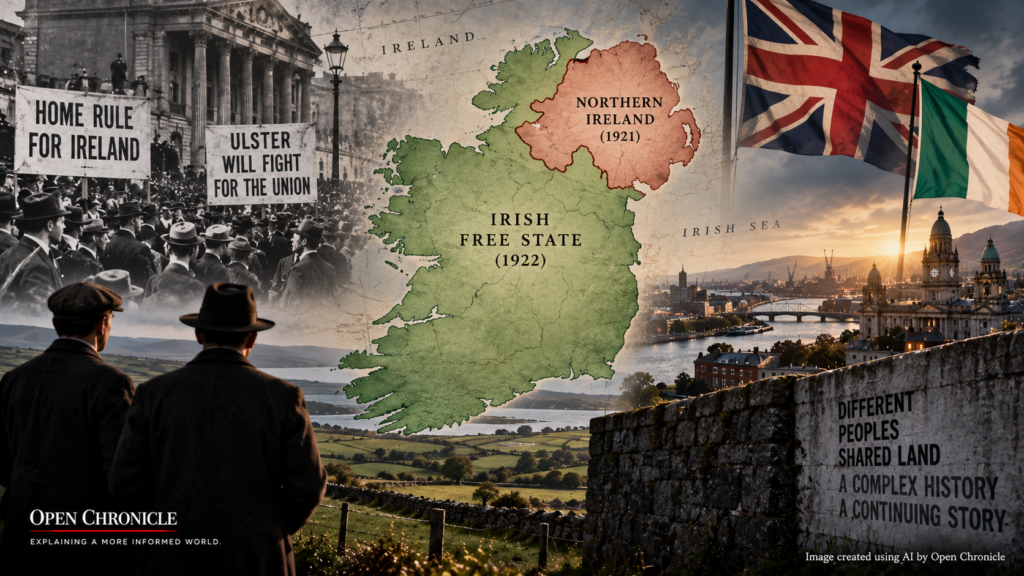
By Open Chronicle Explained
Look at a modern map of Ireland and one political fact immediately stands out.
Most of the island forms the independent Republic of Ireland.
But six counties in the northeast belong to the United Kingdom, forming Northern Ireland.
Why?
The answer cannot be reduced to a simple religious divide or a line drawn arbitrarily across a map.
The partition of Ireland emerged from centuries of English and later British rule, colonisation, competing national identities, religious divisions, industrial development, political mobilisation and ultimately a struggle over whether Ireland should govern itself.
By the early 20th century, two powerful political movements had reached fundamentally incompatible conclusions.
Irish nationalists increasingly wanted self-government — and eventually independence.
Ulster unionists wanted to remain part of the United Kingdom.
Partition became the political compromise that resolved one constitutional struggle while creating another that would shape Ireland for generations.
Ireland Before Partition
For centuries, the relationship between Ireland and England was marked by conquest, rebellion and attempts to impose political control.
English involvement in Ireland stretched back to the medieval period, but British power expanded dramatically during the early modern era.
One development became particularly important for the future of Northern Ireland:
the Plantation of Ulster.
Beginning in the early 17th century, land in Ulster was transferred to settlers, many of them Protestants from England and Scotland.
The plantation transformed parts of the province.
Over time, Ulster developed a substantial Protestant population with strong political, economic and cultural connections to Britain.
Meanwhile, most of Ireland remained overwhelmingly Catholic.
This did not mean that every Protestant was a unionist or every Catholic a nationalist.
But religion, political identity and attitudes toward British rule increasingly overlapped.
That historical pattern would become crucial centuries later.
How Did Ireland Become Part of the United Kingdom?
After the failed Irish Rebellion of 1798, the British government moved toward incorporating Ireland more directly into the British state.
The Acts of Union, which came into force in 1801, abolished the separate Irish Parliament.
Ireland joined Great Britain in the United Kingdom of Great Britain and Ireland.
Irish representatives now sat at Westminster.
But the constitutional question was far from settled.
During the 19th century, movements demanding greater Irish political autonomy grew increasingly powerful.
Eventually, the central demand became known as Home Rule.
What Was Home Rule?
Home Rule did not initially mean complete Irish independence.
It meant creating an Irish parliament responsible for domestic affairs while Ireland remained within the United Kingdom.
For many Irish nationalists, this represented a practical path toward greater self-government.
But opposition was especially strong in Ulster.
Why?
Because many Protestants in the northeast regarded themselves as both Irish and British and strongly supported the union with Great Britain.
They feared that an Irish parliament dominated by nationalists — most of whom were Catholic — could threaten their political position, economic interests and cultural identity.
A famous unionist slogan captured the anxiety:
“Home Rule is Rome Rule.”
The phrase reflected the fear that a self-governing Ireland would be politically influenced by the Catholic Church.
Religion mattered.
But economics, political power, national identity and attachment to Britain mattered too.
Why Was Ulster Different?
Ulster was not politically or religiously uniform.
The historic province contains nine counties, and substantial nationalist and Catholic populations lived throughout it.
Nevertheless, the northeastern part of Ulster had characteristics that distinguished it from much of the rest of Ireland.
Industrialisation was one.
While much of Ireland remained heavily agricultural, Belfast became a major industrial city within the British Empire.
Shipbuilding, linen manufacturing and engineering flourished.
The shipyard Harland & Wolff, where Titanic was built, became one of the world’s most famous industrial enterprises.
The region’s economy was closely integrated with British markets.
For many unionists, remaining within the United Kingdom therefore seemed economically as well as politically important.
But above all, unionism had become a powerful political identity.
When Home Rule appeared increasingly likely, Ulster unionists prepared to resist it.
The Home Rule Crisis
By the early 20th century, the dispute was becoming dangerous.
In 1912, the British government introduced another Home Rule Bill.
Unionist resistance intensified.
Hundreds of thousands signed the Ulster Covenant, pledging opposition to Home Rule.
In 1913, unionists established the Ulster Volunteer Force (UVF).
Weapons were imported.
Irish nationalists responded by forming the Irish Volunteers.
Ireland appeared to be moving toward armed confrontation over its constitutional future.
Then Europe descended into a much larger catastrophe.
How Did the First World War Change Everything?
Home Rule became law in 1914, but its implementation was suspended because of the outbreak of the First World War.
The political landscape changed dramatically during the war.
In April 1916, Irish republicans launched the Easter Rising in Dublin.
The rebellion was militarily defeated within days.
Initially, much of the Irish public had not supported the uprising.
But the British execution of its leaders helped transform public opinion.
Support for more radical Irish nationalism increased.
By the end of the war, the political centre of gravity had shifted.
The question was no longer simply whether Ireland should receive Home Rule.
Increasingly, the question was whether Ireland should become independent.
The 1918 Election
The British general election of December 1918 demonstrated the scale of the transformation.
Sinn Féin, campaigning for Irish independence, won an overwhelming majority of Irish seats outside the unionist strongholds of the northeast.
Its elected MPs refused to take their seats at Westminster.
Instead, they assembled in Dublin in January 1919 and established Dáil Éireann, declaring an independent Irish republic.
At almost the same time, armed conflict began between the Irish Republican Army (IRA) and British forces.
The Irish War of Independence had begun.
Britain now faced a fundamental problem.
Maintaining the existing constitutional arrangement across the entire island was becoming increasingly difficult.
But forcing strongly unionist areas of Ulster into an independent Ireland risked another conflict.
Partition increasingly appeared to British policymakers as a solution.
Why Six Counties?
This is one of the most important questions in understanding Northern Ireland.
Ulster historically contains nine counties:
Antrim, Armagh, Cavan, Donegal, Down, Fermanagh, Londonderry, Monaghan and Tyrone.
Northern Ireland, however, contains only six:
Antrim, Armagh, Down, Fermanagh, Londonderry and Tyrone.
Why were Cavan, Donegal and Monaghan excluded?
Because creating a Northern Ireland from all nine Ulster counties would have produced a much smaller and less secure unionist majority.
A six-county territory provided unionists with a stronger demographic majority while still creating an area large enough to function as a political unit.
But even the six-county solution contained large Catholic and nationalist populations.
In counties such as Fermanagh and Tyrone, nationalists were particularly numerous.
Partition therefore did not neatly separate two populations.
There was no clean geographic line between unionist and nationalist Ireland.
Any border would leave substantial minorities on the “wrong” side from their constitutional perspective.
That reality would have enormous consequences.
The Government of Ireland Act 1920
The legal foundation for partition came through the Government of Ireland Act 1920.
The legislation created two self-governing jurisdictions within the United Kingdom:
Northern Ireland, consisting of six counties.
And Southern Ireland, consisting of the remaining 26 counties.
Both were supposed to have their own parliaments.
Northern Ireland’s institutions took shape.
The Parliament of Northern Ireland opened in 1921.
The arrangements for Southern Ireland effectively failed because the independence struggle had overtaken Britain’s Home Rule solution.
Negotiations between British representatives and Irish nationalist leaders would soon produce a radically different settlement.
The Anglo-Irish Treaty
In December 1921, Britain and representatives of the Irish independence movement signed the Anglo-Irish Treaty.
The treaty established the Irish Free State as a self-governing dominion comprising 26 counties.
But Northern Ireland was given the right to opt out of the new state.
It did so.
The result was the political map whose basic structure survives today:
26 counties governed separately from Britain.
Six counties remaining within the United Kingdom.
Ireland had been partitioned.
Was Partition Supposed to Be Permanent?
The answer is complicated.
Some believed the border might eventually be adjusted.
The Anglo-Irish Treaty provided for a Boundary Commission to examine the frontier between Northern Ireland and the Irish Free State.
Nationalists hoped that areas with nationalist majorities might be transferred to the Free State.
If substantial territory moved south, some believed Northern Ireland might become economically or politically unsustainable.
But the commission did not produce the dramatic territorial changes many nationalists expected.
The existing border was ultimately maintained.
What had initially emerged as part of a political settlement became an enduring international boundary.
What Happened to the Irish Free State?
The Irish Free State gradually loosened its remaining constitutional connections with Britain.
In 1937, a new constitution established the state known as Éire, or Ireland.
In 1949, Ireland formally became a republic and left the British Commonwealth.
Northern Ireland, however, remained within the United Kingdom.
The constitutional divide on the island became even clearer.
But the political disagreement inside Northern Ireland remained unresolved.
What Was Northern Ireland Like After Partition?
Northern Ireland developed its own parliament and government, based at Stormont, while remaining part of the United Kingdom.
Unionists held political power for decades.
The state contained a permanent nationalist minority, many of whom did not accept partition and identified primarily as Irish rather than British.
Catholic and nationalist communities experienced serious discrimination and inequality, particularly in areas such as housing, employment and political representation.
Electoral practices and local government structures also became sources of controversy.
This created a fundamental problem.
Partition had established a territory with a unionist majority.
But it had not resolved the competing national identities within that territory.
The border separated states.
It did not separate peoples.
Did Religion Cause the Division?
Religion is essential to understanding the history — but describing partition simply as Catholics versus Protestants is misleading.
The deeper conflict concerned sovereignty, identity and political power.
Many Protestants were unionists.
Many Catholics were nationalists.
But the categories were never perfectly interchangeable.
The fundamental constitutional disagreement was:
Should Ireland govern itself independently from Britain?
And, once Irish independence became likely:
Should Ulster — or part of Ulster — be required to join an independent Irish state?
Nationalists and unionists answered those questions differently.
Religion reinforced those identities, but it was not the only cause.
Why Didn’t Britain Simply Keep the Whole of Ireland?
By the end of the Irish War of Independence, maintaining direct British rule across the entire island had become increasingly costly politically and militarily.
Irish nationalist demands for independence had enormous popular support across most of the island.
But abandoning unionists in northeastern Ulster was politically unacceptable to Britain and fiercely resisted by the unionists themselves.
Partition offered a compromise.
Britain could reach a settlement with nationalist Ireland while allowing a predominantly unionist region to remain within the United Kingdom.
But compromises can solve one problem by institutionalising another.
That is essentially what happened.
Why Didn’t Northern Ireland Simply Join the Rest of Ireland?
Because a substantial majority of Protestants and unionists in the six counties strongly opposed incorporation into an independent Irish state.
To them, Britain was not simply a foreign power occupying Ireland.
They considered themselves citizens of the United Kingdom.
Their British identity was real.
Their political institutions, economic connections and historical experience were closely connected to Britain.
Forcing them into an Irish state against their will would therefore have violated their own conception of national self-determination.
The Irish problem contained two competing claims to self-determination.
Irish nationalists argued that Ireland as an island constituted one nation.
Ulster unionists argued that they had the right to remain British.
Partition emerged from the collision between those two principles.
From Partition to the Troubles
The contradictions created by partition did not disappear.
Northern Ireland contained two large communities with different national identities and different visions of the territory’s future.
Unionists generally wanted Northern Ireland to remain within the United Kingdom.
Nationalists generally wanted Irish reunification.
During the 1960s, a civil-rights movement challenged discrimination against Catholics.
Protests, riots and communal violence escalated.
British troops were deployed in 1969.
What followed became known as the Troubles.
For approximately three decades, republican paramilitaries, loyalist paramilitaries and state security forces were involved in a conflict that killed more than 3,500 people.
The constitutional question created by partition had become inseparable from a violent political conflict.
How Did the Good Friday Agreement Change the Question?
The 1998 Belfast Agreement, commonly known as the Good Friday Agreement, did not abolish Northern Ireland or end the possibility of Irish reunification.
Instead, it transformed the rules surrounding the constitutional question.
Northern Ireland would remain within the United Kingdom for as long as a majority of its people wanted that arrangement.
But if a majority someday supported a united Ireland, a peaceful democratic route to constitutional change would exist.
This is known as the principle of consent.
It was an extraordinarily important compromise.
Unionists received recognition that Northern Ireland could not simply be transferred to Irish sovereignty against the wishes of its population.
Nationalists received recognition that the border was not immutable and that Irish unity remained a legitimate political objective.
The constitutional conflict remained.
The method for resolving it changed.
Could Ireland Be Reunified?
Yes.
The possibility is explicitly recognised within the political settlement established by the Good Friday Agreement.
If sufficient evidence emerged that a majority in Northern Ireland was likely to support reunification, the British government could call a referendum commonly described as a border poll.
A corresponding democratic process would also be necessary in Ireland.
Brexit, demographic developments and changing electoral patterns have intensified discussion about whether such a referendum might eventually take place.
But Northern Ireland’s future is not predetermined.
The central principle of the modern settlement is that its constitutional status depends upon democratic consent.
Why Does Partition Still Matter Today?
Because many of Northern Ireland’s contemporary political debates ultimately return to the settlement created a century ago.
Arguments over British and Irish identity.
Debates over flags and symbols.
Power-sharing at Stormont.
Relations with Dublin.
The effects of Brexit.
The Northern Ireland Protocol and Windsor Framework.
Calls for a border poll.
Debates about Irish reunification.
All are connected, directly or indirectly, to the constitutional question partition attempted to manage.
Understanding Northern Ireland today therefore requires understanding why the border exists in the first place.
What? How? Why?
What was the partition of Ireland?
The political division of the island in the early 1920s into a six-county Northern Ireland that remained within the United Kingdom and a 26-county territory that became the Irish Free State and eventually today’s Republic of Ireland.
How did it happen?
Partition emerged from the collision between Irish nationalism and Ulster unionism during the struggle over Home Rule and Irish independence. British legislation created Northern Ireland in 1920, while the Anglo-Irish Treaty of 1921 established the political framework through which the rest of Ireland separated from the United Kingdom.
Why were only six counties included in Northern Ireland?
Because a six-county territory provided a substantially stronger unionist majority than including all nine counties of historic Ulster.
Why does it still matter?
Because partition created the constitutional framework within which Northern Ireland still exists — and the competing British and Irish identities that made partition controversial remain central to its politics.
The border across Ireland therefore represents far more than geography.
It is the physical expression of a question that generations of politicians, activists and communities struggled to answer:
Who should govern Ireland — and who gets to decide?
Partition produced one answer in the early 20th century.
The Good Friday Agreement eventually produced a different principle for the future.
The answer should not be imposed by force.
It should be decided by consent.
Continue the Explanation
What Is the Good Friday Agreement — and How Did It Help End the Troubles?
The 1998 settlement created a new framework for power-sharing, British-Irish cooperation and the peaceful democratic determination of Northern Ireland’s constitutional future.
Read the Good Friday Agreement Explainer →
Open Chronicle Explained
What? How? Why?
Understand how the world works.
Understanding the systems behind the headlines.
Explore Open Chronicle Explained →