
By Open Chronicle with agencies
US President Donald Trump has unexpectedly thrown his support behind the idea of a united Ireland, saying during a visit to Dublin that he believes reunification of the island will happen eventually.
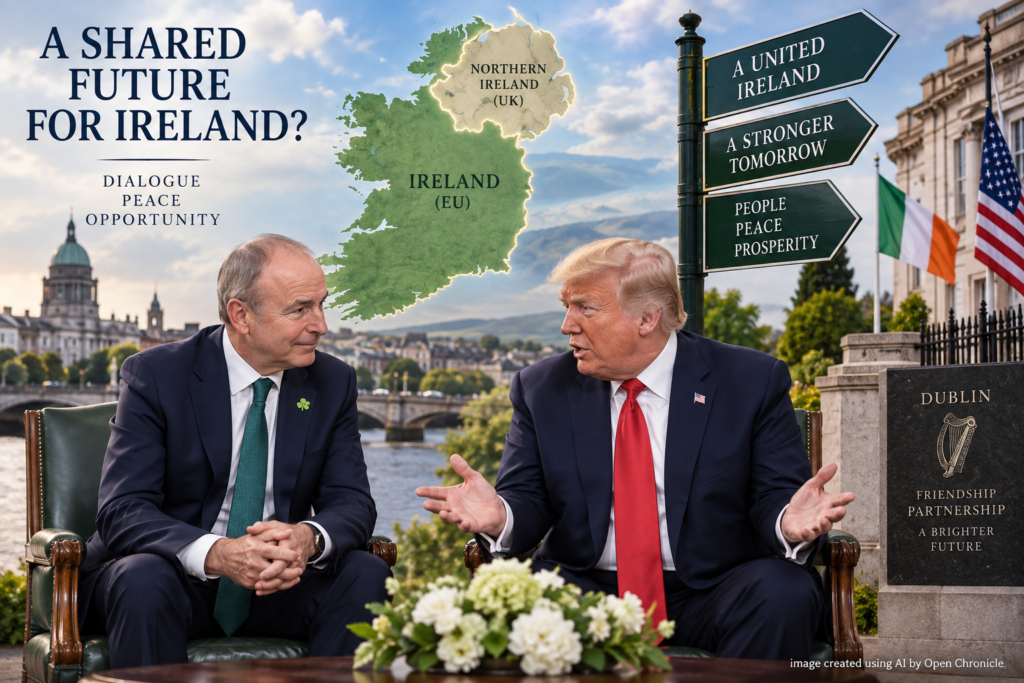
Sitting alongside Taoiseach Micheál Martin on Saturday, Trump said he would welcome Northern Ireland joining the Republic of Ireland, while acknowledging that the United Kingdom would have a decisive interest in any change to the region’s constitutional status.
“I’d love to see it unified. I think it’d be great,” Trump said. “It’s going to happen eventually.”
The comments immediately reopened one of the most sensitive questions in Irish and British politics and prompted a sharp response from Northern Ireland’s largest unionist party.
Trump makes unexpected intervention
Trump made the remarks after arriving in Ireland for a two day visit that combines political engagements with a trip to his golf resort in Doonbeg, County Clare.
Speaking beside Martin, the US president questioned why Northern Ireland had remained separate from the Republic more than a century after most of Ireland gained independence from Britain.
“A great feather in everybody’s cap if that happened,” Trump said.
Gesturing toward Martin, Trump added: “You’ve got the right man over here to get it moving.”
He nevertheless acknowledged the constitutional complexity of the issue.
“The U.K. will have something to say about it obviously. But I think it’d be a great thing. How can it be bad?”
For an American president to express such an explicit preference is politically significant because the United States has historically played an important role in supporting Northern Ireland’s peace process.
Good Friday Agreement puts decision in voters’ hands
Northern Ireland’s constitutional status was at the heart of decades of conflict known as the Troubles, during which nearly 3,700 people were killed.
The 1998 Good Friday Agreement largely brought that conflict to an end and established the principle that Northern Ireland remains part of the United Kingdom for as long as a majority of its population wishes it to do so.
The agreement also provides a democratic route through which constitutional change could take place if sufficient support for Irish reunification emerges.
That principle of consent remains fundamental to the peace settlement.
Trump’s prediction that reunification will eventually occur therefore does not itself change Northern Ireland’s status or the constitutional mechanisms governing any future referendum.
DUP rejects Trump’s comments
The reaction from unionism was immediate.
Democratic Unionist Party leader Gavin Robinson rejected the suggestion that Northern Ireland was inevitably moving toward reunification.
“President Trump knows better than most that elections matter,” Robinson said.
“Northern Ireland is part of the United Kingdom because that is the settled democratic will of its people.”
Robinson added that unionists were “not interested in the destruction of our country by joining with the Irish Republic.”
The intervention is particularly striking because elements within Northern Ireland’s unionist community have previously expressed support for Trump and his MAGA political movement.
His remarks therefore place some of his political admirers in Northern Ireland in direct disagreement with him over the issue that defines unionist politics.
Demographic and political landscape has changed
The debate over Northern Ireland’s future has become increasingly prominent in recent years.
The traditional Protestant unionist majority has declined, while Irish nationalist parties have increased their political influence.
Sinn Féin’s emergence as a major political force on both sides of the border has also intensified discussion about whether and when a referendum on reunification should be held.
Brexit added another dimension to the debate.
The United Kingdom’s departure from the European Union created new economic and political complications for Northern Ireland, which shares a land border with the Republic, an EU member.
Post Brexit trading arrangements have left Northern Ireland with distinctive access to both British and European markets, while simultaneously generating fierce disputes among unionists over the region’s place within the United Kingdom.
Irish nationalists have argued that these changes strengthen the case for eventually holding a referendum on reunification.
Martin has taken a more cautious approach
Trump’s remarks also placed Micheál Martin in a delicate position.
The Taoiseach supports the long term aspiration of Irish unity, as have successive Irish governments, but has generally emphasized reconciliation, cooperation and the need to build relationships across Northern Ireland’s political traditions.
Dublin has been particularly careful about avoiding the impression that constitutional change could simply be imposed on Northern Ireland’s unionist population.
Trump’s suggestion that Martin was the person who could “get it moving” therefore went considerably further than the cautious language normally associated with the Irish government’s approach.
Any future change would have to take place within the democratic framework established by the Good Friday Agreement.
Trump knew his remarks would make headlines
Later in the day, Trump returned to the subject during an appearance at the residence of US Ambassador to Ireland Edward Walsh.
Addressing an audience that included political leaders and prominent business figures, Trump acknowledged that his comments were likely to attract considerable attention.
He said he had told journalists that a united Ireland would “be a very cool thing.”
“I gave a nice answer, I think. We’ll read about it tomorrow,” Trump told the audience, prompting laughter.
“There’s no good answer, right?” he added.
The remark suggested Trump was well aware of the political sensitivity surrounding the issue.
Washington has a unique role in Northern Ireland
The United States occupies an unusual position in the history of the Northern Ireland peace process.
Washington played an important diplomatic role in the negotiations that ultimately produced the Good Friday Agreement, with the administration of President Bill Clinton closely involved in efforts to bring the opposing sides together.
Successive American administrations have since supported the agreement and emphasized that Northern Ireland’s constitutional future must be determined peacefully and democratically.
Trump’s intervention is therefore likely to receive close attention not only in Dublin and Belfast but also in London.
His comments express a personal preference for reunification rather than announcing a formal change in US policy.
That distinction will be important as governments assess the significance of his remarks.
A question that continues to shape Ireland
More than a century after partition and almost three decades after the Good Friday Agreement, the constitutional future of Northern Ireland remains one of the island’s defining political questions.
Unionists maintain that Northern Ireland’s future belongs within the United Kingdom. Nationalists increasingly argue that changing demographics, Brexit and closer economic integration across the island strengthen the case for reunification.
The Good Friday Agreement provides the framework through which that disagreement can be resolved democratically.
Trump’s declaration does not alter that framework, but it has injected the sitting US president directly into a debate that political leaders in Ireland, Northern Ireland and Britain normally approach with considerable caution.
His prediction was unusually unequivocal.
For Trump, Irish reunification is not simply a possibility. He told his hosts that he believes it will eventually happen.