
By Open Chronicle with agencies
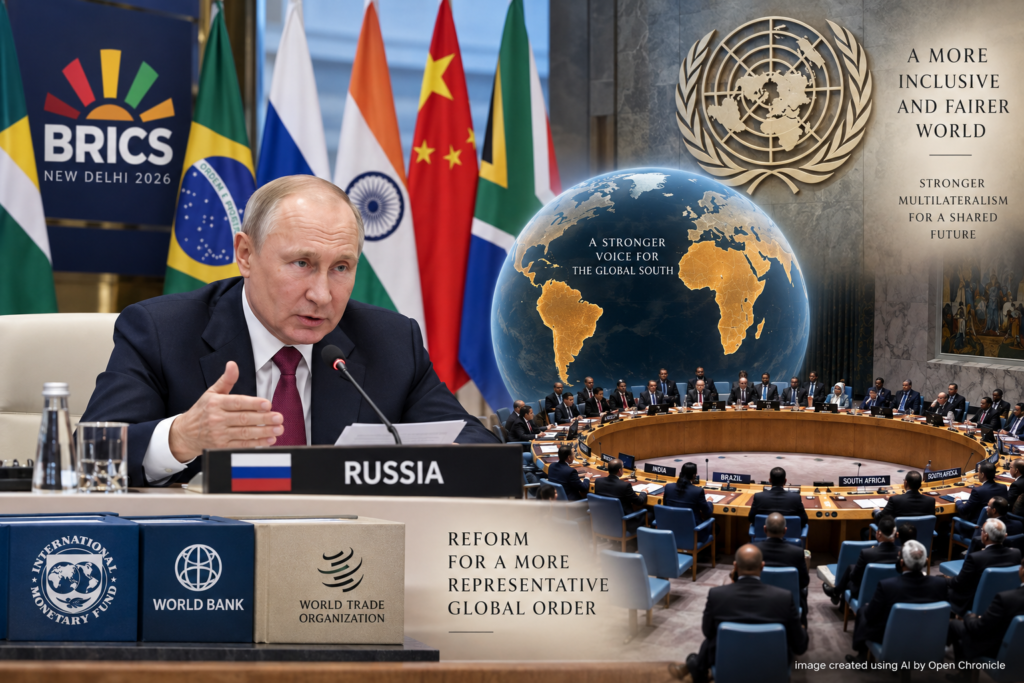
Russian President Vladimir Putin has called for an expansion of the United Nations Security Council to give countries from Asia, Africa and Latin America greater representation, arguing that international institutions must adapt to the emergence of a more multipolar world.
Speaking on Saturday at the 18th BRICS summit in New Delhi, Putin said Russia remained committed to preserving the United Nations as the central institution of international affairs but argued that reforms were necessary to make its structures more representative.
He also called for changes to major global economic institutions, including the International Monetary Fund, World Bank and World Trade Organization, saying their structures need to reflect shifting economic and political realities.
Putin backs wider Security Council representation
Putin told BRICS leaders that expanding the Security Council could strengthen the effectiveness and legitimacy of the United Nations.
“Expanding the UN Security Council, specifically by increasing representation for countries in Asia, Africa, and Latin America, would contribute to this goal,” Putin said, according to a Kremlin transcript of his remarks.
The Security Council currently has 15 members. Five countries, China, France, Russia, the United Kingdom and the United States, hold permanent seats and veto powers, while the remaining ten seats are allocated to members elected for limited terms.
Putin’s proposal focused on increasing representation for regions that Moscow argues remain underrepresented in the existing international system.
The Russian president did not, in the information provided, set out a detailed formula for how additional seats should be allocated or specify which countries should receive permanent representation.
BRICS seeks stronger voice in global governance
Putin presented reform of the UN as part of a broader transformation of international politics.
He argued that BRICS has become one of the principal centers of global governance, with its members increasingly influencing international politics, security, economic cooperation and humanitarian affairs.
According to Putin, the grouping’s intellectual and technological capabilities represent one of its major strengths.
As the international system moves toward what Moscow describes as a multipolar order, Putin said BRICS members should cooperate to strengthen multilateral institutions and increase the participation of developing countries in global decision making.
The argument reflects one of the central themes emerging from the New Delhi summit: that the growing economic and demographic weight of the Global South should be accompanied by greater political influence.
IMF, World Bank and WTO also targeted for reform
Putin extended his call for institutional reform beyond the United Nations.
He said there was a “long standing need” to improve the IMF, World Bank and WTO, arguing that the institutions were struggling to adapt to contemporary political and economic realities.
Despite his criticism, Putin did not dismiss their importance.
Instead, he described them as significant channels for dialogue among the world’s major economies and called for BRICS countries to coordinate their positions more closely within them.
That approach suggests Moscow wants BRICS not simply to develop alternatives to institutions historically shaped by Western powers, but also to increase the bloc’s collective influence within the existing international architecture.
Russia frames changes as part of multipolar order
Putin said the emergence of a multipolar international system was encountering resistance.
He accused countries accustomed to dominating global institutions of attempting to contain rising competitors through tariffs, sanctions and force.
The Russian president described this resistance in explicitly anti colonial terms, arguing that some powers continued to view the world through a hierarchy separating prosperous states from countries expected to remain subordinate.
His remarks reflect a theme Russia has increasingly used in its diplomatic outreach across Africa, Asia and Latin America.
Moscow presents BRICS and other non Western forums as instruments through which developing countries can obtain greater influence over international decisions.
Russia’s own actions and interpretation of the international order remain deeply contested, particularly because of its war against Ukraine, which has generated widespread condemnation and sanctions from Western governments and other countries.
Security Council reform remains difficult
Calls to reform the UN Security Council are not new.
For decades, governments have debated whether its permanent membership accurately reflects the balance of political, demographic and economic power in the modern world.
The institution’s structure largely reflects the international order that emerged from the Second World War.
Countries including India, Brazil, Germany and Japan have sought permanent membership, while African governments have repeatedly argued that their continent deserves permanent representation.
Yet agreement on reform has remained elusive because governments differ over which countries should receive new seats, whether additional members should have veto powers and how regional representation should be structured.
Any significant restructuring would therefore require extensive international negotiations.
New Delhi puts Global South at center of BRICS agenda
Putin’s intervention follows similar calls at the summit for BRICS to assume greater responsibility in international affairs.
Chinese President Xi Jinping has urged members to play a larger diplomatic role in the Middle East while promoting greater influence for emerging economies in global governance.
Together, the statements underline BRICS’ ambition to move beyond its origins as an economic grouping and become a more influential political platform.
For Russia, expanding representation for Asia, Africa and Latin America is part of that wider project.
Putin argued that the growing influence of emerging economies should ultimately be reflected in the institutions responsible for managing international security, finance and trade.
Whether BRICS can translate that ambition into institutional reform remains uncertain. But the New Delhi summit is reinforcing a message shared by several of its most powerful members: the global institutions created in the previous century are facing growing pressure to reflect the distribution of power in the twenty first.