
By Open Chronicle with agencies
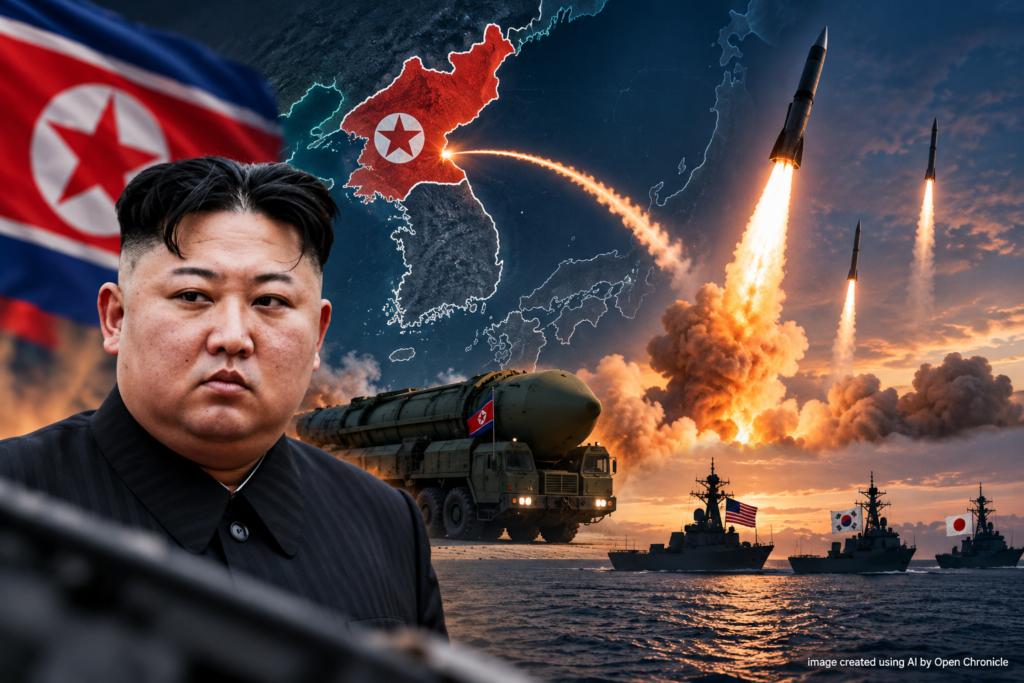
North Korea fired several ballistic missiles into the sea off its eastern coast on Saturday, adding fresh tension to the Korean Peninsula just one day after the United States, South Korea and Japan completed a five day series of joint maritime exercises.
South Korea’s Joint Chiefs of Staff said the missiles were launched from an area near the eastern coastal city of Wonsan at approximately 5:20 a.m. local time. The projectiles travelled around 250 kilometres before falling into waters off North Korea’s east coast.
Following the launches, South Korea increased its surveillance posture and began exchanging information with the United States and Japan as military authorities assessed the trajectory and characteristics of the missiles.
Emergency security meeting in Seoul
South Korea’s presidential National Security Office convened an emergency meeting involving officials from the Defence Ministry, Joint Chiefs of Staff and other relevant government agencies.
The United States Pacific Command said the launches did not represent an immediate threat to US territory or American allies, while reiterating Washington’s commitment to the defence of South Korea and other regional partners.
The latest launches nevertheless highlight the continuing cycle of military exercises, warnings and weapons demonstrations that has kept security tensions elevated across Northeast Asia.
Launch follows major trilateral exercises
The missile launches came a day after South Korea, the United States and Japan completed five days of joint maritime exercises.
The drills were focused in part on strengthening cooperation between the three countries in responding to potential North Korean threats.
Pyongyang had already condemned the exercises. North Korean Defence Minister Kim Song Gi warned after the drills began that his country was prepared to take what he described as strong countermeasures.
North Korea has repeatedly portrayed US and South Korean military exercises as rehearsals for an invasion, an accusation rejected by Washington and Seoul, which describe the drills as defensive.
Pyongyang has frequently responded to major exercises with missile tests, military manoeuvres or increasingly confrontational statements.
North Korea had also criticised plans for the Freedom Edge exercises in international waters off South Korea, describing the activity as a threat to the country and to regional security.
Another missile demonstration after August launch
Saturday’s launches follow another North Korean missile demonstration on August 20, when Pyongyang fired a barrage of missiles into the sea.
That launch occurred while the United States and South Korea were conducting a reduced version of their annual Ulchi Freedom Shield exercises.
The exercises had been scaled back after US President Donald Trump described the drills as inappropriate and hostile toward North Korea, part of his broader effort to reopen diplomatic channels with Pyongyang.
Trump has said he intends to meet North Korean leader Kim Jong Un this year, although no summit has yet been formally announced.
The possibility of renewed diplomacy has therefore developed alongside continued military activity on the peninsula, with North Korea showing little indication that it intends to suspend its missile programme while negotiations remain uncertain.
A persistent security challenge
The latest launches demonstrate the difficulty of reducing military tensions while North Korea continues developing its missile capabilities and the United States maintains extensive security commitments to South Korea and Japan.
Washington, Seoul and Tokyo have increasingly expanded their ability to share missile warning information and coordinate military responses, while Pyongyang has portrayed that growing trilateral cooperation as evidence of an emerging military bloc directed against it.
Saturday’s missile launches are likely to reinforce calls in Seoul and Tokyo for continued surveillance and defence cooperation, even as Washington explores whether another diplomatic opening with Kim Jong Un remains possible.
For now, the Korean Peninsula remains caught between those competing approaches, with diplomacy being discussed while military preparations continue on both sides.