
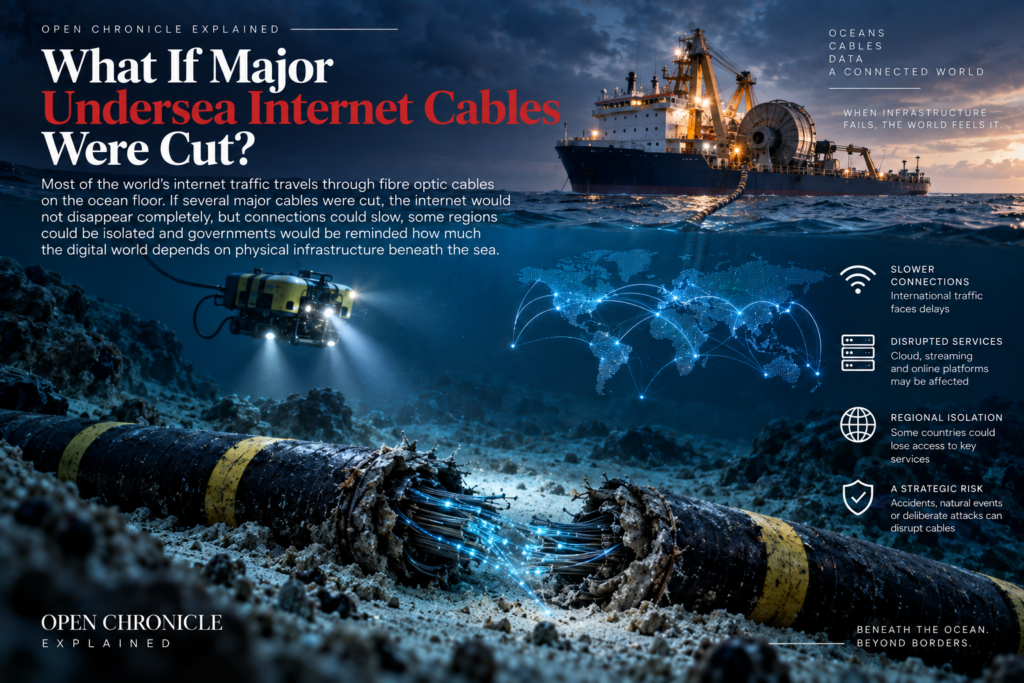
By Open Chronicle Explained
Imagine opening your laptop one morning and noticing that websites are loading more slowly than usual.
Video calls begin freezing.
Cloud services struggle.
International payment systems report delays.
Companies that rely on data centres overseas experience interruptions.
Some regions lose access to services hosted abroad.
Telecommunications companies announce that several submarine cables have been damaged.
Then the news becomes more serious.
It is not one cable.
It is several.
And they were cut almost simultaneously.
What happens now?
The answer is more complicated than saying that the internet would simply switch off.
The internet was designed to route around failures.
But resilience has limits.
The more important question is this:
How much redundancy exists, and where?
First, what are undersea internet cables?
Submarine cables are physical fibre optic cables laid across the seabed.
They connect continents.
They connect islands.
They connect major data centres and telecommunications hubs.
Inside these cables, information travels as pulses of light through extremely thin strands of glass.
Emails.
Financial transactions.
Video calls.
Cloud computing.
Streaming.
Corporate data.
Government communications.
Much of the international internet depends on these cables.
Satellites play important roles, particularly in remote regions and specialized communications.
But the vast majority of intercontinental data traffic travels through undersea fibre optic networks.
Why are cables used instead of satellites?
Capacity and latency.
Fibre optic cables can carry extraordinary amounts of data.
Light travelling through fibre provides fast, stable connections suitable for enormous volumes of traffic.
Satellites can be useful where cables are impractical.
Modern low Earth orbit satellite networks have dramatically improved satellite internet.
But undersea fibre remains the backbone of global digital connectivity.
A single cable system can carry huge volumes of international traffic.
That makes cables efficient.
It also makes them strategically important.
Where are these cables?
They cross most major oceans and seas.
Dense networks connect North America and Europe.
Others connect Europe with Africa and Asia.
Multiple routes cross the Pacific.
Cables run through the Mediterranean, Red Sea, Indian Ocean, Atlantic and other important corridors.
They usually come ashore at cable landing stations.
These stations connect submarine infrastructure to terrestrial telecommunications networks.
From there, data continues through fibre networks toward cities, data centres and users.
The internet may feel wireless.
At the global level, it is deeply physical.
What could cut a submarine cable?
Many things.
Fishing activity can damage cables.
Ships can drag anchors across the seabed.
Underwater landslides and earthquakes can break them.
Equipment can fail.
Construction activity can create accidents.
Deliberate sabotage is also possible.
Most cable faults are not dramatic attacks.
They are ordinary infrastructure failures.
But a coordinated loss of several major cables would create a very different problem.
What happens when one cable breaks?
Usually, most users notice little or nothing.
Telecommunications networks reroute traffic through other cables.
Internet routing protocols are designed to find alternative paths.
Operators can shift capacity.
Traffic can travel through different countries or across different cable systems.
Repair ships are dispatched.
Eventually, the damaged cable is located, lifted from the seabed and repaired.
This happens more often than many people realize.
The system survives because redundancy exists.
So why would several cuts matter?
Because redundancy is not infinite.
Imagine a motorway network.
If one motorway closes, traffic can use another route.
If three major motorways close simultaneously, the remaining roads become congested.
Travel still happens.
It just becomes slower and less reliable.
The same principle applies to data networks.
If several high capacity submarine cables fail at once, remaining routes must carry more traffic.
Connections may experience congestion.
Latency can increase.
Some networks may have insufficient alternative capacity.
Remote or poorly connected regions may be particularly vulnerable.
Would the entire internet go offline?
No.
The internet is not a single cable.
It is a network of networks.
Domestic internet services within a country could continue even if some international connections failed.
Websites hosted locally might still work.
Local communications could continue.
Data centres inside the country could remain accessible.
The disruption would be most serious for traffic needing to cross affected international routes.
The result would likely be uneven.
Some countries might experience modest slowdowns.
Others could experience severe disruption.
A few highly dependent locations could become almost digitally isolated.
What happens to websites?
It depends on where they are hosted.
Suppose you are in Europe and a website’s servers are also in Europe.
A transatlantic cable failure may have little direct effect.
But if the service relies on servers or databases in North America, the traffic needs an alternative route.
Cloud services are often distributed across multiple regions.
Large technology companies deliberately build redundancy into their infrastructure.
But smaller companies may depend on fewer data centres and fewer network providers.
The internet would therefore become less predictable.
Some services would continue normally.
Others would slow.
Some might temporarily fail.
What happens to cloud computing?
This could become important very quickly.
Modern businesses store enormous amounts of data in cloud platforms.
Applications may run in data centres located in different countries.
Companies frequently synchronize information across regions.
A major cable disruption could reduce available bandwidth between those regions.
Cloud providers would attempt to reroute traffic.
Applications designed for geographic redundancy could switch operations to alternative regions.
But synchronization might slow.
Backups could take longer.
Some services could experience outages.
Businesses might discover that “the cloud” ultimately depends on physical cables.
What about banks and financial markets?
Financial institutions rely on fast and reliable communications.
Banks send transaction information across borders.
Financial exchanges connect participants around the world.
Payment networks process international activity.
Trading firms care deeply about latency.
A major cable disruption would not automatically stop global finance.
Financial networks use redundancy and dedicated connections.
But delays and route changes could matter.
Some transactions could be rerouted.
Some systems might temporarily limit activity.
Financial institutions would prioritize continuity and secure alternative communications.
Markets could also react to uncertainty surrounding the cause and duration of the disruption.
Would credit cards still work?
Most domestic card payments would likely continue.
A local payment does not necessarily require traffic to cross an ocean.
But international payment processing could face delays depending on network architecture.
Some merchants and payment providers rely on services hosted abroad.
If those services became difficult to reach, individual transactions could fail.
Again, the impact would vary.
The internet does not fail everywhere in the same way.
Infrastructure architecture determines who feels the disruption.
What happens to mobile phones?
Ordinary voice calls within domestic networks could continue.
Mobile networks themselves would not simply disappear because an undersea cable was cut.
But international calls, roaming services and internet traffic could be affected.
Mobile applications depending on foreign servers might slow or fail.
Telecommunications operators would reroute traffic wherever possible.
Users might notice congestion rather than total loss of service.
The mobile tower beside your house could still work perfectly while the international network beyond it was under pressure.
What about streaming services?
They could perform surprisingly well in some places.
Large streaming companies use content delivery networks.
Popular films, television programmes and other content can be stored in data centres closer to users.
That reduces the need for every stream to travel across an ocean.
If a copy of the content already exists in your region, playback could continue.
But account systems, recommendations, authentication and other services may still depend on international infrastructure.
Less popular content hosted elsewhere could become harder to access.
The architecture of modern streaming platforms is partly designed to reduce exactly this kind of dependency.
Could social media disappear?
Probably not completely.
Major platforms operate globally distributed infrastructure.
They often have data centres and caching systems across multiple regions.
But uploads, synchronization and communication between regions could slow.
Users in different continents might experience different versions of the disruption.
A local social network service could remain available while communication with another region deteriorated.
The global internet might begin feeling more fragmented.
What happens to businesses?
Many companies would quickly discover how international their digital operations had become.
A business in Portugal might use email hosted in one country.
Accounting software hosted in another.
Customer relationship software in another.
Cloud storage elsewhere.
Payment services somewhere else.
Video conferencing from another provider.
Every service depends on network paths.
If those paths become congested or unavailable, operations can slow even if the company’s own office connection remains online.
Digital globalization means a local business can depend on infrastructure thousands of kilometres away without realizing it.
What about hospitals?
Hospitals increasingly depend on digital systems.
Medical records.
Imaging.
Cloud platforms.
Laboratory systems.
Remote consultation.
Supply management.
Many critical systems are designed to operate locally if external connections fail.
Hospitals also maintain emergency procedures.
But access to external services could become more difficult.
Telemedicine with overseas specialists could be disrupted.
Cloud based systems might slow.
The healthcare sector would prioritize local continuity while waiting for international connectivity to stabilize.
Governments would become very interested very quickly
The first question would be technical.
Which cables failed?
Where?
How much capacity was lost?
Then the security questions would begin.
Was it an accident?
A natural disaster?
Multiple unrelated failures?
Or deliberate action?
Governments would work with telecommunications companies, cable operators, navies, intelligence services and allies.
Undersea infrastructure is increasingly regarded as critical infrastructure.
Several simultaneous failures would therefore become both a telecommunications emergency and a national security issue.
How would anyone know whether it was sabotage?
That can be difficult.
A broken cable itself does not reveal intent.
Investigators would examine the location and nature of damage.
Ship tracking data could be reviewed.
Nearby vessel activity could be studied.
Seabed conditions would matter.
Other incidents in the same period would be compared.
Intelligence information might contribute.
A single damaged cable near an anchorage could have an obvious accidental explanation.
Several unrelated cables damaged in strategically important areas within hours would raise very different questions.
Attribution could take time.
Why would attribution matter?
Because the response depends on the cause.
An accident requires repair.
A natural disaster requires resilience and rerouting.
Deliberate sabotage could trigger diplomatic, economic or even military consequences.
Governments would need strong evidence before blaming another state.
This creates a dangerous period of uncertainty.
The infrastructure failure is visible immediately.
The political explanation may not be.
Could internet traffic use satellites instead?
Some of it could.
Satellite internet networks provide an increasingly useful backup.
Low Earth orbit systems can deliver significant capacity.
Governments, companies and emergency services could prioritize satellite connections.
But current satellite networks cannot instantly replace the total capacity of the global submarine cable system.
Think of satellites as an important alternative route.
Not a perfect replacement for every fibre cable under the ocean.
Capacity matters.
Could traffic simply go the long way around?
Yes, sometimes.
If a direct Atlantic route failed, data might travel through another geographic path.
But longer routes increase latency.
They also consume capacity on networks that may already be busy.
Imagine traffic between two European and American cities being forced through a much less direct route.
The connection can still exist.
But it becomes slower and potentially more expensive.
Routing around damage is one of the internet’s strengths.
Physical geography still imposes costs.
Why does latency matter?
Latency is the time it takes information to travel from one point to another and back.
For ordinary web browsing, small increases may be barely noticeable.
For video calls, they can become annoying.
For online gaming, they can be significant.
For some financial trading systems, even tiny delays matter.
For remote control systems, industrial applications and interactive cloud services, latency can affect performance.
A cable outage therefore does not need to disconnect a user completely to have economic consequences.
Making everything slightly slower can matter at enormous scale.
What happens to data centres?
Data centres themselves would continue running if they retained electricity and local network connections.
But their links to other data centres could be affected.
Major cloud providers connect facilities using extensive private fibre networks as well as public telecommunications infrastructure.
If several routes disappeared, workloads might be shifted.
Traffic management systems would attempt to balance capacity.
Some data centres could temporarily become harder to reach from particular regions.
The buildings would still operate.
Their position inside the global network would have changed.
What happens after six hours?
By now, network operators would have a clearer picture of the damage.
Traffic engineers would reroute connections.
Large companies would activate continuity plans.
Governments would coordinate with cable operators.
Telecommunications providers might prioritize critical traffic.
Some users would experience slow connections.
Others might face complete loss of certain international services.
News reports would likely exaggerate some effects and underestimate others.
The phrase “internet blackout” might appear even though much of the internet remained operational.
What happens after one day?
Congestion could become more noticeable.
Businesses would begin adapting.
Companies might shift workloads into local data centres.
Satellite backup systems could be activated more widely.
Some cloud services might temporarily restrict nonessential activity.
Repair ships would be mobilized.
Governments would investigate the causes.
Markets might react if the disruption affected major commercial regions.
The question would increasingly become:
How long until the cables can be repaired?
How are submarine cables repaired?
Repairing a cable is difficult but routine engineering.
Operators first identify the approximate location of the fault.
A specialized cable repair ship travels to the area.
Equipment is used to locate and recover the damaged cable from the seabed.
The broken section is brought aboard.
Engineers splice the fibre.
The repaired cable is tested.
Then it is returned to the seabed.
Weather and water depth can complicate operations.
Repairing multiple damaged cables could take much longer because specialized ships are limited in number.
What if the cuts happened in very deep water?
Repairs would become more difficult.
Cables crossing deep oceans can lie kilometres below the surface.
Specialized grappling and remotely operated equipment may be required.
Operations can be slow.
The number of ships capable of conducting repair work is finite.
If many systems were damaged simultaneously, operators would have to prioritize.
Which cable should be repaired first?
Which route serves the most critical traffic?
Which regions have the fewest alternatives?
A technical repair problem could become a strategic allocation problem.
Islands could face much greater risks
Large continental countries often have multiple cable routes and terrestrial links.
Islands can be more dependent on a limited number of submarine systems.
If all cables serving a small island state were damaged, satellite communications might become the primary international connection.
Bandwidth could fall dramatically.
Government services, banking, tourism and businesses could all be affected.
This is why redundancy is especially important for geographically isolated countries.
For them, submarine cables are not just another part of the internet.
They are the bridge to the rest of the digital world.
Could entire countries be disconnected?
Yes, in unusual circumstances.
Countries connected through only a few international cable systems are more vulnerable than major telecommunications hubs with many routes.
If every significant international cable serving a country failed, outside connectivity could be severely reduced.
Satellite connections could provide emergency capacity.
Domestic networks might still function.
But the country could effectively become a digital island.
This has happened temporarily in various forms after major cable disruptions.
What about military communications?
Military organizations use many different communication systems.
Secure satellite communications.
Radio.
Dedicated fibre.
Terrestrial networks.
Submarine infrastructure.
They plan for disrupted communications because conflict can target infrastructure.
A major civilian cable outage would still matter.
Commercial networks support government and defence activity indirectly.
But militaries with mature resilience planning would attempt to switch to independent or protected systems.
The broader strategic concern would be whether the cable failures represented the beginning of a wider attack.
Why are cables difficult to protect?
Because there are thousands of kilometres of them.
They cross enormous areas of seabed.
Patrolling every metre is impossible.
Near coastlines, cables can be buried for protection.
Landing stations can be secured.
Governments can monitor suspicious vessel activity.
Navies can patrol critical areas.
Sensors can be deployed.
But complete protection is unrealistic.
Resilience therefore depends heavily on redundancy.
If one route fails, another must exist.
Are cable landing stations vulnerabilities too?
Yes.
A cable does not become useful simply by reaching land.
It must connect through landing infrastructure.
These stations can concentrate important network connections.
A region may have several cables arriving within a relatively small geographic area.
That creates efficiency.
It can also create concentration risk.
Protecting the ocean route while ignoring the landing point would make little sense.
Infrastructure resilience requires thinking about the entire system.
Cable.
Landing station.
Terrestrial fibre.
Data centres.
Electricity.
Network operators.
All of them matter.
What could governments do during a major disruption?
They could coordinate network operators.
Prioritize communications for emergency services and critical infrastructure.
Increase satellite capacity.
Share connectivity with neighbouring countries.
Protect remaining cable routes.
Investigate suspicious maritime activity.
Accelerate repair permits and operations.
Coordinate with allies.
Provide public information.
Governments might also ask companies to temporarily reduce nonessential traffic if capacity became severely constrained.
The objective would be to preserve critical services until physical infrastructure could be restored.
Could companies prepare for this?
Yes.
Businesses can host services in multiple geographic regions.
They can use more than one telecommunications provider.
Critical data can be replicated.
Offline procedures can be maintained.
Satellite backup can be installed for essential sites.
Local copies of important information can reduce dependence on cloud access.
The principle is simple.
Do not assume that one connection will always exist.
The difficulty is cost.
Redundancy can look unnecessary until the day it becomes essential.
What would happen after one week?
By now, repairs would probably be underway.
Traffic patterns would have stabilized around remaining routes.
Large organizations would have adapted.
Users might become accustomed to slower international services.
Some companies could experience significant economic losses.
Regions with poor redundancy might still face serious connectivity problems.
International investigations could intensify if sabotage were suspected.
Insurance claims would grow.
The political importance of submarine cables would suddenly become obvious to the public.
Could this trigger a global economic crisis?
Several cable cuts alone would probably not cause a global economic collapse.
The internet is highly redundant.
Major economies have multiple routes.
Technology companies maintain distributed infrastructure.
Networks can adapt.
But the economic effect could become serious if enough critical routes were disrupted for long enough.
The greater danger would be a cable attack occurring as part of a broader crisis.
Imagine simultaneous cyberattacks.
Energy disruptions.
Satellite interference.
Financial instability.
A cable failure that is manageable alone becomes much more dangerous when combined with other shocks.
Resilience must therefore be assessed at the system level.
Would the internet become more national?
Possibly, at least temporarily.
Services hosted locally would become more valuable.
Countries with strong domestic data centre infrastructure could maintain more digital activity internally.
Governments might reconsider dependence on foreign cloud services.
Companies could begin storing more data closer to users.
Investment in terrestrial routes and new submarine cables could increase.
A major disruption would almost certainly accelerate debates about digital sovereignty and infrastructure resilience.
Would new cables be built?
Almost certainly over time.
Major infrastructure failures change investment decisions.
Telecommunications companies might finance additional routes.
Governments could subsidize strategically important cables.
New landing stations might be developed.
Cable routes could be geographically diversified.
Island nations might seek additional connections.
Satellite infrastructure could receive further investment.
The crisis would demonstrate that internet resilience depends not just on software.
It depends on having enough physical paths.
The Bigger Picture
The internet is often described as virtual.
The cloud.
Wireless communication.
Digital platforms.
Online services.
But underneath that language is a physical machine.
Data centres full of computers.
Power stations generating electricity.
Fibre optic networks buried beneath streets.
Cable landing stations on coastlines.
And thousands of kilometres of glass fibre resting on the ocean floor.
Cut one cable and the network usually adapts.
Cut several major cables and the world begins to notice.
Traffic moves.
Connections slow.
Cloud services struggle.
Companies change routes.
Governments activate contingency plans.
Repair ships leave port.
Satellites provide backup.
The internet survives.
But survival is not the same as normal operation.
A major submarine cable disruption would reveal one of the most important truths about the digital age:
Information may move at the speed of light.
But it still needs somewhere physical to travel.
Open Chronicle Explained
What If?
Exploring scenarios to understand how the world responds when something important changes.
Understanding the systems behind the headlines.
Explore Open Chronicle Explained →