
By Open Chronicle Explained
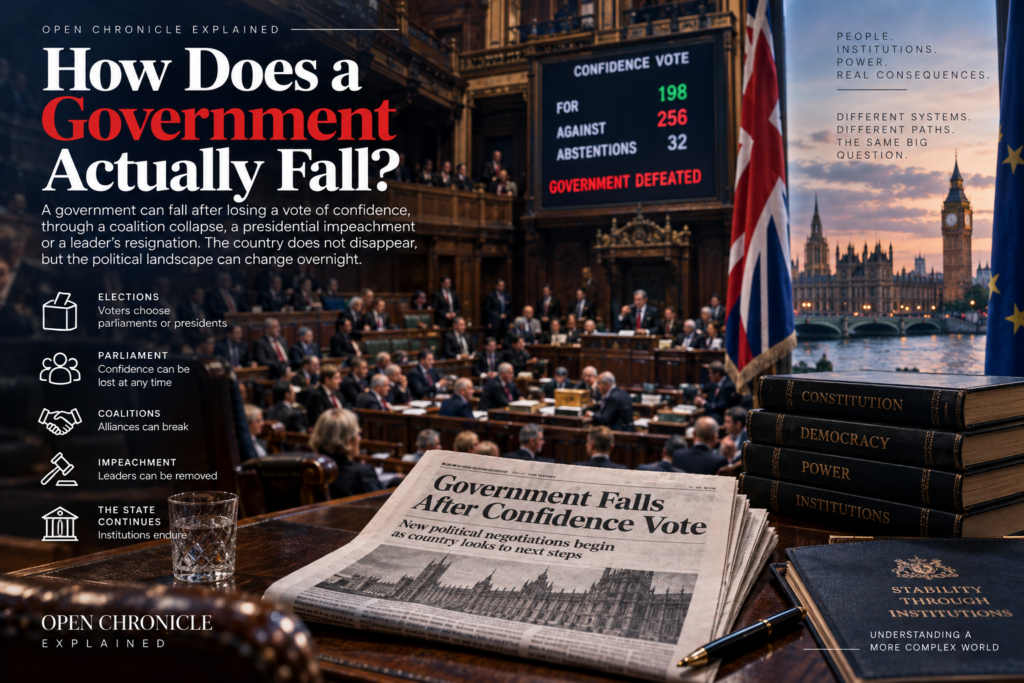
A headline appears:
Government falls after losing confidence vote.
Television cameras gather outside parliament.
Ministers cancel meetings.
Political parties begin negotiations.
The prime minister travels to meet the head of state.
Commentators immediately start discussing elections.
But outside the political institutions, everyday life continues.
Police officers remain at work.
Courts remain open.
Taxes are still collected.
Schools continue teaching.
Passports remain valid.
The country has not disappeared.
The state has not necessarily collapsed.
What has changed is something much more specific.
The political leadership that had authority to govern has lost the ability, legitimacy or constitutional support required to continue doing so.
To understand how governments fall, we first need to understand what a government actually is.
What is a government?
The words state, country and government are often used as though they mean the same thing.
They do not.
The state is the permanent political and legal structure of a country.
It includes institutions such as courts, public administration, armed forces, police and other organs established under its constitutional system.
A government is temporary.
It is the political leadership that exercises executive authority within that state.
Governments change.
The state continues.
That is why a government can fall without the country itself collapsing.
Who actually governs?
That depends on the political system.
In a parliamentary democracy, executive power is usually exercised by a prime minister and cabinet who depend on support in parliament.
In a presidential system, a president is elected separately and normally serves a fixed term.
Some countries operate semi presidential systems, where executive authority is divided between a president and prime minister.
Other constitutional arrangements exist around the world.
The way a government can fall therefore depends heavily on how that government obtained its authority in the first place.
How does a parliamentary government come to power?
Imagine an election for a parliament with 200 seats.
No party automatically becomes the government simply because it received the most votes.
What matters is whether someone can command sufficient parliamentary support to govern.
Suppose the result is:
Party A: 85 seats
Party B: 70 seats
Party C: 30 seats
Party D: 15 seats
No party has 101 seats.
Party A could attempt to form a minority government.
Or it could negotiate a coalition with Party C.
Party B might attempt to build a different majority.
The central question becomes:
Who can command the confidence of parliament?
That principle is at the heart of many parliamentary systems.
What does “confidence” mean?
Parliamentary confidence means that the government retains enough support in the legislature to remain in office and carry out its programme.
This does not mean every member of parliament agrees with every government decision.
Coalition partners argue.
Members rebel.
Opposition parties attack government policy.
But there is a threshold beyond ordinary disagreement.
If parliament formally determines that it no longer supports the government, the government’s ability to remain in office may end.
That is where a vote of no confidence becomes important.
What is a vote of no confidence?
A vote of no confidence is a parliamentary mechanism for testing whether the government still has sufficient political support.
The precise rules differ between countries.
But the basic question is simple:
Does parliament still trust this government to govern?
If the government loses, several outcomes may follow.
The prime minister may resign.
The entire cabinet may resign.
Another government may be formed using the existing parliament.
Or the political system may move toward an election.
Losing confidence can therefore bring down a government without a single soldier entering the streets and without the constitution ceasing to function.
It is a normal mechanism of parliamentary democracy.
Can parliament remove a government whenever it wants?
Not always.
Constitutions establish different safeguards.
Some countries allow relatively straightforward no confidence motions.
Others use what is called a constructive vote of no confidence.
Under this system, parliament cannot simply vote to remove the current leader.
It must simultaneously agree on a replacement.
The logic is to prevent parliament from destroying a government without creating an alternative.
Different constitutional systems therefore balance two objectives differently:
making governments accountable,
and maintaining political stability.
Can a government fall without losing a formal vote?
Absolutely.
Sometimes everyone already knows that the parliamentary numbers have changed.
A coalition partner withdraws.
Several legislators defect.
A budget cannot pass.
The prime minister concludes that governing has become impossible.
Instead of waiting to lose a formal confidence vote, the leader resigns.
The constitutional effect can be similar even though the decisive event happened politically rather than through a parliamentary vote.
Governments survive through numbers.
Once the numbers disappear, formal votes may simply confirm reality.
How does a coalition collapse?
Coalition governments are agreements between political parties that cooperate to form a governing majority.
Imagine Party A has 85 seats and Party C has 30.
Together they control 115 of 200 seats.
They form a government.
Later, the parties disagree over taxation, defence spending or another major policy.
Party C withdraws its ministers and leaves the coalition.
Party A now has only 85 seats.
The government may continue as a minority administration if other parties tolerate it.
But it may no longer be able to pass legislation or survive a confidence vote.
One political agreement has changed.
The entire government can fall.
Why are budgets so important?
Governments need money to implement policy.
Parliaments normally authorize taxation and public expenditure.
A government that cannot pass its budget may have demonstrated that it no longer controls a workable legislative majority.
In some political systems, losing an important financial vote can therefore be treated as a question of confidence.
The constitutional rules differ.
But politically, budgets often reveal whether a government can still govern.
A government unable to finance its programme may remain in office formally while becoming politically unsustainable.
What happens when the prime minister resigns?
Again, the details depend on the constitution.
The resignation may effectively mean the resignation of the government.
The head of state may then consult political parties.
Another leader might be capable of forming a government from the same parliament.
If so, there may be no need for a general election.
This is an important point.
Changing prime minister does not necessarily require changing parliament.
Voters elect legislatures in parliamentary systems.
Governments emerge from the political balance inside those legislatures.
If a new majority can be assembled, government can change without citizens immediately returning to the polls.
Who is the head of state?
This varies by country.
In a republic, it may be a president.
In a constitutional monarchy, it may be a king or queen.
The head of state and head of government are often different roles.
The prime minister usually leads the government.
The head of state may perform constitutional functions during government formation, resignation and dissolution of parliament.
In ordinary political life, many of these functions can appear ceremonial.
During a government crisis, they can become extremely important.
Can the president simply choose whoever they want?
Usually not in a functioning parliamentary democracy.
The head of state must operate within constitutional rules and political reality.
Appointing someone who cannot obtain parliamentary support would not solve the problem.
The central task is often to identify a person capable of forming a viable government.
That may involve consultations with party leaders.
The largest party may be invited first.
Or an existing coalition may nominate a new leader.
Political convention can matter alongside written constitutional law.
The head of state’s power can therefore be important without being unlimited.
When does parliament get dissolved?
Dissolution ends the current parliament and normally leads to an election.
But a government crisis does not automatically require dissolution.
Political leaders may first attempt to form another government from the existing legislature.
If no viable majority can be created, an election may become necessary.
Different constitutions give different actors authority over dissolution.
A prime minister may request it.
A president may possess specific powers.
Fixed term rules may restrict it.
Some countries impose conditions designed to prevent unnecessary elections.
The basic logic is straightforward.
If parliament can no longer produce a government, voters may need to produce a new parliament.
What happens during the gap?
Government does not simply disappear.
An outgoing administration may remain temporarily in office.
This is commonly called a caretaker government.
Its job is to maintain continuity until a new government takes office.
Essential public administration continues.
Government employees continue working.
Bills still need to be paid.
International obligations continue.
Emergency decisions may still need to be taken.
Political conventions may limit major new policies during this period because the outgoing government has reduced political authority.
But the state keeps functioning.
Could a country have no government?
It can experience prolonged difficulty forming one.
After fragmented elections, parties may spend weeks or even months negotiating.
An existing caretaker administration may continue handling routine affairs.
Civil servants maintain much of the machinery of state.
This demonstrates how important permanent institutions are.
Modern states are designed to continue functioning even when politicians have not yet agreed on who should form the next government.
What about presidential systems?
The logic is different.
A president usually has a fixed constitutional mandate obtained separately from the legislature.
Losing a parliamentary vote does not normally remove the president.
A president can therefore face a hostile legislature and still remain in office.
This can produce political gridlock.
The executive wants one policy.
The legislature refuses to approve it.
Neither institution necessarily has the power to dismiss the other.
Removing a president usually requires a different constitutional mechanism.
What is impeachment?
Impeachment is a constitutional process through which certain public officials can be accused of serious misconduct and potentially removed from office.
It is not simply a parliamentary opinion poll on whether legislators like the president.
The exact grounds and procedures vary greatly between countries.
Typically, one institution brings or approves charges.
Another may conduct a trial or final decision.
Removal can require a special majority.
This makes impeachment fundamentally different from an ordinary no confidence vote.
A parliamentary government depends continuously on political confidence.
A president normally holds a fixed mandate unless specific constitutional conditions for removal are met.
Does impeachment automatically remove a president?
No.
Impeachment can refer to the formal accusation stage rather than final removal.
A president may be impeached and still remain in office if the subsequent process does not produce the majority required for removal.
This distinction is frequently misunderstood.
The constitutional procedure matters more than the headline.
Can a president resign?
Yes.
A president may resign because of political pressure, scandal, health, impending removal or other circumstances.
The constitution then determines succession.
A vice president may take office.
Another official may temporarily assume the presidency.
An election may eventually follow.
The essential principle is continuity.
A stable constitutional system tries to ensure that everyone knows who possesses executive authority at every moment.
What happens if a leader dies in office?
Again, succession rules apply.
Political systems attempt to eliminate uncertainty by specifying who assumes authority.
In presidential systems, a vice president or another constitutional successor may immediately take office.
In parliamentary systems, the governing party or coalition may select a new leader while constitutional procedures determine the formal appointment.
The individual leader can disappear suddenly.
The state must continue.
What if an election produces no clear winner?
This is common in parliamentary politics.
An election determines the composition of parliament.
It does not always determine the government immediately.
Parties negotiate.
Coalitions are explored.
Policy agreements are drafted.
Minority governments may seek support from other parties.
The process can appear chaotic.
But negotiation is not necessarily constitutional failure.
It is often the mechanism through which election results are translated into governing authority.
What is a minority government?
A minority government does not control an absolute majority of parliamentary seats.
Suppose Party A holds 90 seats in a 200 seat parliament.
It may still govern if opposition parties cannot or will not unite to remove it.
Other parties may support the government on individual bills.
They may abstain during confidence votes.
They may agree to support budgets without formally joining the cabinet.
A government therefore does not always need a majority of its own.
It needs enough parliamentary support, or enough parliamentary tolerance, to survive.
Why do some governments seem to fall constantly?
Political systems differ in fragmentation and institutional design.
If parliament contains many parties, coalition building may be difficult.
Small parties can sometimes hold decisive leverage.
Coalitions may contain parties with substantially different ideologies.
Constitutions may make confidence votes easier.
Political culture also matters.
Other systems produce large parliamentary majorities and relatively stable governments.
Neither instability nor stability alone tells us whether a democracy is healthy.
A government can last a long time while governing badly.
Another can change frequently while constitutional institutions remain strong.
Is a government collapse the same as a political crisis?
Not necessarily.
A government can fall through completely normal constitutional procedures.
The prime minister loses parliament.
The prime minister resigns.
Another government forms.
Politics continues.
That is not state collapse.
A political crisis becomes more serious when institutions themselves are disputed.
What if leaders refuse to accept constitutional rules?
What if election results are rejected without legal basis?
What if rival institutions claim authority?
What if security forces become involved?
Then the question moves beyond who governs toward whether the political system itself remains legitimate and functional.
Is a government falling the same as a regime falling?
No.
This distinction is fundamental.
A government is the current political leadership.
A regime is the broader system through which political authority is organized.
In a democracy, one government can replace another while the constitutional regime remains unchanged.
A conservative government may lose an election and be replaced by a progressive government.
The constitution remains.
The courts remain.
Parliament remains.
The political system remains.
A regime change is much deeper.
It changes the rules governing political power itself.
What is a coup d’état?
A coup is fundamentally different from a normal government collapse.
A coup involves the seizure or attempted seizure of political power outside ordinary constitutional procedures, often involving military or security institutions.
Instead of parliament withdrawing confidence or voters changing governments through elections, actors attempt to take control of the state through coercive means.
A successful coup may remove a government.
But it can also threaten or replace the constitutional order.
That is why saying a government “fell” can describe very different events.
The mechanism matters.
What happens during a coup?
There is no universal sequence.
But potential targets can include the political leadership, communications systems, military command structures and key state institutions.
The crucial question is whether those attempting the seizure can establish effective authority.
Do the armed forces obey them?
Do police forces accept the new leadership?
Do ministries continue functioning?
Do courts recognize the change?
Does the public comply?
Do foreign governments recognize the authorities?
Political power is not simply possession of a government building.
It depends on institutions and people accepting commands.
Can governments fall because of protests?
Yes, but usually through an additional political or constitutional mechanism.
Large protests can make governing politically impossible.
Members of a ruling party may withdraw support.
Coalition partners may leave.
A leader may resign.
Parliament may remove the government.
In authoritarian systems, mass demonstrations can sometimes contribute to regime collapse.
But protesters standing in a square do not automatically possess constitutional authority to appoint a new government.
The transition from public pressure to political change depends on institutions, political actors and sometimes security forces.
What if millions of people demand the government’s resignation?
Politically, that can be enormously important.
Legally, the effect depends on the constitutional system.
Democracies provide formal mechanisms for changing governments.
Elections.
Parliamentary votes.
Resignations.
Impeachment.
Referendums in some constitutional arrangements.
Public protest influences those mechanisms by changing political incentives.
A government may retain legal authority while losing political legitimacy.
That gap can become unsustainable.
Can courts bring down a government?
Courts can profoundly affect governments, but their role differs across systems.
A court may rule that government actions are unconstitutional.
It may convict political leaders.
An electoral court may invalidate an election under particular legal circumstances.
Constitutional courts can resolve disputes between institutions.
But courts generally do not operate like parliaments deciding whether they politically support a government.
Their authority comes from law.
When courts do remove or disqualify political figures, the legal basis and constitutional procedure are therefore crucial.
Can a government lose power while remaining popular?
Yes.
Imagine a prime minister leading a coalition.
The prime minister’s party remains popular.
But the coalition partner withdraws.
The parliamentary majority disappears.
The government falls.
Popularity and constitutional authority are not identical.
Public opinion matters politically.
Parliamentary numbers matter institutionally.
This distinction can create situations where a leader argues that voters still support them while opponents argue that parliament no longer does.
An election may ultimately resolve the dispute.
Can an unpopular government stay in power?
Yes.
Governments do not normally rise and fall according to daily opinion polls.
A parliamentary government may retain a legislative majority even when its approval ratings are extremely low.
A president may remain in office until the end of a fixed term despite widespread unpopularity.
Democratic systems deliberately separate public opinion from immediate removal.
Otherwise, governments could change every time polling numbers moved.
Elections provide periodic accountability.
Constitutional removal mechanisms address exceptional situations between elections.
Why do governments sometimes call early elections?
A governing party may believe the political moment is favourable.
A coalition may become unstable.
Parliament may be deadlocked.
A government may seek a stronger mandate.
A prime minister may conclude that continuing with a fragile majority is impossible.
Whether an early election can actually be called depends on constitutional rules.
Politically, however, the logic is often the same:
return the question to voters.
What happens after the election?
Votes become seats according to the country’s electoral system.
Then government formation begins.
A clear parliamentary majority can make the process straightforward.
A fragmented result can produce negotiations.
The outgoing government may remain temporarily as caretaker.
Eventually, a new prime minister and cabinet take office according to constitutional procedures.
The extraordinary moment ends.
Government becomes ordinary again.
Why does peaceful transfer of power matter so much?
Because political disagreement is inevitable.
Someone will lose every election.
Some governments will lose parliamentary support.
Leaders will eventually leave office.
The strength of a political system is therefore not demonstrated only by how leaders acquire power.
It is demonstrated by how they surrender it.
A stable democracy creates procedures that allow enormous political power to change hands without violence.
One government leaves.
Another arrives.
The army stays in its barracks.
The courts continue working.
Civil servants continue working.
Citizens wake up the next morning under the same constitutional order.
That is an extraordinary political achievement precisely because it can look so ordinary.
Why are constitutions important during political crises?
A constitution is partly a rulebook for moments when political actors disagree.
Who appoints the prime minister?
Who can dismiss whom?
When can parliament be dissolved?
Who assumes office if the president dies?
How can a leader be removed?
When must elections occur?
What powers does a caretaker government have?
During normal times, these questions can seem technical.
During a crisis, they determine who legitimately controls the state.
Good constitutional design attempts to replace political improvisation with known procedures.
What if nobody follows the rules?
Then the problem becomes much more serious.
Constitutions ultimately depend on institutions and political actors accepting their authority.
A document cannot physically force a president to leave office.
It cannot physically make soldiers obey civilian leaders.
It cannot physically force parliament to recognize an election.
Institutions work because enough participants agree that the rules are legitimate and that breaking them carries consequences.
When that consensus collapses, a government crisis can become a constitutional crisis.
And a constitutional crisis can become a regime crisis.
The Bigger Picture
When people hear that a government has fallen, the phrase sounds dramatic.
Sometimes it is.
But in a functioning constitutional system, the fall of a government can actually demonstrate the strength of the state.
A prime minister loses support.
The government resigns.
Parliament searches for another majority.
The head of state follows constitutional procedures.
Perhaps voters return to the polls.
A new government takes office.
Meanwhile, the country continues functioning.
Police continue protecting citizens.
Courts continue hearing cases.
Hospitals remain open.
Taxes are collected.
International borders remain recognized.
The state survives because political authority is larger than the individuals temporarily exercising it.
That is the fundamental distinction.
Governments are temporary.
Institutions are designed to endure.
The most stable political systems are not those in which governments never fall.
They are those in which governments can fall without bringing the entire state down with them.
Open Chronicle Explained
Politics & Power
Understanding how institutions, political authority and power actually work.
Understanding the systems behind the headlines.
Explore Open Chronicle Explained →