
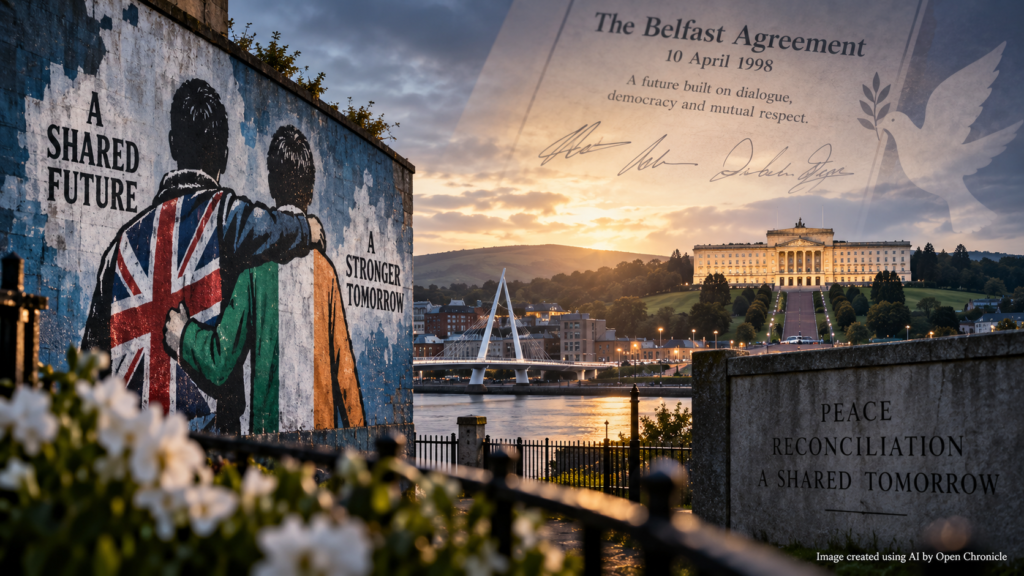
By Open Chronicle Explained
For three decades, Northern Ireland was at the centre of one of Western Europe’s most persistent and violent political conflicts.
Bombings, shootings, assassinations and sectarian violence became part of a conflict known simply as the Troubles. More than 3,500 people were killed, tens of thousands were injured, and communities became divided not only by politics and religion but sometimes by physical walls.
Then, on 10 April 1998 — Good Friday — political parties from Northern Ireland and the governments of the United Kingdom and Ireland reached an agreement that fundamentally changed the political landscape.
The Belfast Agreement, more commonly known as the Good Friday Agreement, did not make every disagreement disappear.
It did something more complicated.
It created a political system in which people with fundamentally different ideas about Northern Ireland’s identity and constitutional future could pursue those ambitions without returning to large-scale political violence.
More than a quarter of a century later, that architecture remains central to understanding Northern Ireland.
What Was the Conflict About?
At the heart of the Troubles was a fundamental disagreement over a deceptively simple question:
What should Northern Ireland be?
Unionists and loyalists, predominantly from Protestant communities, generally wanted Northern Ireland to remain part of the United Kingdom.
Nationalists and republicans, predominantly from Catholic communities, generally wanted Northern Ireland to become part of a united Ireland.
But the conflict was about more than constitutional geography.
Northern Ireland had been created in 1921 following the partition of Ireland. Six counties remained within the United Kingdom while most of the island eventually became the independent Irish state.
Within Northern Ireland, political power was dominated for decades by unionists. Catholic and nationalist communities experienced discrimination and inequality in areas including housing, employment and political representation.
A civil-rights movement emerged during the 1960s.
Political tensions escalated.
Rioting and communal violence followed.
British troops were deployed to Northern Ireland in 1969.
What began as a political and civil-rights crisis developed into a prolonged conflict involving republican paramilitary organisations, loyalist paramilitaries, British security forces and the police.
Among the most prominent republican organisations was the Provisional Irish Republican Army (IRA), which sought to end British rule in Northern Ireland and achieve Irish reunification.
Loyalist paramilitary organisations used violence largely in defence of Northern Ireland’s position within the United Kingdom.
Civilians frequently paid the price.
For decades, attempts to find a political settlement repeatedly failed.
What Changed?
The Good Friday Agreement did not suddenly emerge in 1998.
It was the result of years of diplomacy, secret contacts, political negotiations and changing strategic calculations.
Several developments gradually created the conditions for negotiations.
The British and Irish governments increasingly cooperated over Northern Ireland.
Political leaders explored ways of bringing republicans into a peaceful political process.
The United States became increasingly involved diplomatically, particularly under President Bill Clinton.
The IRA announced a ceasefire in 1994, although it later broke down before another ceasefire was declared in 1997.
Multi-party negotiations eventually brought together representatives from different traditions under the chairmanship of former US senator George Mitchell.
The talks were extraordinarily difficult.
Participants were attempting to reconcile political positions that appeared fundamentally incompatible.
Unionists wanted Northern Ireland’s place within the United Kingdom protected.
Nationalists wanted recognition of their aspiration for Irish unity and stronger institutional connections with the Republic of Ireland.
Republicans were moving from armed struggle toward constitutional politics.
The British and Irish governments needed a framework both could support.
The breakthrough came on 10 April 1998.
What Is the Good Friday Agreement?
What is usually called the Good Friday Agreement actually contains two closely connected agreements.
One was reached among most of Northern Ireland’s political parties.
The other was an international agreement between the British and Irish governments.
Together they created a new political and constitutional framework.
Rather than attempting to decide permanently whether Northern Ireland should be British or Irish, the settlement established rules for how that question should be handled peacefully and democratically.
That distinction is essential.
The agreement did not declare one side victorious.
Instead, it established institutions and principles that allowed competing identities and constitutional aspirations to coexist.
The Principle of Consent
Perhaps the most important idea in the agreement is the principle of consent.
Northern Ireland remains part of the United Kingdom for as long as a majority of its people wish it to remain so.
But if a majority were someday to support joining a united Ireland, the British and Irish governments recognised that this constitutional change should take place.
In other words, Northern Ireland’s constitutional future would be determined by democratic consent rather than violence.
This represented a crucial compromise.
Unionists received recognition that Northern Ireland could not be forced into a united Ireland against the wishes of its population.
Nationalists received recognition that partition was not necessarily permanent and that Irish reunification remained a legitimate democratic objective.
The battlefield was replaced by the ballot box.
How Does Power-Sharing Work?
The agreement created a devolved political system centred on the Northern Ireland Assembly at Stormont.
But this could not operate like an ordinary majority-rule parliament.
Northern Ireland’s history meant that simple majority rule risked allowing one community to dominate the other.
The solution was power-sharing.
The system was designed so that unionist and nationalist representatives would participate together in government.
The Northern Ireland Executive would therefore include representatives reflecting the political balance in the Assembly.
At its centre are the offices of First Minister and deputy First Minister.
Despite the titles, one is not politically subordinate to the other.
The offices function jointly, reflecting the principle that government must rest on cooperation between the major political traditions.
Certain important Assembly decisions also require forms of cross-community support.
The underlying principle is straightforward:
Northern Ireland should not be governed exclusively by one community over another.
The Three Strands
The agreement constructed political relationships across three interconnected levels, usually known as the three strands.
Strand One — Northern Ireland
The first strand created democratic institutions within Northern Ireland itself.
This included the Northern Ireland Assembly and the power-sharing Executive.
The objective was to give Northern Ireland substantial responsibility over its own domestic affairs while ensuring that both main political traditions participated in government.
Strand Two — North-South Relations
The second strand addressed relationships between Northern Ireland and the Republic of Ireland.
It created the North/South Ministerial Council, allowing ministers from both jurisdictions to cooperate on areas of mutual interest.
This recognised an obvious geographic reality.
Whatever Northern Ireland’s constitutional status, the two parts of the island share economic, environmental, infrastructural and social interests.
Strand Three — British-Irish Relations
The third strand created institutions for wider cooperation between the governments and administrations of Britain and Ireland.
These arrangements recognised that Northern Ireland exists within a broader network of relationships connecting London, Dublin, Belfast and the devolved administrations of the United Kingdom.
Together, the three strands attempted to balance three dimensions of the problem:
Northern Ireland within itself.
Northern Ireland and Ireland.
Britain and Ireland.
British, Irish — or Both
One of the agreement’s most significant achievements concerned identity.
People born in Northern Ireland were recognised as having the right to identify themselves and be accepted as British or Irish, or both.
They could hold British citizenship, Irish citizenship, or both, subject to the terms established by the agreement and subsequent law.
This addressed one of the conflict’s deepest problems.
The settlement did not demand that everyone agree on a single national identity.
Instead, it made room for different identities within the same political framework.
A person could consider Northern Ireland an integral part of the United Kingdom.
Another could consider themselves Irish and aspire peacefully to reunification.
The political system was designed to accommodate both.
What Happened to the Weapons?
Creating political institutions was only part of the peace process.
Paramilitary organisations possessed significant arsenals.
The agreement included commitments concerning the decommissioning of weapons.
This became one of the most contentious issues during implementation.
Republican and loyalist organisations faced pressure to place weapons permanently beyond use while political parties argued over the sequencing of decommissioning and participation in government.
The process took years.
The IRA eventually announced the end of its armed campaign in 2005, and an independent commission subsequently reported that its weapons had been put beyond use.
The transition demonstrated an important reality about peace agreements:
Signing an agreement can happen in a day.
Implementing one can take years.
Prisoners, Policing and Justice
Other provisions were equally controversial.
The agreement provided for the accelerated release of prisoners affiliated with paramilitary organisations maintaining ceasefires.
For victims and their families, this was one of the settlement’s most painful elements.
Policing was another major issue.
Nationalists had long deeply distrusted the Royal Ulster Constabulary (RUC).
The agreement led to an independent commission on policing chaired by Chris Patten.
The subsequent reforms resulted in the creation of the Police Service of Northern Ireland (PSNI) in 2001.
The objective was to create a police service capable of commanding broader legitimacy across Northern Ireland’s divided communities.
Human rights, equality and institutional reform were therefore not secondary issues.
They were part of the foundations of the settlement.
Did Everyone Support the Agreement?
No.
The agreement represented compromise, and compromise inevitably produced opposition.
The Democratic Unionist Party (DUP) opposed the agreement in 1998.
Some republican dissidents also rejected the peace process and continued to support violence.
The most horrific demonstration of that threat came only months after the agreement.
On 15 August 1998, a bomb planted by the dissident republican Real IRA exploded in Omagh, killing 29 people, including a woman pregnant with twins.
It was the deadliest single atrocity of the Troubles.
Yet the attack did not derail the peace process.
Public revulsion reinforced the determination of much of society to reject a return to widespread violence.
What Did the Public Decide?
The agreement was not simply imposed by political leaders.
On 22 May 1998, voters were asked to endorse it.
In Northern Ireland, approximately 71% voted Yes.
The Republic of Ireland simultaneously held a referendum approving constitutional changes connected with the settlement, with an overwhelming majority voting in favour.
This democratic endorsement gave the agreement political legitimacy beyond the negotiating table.
Did the Good Friday Agreement End the Troubles?
It is tempting to say that the agreement “ended” the Troubles.
Reality is more complicated.
Political violence declined dramatically, but it did not disappear completely.
Dissident republican groups continued to carry out attacks.
Loyalist organisations did not simply vanish.
Sectarian divisions remained visible in housing, education and community life.
So-called peace walls still separate some neighbourhoods.
And the institutions created by the agreement have repeatedly experienced political crises.
The Northern Ireland Assembly and Executive have been suspended several times.
Nevertheless, the transformation since the worst years of the Troubles has been profound.
Political disagreement continues.
But the central arena for resolving it is now democratic politics rather than sustained paramilitary conflict.
That is the agreement’s fundamental achievement.
Why Did Brexit Create a Problem?
The United Kingdom’s decision to leave the European Union introduced a challenge that the architects of the 1998 settlement had not anticipated.
When the agreement was signed, both the United Kingdom and Ireland were members of the European Union.
The border between Northern Ireland and the Republic of Ireland became increasingly unobtrusive.
People and goods could cross with little visible infrastructure.
Brexit changed the equation.
The United Kingdom left the EU while Ireland remained a member.
That meant the border on the island of Ireland became, in legal and economic terms, a frontier between the United Kingdom and the European Union.
But restoring extensive customs infrastructure along that border risked political and security consequences.
The resulting negotiations produced the Northern Ireland Protocol, later modified through the Windsor Framework, creating special arrangements for goods moving between Great Britain, Northern Ireland and the European Union.
Those arrangements themselves became politically controversial, particularly among unionists concerned about Northern Ireland’s economic position within the United Kingdom.
Brexit therefore exposed something important:
The Good Friday Agreement is not simply a historical document.
It remains part of the operating architecture of contemporary British-Irish politics.
Could Northern Ireland Become Part of a United Ireland?
Yes — but only through democratic consent.
The agreement provides a constitutional pathway through which Northern Ireland could leave the United Kingdom and become part of a united Ireland if majorities supported that outcome.
This is why discussion of a future border poll matters.
Demographic change, electoral developments, Brexit and changing attitudes toward national identity have all renewed debate about Northern Ireland’s long-term constitutional future.
But the agreement does not predetermine the result.
Its achievement is precisely the opposite.
It establishes that the question should be decided peacefully by voters.
Why Does the Good Friday Agreement Matter Beyond Ireland?
The agreement has frequently been studied as an example of conflict resolution because it demonstrates several important principles.
It recognised competing identities rather than attempting to erase them.
It created institutions requiring former adversaries to share political power.
It involved neighbouring states whose interests were directly connected to the conflict.
It combined constitutional arrangements with reforms involving policing, rights, security and weapons.
And it provided peaceful democratic mechanisms for addressing the most fundamental disagreement at the heart of the conflict.
But it also demonstrates the limitations of peace agreements.
A document cannot instantly eliminate distrust accumulated over generations.
Institutions can collapse.
Political disputes can return.
Communities can remain divided long after violence declines.
Peace is therefore not a single event.
It is a political process that must continually be maintained.
What? How? Why?
What is the Good Friday Agreement?
A political settlement reached in 1998 that established a new constitutional and institutional framework for Northern Ireland and relations between Britain and Ireland.
How does it work?
Through democratic consent, devolved power-sharing, cross-border cooperation, British-Irish institutions, protections for different identities and reforms connected with security, policing and political participation.
Why does it matter?
Because it provided a framework through which people who profoundly disagree about Northern Ireland’s identity and future could pursue those ambitions through democratic politics rather than sustained political violence.
That may ultimately be the most important lesson of 1998.
The Good Friday Agreement did not solve every disagreement.
It changed the rules by which those disagreements could be fought.
Not with bombs.
Not with bullets.
But through institutions, negotiation and votes.
And that is why, decades later, the agreement remains one of the most consequential political settlements in modern European history.
Open Chronicle Explained
What? How? Why?
Understand how the world works.
Understanding the systems behind the headlines.
Explore Open Chronicle Explained →