
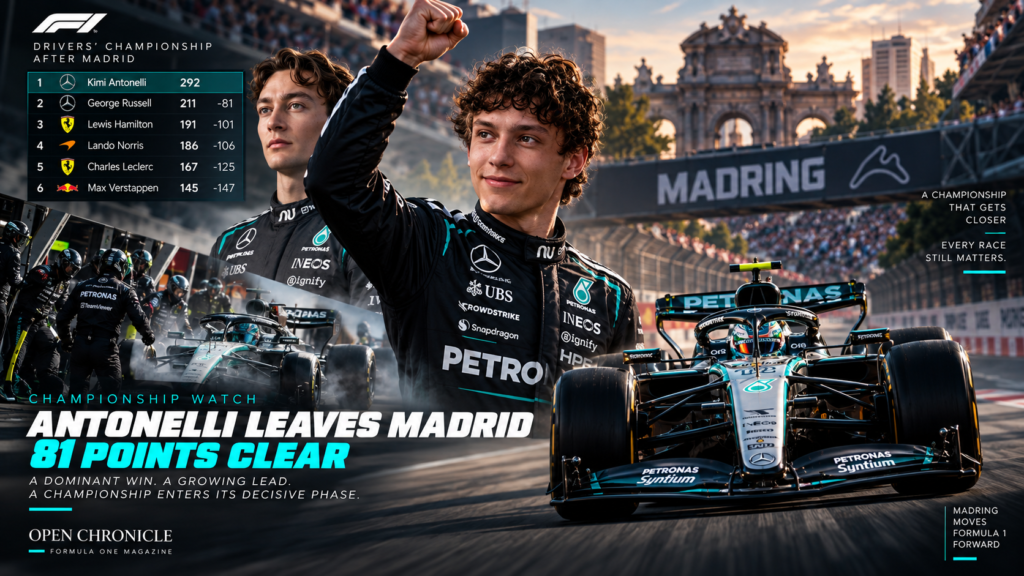
Kimi Antonelli arrived at Madring with a commanding 66 point championship advantage. He leaves Madrid 81 points ahead of George Russell after claiming his eighth victory of the season. With nine Grands Prix remaining, the mathematics still leaves several drivers in contention, but the competitive reality is becoming increasingly severe: Formula 1’s challengers no longer simply need to beat Antonelli. They need to stop him scoring heavily, repeatedly.
By Open Chronicle Formula One Magazine
Fourteen Grands Prix completed.
Eight victories.
292 points.
An 81 point championship lead.
Kimi Antonelli’s extraordinary 2026 season has reached the point where every remaining race must now be viewed through two different perspectives.
There is the battle to win each Grand Prix.
And there is the increasingly urgent battle to prevent Antonelli from turning a commanding championship advantage into an irreversible one.
Madrid was supposed to provide another test.
A completely new circuit.
No previous Formula One race data.
McLaren competitive.
Ferrari close.
Max Verstappen back near the front.
George Russell still carrying Mercedes’ strongest internal challenge to Antonelli.
Instead, Antonelli left Madring stronger than he arrived.
The Italian won the inaugural Grand Prix at the new Madrid circuit, taking his eighth victory of 2026 and increasing his championship advantage over Russell from 66 points to 81.
The championship is not mathematically finished.
But Championship Watch is no longer asking whether Antonelli is the favourite.
The question now is whether anybody can create enough pressure to stop him.
The Championship After Madrid
The official Formula One standings had Antonelli on 267 points before the Spanish Grand Prix, with Russell on 201, Hamilton on 191, Norris on 171, Leclerc on 155 and Verstappen on 127.
Madrid changed the picture significantly.
| Position | Driver | Team | Points | Gap to Antonelli |
|---|---|---|---|---|
| 1 | Kimi Antonelli | Mercedes | 292 | Leader |
| 2 | George Russell | Mercedes | 211 | 81 |
| 3 | Lewis Hamilton | Ferrari | 191 | 101 |
| 4 | Lando Norris | McLaren | 186 | 106 |
| 5 | Charles Leclerc | Ferrari | 167 | 125 |
| 6 | Max Verstappen | Red Bull Racing | 145 | 147 |
| 7 | Oscar Piastri | McLaren | 120 | 172 |
Antonelli’s 292 points and Russell’s 211 are confirmed after Madrid, giving the championship leader an 81 point advantage.
For everyone behind Russell, the situation is even more difficult.
Madrid Cost Russell Another 15 Points
Before the Spanish Grand Prix, Russell was 66 points behind his team mate.
That was already substantial.
But it was still a gap that could theoretically be attacked through a sequence of victories and Antonelli setbacks.
Madrid moved the target further away.
Antonelli won.
Russell finished fifth.
The result gave Antonelli 25 points and Russell 10.
Difference:
15 points.
Championship gap before Madrid:
66
Championship gap after Madrid:
81
For Russell, that is the number that matters more than the race result itself.
He did not merely fail to reduce Antonelli’s advantage.
He lost another significant portion of ground.
The Gap Has Become More Important Than Individual Results
An 81 point advantage changes the championship dynamic.
Antonelli no longer needs to beat Russell every weekend.
Russell needs to beat Antonelli.
That distinction is fundamental.
If Antonelli finishes second while Russell wins, Russell gains only seven points under the standard Grand Prix scoring system.
If Antonelli finishes third and Russell wins, Russell gains ten.
Even repeated victories therefore produce relatively slow championship recovery if Antonelli continues appearing on the podium.
The challenge for Russell is no longer simply:
Win races.
It is:
Win races while Antonelli finishes significantly lower.
That second part is much harder to control.
Antonelli’s Greatest Weapon Is Now Consistency
Championships eventually change character.
Early in the season, victories create momentum.
Later, accumulated points create strategic freedom.
Antonelli is entering that second phase.
He can still attack victories.
But he no longer requires victory every weekend.
If Russell, Norris, Hamilton or Verstappen win while Antonelli continues collecting large points totals, the championship leader can absorb those results.
That means Antonelli’s rivals need more than their own success.
They need disruption to his consistency.
A retirement.
A mechanical problem.
A poor qualifying session.
An incident.
A weekend where Mercedes simply lacks performance.
Without those events, the mathematics becomes increasingly difficult.
Eight Victories in Fourteen Grands Prix
Madrid was Antonelli’s eighth Grand Prix victory of the season.
That means he has won more than half of the first fourteen Grands Prix.
The sequence is remarkable.
Antonelli won in China.
He won in Japan.
He won in Miami.
He won in Canada.
He won in Monaco.
He returned to victory in Belgium.
Then came Monza.
And now Madrid.
Different circuits.
Different conditions.
Different strategic circumstances.
That matters because championships are rarely won by being exceptional at only one type of circuit.
Antonelli’s victories have come across a broad enough range of venues to suggest Mercedes and its championship leader possess something more dangerous than specialist speed.
They possess adaptability.
From Monza to Madrid
The last two Grands Prix have been particularly damaging for Antonelli’s rivals.
At Monza, Antonelli started from 19th and still won.
Russell finished second.
Antonelli therefore left Italy with a 66 point championship lead.
Madrid presented a completely different challenge.
At Madring, Antonelli was competitive immediately.
Russell led FP1.
Antonelli led FP2.
Antonelli led FP3.
Then Norris produced an extraordinary qualifying lap to beat Antonelli to pole by only 0.011 seconds.
On Sunday, Antonelli converted the strategic opportunity created by the Virtual Safety Car and won.
Two consecutive victories.
Two completely different routes to the same result.
That is exactly what a championship leader wants.
Russell Remains the Closest Challenger
If anyone is going to turn the championship around, Russell remains the most obvious candidate.
He has 211 points.
He has the same fundamental Mercedes machinery.
He knows the strengths of the car.
And he has already won races this season.
Before Madrid, Russell openly acknowledged that Antonelli had done the better job across 2026 and deserved to lead the championship. But he also refused to completely surrender the fight.
The problem is no longer identifying the challenger.
It is identifying the route back.
At 81 points behind, isolated victories will not be enough.
Russell needs a sequence.
What Russell Needs Now
The ideal championship weekend for Russell is obvious.
Russell wins.
Antonelli finishes outside the major points.
That creates a meaningful swing.
But if Russell wins and Antonelli finishes second, the gain is modest.
This demonstrates how a large championship advantage becomes self protecting.
Antonelli does not need to respond to every Russell victory with another victory.
He needs to remain close enough.
Russell therefore requires weekends where Antonelli is not close.
That may be the single most important championship dynamic for the remaining nine Grands Prix.
Hamilton: Madrid May Have Ended the Realistic Challenge
Lewis Hamilton entered Madrid third in the championship with 191 points.
He leaves with the same total.
The Ferrari driver’s brake problem forced him out of the Spanish Grand Prix while Antonelli won.
The consequence is brutal.
Before Madrid:
Antonelli 267.
Hamilton 191.
Gap:
76 points.
After Madrid:
Antonelli 292.
Hamilton 191.
Gap:
101 points.
Hamilton lost 25 championship points to Antonelli in a single afternoon.
At this stage of the season, that is enormously damaging.
Mathematically, Hamilton remains relevant.
Competitively, he now requires an extraordinary reversal.
Ferrari Had the Speed, But Hamilton Needed the Points
The frustration is greater because Ferrari showed genuine performance at Madring.
Charles Leclerc was close to the front throughout the weekend.
Hamilton qualified fourth with 1:32.013.
Leclerc was fifth with 1:32.019.
Only six thousandths separated them.
Both Ferraris were within two tenths of Norris’ pole.
The car therefore had sufficient pace to influence the championship battle.
Hamilton’s retirement meant that performance produced no championship reward for him.
This is where a title campaign becomes unforgiving.
Speed creates opportunity.
Reliability converts it into points.
Norris: Faster in Madrid, Further Behind in the Championship
Lando Norris presents the most fascinating contradiction.
He may have been the driver who most deserved to win the Spanish Grand Prix.
He took pole.
He controlled the opening phase.
He built a significant advantage.
Then the timing of the Virtual Safety Car and a slow pit stop changed his race.
Antonelli himself acknowledged after the Grand Prix that Norris deserved the victory.
But championships do not award points for deserved victories.
Norris finished third.
He gained 15 points.
Antonelli gained 25.
So even on a weekend where McLaren demonstrated the performance required to beat Mercedes, Norris lost another ten points to the championship leader.
Norris Now Faces a 106 Point Deficit
Norris arrived in Madrid 96 points behind Antonelli and openly admitted that he considered Russell the driver with the better opportunity to challenge the championship leader.
Madrid made Norris’ situation worse.
Antonelli: 292
Norris: 186
Gap:
106 points.
This creates a strange situation.
McLaren may still be capable of winning several of the remaining Grands Prix.
Norris may still be capable of producing qualifying performances like Madrid.
But being capable of winning races and being capable of winning the championship are now increasingly different propositions.
Norris Can Still Influence the Championship
That does not make Norris irrelevant.
Quite the opposite.
If McLaren remains competitive, Norris can become one of the most important drivers in the title battle.
Every time Norris finishes between Russell and Antonelli, he changes the points swing.
Every time he beats Antonelli, he reduces the number of points available to the championship leader.
Every McLaren victory denies Mercedes another maximum score.
Norris may therefore influence the championship even if his own title probability becomes increasingly remote.
The same applies to Piastri.
This is where a championship stops being a simple duel.
Leclerc Is Becoming a Major Variable
Charles Leclerc finished fourth in Madrid.
That moves him to approximately 167 points, 125 behind Antonelli.
His own championship position is difficult.
But Ferrari’s speed means Leclerc can significantly influence what happens between the Mercedes drivers.
Imagine Russell wins.
Leclerc finishes second.
Antonelli finishes third.
Russell gains ten points on Antonelli.
Now imagine Leclerc wins, Russell finishes second and Antonelli third.
Russell gains only three.
Drivers outside the primary championship duel can therefore determine how quickly the gap changes.
That makes Ferrari strategically important even if its drivers are increasingly distant from Antonelli.
Verstappen Is Another Wild Card
Max Verstappen finished second at Madring.
That result moves him to approximately 145 points.
His championship deficit remains enormous.
But Red Bull’s performance in Madrid matters.
Verstappen qualified only 0.140 seconds from pole.
Then he finished second.
If Red Bull can reproduce that competitiveness at future circuits, Verstappen becomes another driver capable of taking victories and podium positions away from the Mercedes pair.
And Verstappen does not need to be fighting for the championship to change its outcome.
He simply needs to be fighting at the front.
The Championship Is Becoming Antonelli Versus the Field
This is where the title race becomes particularly interesting.
Russell is Antonelli’s closest direct rival.
But Russell may need help.
McLaren can take points from Antonelli.
Ferrari can take points from Antonelli.
Verstappen can take points from Antonelli.
Reliability can take points from Antonelli.
Strategy can take points from Antonelli.
Antonelli’s championship challenge is therefore not simply to beat Russell.
It is to continue navigating a field in which several teams now appear capable of challenging Mercedes on individual weekends.
Madrid showed that clearly.
Norris took pole.
Verstappen finished second.
Leclerc finished fourth.
Four different leading teams possessed meaningful performance during the weekend.
Yet Antonelli still won.
Eight Wins Tell Only Part of the Story
The most intimidating aspect of Antonelli’s championship position is not simply the number of victories.
It is the way the victories have been achieved.
Some have come through straightforward performance.
Monza required recovery from 19th.
Madrid required Mercedes to exploit a strategic opportunity.
A championship contender who can only win when everything is perfect remains vulnerable.
A championship contender who can win when circumstances become complicated is much harder to stop.
That distinction may define Antonelli’s 2026 campaign.
The 81 Point Cushion Changes Risk
There is another consequence of the championship lead.
Risk tolerance.
Russell cannot afford too many conservative weekends.
Antonelli can.
Suppose late in a future race Russell is leading while Antonelli sits third and needs a risky move to take second.
Does Antonelli need to make it?
Perhaps not.
A championship leader with an 81 point advantage can occasionally accept the points already available.
The challenger has less freedom.
Russell increasingly needs maximum returns.
That asymmetry becomes more important as the calendar shrinks.
Nine Grands Prix Remain
The 2026 calendar contains 23 rounds.
Madrid was Round 14.
That leaves nine Grands Prix. The remaining schedule takes Formula One through Azerbaijan, the Bahrain named round in Malaysia, Singapore, the United States, Mexico, Brazil, Las Vegas, Qatar and finally Abu Dhabi.
There is still substantial racing ahead.
This is why the championship cannot be declared over.
Nine races provide opportunities for enormous swings.
But every completed race also removes one opportunity for Russell to recover.
Antonelli’s most valuable resource is therefore not simply points.
It is time.
Every weekend that passes without Russell making a significant reduction is a victory for the championship leader.
The Next Target: Baku
Formula One now moves to Azerbaijan for Round 15.
Baku offers a dramatically different engineering and racing challenge from Madring.
That matters.
Antonelli does not need another victory to leave Azerbaijan satisfied.
If Russell wins and Antonelli finishes second, the championship leader still retains a very large advantage.
Russell needs something more disruptive.
A major points swing.
And preferably several of them.
Championship Pressure Is Reversing
Earlier in the season, Antonelli was the young driver building an unexpected title challenge.
Now the psychological situation is different.
He is the benchmark.
Everyone else is chasing.
Russell admitted before Madrid that his team mate had performed better across the season.
Norris acknowledged that his own McLaren had not been consistently strong enough across every circuit to make him confident of retaining the championship.
Antonelli, meanwhile, has repeatedly attempted to keep the championship itself out of his immediate thinking, focusing instead on individual race weekends.
That approach becomes increasingly powerful when the points table already provides such a substantial cushion.
The Championship Momentum
The progression across the last two rounds tells the story.
| After | Antonelli | Russell | Gap |
|---|---|---|---|
| Italian GP | 267 | 201 | 66 |
| Spanish GP | 292 | 211 | 81 |
| Change in Madrid | +25 | +10 | Antonelli gains 15 |
Madrid did not merely preserve Antonelli’s advantage.
It accelerated it.
That is why the Spanish Grand Prix matters so much to Championship Watch.
What Each Contender Needs
Kimi Antonelli
Consistency.
He can continue attacking victories when they are available, but the championship situation increasingly rewards controlled high scoring weekends.
George Russell
A sequence of victories combined with Antonelli finishing significantly lower.
Second versus first will not reduce an 81 point gap quickly enough.
Lewis Hamilton
A dramatic change in momentum and multiple Antonelli setbacks.
Madrid’s retirement transformed an already difficult situation into an extremely demanding one.
Lando Norris
McLaren must reproduce its Madrid speed repeatedly, while Antonelli needs to begin losing significant points.
Race victories alone may no longer be sufficient.
Charles Leclerc and Max Verstappen
Their own title prospects are increasingly remote, but both can become decisive participants in the fight by taking victories and podium positions away from Mercedes.
The Mathematics and the Reality
There are two championship tables.
The mathematical table says the season remains open.
The competitive table says Antonelli is increasingly in control.
Both statements can be true.
Formula One championships can change suddenly.
One retirement can cost 25 points relative to a winning rival.
Two difficult weekends can transform the atmosphere of an entire season.
Antonelli is not immune to reliability problems, incidents, strategy mistakes or poor weekends.
But his advantage means one bad result is no longer necessarily catastrophic.
Russell needs to create pressure before Antonelli’s cushion becomes large enough to absorb almost anything.
The Critical Number Is No Longer Eight
Eight victories are impressive.
But the most important number after Madrid is not eight.
It is:
81
That is the distance between Antonelli and Russell.
It represents more than three conventional Grand Prix victories worth of points.
And because Antonelli continues scoring heavily, simply winning races will not necessarily eliminate it quickly.
Russell needs swings.
The calendar is now a countdown to opportunities for those swings.
Championship Watch Verdict
Madrid strengthened the central narrative of the 2026 Formula One World Championship.
Kimi Antonelli is no longer simply having an extraordinary season.
He is constructing a championship position that increasingly forces everyone else to depend on circumstances beyond their own results.
Russell remains the closest challenger.
Hamilton’s retirement has pushed him beyond 100 points behind.
Norris demonstrated championship level speed at Madring but still lost ground.
Leclerc and Verstappen remain dangerous enough to influence individual races.
And Mercedes continues to provide Antonelli with a car capable of fighting at the front across very different circuits.
Nine Grands Prix remain.
There is enough racing left for the championship to change.
But the burden has shifted.
Antonelli does not need a comeback.
Russell does.
Norris does.
Hamilton does.
And every race that passes without one makes Antonelli’s position stronger.
At Monza, the lead became 66.
At Madrid, it became 81.
Baku now becomes the next test.
Not of whether Antonelli can win again.
But of whether anyone can finally begin taking the championship back from him.
The title is not decided.
But for the first time, the remaining races are beginning to look less like opportunities for Antonelli to build a championship lead and more like opportunities for his rivals to prevent him from finishing the job.