
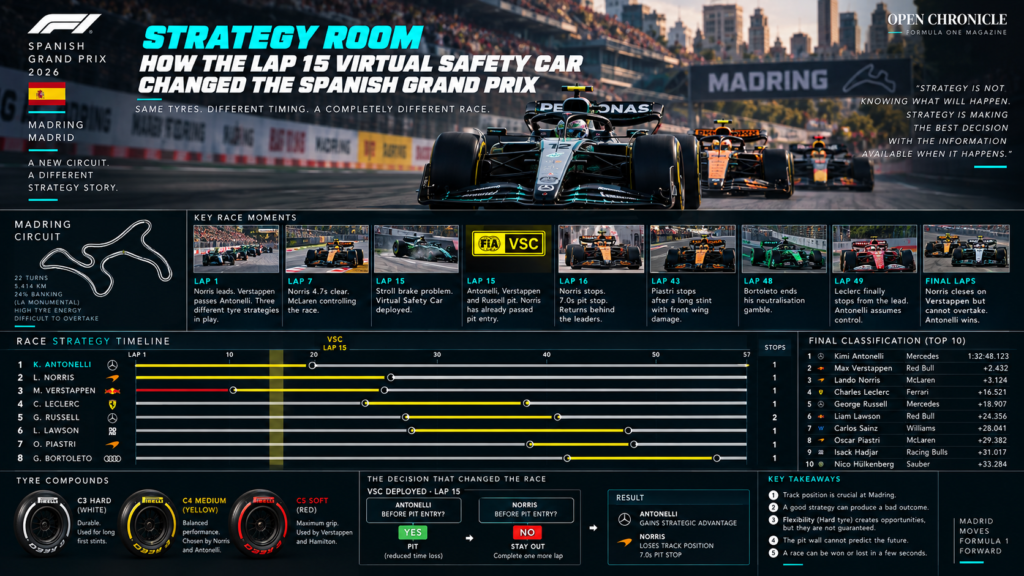
Lando Norris had the pace, the lead and a strategy that appeared to be working. Then Lance Stroll’s brake problem triggered a Virtual Safety Car at precisely the wrong moment for McLaren. Within minutes, Kimi Antonelli had gone from pursuing the race leader to holding the strategic advantage. Open Chronicle reconstructs the decisions behind the first Madring Grand Prix and explains why the winning strategy was created not before the race, but in a few decisive seconds on Lap 15.
By Open Chronicle Formula One Magazine
Formula One strategy is often judged backwards.
A driver wins, therefore the strategy must have been brilliant.
Another finishes outside the points, therefore the strategy must have been wrong.
But that is not how a Formula One pit wall operates.
Engineers cannot make decisions knowing what will happen twenty laps later. They work with the information available at that exact moment.
Tyre degradation.
Traffic.
Gaps.
Weather.
Competitors.
Pit loss.
Safety Car probability.
Driver feedback.
And sometimes, events that nobody can predict.
The inaugural Madring Grand Prix provided a near perfect demonstration.
For the opening phase of the race, Norris appeared to have everything under control.
Then came Lap 15.
And the strategic structure of the Spanish Grand Prix changed almost instantly.
Before the Start: Three Different Strategic Philosophies
Strategy began before the lights went out.
The leading drivers did not all choose the same compound.
Norris and Antonelli started on the Medium.
Verstappen and Hamilton selected the Soft.
Leclerc, Russell, Piastri, Lawson and Bortoleto were among those starting on the Hard.
Three compounds.
Three different strategic philosophies.
The Medium offered balance.
The Soft offered immediate performance and track position potential.
The Hard offered flexibility and the possibility of extending deep into the race.
Nobody yet knew which philosophy would prove strongest.
Norris and Antonelli: The Balanced Approach
For the front row, the Medium was a logical choice.
It provided enough performance for the opening phase without creating the shorter first stint associated with the Soft.
Norris had another advantage.
Pole position.
If he could retain the lead, he could control the pace and force the cars behind to react to him.
Antonelli’s task was different.
He needed to attack without damaging the tyres that would determine the length and quality of his first stint.
The opening seconds immediately demonstrated that tension.
Antonelli challenged Norris and twice had to negotiate the chicane before ultimately returning position.
Verstappen took advantage and moved ahead of Antonelli.
Suddenly the strategic order was:
Norris
Verstappen
Antonelli
And Norris began escaping.
Verstappen: Soft as a Track Position Weapon
Red Bull had selected the Soft for Verstappen.
That was an aggressive opening strategy.
The Soft was not necessarily designed to provide the longest first stint.
Its value was immediate grip.
At a circuit where overtaking was expected to be difficult, gaining a position at the start could be worth more than extending the tyre several additional laps.
That is exactly what happened.
Antonelli’s opening battle with Norris created the opportunity.
Verstappen took it.
The Soft had helped place the Red Bull between Norris and Antonelli.
Red Bull had converted tyre choice into track position.
Lap 7: McLaren Is Controlling the Race
By approximately Lap 7, Norris had built an advantage of around 4.7 seconds.
This is an important strategic reference.
McLaren was not waiting desperately for something to happen.
Its strategy was working.
Norris had track position.
He had a useful gap.
His Medium tyres were functioning.
He was controlling the race from the front.
At this point there was no obvious reason to abandon the plan.
This distinction becomes critical later.
Because what happened to Norris was not evidence that starting on the Medium had been a strategic mistake.
The strategy was succeeding.
Then the race changed.
The Hard Tyre Group Was Playing a Different Game
Further behind, several drivers were deliberately extending.
Leclerc.
Russell.
Piastri.
Lawson.
Bortoleto.
The Hard gave them something the leaders did not possess to the same degree.
Optionality.
They could remain on track while Medium and Soft runners approached their first stops.
They could potentially gain track position temporarily.
They could wait for a Safety Car or Virtual Safety Car.
They could move their pit window deeper into the race.
But flexibility is not the same as guaranteed advantage.
The Hard strategy needed the race to develop in a useful direction.
Strategy Room Principle: Track Position Has Value
Madring added another important variable.
Passing was difficult.
That means track position carried a premium.
Imagine two strategies.
Strategy A produces tyres that are five laps fresher.
Strategy B keeps the driver ahead.
At a circuit where overtaking is easy, Strategy A may be extremely powerful.
At a circuit where overtaking is difficult, Strategy B can be stronger even with older tyres.
The pit wall therefore cannot analyse tyres independently from circuit characteristics.
At Madring, every pit stop carried not only a time cost.
It carried a track position cost.
Hamilton’s Strategy Disappears
Hamilton had also started on the Soft.
Ferrari therefore had an aggressive opening option similar in philosophy to Verstappen’s.
But strategy cannot overcome mechanical failure.
Hamilton began reporting a long brake pedal.
The situation deteriorated.
Leclerc was allowed through.
Hamilton ran straight as the problem became increasingly serious and told Ferrari that he had no brakes.
The team eventually retired the car.
Whatever Ferrari had planned strategically for Hamilton became irrelevant.
This illustrates another fundamental principle.
Strategy operates inside the limits imposed by reliability.
No tyre model can compensate for a car that can no longer safely continue.
Lap 15: The Race Changes
Then came the defining moment.
Lance Stroll encountered a brake problem.
A Virtual Safety Car was deployed.
This was the moment every pit wall immediately had to calculate.
Under normal racing conditions, a pit stop carries a substantial penalty because the car travelling through the pit lane is moving much more slowly than competitors remaining at racing speed.
During a Virtual Safety Car, everyone on circuit must reduce speed according to the prescribed delta.
The cars on track are therefore travelling more slowly than normal.
The relative time lost by entering the pits becomes smaller.
A pit stop under VSC can consequently be extremely valuable.
But only if the driver can reach the pit entry at the right moment.
Norris Had Already Passed the Pit Entry
This is the detail around which the Spanish Grand Prix turned.
When the opportunity appeared, Norris had already passed the pit entry.
McLaren could not simply bring him in immediately.
He had to continue.
Behind him, Antonelli was positioned to exploit the neutralisation.
So was Verstappen.
Russell could also use the opportunity.
Within seconds, something completely outside McLaren’s control had changed the strategic value of stopping.
Before the VSC, Norris’ position on the circuit was an advantage.
At the instant the VSC appeared, his position relative to pit entry became a disadvantage.
The Decision Tree
The strategic problem can be simplified.
VSC DEPLOYED
Is the driver still able to enter the pits?
YES
↓
Evaluate immediate stop
↓
Reduced relative pit loss
For Antonelli, the opportunity existed.
For Norris:
VSC DEPLOYED
↓
Pit entry already passed
↓
Cannot stop immediately
↓
Complete another lap
↓
Pit later
That single geographical difference changed the race.
Not tyre compound.
Not raw pace.
Not an incorrect pre race model.
Timing.
Mercedes Reacts
Mercedes brought Antonelli in.
This was exactly the kind of opportunity a pit wall must recognise immediately.
The team did not know on Lap 1 that Stroll would suffer a brake problem on Lap 15.
It did not build the entire race strategy around a predicted VSC.
Instead, the opportunity appeared.
Mercedes recognised it.
And acted.
That distinction defines reactive race strategy.
The original plan provides structure.
Events determine whether the plan should survive.
Red Bull Takes the Same Opportunity
Verstappen also stopped during the neutralisation.
His Soft tyre strategy had already achieved one objective by helping him gain track position early.
Now the VSC gave Red Bull an opportunity to move into the next phase of the race with reduced relative pit loss.
The Soft strategy had therefore produced:
early grip;
track position;
and then a favourable transition opportunity.
That does not mean Red Bull predicted the VSC.
It means the team was positioned to exploit it.
Russell Gains Strategic Value Too
Russell had started on the Hard.
That already gave Mercedes strategic diversity.
Antonelli and Russell were not committed to identical races.
This matters enormously.
If both drivers follow exactly the same strategy, the team becomes exposed to exactly the same events.
Splitting strategies allows a team to cover different possibilities.
Russell’s Hard tyre provided flexibility.
The VSC then gave Mercedes another opportunity to reshape his race.
Later, Russell would enter another strategic phase with a second stop around Lap 29.
He eventually finished fifth.
McLaren Finally Brings Norris In
Norris had no choice but to complete another lap before stopping.
By then, the strategic situation had changed.
His stop also took approximately seven seconds according to post race reporting.
The combination was damaging.
First, Norris could not use the VSC opportunity at the same moment as his rivals.
Then the stop itself cost additional time.
The driver who had been controlling the opening phase now returned to the race in fifth.
This is the crucial point:
McLaren’s strategy had not gradually collapsed.
The race had changed around it.
A Good Strategy Can Produce a Bad Outcome
This is one of the most important lessons from Madring.
Imagine evaluating the race only from the final classification.
Antonelli won.
Therefore Mercedes chose the correct strategy.
Norris finished third.
Therefore McLaren chose the wrong strategy.
That conclusion is too simplistic.
Before Lap 15, Norris was leading comfortably.
His Medium strategy was functioning.
McLaren could not reasonably have known that a VSC would appear moments after Norris passed pit entry.
Had the neutralisation occurred slightly earlier, Norris might have been able to stop.
Had it occurred slightly later, the strategic consequences could again have been different.
The quality of a decision must therefore be judged using the information available when the decision was made.
Not the information available after the chequered flag.
Antonelli Inherits the Strategic Advantage
Once the first stops had played out, Antonelli’s race had been transformed.
The Mercedes driver had begun the race attacking Norris.
He had then fallen behind Verstappen.
Norris had pulled away.
Purely from the opening phase, McLaren appeared to hold the stronger position.
But strategy does not freeze the race at Lap 7.
The VSC dramatically reduced the cost of Antonelli’s stop.
Mercedes converted the opportunity.
When the remaining strategies unwound, Antonelli was positioned to become the central figure in the race.
That is how a race can change without the fastest car suddenly becoming slower.
Leclerc: Extending the Hard
Ferrari played a very different game with Leclerc.
Starting on the Hard allowed him to run extremely long.
As other drivers stopped, his apparent position improved.
Eventually Leclerc found himself much higher in the order.
But there was an important distinction between track position and net race position.
Leclerc still had to use another compound.
The mandatory stop had not disappeared.
His high position was therefore partly provisional.
Ferrari was effectively asking whether extending the Hard could create a later opportunity.
A Safety Car.
Another VSC.
A favourable gap.
A strategic disruption.
Something that could reduce the cost of the eventual stop.
Lap 49: Ferrari Finally Acts
Leclerc continued until approximately Lap 49 before stopping.
That handed the actual lead fully to Antonelli.
The Ferrari strategy illustrates the value and limitation of extending.
Staying out preserves current track position.
But the required stop remains a liability until it is completed.
Every additional lap becomes a calculation.
How much pace are we losing?
What is the probability of neutralisation?
Where will we rejoin?
What condition will the new tyres be in relative to rivals?
Is track position currently more valuable than tyre performance later?
Strategy is constantly comparing the value of now against the potential value of later.
Piastri: Strategy Meets Damage
Oscar Piastri also started on the Hard.
But his race was compromised by contact with Russell and front wing damage.
That changes strategic modelling.
A pre race plan assumes a certain performance level.
Damage changes that level.
Now McLaren has to reconsider.
How much lap time is being lost?
Is the damage worsening tyre degradation?
Does an earlier stop offer an opportunity to inspect or adjust the car?
Can the original stint still be extended?
Piastri eventually made his first stop around Lap 43.
He recovered to eighth.
But the strategic possibilities available to him were no longer the same ones McLaren had calculated before the start.
Lawson: Turning Track Position Into Points
Liam Lawson provided another interesting example.
The Red Bull driver was among the Hard starters and extended his opening stint.
He eventually stopped around Lap 45.
By then, his strategy had kept him involved in the points battle.
He finished sixth.
At a circuit where overtaking was difficult, preserving useful track position while maintaining sufficient tyre performance was particularly valuable.
Lawson’s race demonstrates that the Hard strategy did not need a spectacular Safety Car intervention to succeed.
It could also work through disciplined extension and positioning.
Bortoleto: The Gamble That Never Received Its Event
Gabriel Bortoleto produced perhaps the most interesting strategic case outside the leaders.
Audi started him on the Hard.
Then kept him out.
And kept him out.
By the later stages of the race, Bortoleto was effectively waiting for the race to give Audi something.
Another VSC.
A Safety Car.
An incident.
Any neutralisation could dramatically reduce the cost of his eventual stop.
This was a gamble.
But gamble does not automatically mean irrational.
Lap 48: How Long Do You Wait?
By Lap 48, Bortoleto was still on his original Hard tyres.
Now Audi faced the opposite problem from the one McLaren had encountered earlier.
McLaren had been hurt by an event arriving at the wrong time.
Audi was waiting for an event that was not arriving at all.
Every additional lap had two competing values.
Potential benefit
Another lap increases the chance of reaching a neutralisation before stopping.
Immediate cost
Older tyres reduce performance and increase vulnerability to cars behind.
Eventually the balance shifts.
The expected value of waiting becomes smaller than the performance being lost.
Audi finally brought Bortoleto in on Lap 48.
The neutralisation never came.
He finished P13.
Was Audi Wrong?
This is precisely the kind of question Strategy Room should ask.
Looking only at the result:
P13.
No points.
The gamble failed.
But failure does not necessarily mean the decision was unreasonable.
Audi had to consider Bortoleto’s existing position, tyre condition, difficulty overtaking, the cost of a conventional stop and the potential value of a late neutralisation.
If stopping normally was likely to leave him outside the points anyway, extending could create a low probability but high value opportunity.
The correct strategic question is therefore not:
Did the gamble work?
It is:
Was the potential reward worth the cost of waiting given the information Audi had?
Those are completely different questions.
The Final Strategic Battle: Norris Versus Verstappen
After the race had settled into its final phase, Norris found himself chasing Verstappen.
The McLaren appeared to have enough performance to close.
But closing is not passing.
Madring had already demonstrated that overtaking was difficult.
Now the earlier strategic importance of track position became decisive again.
Verstappen occupied second.
Norris needed to take it from him on circuit.
The McLaren closed.
Verstappen defended.
Norris applied pressure.
But he could not complete the pass.
A strategic position gained earlier in the race had survived into the final classification.
Antonelli Did Not Need to Pass Norris for the Win
This is perhaps the most striking strategic consequence of the race.
Antonelli had attacked Norris at the start.
He had not been able to take control.
Norris then pulled away.
Yet Antonelli ultimately did not need to overtake Norris on track to win the Grand Prix.
The strategic sequence around the VSC changed their relative positions through the pit cycle.
That is the power of race strategy.
A Formula One race takes place simultaneously on two circuits.
The physical circuit, where drivers race one another.
And the strategic circuit, where pit walls race time.
At Madring, the second contest changed the first.
The Critical Timeline
| Race Moment | Strategic Situation | Consequence |
|---|---|---|
| Start | Norris and Antonelli on Medium | Balanced opening strategy |
| Start | Verstappen on Soft | Immediate attack and track position |
| Lap 7 | Norris around 4.7s clear | McLaren controlling race |
| Lap 15 | Stroll brake issue | VSC deployed |
| Lap 15 | Norris already past pit entry | McLaren cannot stop immediately |
| Lap 15 | Antonelli can pit | Mercedes captures reduced pit loss |
| Lap 15 | Verstappen can pit | Red Bull also benefits |
| Following lap | Norris stops | Strategic advantage lost |
| Lap 29 | Russell stops again | Mercedes moves to next strategic phase |
| Lap 43 | Piastri pits | Long Hard stint ends |
| Lap 45 | Lawson pits | Extended strategy converted into points |
| Lap 48 | Bortoleto pits | Neutralisation gamble ends |
| Lap 49 | Leclerc pits | Antonelli assumes definitive lead |
| Final laps | Norris attacks Verstappen | Track position proves decisive |
The Pit Wall Cannot See the Future
This is the central lesson from the Spanish Grand Prix.
The pit wall possesses extraordinary information.
Tyre models.
Telemetry.
GPS.
Timing data.
Competitor gaps.
Degradation estimates.
Weather information.
Strategy simulations.
But it does not possess the one piece of information that would make strategy easy.
The future.
Mercedes did not know before the race that Stroll would have a brake problem on Lap 15.
McLaren did not know that the VSC would appear immediately after Norris had passed the pit entry.
Audi did not know whether another neutralisation would arrive before Bortoleto finally stopped.
Every decision was made under uncertainty.
That is what strategy actually is.
The Counterfactual: What If the VSC Never Happened?
This is where the race becomes particularly fascinating.
Before the neutralisation, Norris was controlling the Grand Prix.
He had built a meaningful advantage.
His Medium tyres were functioning.
McLaren held the initiative.
Without the VSC, the first pit cycle would have developed under conventional racing conditions.
Antonelli and Verstappen would have faced the full cost of their stops.
McLaren could have selected Norris’ pit window based primarily on degradation, gaps and undercut risk.
That does not guarantee Norris would have won.
But it tells us something important.
The VSC did not rescue a failing McLaren strategy.
It disrupted a successful one.
What If Norris Had Been Twenty Seconds Further Back?
Even tiny differences in timing could have transformed the outcome.
Had the VSC appeared while Norris was still approaching pit entry, McLaren might have stopped him immediately.
The strategic advantage enjoyed by Antonelli could have disappeared.
This demonstrates why neutralisations can produce such dramatic consequences.
The difference between gaining and losing can be measured not in laps.
Sometimes it is measured in seconds.
Sometimes metres.
Sometimes simply whether the driver has crossed the pit entry line.
Strategy Is Probability, Not Prediction
Teams run simulations containing enormous numbers of potential race scenarios.
But the purpose is not to predict the exact future.
It is to understand probabilities.
What happens if the Safety Car comes now?
What happens if the competitor pits?
What happens if degradation is higher than expected?
What happens if we extend five laps?
What happens if we stop first?
Strategy software can evaluate scenarios.
Humans still have to decide which scenario matters when reality arrives.
Madring demonstrated why that distinction remains essential.
The Winning Strategy Was Not Written Before the Start
Antonelli started on the Medium.
That was the foundation.
But the decisive strategic advantage was not simply the compound.
It was Mercedes reacting to the race.
The team recognised the VSC opportunity.
Antonelli was physically positioned to use it.
The stop reduced the relative time penalty.
McLaren could not respond immediately.
The structure of the race changed.
That is why describing Antonelli’s victory simply as a successful Medium strategy misses the most important part of the story.
The winning strategy was partly created during the race itself.
Strategy Room Verdict
The inaugural Madring Grand Prix was not decided by one brilliant pre race prediction.
It was shaped by a sequence of decisions made under uncertainty.
Norris started on the Medium and controlled the opening phase.
Verstappen used the Soft to gain immediate track position.
The Hard runners created strategic flexibility.
Then Stroll suffered a brake problem.
The Virtual Safety Car appeared.
Norris had already passed pit entry.
Antonelli had not.
Mercedes reacted.
And the strategic balance of the Spanish Grand Prix changed.
Later, Russell used the flexibility of his race to move through another pit cycle.
Leclerc extended deep into the Grand Prix.
Piastri adapted around damage.
Lawson converted a long opening stint into sixth.
Bortoleto waited for a neutralisation that never came.
And Norris eventually reached Verstappen but discovered the final consequence of Madring’s strategic premium on track position.
There is a temptation to describe Formula One strategy as predicting what will happen next.
Madring showed something more accurate.
Strategy is not knowing what will happen.
Strategy is making the best decision with the information available when it happens.
On Lap 15, Mercedes received an opportunity.
McLaren received the same event at the wrong point on the circuit.
That difference lasted only seconds.
Its consequences lasted until the chequered flag.