
By Open Chronicle Sports
13 September 2026
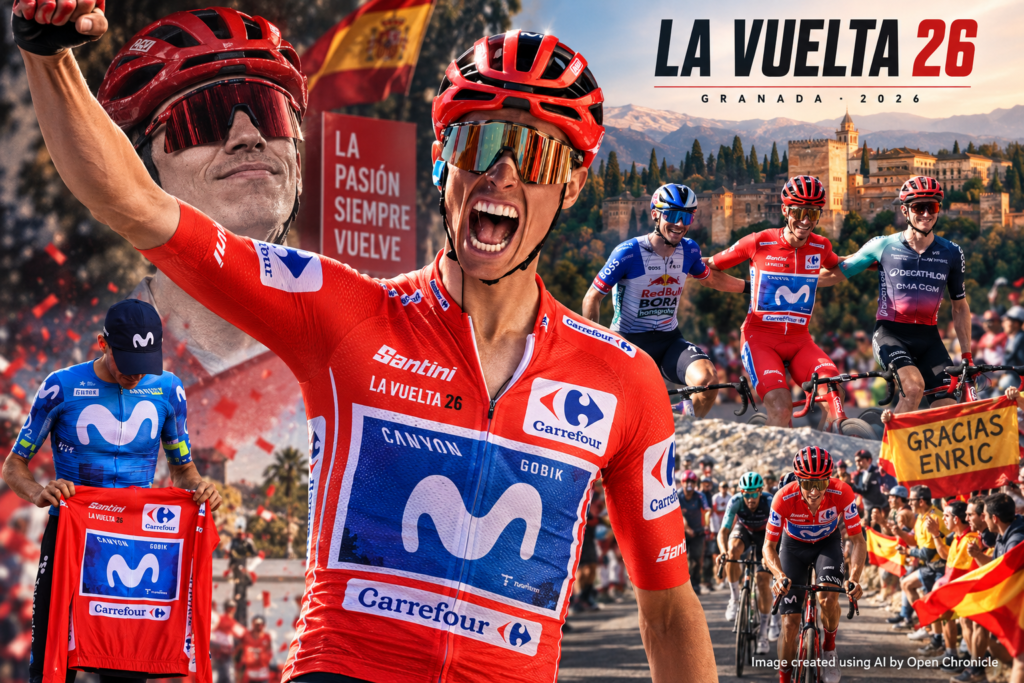
The 2026 Vuelta a España began with Tadej Pogačar winning against the clock in Monaco and ended three weeks later with Enric Mas riding into Granada as a Grand Tour champion.
Between those two moments came a race of constant reinvention: extreme weather, mountain ambushes, sprint battles, a cancelled stage, five victories for Matthew Brennan, Wout van Aert attacking across terrain, Stefan Küng dominating the race against the clock and a final mountain confrontation that confirmed Mas as the strongest and most consistent rider of the 81st edition.
When the race finally reached Granada on Sunday, Mas had done what had eluded him throughout a career spent repeatedly close to Grand Tour glory.
He had won La Vuelta.
The Movistar leader finished 2 minutes 15 seconds ahead of Primož Roglič, with Felix Gall third at 2:44. Richard Carapaz completed the race in fourth, while Sepp Kuss climbed to fifth overall during the decisive final weekend.
For Mas, it was more than another podium. It was his first Grand Tour victory — and the first Spanish victory at La Vuelta since Alberto Contador in 2014.
A Race That Refused to Follow the Script
La Vuelta started in Monaco with one of cycling’s biggest names immediately taking centre stage.
Tadej Pogačar won the opening individual time trial, establishing himself as the first race leader. He would strike again in Andorra on Stage 4 and at Castelló on Stage 6.
But Pogačar’s Vuelta would not reach Madrid — or, in this year’s case, Granada.
His crash and abandonment on Stage 8 fundamentally changed the character of the race. What initially appeared capable of becoming another Pogačar-controlled Grand Tour suddenly became an open contest.
The Red Jersey changed hands, opportunities multiplied and the race entered a much less predictable phase.
Extreme weather had already intervened. Stage 3 was cancelled, leaving the 21-stage programme with 20 official stage winners to be decided.
What followed was one of the most varied Vueltas in recent years.
Matthew Brennan Becomes the Breakout Star
If Mas ultimately owned the general classification, Matthew Brennan became one of the defining riders of the race.
The young British rider arrived at his debut Vuelta without the status of the established Grand Tour stars. He left it with five stage victories.
Brennan first won Stage 2 in Novara and later added victories in Guijuelo, Ponferrada, La Rábida and Sevilla.
His Stage 17 victory was especially significant because it completed a remarkable sequence of five wins in a single Grand Tour.
Brennan’s emergence was not simply about winning conventional bunch sprints. He repeatedly demonstrated the versatility needed to survive difficult terrain and still possess the acceleration required to finish the job.
By Granada, the Vuelta had produced another name capable of shaping the next generation of elite road racing.
The Mountains Reshape the Race
As the Vuelta moved deeper into Spain, the general classification became increasingly defined by the mountains.
Andreas Leknessund won at Valdelinares, Bastien Tronchon struck at Elche de la Sierra, and Jakob Omrzel took a major victory at Calar Alto.
The climbing stages steadily separated the genuine contenders from riders merely occupying high positions early in the race.
Mas emerged as the central figure.
He did not need to dominate every summit. Instead, his campaign was built on consistency, positioning and an ability to limit damage whenever his rivals attempted to isolate him.
Roglič remained the greatest threat.
The Slovenian had already built one of the most formidable Vuelta records of his generation and knew better than almost anyone how to manage a three-week Spanish Grand Tour.
Felix Gall also refused to disappear, while Richard Carapaz remained close enough to threaten the podium.
The final week therefore became less about identifying the favourites and more about determining whether anyone could finally break Mas.
Van Aert Everywhere
Another unmistakable presence was Wout van Aert.
Van Aert won Stages 13 and 15 and became the reference in the points competition.
His Vuelta once again demonstrated why traditional labels struggle to describe him. Sprinting, breakaways, rolling terrain and difficult transitional stages all offered opportunities.
Rather than being restricted to one particular type of day, Van Aert repeatedly found ways to influence the race.
By the final weekend he had established himself as the leader of the points classification, one of several secondary competitions that gave the Vuelta storylines well beyond the battle for red.
Santiago Buitrago led the mountains competition, while Oscar Onley emerged as the leading young rider.
Küng’s Race Against the Clock
Stage 18 offered a completely different test.
The 32.1-kilometre individual time trial in Jerez belonged to Stefan Küng.
The Swiss specialist produced one of the most authoritative performances of the Vuelta, using the discipline that has defined much of his career to take the stage.
More importantly for the overall race, the time trial changed the hierarchy behind Mas.
Roglič moved ahead of Gall and into second place overall.
Mas, however, survived.
The question entering the final mountain stages was becoming increasingly simple: could Roglič turn his superior time-trial performance into a successful attack in the mountains?
Eddie Dunbar Takes Peñas Blancas
Stage 19 to Peñas Blancas provided another opportunity to destabilise the Red Jersey.
Instead, it produced a superb victory for Eddie Dunbar.
The Irishman conquered the summit finish while Mas again successfully controlled the GC battle behind.
Roglič remained second. Gall stayed in contention. Carapaz continued hunting for an opportunity.
But there was now only one serious mountain stage remaining.
Mas had survived almost everything La Vuelta could throw at him.
One final examination remained.
Landa Wins the Queen Stage — Mas Wins the War
Stage 20 from La Calahorra to Collado del Alguacil, covering 186.8 kilometres, was designed to provide the final battlefield.
It delivered.
Mikel Landa attacked around seven kilometres from the summit and rode to one of the most prestigious victories of his season.
Landa finished 47 seconds ahead of Tobias Halland Johannessen, with Ramses Debruyne third at 1:27.
Behind the fight for the stage, the fight for La Vuelta reached its conclusion.
Roglič needed to crack Mas.
He couldn’t.
Mas controlled the attacks, managed his effort and reached the finish with his overall advantage intact.
When Stage 20 ended, his lead over Roglič stood at 2:15.
There was still another stage on the programme, but the battle for red was effectively over.
Enric Mas had won La Vuelta.
Johannessen Takes the Final Stage in Granada
The final day belonged to Tobias Halland Johannessen.
The Norwegian won Stage 21 in Granada, beating Ramses Debruyne and Alessandro Romele in the closing sprint.
For Johannessen, it was a significant personal triumph and a fitting conclusion to a race in which the next generation had repeatedly challenged established names.
For Mas, however, the day was about something entirely different.
There were no more mountains to defend, no time trial to survive and no Roglič attack to answer.
He could finally ride with the knowledge that the Red Jersey was his.
Mas crossed the finish with his Movistar team-mates and completed the transformation from perennial Grand Tour contender to Grand Tour winner.
Final General Classification
1. Enric Mas — Movistar Team
2. Primož Roglič — Red Bull–BORA–hansgrohe, +2:15
3. Felix Gall — Decathlon CMA CGM Team, +2:44
4. Richard Carapaz — EF Education–EasyPost, +6:54
5. Sepp Kuss — Team Visma | Lease a Bike, +8:45
The numbers tell part of the story, but Mas’s victory was defined just as much by what did not happen.
There was no catastrophic bad day.
No decisive mistake.
No mountain on which his rivals could finally leave him behind.
Across three weeks, that resilience became his greatest weapon.
Five Wins for Brennan, Three for Pogačar
The stage victories underline just how diverse the race became.
Matthew Brennan finished with an extraordinary five wins, the highest total of the race.
Pogačar collected three victories before his abandonment. Van Aert won twice. Other stages went to riders including Leknessund, Coquard, Tronchon, Omrzel, Marco Brenner, Küng, Dunbar, Landa and Johannessen.
There was no single team capable of controlling every terrain and no single type of rider capable of dominating the entire race.
That variety became one of the defining characteristics of the 2026 edition.
A Victory That Changes Mas’s Career
Enric Mas has spent years being judged against the victories he had not achieved.
Multiple Grand Tour podiums established his quality but simultaneously increased the pressure surrounding every new opportunity.
At the 2026 Vuelta, the distinction disappeared.
Mas is no longer simply a rider capable of challenging for a Grand Tour.
He is a Grand Tour winner.
And the historical significance goes beyond one rider.
Spanish cycling had waited since Alberto Contador’s 2014 victory for another home rider to win La Vuelta.
Twelve years later, Mas ended that wait.
For Movistar, the victory carries equally powerful symbolism. A Spanish rider, racing for Spain’s most recognisable WorldTour team, winning the country’s Grand Tour provides a result that reaches far beyond another entry in the team’s palmarès.
The Vuelta of a New Generation
The 2026 edition may also be remembered as a transitional Grand Tour.
Brennan won five stages.
Johannessen won in Granada.
Onley emerged among the leading young riders.
Omrzel won at Calar Alto.
At the same time, established riders such as Mas, Roglič, Van Aert, Landa, Carapaz and Küng remained central to the race.
That collision between generations gave the Vuelta much of its character.
The established hierarchy was still powerful, but it no longer controlled every story.
From Monaco to Granada
The race travelled from the glamour of Monaco to the mountains of Spain and ultimately to Granada.
Along the way it lost its biggest pre-race superstar, endured extreme weather, discovered new winners and produced a general-classification battle that remained alive until the final mountain weekend.
But every Grand Tour eventually becomes associated with one image.
For the 2026 Vuelta, it will be Enric Mas in red.
After years spent chasing the victory that would redefine his career, the Spaniard finally found it on home roads.
Enric Mas is the winner of the 2026 Vuelta a España.
And after three weeks of racing, that is the story that will remain.