
By Open Chronicle with agencies
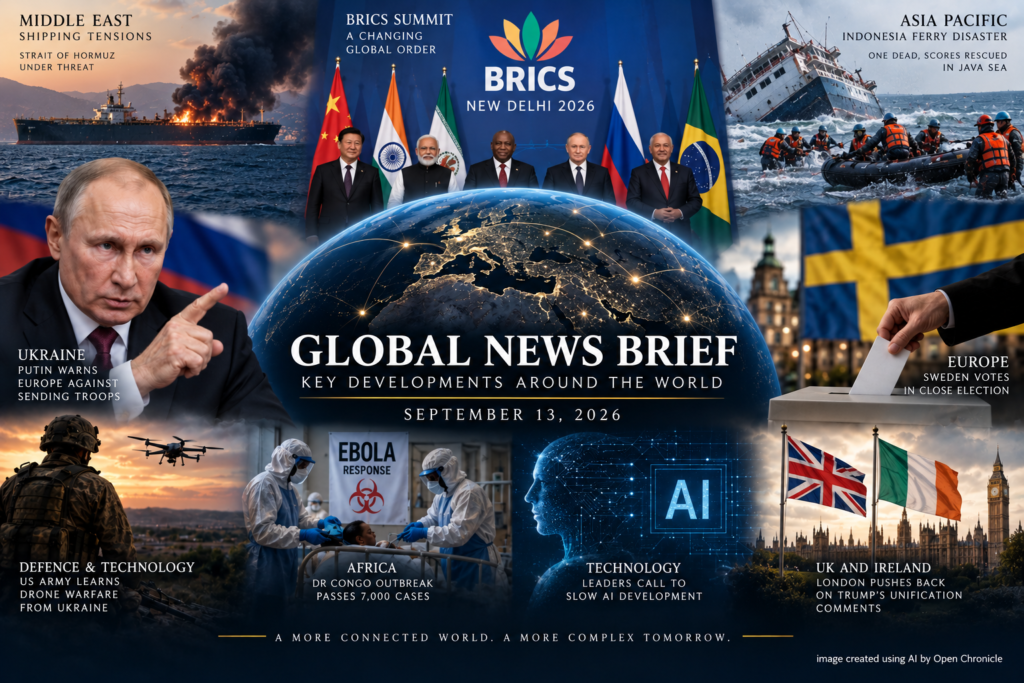
From the increasingly dangerous waters around the Strait of Hormuz and the Red Sea to a major maritime disaster in Indonesia, a closely fought election in Sweden and growing international concern over artificial intelligence, September 12 brought another day of rapidly moving global developments.
The second day of the BRICS summit in New Delhi placed diplomacy and the changing international order at the centre of the global agenda, while conflicts in the Middle East continued to threaten energy routes and commercial shipping. In Africa, the Democratic Republic of Congo is confronting an Ebola epidemic that has now surpassed 7,000 cases.
Middle East
Commercial vessels struck near the Strait of Hormuz
Maritime security concerns intensified after a commercial vessel was struck by an unidentified projectile in the Strait of Hormuz. The crew was evacuated following the incident, according to reports citing maritime security authorities. Separate reports said an Iranian commercial vessel was struck in the area, killing one person and wounding several others.
The incidents add another layer of uncertainty around one of the world’s most strategically important waterways. The Strait of Hormuz remains critical to international energy markets, making attacks on commercial shipping a potential threat far beyond the immediate conflict zone.
Houthis intensify Red Sea offensive against Saudi Arabia
Yemen’s Houthis claimed responsibility for further attacks against Saudi Arabia as their military campaign around the Red Sea continues to expand. Reports on Saturday said the group had used ballistic missiles and drones against a Saudi military target.
The escalation follows the Houthis’ recent territorial advances along Yemen’s western coast and mounting concerns over the security of the Bab el Mandeb Strait. Together with instability around Hormuz, the fighting is placing pressure on both major maritime gateways connecting Gulf energy producers with international markets.
Iran executes five Baloch prisoners
Iran executed five Baloch prisoners on drug related charges, according to reports emerging Saturday.
The executions come amid continuing international scrutiny of Iran’s use of capital punishment and heightened internal security measures during the wider regional conflict.
Asia Pacific
Indonesian maritime disaster leaves one dead and scores missing
A major search and rescue operation is underway in Indonesia after a vessel carrying 243 people went down in the Java Sea. Updated reports said at least one person had died and more than 100 people had been rescued, although a large number remained unaccounted for.
Earlier accounts had placed the number rescued at 86. Bad weather was reported in the area as authorities continued searching for survivors.
The changing figures reflect an active rescue operation, with the number of people located continuing to rise as emergency teams work across the affected area.
BRICS leaders continue New Delhi summit
BRICS leaders gathered in New Delhi for a second day of talks focused on economic cooperation, global governance and the growing role of emerging economies.
Indian Prime Minister Narendra Modi said confidence in BRICS was growing across the Global South, while Chinese President Xi Jinping called for stable and unobstructed international supply chains. The discussions also touched on technology, critical minerals and efforts to reform institutions of global governance.
The summit comes at a moment when BRICS countries are seeking greater influence over the architecture of the international political and economic system.
Europe
Sweden votes in closely contested election
Swedes went to the polls in a closely fought general election that could significantly reshape the country’s political landscape and potentially give the far right a role in government.
The contest is being closely watched elsewhere in Europe because of its implications for immigration policy, European cooperation and Sweden’s domestic political direction. Reports described the election as a potential turning point for the country’s far right.
Britain pushes back after Trump’s Irish reunification remarks
Political debate over the future of Northern Ireland intensified following President Donald Trump’s comments during his visit to Ireland that he would like to see the island reunified.
The remarks triggered criticism from unionist politicians and prompted a response from Britain, while reopening discussion about the constitutional arrangements established under the 1998 Good Friday Agreement.
The controversy has quickly become one of the most politically sensitive elements of Trump’s Irish visit, with further reports examining whether his remarks could encourage renewed debate over referendums elsewhere in the United Kingdom.
Türkiye criticizes US decision on Greek Cypriot arms restrictions
Türkiye criticized Washington’s decision to extend a waiver concerning restrictions on arms supplies to the Greek Cypriot administration.
The issue remains sensitive because of the unresolved division of Cyprus and the competing security concerns of Türkiye, Greece, Greek Cypriots and Turkish Cypriots. The Turkish Cypriot authorities also expressed regret over the US decision.
Americas and Defence
US Army studies Ukraine’s drone warfare experience
The US Army is drawing lessons from Ukraine’s extensive battlefield use of drones as it seeks to adapt its tactics and military organization to a rapidly changing form of warfare.
Ukraine’s war with Russia has demonstrated how relatively inexpensive unmanned systems can be used for reconnaissance, communications, targeting and attacks while forcing conventional armies to rethink camouflage, electronic warfare and battlefield movement.
For Washington, the lessons are increasingly influencing preparations for future conflicts in which drones are expected to operate alongside traditional artillery, aircraft and armored forces.
Technology
Leading AI figures support calls to slow development
Debate over the speed of artificial intelligence development intensified after prominent technology leaders reportedly backed Anthropic chief executive Dario Amodei’s call for the industry to consider slowing the development of increasingly powerful systems.
Amodei has proposed a three step approach to addressing the risks surrounding advanced AI, while the wider debate has drawn attention from other technology leaders and political figures.
The discussion reflects a growing divide within the technology sector over whether the race toward more capable AI systems is moving faster than governments, companies and society can safely manage.
Africa
DR Congo Ebola epidemic surpasses 7,000 cases
The Democratic Republic of Congo’s Ebola outbreak has passed 7,000 cases, according to reports describing it as the country’s worst epidemic of the disease.
The scale of the outbreak places additional pressure on health authorities already operating in difficult conditions and raises concerns about containment, treatment capacity and the possibility of further transmission.
The crisis is likely to require sustained international public health support as authorities attempt to bring the epidemic under control.
A world shaped by overlapping crises
The day’s developments illustrate how several major international pressures are increasingly intersecting.
Instability around the Strait of Hormuz and Bab el Mandeb threatens two of the world’s most important maritime corridors. BRICS leaders are simultaneously debating how emerging powers should shape a changing international system. Europe faces renewed political tensions over nationalism and territorial questions, while the United States and other military powers are adapting to technological changes demonstrated on the Ukrainian battlefield.
Beyond geopolitics, the Indonesian maritime disaster and Congo’s worsening Ebola epidemic are reminders that humanitarian emergencies continue alongside the major strategic crises dominating international attention.