
By Open Chronicle News Desk
Tesla has begun offering paid rides in its purpose-built Cybercab in Austin, Texas, taking one of the most significant steps yet toward Elon Musk’s long-promised vision of fully autonomous transportation.
The service began operating on a limited basis in early September with 45 vehicles authorized to carry passengers in Austin. Unlike conventional cars equipped with increasingly sophisticated driver-assistance technology, the Cybercab has been designed around the assumption that there will be no human driver at all.
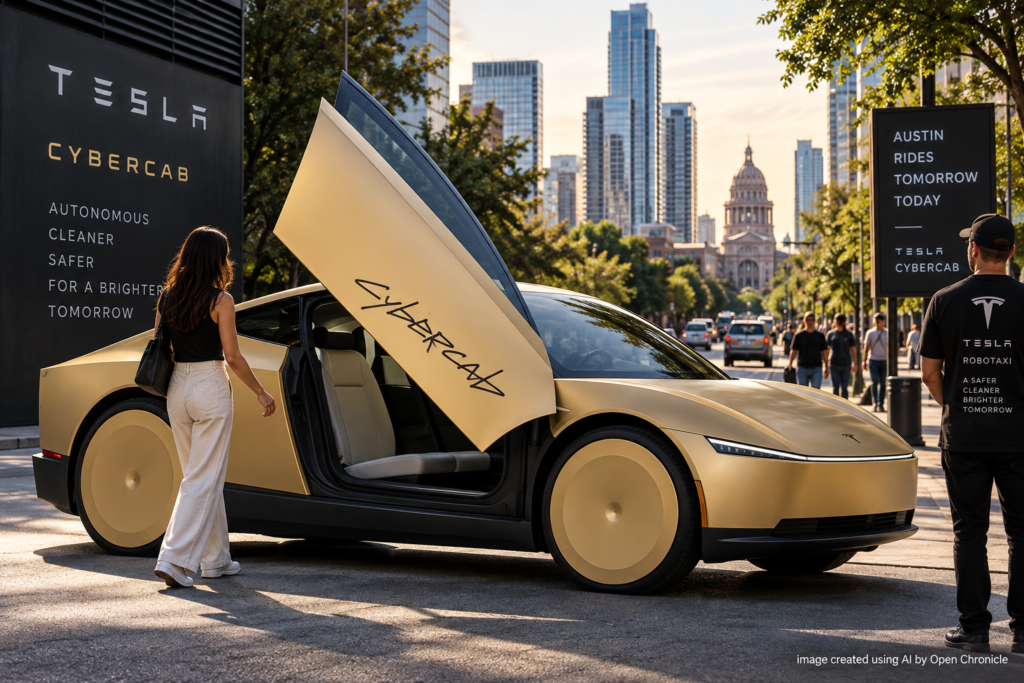
There is no steering wheel, no accelerator or brake pedals, and no conventional rear-view mirrors. For passengers, that makes the Cybercab not simply an autonomous version of an existing vehicle, but a machine designed from the outset for a future in which software replaces the person behind the wheel.
The launch, however, has immediately reopened one of the biggest arguments surrounding autonomous vehicles: how much sensing technology is enough when human intervention is no longer possible?
Tesla puts cameras and AI at the centre
Tesla has taken a markedly different technological path from several of its autonomous-driving rivals.
The Cybercab relies on eight cameras combined with Tesla’s AI4 computing platform. Artificial intelligence interprets the visual information and makes driving decisions without the extensive array of lidar and ultrasonic sensors used by many competing autonomous vehicles.
The philosophy reflects Musk’s long-standing argument that autonomous driving can ultimately be achieved largely through computer vision and artificial intelligence.
It could also make the vehicles considerably cheaper.
Waymo’s sixth-generation autonomous system, by comparison, combines 13 cameras with four lidar units and six radar sensors. Amazon-owned Zoox similarly uses several types of sensors, including cameras, lidar and infrared technology.
Such redundancy is intended to ensure that if one type of sensor performs poorly, another can continue providing information about the vehicle’s surroundings.
Tesla’s decision to dispense with much of that hardware reduces complexity and potentially manufacturing costs, but critics argue that it also removes layers of redundancy that could become important in difficult conditions.
Regulators move quickly
The Cybercab’s debut has already attracted scrutiny from the National Highway Traffic Safety Administration. According to UOL, the US regulator opened an audit of the vehicle only hours after paid operations began.
The attention comes against a broader backdrop of regulatory concern surrounding Tesla’s automated-driving technology.
An investigation involving approximately 3.2 million conventional Tesla vehicles had previously examined crashes in conditions including fog, dust and strong sunlight, circumstances in which camera-based systems can face additional difficulties. Nine crashes, including one fatal accident, were cited in connection with that investigation, according to the UOL report.
That history matters because the Cybercab uses an evolution of Tesla’s existing autonomous-driving software.
The consequences of a technical weakness are potentially more significant in a vehicle without conventional controls. A passenger cannot simply grab the steering wheel if something goes wrong because there is no steering wheel to grab.
If regulators eventually determine that additional sensors are necessary, Tesla could face costly modifications to a vehicle whose economics depend partly on eliminating hardware its competitors consider essential.
The controversial economics behind Cybercab
Tesla is not merely trying to demonstrate that a robotaxi can drive itself. Musk wants to change the economics of transportation.
The company is targeting a future Cybercab price below $30,000 and an operating cost of approximately $0.20 per mile. Musk has described the concept as a form of individualized public transportation. These remain company targets rather than demonstrated economics at large commercial scale.
Tesla is also introducing a different manufacturing strategy known as the “unboxed” process. Instead of assembling a vehicle primarily through a traditional sequential production line, major sections can be built in parallel before being brought together later in production.
Tesla hopes that approach will reduce manufacturing costs and accelerate production.
Musk has outlined an extraordinarily ambitious long-term objective of producing as many as two million Cybercabs annually, equivalent to roughly one vehicle every ten seconds at full-scale production.
Whether Tesla can reach anything approaching that level remains uncertain.
Robotaxis are becoming central to Tesla’s future
Cybercab arrives at an important moment for Tesla.
The company sold approximately 1.63 million vehicles in 2025, according to the UOL report, representing an 8.5 percent decline from the previous year and the largest annual sales fall in its history. Profit also fell sharply.
Autonomous vehicles have consequently become increasingly important to the investment case surrounding the company.
Morgan Stanley analysis cited by UOL estimates that almost one third of Tesla’s current market value is associated not with its existing vehicle business but with expectations surrounding its future robotaxi operations.
That creates enormous pressure for Tesla to demonstrate that autonomous driving can move from technological promise to commercially viable transportation.
Musk has made similarly ambitious predictions before. In 2019, he predicted that more than one million autonomous Tesla taxis could be operating the following year. That did not happen.
Even analysts generally positive about Tesla have warned that building a profitable autonomous transportation network could take considerably longer than Musk’s public timelines suggest.
Waymo illustrates the scale of the challenge. The company began autonomous vehicle testing in 2009 and, despite years of investment and development, operates a fleet numbering only in the thousands.
A car designed for a world without drivers
The Cybercab nevertheless represents something important in the evolution of the automobile.
For decades, autonomous-driving technology was largely added to vehicles fundamentally designed for humans. The steering wheel remained in front of the driver’s seat because a person was still expected to take control when necessary.
Cybercab removes that assumption.
Its two-seat cabin, gull-wing doors and absence of driving controls transform the occupant from driver into passenger by design.
The bigger question is no longer simply whether a computer can drive a car.
It is whether regulators and the public will accept a vehicle in which the computer is the only driver.
Austin’s small fleet of 45 Cybercabs will therefore test far more than Tesla’s artificial intelligence. It will test whether Musk’s vision of inexpensive, camera-based autonomous transportation can survive the safety, regulatory and economic realities of the road.
For Tesla, the answer could shape the company’s future.