
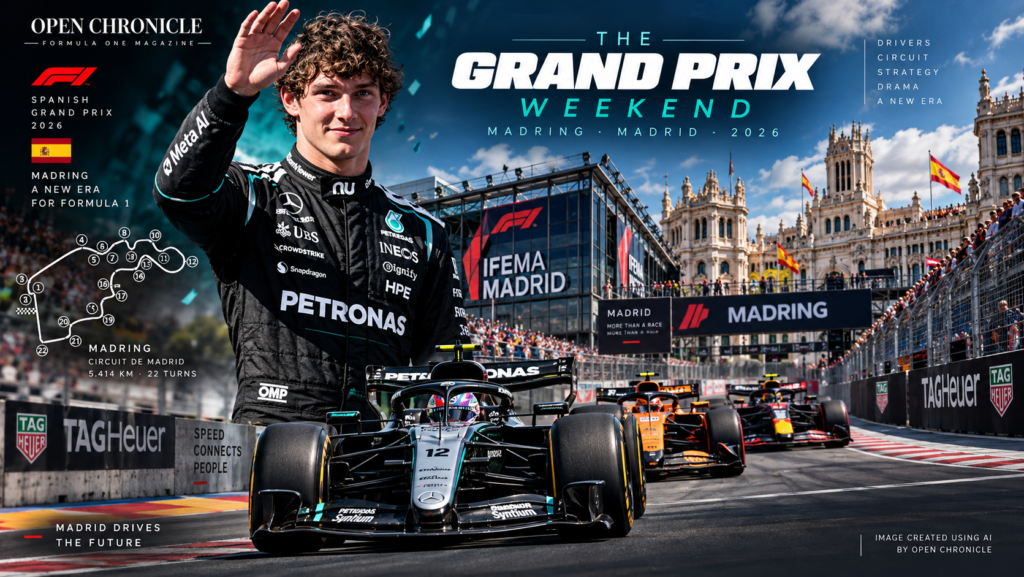
Mercedes set the benchmark through practice, McLaren found the decisive qualifying performance, and Kimi Antonelli converted pace and strategic opportunity into victory. The first Spanish Grand Prix at the Madring revealed a remarkably close battle between Formula 1’s leading teams.
By Open Chronicle Formula One Magazine
Formula 1 arrived at the Madring without a historical reference point.
There were no previous race weekends to analyse, no established setup philosophy and no reliable record of how the circuit would evolve as rubber accumulated on its new surface. Every lap completed during the Spanish Grand Prix weekend therefore added another piece to a performance picture that was changing almost by the hour.
By Sunday evening, however, several conclusions had emerged.
Mercedes possessed perhaps the strongest overall package. McLaren produced the fastest qualifying lap. Ferrari repeatedly demonstrated competitive speed. Max Verstappen kept Red Bull within striking distance.
And Kimi Antonelli ultimately delivered the performance that mattered most.
The championship leader topped two of the three practice sessions, missed pole position by only 0.011 seconds and then became the first Formula 1 driver to win a Grand Prix at the Madring.
Mercedes Establishes the First Benchmark
George Russell became Formula 1’s first practice leader at the Madring when he topped FP1 with a 1:34.077.
It was an encouraging opening statement from Mercedes, made stronger by Antonelli completing a team one two with a 1:34.363.
Ferrari was immediately close. Charles Leclerc finished third on 1:34.536 and Lewis Hamilton followed with a 1:34.620.
The difference between Russell and Hamilton was only 0.543 seconds, despite teams still learning a completely unfamiliar circuit and running different tyre programmes.
More importantly, Mercedes already appeared comfortable with the fundamental balance of its car.
Russell had the fastest lap, Antonelli was close behind, and the team had immediately placed both cars at the front of the field.
Antonelli Takes Control
FP2 shifted the internal Mercedes balance.
Antonelli produced a 1:33.662 to take the fastest time of the session, beating Leclerc by 0.113 seconds and Hamilton by 0.149.
The Ferrari challenge remained strong, but Antonelli had become the new reference.
Russell was fifth with a 1:33.999, while Arvid Lindblad produced an impressive fourth fastest time before an accident brought out the red flag.
The session was particularly difficult to interpret for McLaren because Lando Norris suffered a gearbox related problem and failed to record a representative lap.
Oscar Piastri nevertheless finished seventh, suggesting that the underlying performance of the McLaren remained considerably stronger than the timing screen alone suggested.
Antonelli, meanwhile, had begun establishing a pattern that would continue through Saturday.
He was fast immediately, increasingly confident around the Madring and capable of extracting performance as the circuit evolved.
FP3 Confirms the Pattern
The final practice session provided the clearest indication yet of how close qualifying might become.
Antonelli improved to 1:32.797.
Leclerc was only 0.166 seconds behind.
Piastri was 0.189 seconds away.
Norris, having recovered from his difficult Friday, finished 0.236 seconds behind Antonelli.
Verstappen completed the top five, 0.375 seconds from the Mercedes.
Four different teams therefore occupied the first five positions.
| Position | Driver | Team | FP3 time | Gap |
|---|---|---|---|---|
| 1 | Kimi Antonelli | Mercedes | 1:32.797 | |
| 2 | Charles Leclerc | Ferrari | 1:32.963 | +0.166 |
| 3 | Oscar Piastri | McLaren | 1:32.986 | +0.189 |
| 4 | Lando Norris | McLaren | 1:33.033 | +0.236 |
| 5 | Max Verstappen | Red Bull Racing | 1:33.172 | +0.375 |
| 6 | George Russell | Mercedes | 1:33.499 | +0.702 |
The session was disrupted by accidents involving Hamilton and Oliver Bearman, but the competitive message at the front was unmistakable.
Mercedes remained the reference, but its advantage was small enough to disappear through a single mistake, setup change or exceptional qualifying lap.
The Madring Gets Faster
Perhaps the most revealing performance trend of the weekend was not attached to any individual team.
It was the circuit itself.
Russell’s FP1 benchmark was 1:34.077. By FP3, Antonelli had reduced the fastest time to 1:32.797.
Then qualifying pushed the limit even further.
Norris eventually claimed pole with a 1:31.824.
That meant the outright benchmark improved by 2.253 seconds between FP1 and qualifying.
The progression illustrated just how rapidly the new surface evolved as more rubber was deposited and teams became increasingly confident about setup and braking references.
Antonelli’s own progression tells the same story.
He recorded 1:34.363 in FP1, 1:33.662 in FP2, 1:32.797 in FP3 and finally 1:31.835 in Q3.
Across the weekend, Antonelli found 2.528 seconds between his FP1 and qualifying benchmarks.
McLaren Strikes When It Matters
Mercedes had led every practice session.
Then Norris changed the story.
Antonelli produced a superb final Q3 lap of 1:31.835, becoming the first driver of the weekend to break into the 1:31 range and briefly taking provisional pole.
Norris responded almost immediately.
1:31.824.
The difference was 0.011 seconds.
Verstappen completed his final attempt in 1:31.964, enough for third but 0.140 seconds away from Norris.
Hamilton took fourth for Ferrari with a 1:32.013, only 0.006 ahead of Leclerc.
Russell was sixth, followed by Piastri.
The top six therefore contained Mercedes, McLaren, Red Bull and Ferrari.
There was no dominant qualifying package.
There was simply an exceptionally narrow performance window, and Norris extracted the most from it when the circuit was at its fastest.
Qualifying Performance
| Position | Driver | Team | Q3 time | Gap |
|---|---|---|---|---|
| 1 | Lando Norris | McLaren | 1:31.824 | |
| 2 | Kimi Antonelli | Mercedes | 1:31.835 | +0.011 |
| 3 | Max Verstappen | Red Bull Racing | 1:31.964 | +0.140 |
| 4 | Lewis Hamilton | Ferrari | 1:32.013 | +0.189 |
| 5 | Charles Leclerc | Ferrari | 1:32.019 | +0.195 |
| 6 | George Russell | Mercedes | 1:32.149 | +0.325 |
| 7 | Oscar Piastri | McLaren | 1:32.294 | +0.470 |
Only 0.195 seconds separated pole position from fifth place.
That figure perhaps describes the competitive level of the inaugural Madring weekend better than anything else.
Norris Controls the Opening Phase
Qualifying performance translated into race performance for Norris.
Starting from pole, the McLaren driver survived Antonelli’s attacks through the opening sequence and began establishing control.
Antonelli twice ran through the chicane while fighting Norris, and Verstappen briefly capitalised on the Mercedes driver’s aggression.
Once the order settled, however, Norris began opening the gap.
By lap seven he was approximately 4.7 seconds ahead of Antonelli.
McLaren also believed Norris was managing his tyres better than the Mercedes.
At that stage, the performance picture appeared clear.
Norris had taken pole and was converting his Saturday speed into Sunday control.
Then the race changed.
The VSC Changes the Performance Equation
The Virtual Safety Car on lap 15 became the decisive strategic moment.
Norris had just passed the pit entry.
Antonelli, Verstappen and Russell had not.
They could stop immediately under the neutralisation and reduce the effective time lost during their tyre changes.
Norris had to continue for another lap.
When McLaren finally brought him in, a slow stop added to the damage. The pole sitter returned to the circuit in fifth position.
Nothing about the episode suggested Norris had suddenly lost underlying performance.
Instead, the competitive equation had been changed by timing.
Antonelli had been given an opportunity.
The challenge was now to convert it.
Antonelli Converts Opportunity Into Victory
Antonelli’s performance after the VSC was different from the aggressive opening laps.
He had to manage.
He reported concerns about the steering and was warned by Mercedes not to destroy his tyres while chasing Leclerc.
Later, he touched the wall at the entrance to Turn 7.
Yet none of those moments developed into a race ending problem.
As the alternative strategies gradually unfolded, Antonelli moved towards the effective lead.
Leclerc delayed his stop until lap 49. Once the Ferrari entered the pits, Antonelli inherited first place.
Verstappen attempted to respond.
Norris, recovering from the VSC setback, arrived behind the Red Bull.
But Antonelli maintained enough pace to pull clear of the fight behind him.
The Italian began lap 57 as the leader and completed it as the first Formula 1 Grand Prix winner at the Madring.
Mercedes Had the Most Complete Weekend
The final result did not mean Mercedes was fastest in every circumstance.
It was not.
McLaren had pole.
Norris appeared to possess the strongest combination of pace and tyre management during the opening phase of the race.
Ferrari was consistently close throughout practice and qualifying.
Verstappen placed Red Bull firmly inside the leading group.
But Mercedes produced the most complete performance across the entire event.
Russell led FP1.
Antonelli led FP2.
Antonelli led FP3.
Antonelli missed pole by 0.011 seconds.
Antonelli won the race.
That sequence demonstrates something more significant than a single victory.
The Mercedes was competitive across changing temperatures, fuel loads, tyre compounds and track conditions.
Ferrari Had Speed, But Not the Result
Ferrari’s performance deserves separate consideration because the final classification understates some of its potential.
Leclerc was third in FP1, second in FP2 and second again in FP3.
Hamilton was fourth in FP1 and third in FP2 before crashing during FP3.
Then both Ferraris reached the sharp end of qualifying, Hamilton taking fourth and Leclerc fifth, separated by only six thousandths.
Sunday was different.
Hamilton’s race ended with a brake problem, while Leclerc’s long first stint eventually resulted in fourth place.
Ferrari therefore demonstrated genuine speed but failed to translate that performance into a podium.
McLaren Leaves With Mixed Evidence
McLaren’s weekend was almost the reverse.
Friday was compromised, particularly for Norris.
Saturday showed the true potential of the car.
Sunday initially confirmed it.
Norris went from losing almost the entire FP2 session to taking pole and controlling the first phase of the Grand Prix.
His third place therefore needs context.
The final classification says Mercedes, Red Bull, McLaren.
The early race suggested something different.
Norris had the pace to win.
The VSC changed his strategic position before the underlying performance advantage could be converted into victory.
Piastri’s weekend was more difficult. After qualifying seventh, contact with Russell at the start and front wing damage complicated his race. A long strategy eventually helped him recover to eighth.
Red Bull Remains a Threat
Verstappen never established Red Bull as the outright benchmark, but he remained close enough to exploit opportunities.
He was fifth in FP1, sixth in FP2 and fifth in FP3.
Then qualifying produced a major step forward.
His 1:31.964 put him third on the grid, only 0.140 seconds behind Norris.
On Sunday he remained inside the strategic battle and eventually finished second, resisting intense pressure from Norris during the closing laps.
The result showed that even when Red Bull was not setting the pace, Verstappen remained capable of extracting a major result from the available performance.
Audi Shows Midfield Potential
Audi’s weekend also contained encouraging signs.
Nico Hülkenberg reached eighth in FP3 and eventually scored the final point with tenth place in the race.
Gabriel Bortoleto moved progressively closer to the top ten during practice, finishing 11th in FP1, 13th in FP2 and tenth in FP3.
He was eliminated in Q2 and qualified 12th.
His race was compromised by a difficult opening lap and an extremely long first stint on hard tyres. Audi kept him out until lap 48 while hoping for another neutralisation that never arrived.
Bortoleto eventually finished 13th.
The result was disappointing, but the weekend suggested that Audi had enough underlying performance to contest the lower reaches of the points.
Performance Through the Weekend
| Session | Benchmark | Team | Result |
|---|---|---|---|
| FP1 | George Russell | Mercedes | 1:34.077 |
| FP2 | Kimi Antonelli | Mercedes | 1:33.662 |
| FP3 | Kimi Antonelli | Mercedes | 1:32.797 |
| Qualifying | Lando Norris | McLaren | 1:31.824 |
| Race | Kimi Antonelli | Mercedes | Winner |
The pattern is revealing.
Mercedes controlled Friday and Saturday practice.
McLaren delivered when qualifying reached its decisive moment.
Norris controlled the beginning of the race.
Mercedes reacted perfectly when the strategic opportunity appeared.
Antonelli completed the job.
The Performance Verdict
The inaugural Madring weekend did not produce a single dominant team.
Instead, it revealed four different competitive strengths.
Mercedes had the most complete overall package. McLaren possessed enough outright performance to take pole and potentially win. Ferrari had front running speed but failed to maximise the result. Red Bull remained close enough for Verstappen to turn opportunity into second place.
Above all, the weekend strengthened Antonelli’s position as the benchmark of the 2026 season.
He did not take pole.
He did not control the opening stint.
He was not handed an easy race.
But when circumstances changed, he was in position to exploit them.
That combination of speed, consistency and execution turned a competitive Mercedes into the winning car.
At a circuit where Formula 1 had no previous history, Kimi Antonelli became its first reference.
FP2 leader. FP3 leader. Second on the grid by 0.011 seconds. Grand Prix winner.
For the first Formula 1 weekend at the Madring, that was the defining performance.