
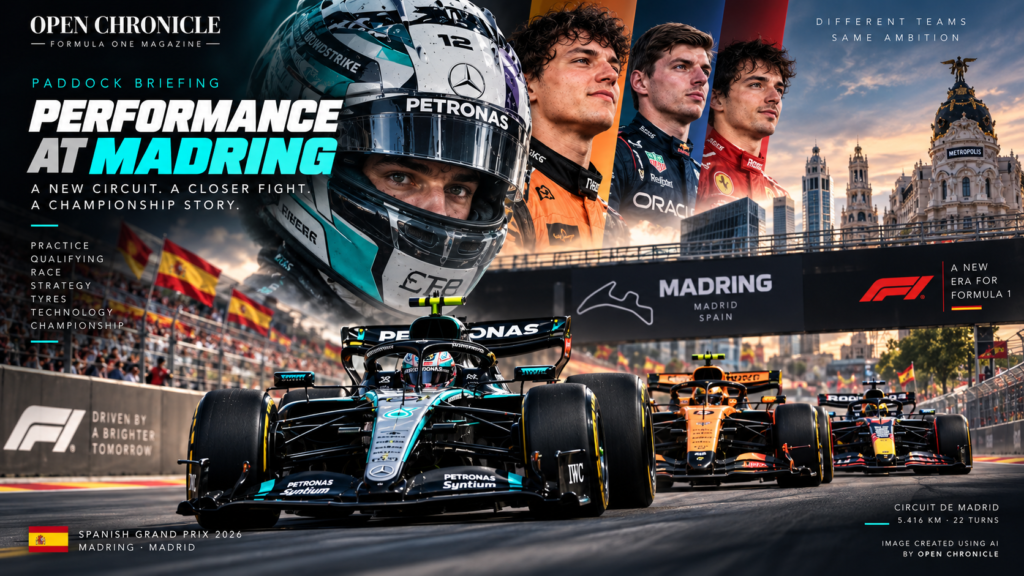
Mercedes controlled practice, McLaren found the fastest qualifying lap, Red Bull remained firmly in contention and Ferrari showed flashes of genuine front running pace. After Formula 1’s first weekend at the Madring, the competitive picture is becoming clearer, but not necessarily simpler.
By Open Chronicle Formula One Magazine
Formula 1 arrived in Madrid with almost no real world reference data.
Simulators had provided thousands of virtual kilometres, engineers had models for tyre loads and aerodynamic requirements, and Pirelli had spent years preparing for the demands of the new circuit. None of that could completely reproduce what would happen when 22 Formula 1 cars finally began putting rubber onto the Madring asphalt.
By Sunday evening, the paddock had considerably more information.
And perhaps the strongest conclusion was this: Mercedes remains the most complete performance reference of the 2026 season, but its advantage is far from absolute.
George Russell led FP1. Kimi Antonelli led FP2. Antonelli led again in FP3. Mercedes therefore completed a clean sweep of practice before Lando Norris produced one of the laps of the season to take pole from Antonelli by just 0.011 seconds.
Twenty four hours later, Antonelli was the winner.
But the route to that victory revealed considerably more about the current Formula 1 hierarchy than the final classification alone.
Mercedes: The Most Complete Package
Madrid reinforced a trend that has become increasingly difficult for Mercedes’ rivals to ignore.
The team can produce competitive performance across different fuel loads, tyre compounds and track conditions.
Russell established the first serious benchmark of the Madring weekend with a 1:34.077 in FP1. Antonelli then moved the performance level forward, recording 1:33.662 in FP2 before lowering the benchmark again to 1:32.797 in FP3.
Mercedes therefore led every practice session.
Formula 1’s own Friday analysis described Antonelli as quick and confident around the new circuit, while Russell’s FP2 position was considered unrepresentative because he did not complete a representative qualifying simulation.
That matters.
The Mercedes performance was not simply the result of one driver finding an exceptional lap. Both cars demonstrated speed at different stages of the weekend.
Qualifying exposed the limits of that advantage. Antonelli produced a 1:31.835 in Q3, but Norris found another eleven thousandths.
Russell managed only sixth.
Mercedes therefore had the strongest practice profile without possessing an untouchable qualifying advantage.
Sunday restored the team’s position at the front, although circumstances played a major role.
Antonelli’s victory was his eighth of the season and increased his championship total to 292 points, 81 ahead of Russell on 211.
Madrid consequently provided another example of why Mercedes has become so difficult to beat across an entire Grand Prix weekend.
It does not necessarily have to dominate every individual session.
It simply has to remain close enough to exploit what happens next.
McLaren: The Peak Performance Is There
McLaren’s Madrid weekend was almost the opposite.
Friday was compromised, particularly for Norris, who lost virtually the entirety of FP2 because of a gearbox problem.
That made what happened on Saturday considerably more significant.
Norris entered his final Q3 attempt without having enjoyed the smooth preparation available to Mercedes. Antonelli had already produced a formidable 1:31.835.
Norris responded with 1:31.824.
Eleven thousandths separated them.
The FIA qualifying press conference revealed just how dramatic the improvement had been. Norris said he improved by roughly seven tenths on his final Q3 lap and described it as one of the best laps of his career.
That tells the paddock something important.
McLaren possesses enough ultimate performance to beat Mercedes.
The problem is extracting it consistently.
Oscar Piastri reinforced that impression. He was third in FP3, only 0.189 seconds behind Antonelli, but qualified seventh and finished eighth after contact with Russell and front wing damage complicated his race.
McLaren therefore leaves Madrid with a curious performance profile.
Its ceiling may be as high as anyone’s.
Its weekend execution was not.
Norris May Have Had the Fastest Race Package
The final result also risks disguising McLaren’s Sunday performance.
Norris started from pole and controlled the opening phase of the race. By lap seven he had established a gap of approximately 4.7 seconds over Antonelli.
That was not qualifying speed.
That was sustained race performance.
The decisive change came when the Virtual Safety Car was deployed shortly after Norris had passed the pit entry. Antonelli and several rivals could stop at reduced strategic cost. Norris could not respond until the following lap.
His subsequent McLaren stop took around seven seconds, compounding the damage. Reuters reported that Antonelli himself acknowledged after the race that Norris had deserved the victory.
That distinction is crucial for the Paddock Briefing.
Antonelli won the race, but Madrid does not provide convincing evidence that Mercedes possessed the fastest race car on Sunday.
McLaren has a legitimate argument that Norris did.
The championship leader and Mercedes were simply better positioned when the race changed.
Red Bull: Verstappen Keeps the Car in the Conversation
Max Verstappen’s Madrid weekend was another reminder of how difficult it is to separate Red Bull’s underlying performance from Verstappen’s individual contribution.
He qualified third, just 0.140 seconds from Norris.
Then he finished second.
That represents a very competitive weekend on paper.
But Red Bull never established the same broad performance footprint as Mercedes.
Verstappen had already warned before the race that overtaking would be extremely difficult at the Madring. He believed tyre degradation represented one of the few variables capable of opening opportunities.
That prediction proved significant.
The race became highly dependent on track position and strategy, and Verstappen used both effectively enough to keep Norris behind during the closing stages.
Norris appeared to have more pace, but Verstappen repeatedly positioned the Red Bull correctly and denied him a clean opportunity.
That makes Red Bull difficult to classify.
It was not the dominant force.
It was not clearly the fastest car.
But with Verstappen inside it, the car remained capable of fighting Mercedes and McLaren.
That is enough to keep Red Bull relevant.
Ferrari: Speed Without the Result
Ferrari’s Madrid weekend may be the most frustrating to interpret.
There was real performance.
Charles Leclerc finished FP3 only 0.166 seconds behind Antonelli. In qualifying, Lewis Hamilton took fourth with 1:32.013 and Leclerc fifth with 1:32.019.
Six thousandths separated the Ferrari drivers.
Both were within two tenths of pole.
That is genuine front running territory.
But Ferrari again failed to convert that speed into the maximum available result.
Hamilton’s weekend was particularly turbulent. His FP3 crash caused a lengthy red flag while the TecPro barrier was repaired, yet Ferrari managed to rebuild the car in time for qualifying.
His fourth place on the grid therefore represented a significant recovery.
Sunday then collapsed.
Hamilton reported a brake problem and eventually retired, while Leclerc used an extremely long first stint before recovering to fourth.
The raw speed suggests Ferrari has not fallen away from the leading group.
The results continue to suggest something else.
For the paddock, that distinction matters. A car capable of qualifying within two tenths of pole is not fundamentally uncompetitive.
Ferrari’s challenge is converting that performance into complete weekends.
The Four Team Battle Is Real
FP3 provided perhaps the cleanest snapshot of the competitive order before qualifying.
| Position | Driver | Team | Time | Gap |
|---|---|---|---|---|
| 1 | Kimi Antonelli | Mercedes | 1:32.797 | |
| 2 | Charles Leclerc | Ferrari | 1:32.963 | +0.166 |
| 3 | Oscar Piastri | McLaren | 1:32.986 | +0.189 |
| 4 | Lando Norris | McLaren | 1:33.033 | +0.236 |
| 5 | Max Verstappen | Red Bull | 1:33.172 | +0.375 |
| 6 | George Russell | Mercedes | 1:33.499 | +0.702 |
Mercedes, Ferrari, McLaren and Red Bull were all represented inside the top five.
Qualifying compressed the picture even further.
Norris, Antonelli and Verstappen were separated by only 0.140 seconds.
Hamilton and Leclerc were less than two tenths further behind.
The implication is significant.
The current competitive order cannot reliably be described simply as Mercedes first, McLaren second, Ferrari third and Red Bull fourth.
Circuit characteristics, tyre preparation, fuel load, setup choices and individual driver execution can rearrange those four teams.
Madring Exposed the Importance of Tyre Performance
The circuit itself deserves part of the explanation.
Before the weekend, Pirelli classified Madring among the five most demanding circuits of the championship in terms of energy transmitted to the tyres.
The 5.416 kilometre layout contains 22 corners, significant elevation change and the extraordinary 550 metre La Monumental section with 24 percent banking. Pirelli calculated that lateral loads would be comparable to Barcelona and Silverstone, while La Monumental would generate the highest vertical tyre load of the season.
Pirelli selected the C2, C3 and C4 compounds.
The original simulations suggested the medium range could encourage two stop racing while providing protection against overheating in Madrid’s expected high temperatures.
Reality produced another complication.
Graining appeared during Friday running and tyre management rapidly became one of the paddock’s main technical discussions.
That helped explain why performance fluctuated so significantly between sessions and compounds.
Madrid was not simply a test of aerodynamic efficiency.
It was a test of whether teams could keep the tyres inside an effective operating window while learning a completely new surface.
The Track Evolution Was Enormous
There is another striking number from the weekend.
Russell’s FP1 benchmark was:
1:34.077
Norris’ pole lap was:
1:31.824
That represents an improvement of 2.253 seconds between the opening practice benchmark and pole position.
Some of that came from fuel loads, engine modes and qualifying preparation.
But the rapidly evolving surface was also an important factor.
For engineers, that creates a particularly difficult first weekend at a new circuit. Friday setup decisions are being made on a track that may behave substantially differently by Saturday afternoon.
The fastest team therefore needs not only a good starting setup, but also the ability to predict where the circuit is going.
Mercedes did that well.
McLaren arguably did it even better by qualifying.
The Overtaking Problem Is Real
One performance characteristic cannot be ignored.
Madring proved difficult for overtaking.
Before the race, Verstappen was already highly sceptical about the possibilities of passing. Drivers had discovered during practice that following another car closely was difficult, increasing the importance of qualifying and track position.
Sunday largely confirmed those fears.
There were overtakes, but several drivers spent long periods trapped behind cars despite possessing superior pace.
That changes how performance should be interpreted.
At some circuits, an advantage of two or three tenths can be converted into track position.
At Madring, that advantage may simply mean spending twenty laps looking at another car’s rear wing.
This makes qualifying performance disproportionately valuable.
Norris demonstrated precisely why when his 0.011 second advantage on Saturday initially gave him control of Sunday’s race.
Audi: Close to the Points, Not Yet Close to the Front
Further down the order, Audi produced one of the more interesting midfield performances.
Nico Hülkenberg reached eighth in FP3 and qualified 11th.
Gabriel Bortoleto improved across the weekend, moving from 11th in FP1 and 13th in FP2 to tenth in FP3 before qualifying 12th.
The race was less successful.
Bortoleto lost positions at the start and Audi extended his opening Hard tyre stint until lap 48, effectively waiting for another neutralisation that never arrived.
He eventually finished 13th.
Hülkenberg salvaged tenth and the final point.
The conclusion is relatively clear.
Audi possessed enough underlying performance to contest the lower end of Q3 and the points, but not enough margin to recover easily when strategy or track position worked against it.
Alpine and Racing Bulls Find Opportunity
Madrid also produced useful evidence from the midfield.
Liam Lawson finished sixth for Red Bull Racing, while Franco Colapinto delivered seventh for Alpine.
Arvid Lindblad finished ninth.
These results matter because they illustrate how compressed the midfield remains. A relatively small performance gain can move a driver several positions when qualifying gaps are measured in hundredths rather than tenths.
For teams outside the leading four, operational execution becomes almost as important as absolute car performance.
A clean qualifying lap, correct tyre preparation and well timed pit stop can transform a weekend.
The Championship Changes the Meaning of Performance
Antonelli’s victory has another consequence.
Performance can no longer be evaluated separately from championship position.
He arrived in Madrid with 267 points and a 66 point advantage over Russell.
He leaves with 292 points and an 81 point lead.
More importantly, this was his eighth Grand Prix victory of 2026.
The previous round at Monza had already demonstrated Antonelli’s ability to recover from adversity, winning from 19th on the grid. Madrid demonstrated something different.
He did not have to be unquestionably fastest.
He had to remain close enough to capitalise.
That is increasingly becoming the defining characteristic of his championship campaign.
Performance Ranking After Madrid
Based specifically on the evidence from the Madring weekend rather than the championship as a whole, the paddock picture looks like this:
Mercedes remains the strongest overall package. It led all three practice sessions, put Antonelli on the front row and converted Sunday into victory.
McLaren may possess an equally high performance ceiling. Norris took pole despite losing almost all of FP2 and appeared to have the strongest race pace before the VSC changed his afternoon.
Red Bull remains a threat whenever Verstappen can place the car in the operating window. Third on the grid and second in the race cannot be dismissed.
Ferrari possesses enough speed to fight at the front, but Madrid again exposed the difference between having performance and converting it.
Behind them, Racing Bulls, Alpine and Audi demonstrated just how little separates the midfield.
Paddock Briefing Verdict
Madrid did not produce a simple answer to the question of who has the fastest Formula 1 car.
It produced something more interesting.
Mercedes had the best overall weekend.
McLaren produced the fastest qualifying lap and arguably the strongest opening race stint.
Red Bull put Verstappen within 0.140 seconds of pole and then onto the second step of the podium.
Ferrari placed both cars within two tenths of the front in qualifying.
That is not domination.
It is convergence.
And yet one statistic continues to separate one driver from everybody else.
Kimi Antonelli: 292 points.
George Russell: 211.
Championship advantage: 81 points.
Nine Grands Prix remain on the official 2026 calendar after Madrid, beginning with Azerbaijan on September 24 to 26.
The performance battle remains remarkably close.
The championship increasingly does not.