
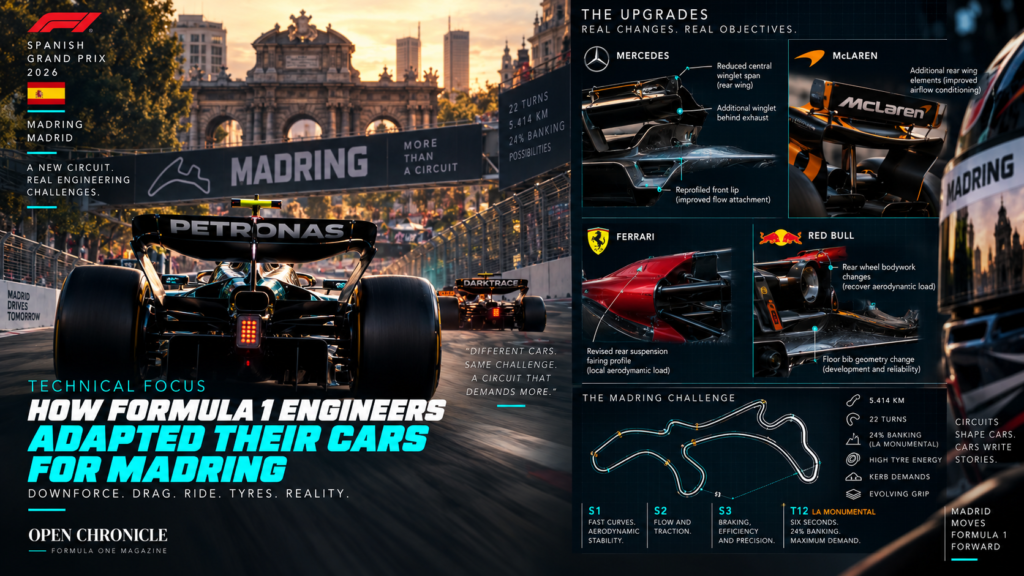
Madring presented Formula 1 engineers with an unusual combination of demands. Fast corners, heavy braking, kerb riding, a smooth but evolving surface, significant tyre loads and the spectacular banking of La Monumental forced teams to search for a compromise between aerodynamic efficiency, mechanical grip and ride control. Mercedes, McLaren, Ferrari and Red Bull all arrived in Madrid with technical changes, but the first weekend at the circuit quickly demonstrated that adapting a Formula 1 car to Madring required much more than simply adding downforce.
By Open Chronicle Formula One Magazine
Formula One had never raced at Madring before September 2026.
That made the Spanish Grand Prix much more than another exercise in finding the correct wing level.
Teams arrived with sophisticated simulations of the new Madrid circuit, but Friday immediately began exposing the difference between the circuit they had modelled and the one their cars were actually driving.
The track was bumpier than some simulations had suggested. Mechanical grip became important. Tyre graining appeared. Kerbs complicated the ideal aerodynamic platform. Energy deployment required attention.
And through all of this, the cars still needed to be fast.
The engineering challenge was therefore not to find one perfect characteristic.
It was to find the best compromise.
The Madring Engineering Problem
Madring presents several different engineering problems within a single lap.
There are high speed sections where aerodynamic stability matters enormously. There are braking zones where the driver needs confidence in the platform. There are slower corners where mechanical grip and traction become increasingly important.
Then there is La Monumental.
Turn 12, with banking reaching approximately 24 percent, places the car and tyres under unusual sustained loads. Pirelli expected Madring to rank among the five most demanding circuits of the season for energy transmitted through the tyres, with La Monumental producing the highest vertical tyre load of the year.
Those characteristics immediately create conflicting setup requirements.
A Formula One car generally benefits aerodynamically from running low and maintaining a controlled platform.
But Madring also requires cars to attack kerbs and absorb surface irregularities.
Lower and stiffer can improve aerodynamic control.
Higher and more compliant can improve the car’s ability to deal with bumps and kerbs.
Finding the point between those two objectives became one of the fundamental technical questions of the weekend.
Aerodynamics Versus Mechanical Reality
Audi sporting director Inaki Rueda described the dilemma particularly clearly during Friday running.
The high speed sections encourage teams to run the car low and stiff because that helps maintain the aerodynamic platform. But the requirement to attack kerbs, particularly around Turn 2, pushes the setup in the opposite direction.
A car that is too stiff may struggle to absorb the kerb.
Raise it too far and the aerodynamic platform may become less effective.
This is one of the great compromises of modern Formula One engineering.
The fastest theoretical aerodynamic configuration is not necessarily the fastest configuration around an actual circuit.
The car must survive the physical environment in which that aerodynamics operates.
Mercedes: Finding the Load and Drag Compromise
Mercedes arrived with specific aerodynamic changes for Madrid.
The team reduced the span of the central winglet associated with the rear wing configuration and introduced another small winglet behind the exhaust.
Mercedes explicitly described these changes as circuit specific, designed to produce an appropriate combination of load and drag for Madring.
That distinction is important.
Downforce helps the car corner.
But aerodynamic load generally comes with drag.
Drag reduces efficiency on the straights.
An engineer therefore cannot simply ask:
How much downforce can we generate?
The more useful question is:
How much downforce can we generate for the aerodynamic cost we are prepared to accept?
Madring demanded both cornering performance and efficiency, so Mercedes adjusted the car accordingly.
Mercedes Also Changed the Front of the Car
Another Mercedes modification involved a reprofiled front lip.
Unlike the rear wing changes, this was not described as exclusively Madring specific.
The objective was to improve flow attachment across different steering conditions.
That seemingly small detail illustrates an important characteristic of Formula One aerodynamics.
The car does not travel permanently in a straight line.
When the driver turns the steering wheel, the relationship between the front wheels and the surrounding airflow changes.
The aerodynamic environment changes with it.
An effective Formula One car therefore needs aerodynamic behaviour that remains predictable as steering angle, speed, ride height and vehicle attitude change.
Peak downforce is valuable.
Usable downforce is more valuable.
Why Flow Attachment Matters
Airflow that remains attached to the surfaces for which it was designed can help aerodynamic components behave more consistently.
If the flow becomes unstable or separates under particular operating conditions, the driver may experience a change in balance.
At Madring, where Antonelli described numerous situations involving braking while turning, predictable behaviour mattered.
The Mercedes modification was therefore not simply about producing a larger headline downforce figure.
It was about making the aerodynamic system work effectively across a broader range of conditions.
That is a recurring theme throughout Formula One engineering.
Performance is not only about the maximum.
It is about the operating window.
Mercedes Started Strongly
The early results were encouraging.
George Russell led FP1 with a 1:34.077.
Kimi Antonelli was second.
In FP2, Antonelli moved to the top with 1:33.662.
He then led FP3 with 1:32.797.
Three practice sessions.
Three Mercedes benchmarks.
The car appeared competitive across changing circuit conditions.
Mercedes trackside engineering director Andrew Shovlin nevertheless made clear that the team was still chasing the correct window. The tyres were difficult to activate initially, track grip continued evolving and the front tyres were being worked particularly hard.
That distinction prevents us from drawing the wrong technical conclusion.
Mercedes was fast.
That does not prove one new winglet made it fast.
Correlation Is Not Causation
This is particularly important when analysing Formula One upgrades.
Mercedes brought aerodynamic changes.
Mercedes then performed strongly.
It would be tempting to connect those statements directly.
But we cannot isolate the performance contribution of an individual component from public information alone.
The car’s speed resulted from the complete package.
Aerodynamics.
Suspension.
Tyres.
Setup.
Power unit.
Energy deployment.
Driver performance.
Track evolution.
What we can establish is that Mercedes arrived with a configuration intended to suit Madring’s load and drag requirements and subsequently demonstrated strong performance across the weekend.
That is evidence of a competitive package.
It is not evidence that one component alone created the result.
McLaren: Managing the Rear Wing Flow
McLaren approached the Madrid challenge with its own aerodynamic refinements.
The team introduced additional elements associated with the rear wing environment, intended to influence the airflow reaching the mainplane and flap system.
This is another example of how Formula One development frequently involves managing airflow rather than simply making a component larger or smaller.
A rear wing does not operate independently.
The quality, direction and energy of the airflow reaching it influence how effectively it can perform.
Small upstream changes can therefore have consequences further downstream.
The objective is to make the aerodynamic system work as a whole.
The declared Madrid upgrades across the field showed exactly this type of targeted development rather than wholesale redesign.
McLaren’s Weekend Demonstrated the Importance of Adaptation
Friday was difficult for McLaren.
Lando Norris effectively lost FP2 because of a gearbox related problem.
At a familiar circuit, losing a session is damaging.
At a completely new circuit, it is particularly expensive because every lap contributes to understanding the car’s relationship with the track.
Yet McLaren recovered.
Norris qualified on pole with:
1:31.824.
Antonelli was only 0.011 seconds behind.
That does not allow us to attribute pole position to a particular aerodynamic component.
It does demonstrate how rapidly a Formula One engineering group can recover from limited running and converge on a competitive configuration.
Ferrari: Small Change, Specific Objective
Ferrari’s declared technical intervention was comparatively subtle.
The team revised the profile of its rear suspension fairing with the stated objective of producing a local aerodynamic load benefit.
That is a fascinating example because it shows why the visible suspension of a Formula One car cannot be viewed only as a mechanical system.
Suspension components obviously have mechanical responsibilities.
But the external shapes that sit in the airflow also interact with the car’s aerodynamic environment.
That means engineers have to think about both worlds.
Mechanical function.
Aerodynamic consequence.
A small alteration around the rear suspension may therefore be designed not to transform the entire car, but to improve the behaviour of the airflow in a very specific region.
Ferrari Had Genuine Speed
The SF26 showed encouraging performance.
Leclerc finished FP2 only 0.113 seconds behind Antonelli.
In FP3 he was 0.166 seconds away.
Qualifying produced another striking comparison:
Hamilton: 1:32.013
Leclerc: 1:32.019
Only six thousandths separated the Ferrari drivers.
Both were within two tenths of Norris’ pole.
That suggests Ferrari’s fundamental package was competitive around Madring even if the final race result did not fully convert that speed into the outcome the team wanted.
Again, the technical lesson is not that a suspension fairing generated two tenths.
It is that Ferrari’s overall aerodynamic and mechanical package could operate competitively within Madring’s unusual combination of demands.
Red Bull: Looking Underneath the Car
Red Bull’s declared Madrid changes took us into another crucial area.
The team made changes around the rear wheel bodywork aimed at recovering aerodynamic load and also altered the geometry of the floor bib.
The floor is fundamental to the performance of modern Formula One cars.
And unlike a rear wing, much of its most important aerodynamic work occurs where spectators cannot easily see it.
Under the car.
Why the Floor Matters So Much
The floor is part of an aerodynamic system designed to manipulate pressure and airflow beneath the car.
The effectiveness of that system depends heavily on the relationship between the floor and the track.
Ride height matters.
Pitch matters.
Roll matters.
Kerbs matter.
Bumps matter.
This creates an engineering problem.
A floor can produce excellent performance under controlled conditions, but a Formula One car never remains perfectly controlled.
It brakes.
Accelerates.
Turns.
Rolls.
Moves vertically.
Hits kerbs.
Crosses bumps.
The challenge is therefore not simply to create enormous aerodynamic performance at one ideal ride height.
It is to maintain useful and predictable performance while the car moves.
Madring exposed exactly that challenge.
The Bumps Changed the Problem
Red Bull discovered on Friday that reality differed from expectation.
Technical director Pierre Waché said mechanical grip and ride were more challenging than anticipated. The track was bumpier than Red Bull had expected from its simulator work, while tyre behaviour also required attention.
This is an enormously important technical observation.
Imagine a car optimised to run at a particular height above the track.
Now introduce unexpected vertical movement.
The aerodynamic platform changes.
The floor’s relationship with the track changes.
The balance can change.
The driver’s confidence can change.
Tyre behaviour can change.
A circuit that is only slightly bumpier than expected can therefore produce consequences across multiple areas of the car.
Red Bull Had Another Problem: Energy
Waché also identified energy deployment as an area requiring work.
That is particularly relevant under the 2026 regulations.
The engineering compromise at Madring was not limited to downforce versus drag or stiffness versus kerb compliance.
Teams also needed to decide how electrical energy should be managed around a circuit containing very different types of corner and acceleration zone.
Red Bull therefore faced several interacting optimisation problems:
aerodynamic platform;
mechanical grip;
ride;
tyres;
and energy deployment.
That helps explain why a new circuit can be so difficult to solve even with advanced simulation.
Verstappen Still Put Red Bull in the Fight
Despite those difficulties, Max Verstappen qualified third.
His 1:31.964 was only 0.140 seconds slower than Norris’ pole.
He then finished second in the Grand Prix.
That result does not erase Red Bull’s Friday concerns.
Instead, it illustrates how effectively a team can improve a car after identifying its weaknesses.
Friday provides the diagnosis.
Saturday tests the treatment.
Sunday reveals how much of the problem has actually been solved.
The Setup Tradeoff Madring Exposed
Perhaps the most important technical lesson of the entire weekend was the conflict between aerodynamic optimisation and physical compliance.
The basic problem can be expressed simply:
| Engineering Direction | Potential Benefit | Madring Compromise |
|---|---|---|
| Lower ride height | Stronger aerodynamic platform | Greater sensitivity to bumps and kerbs |
| Stiffer car | More controlled aero platform | Reduced compliance |
| Higher ride height | Better kerb and bump tolerance | Potential aerodynamic cost |
| Softer setup | Improved mechanical compliance | Less precise platform control |
| More downforce | Cornering performance | Increased drag |
| Less downforce | Straight line efficiency | Reduced cornering support |
There is no universally correct answer.
The optimum depends on the circuit.
And at Madring, different parts of the circuit demanded different answers.
Turn 2 Versus La Monumental
This contrast can be understood through two parts of the lap.
At Turn 2, attacking the kerb can produce meaningful lap time.
The car needs sufficient compliance and ride characteristics to handle that aggression.
Then consider La Monumental.
Now the car is experiencing sustained load through a long, fast banked section where aerodynamic stability and tyre loading become critical.
The setup must work in both places.
A car designed only for the kerb compromise could sacrifice performance elsewhere.
A car optimised only for the fast aerodynamic sections could become difficult when the driver needs to attack the circuit physically.
That is the essence of circuit setup.
Not maximising one characteristic.
Balancing all of them.
Tyres Complicated Everything
Then came another variable.
Pirelli reported significant graining during Friday running, particularly on the left side tyres on some cars. The combination of high grip and an unusually smooth surface contributed to the phenomenon, while cars that slid more heavily could accelerate wear.
Pirelli also found degradation higher than initially expected and identified the Hard as an increasingly important race compound.
This connects directly to car setup.
A car that slides excessively does not merely lose immediate lap time.
It can damage tyre performance.
An aerodynamic or mechanical imbalance can therefore become a tyre problem.
The tyre problem then becomes a strategy problem.
This is why Formula One engineering departments cannot work as isolated systems.
Everything interacts.
The Front Tyres Became a Mercedes Concern
Mercedes identified the front tyres as an important area after Friday.
Russell noted high degradation in FP1, while Shovlin said the front tyres appeared to be having a particularly difficult time.
That creates another setup dilemma.
The engineer may want to change the balance to protect the front tyres.
But that change can alter qualifying performance.
It can influence rear stability.
It can change how the driver attacks the corner.
A setup optimised for one lap is not necessarily the setup required for 57 race laps.
Madring therefore forced teams to decide how much Saturday performance they were prepared to trade for Sunday stability.
Technical Development Is More Than New Parts
This is another important lesson from Madrid.
Technical development is often discussed through photographs of new wings and floors.
But a Formula One car can change dramatically without a major new component appearing.
Ride height can change.
Wing settings can change.
Suspension parameters can change.
Cooling configurations can change.
Tyre preparation can change.
Energy management can change.
Differential and other permitted driver settings can change.
The physical components are only the beginning.
The task is to make those components work together.
From Upgrade to Performance
The engineering process at Madring can therefore be understood as a chain:
Component
↓
Engineering Objective
↓
Circuit Requirement
↓
Setup
↓
Driver Feedback
↓
Telemetry
↓
Adjustment
↓
Performance
Mercedes did not simply install a different winglet and wait for the stopwatch.
McLaren did not simply modify rear wing airflow.
Ferrari did not simply reshape a fairing.
Red Bull did not simply change the floor.
Each modification became part of a much larger optimisation process once the cars entered the circuit.
What the Four Leading Teams Told Us
The declared changes provide a useful snapshot of their different approaches.
| Team | Technical Area | Declared Objective |
|---|---|---|
| Mercedes | Rear wing winglets | Circuit appropriate load and drag |
| Mercedes | Front lip | Improved flow attachment through steering conditions |
| McLaren | Rear wing environment | Improved airflow conditioning |
| Ferrari | Rear suspension fairing | Local aerodynamic load |
| Red Bull | Rear wheel bodywork | Recover aerodynamic load |
| Red Bull | Floor bib | Floor geometry development |
The details differ.
The underlying philosophy does not.
Every team was attempting to make airflow, mechanical behaviour and circuit requirements coexist more effectively.
The Cars Converged
The ultimate evidence of how competitive the engineering battle became arrived in qualifying.
Norris took pole with 1:31.824.
Antonelli was 0.011 seconds behind.
Verstappen was 0.140 away.
Hamilton followed at 0.189.
Leclerc was 0.195 behind.
Four manufacturers were represented inside two tenths of a second.
That is extraordinary convergence.
And each car had arrived at approximately the same stopwatch result through a different engineering philosophy.
Mercedes Ultimately Converted
Mercedes had been competitive from the beginning.
Russell led FP1.
Antonelli led FP2.
Antonelli led FP3.
Antonelli narrowly missed pole.
Then he won the race.
That makes Mercedes the clearest example of a package that operated effectively across the entire Madring weekend.
But even Mercedes did not simply dominate every condition.
McLaren produced the fastest qualifying lap.
Ferrari was within two tenths.
Red Bull qualified within 0.140 and finished second.
Madring did not reveal one technical solution.
It revealed several different ways of approaching the same engineering problem.
Technical Focus Verdict
The first Madring Grand Prix demonstrated why Formula One engineering cannot be reduced to a collection of aerodynamic upgrades.
Mercedes altered its rear wing configuration and front airflow treatment.
McLaren refined the aerodynamic environment around its rear wing.
Ferrari targeted local load around the rear suspension.
Red Bull worked around the rear wheel and floor.
But once Friday began, another engineering challenge emerged.
The circuit was bumpier than expected.
Mechanical grip mattered.
Kerbs complicated ride height choices.
Tyres grained.
Energy deployment needed refinement.
The track evolved.
Suddenly, the question was no longer simply whether the new components produced more performance.
It was whether the entire car could be placed inside an operating window where that performance remained usable.
That is the fundamental engineering lesson from Madrid.
The fastest Formula One car is not necessarily the car that produces the greatest theoretical downforce.
It is the car that can use its performance where the circuit demands it.
At Madring, Formula One arrived with simulations and carefully designed components.
Then the physical circuit challenged those assumptions.
The teams measured.
They adjusted.
They compromised.
And by qualifying, four different cars were separated by less than two tenths of a second.
That is what Technical Focus reveals about Madring.
The upgrades brought the potential.
Engineering adaptation turned that potential into lap time.