
By Open Chronicle Sports
Motorsport is not one championship, one type of car or even one kind of racing.
Across the world, drivers and riders compete on permanent circuits, city streets, high-speed ovals, mountain roads and gravel stages. Some races last less than an hour. Others continue through the night. Some championships reward technological freedom; others deliberately place competitors in similar machinery to expose differences in driving ability.
Formula 1 may command the largest global audience, but it represents only one corner of this enormous sporting world.
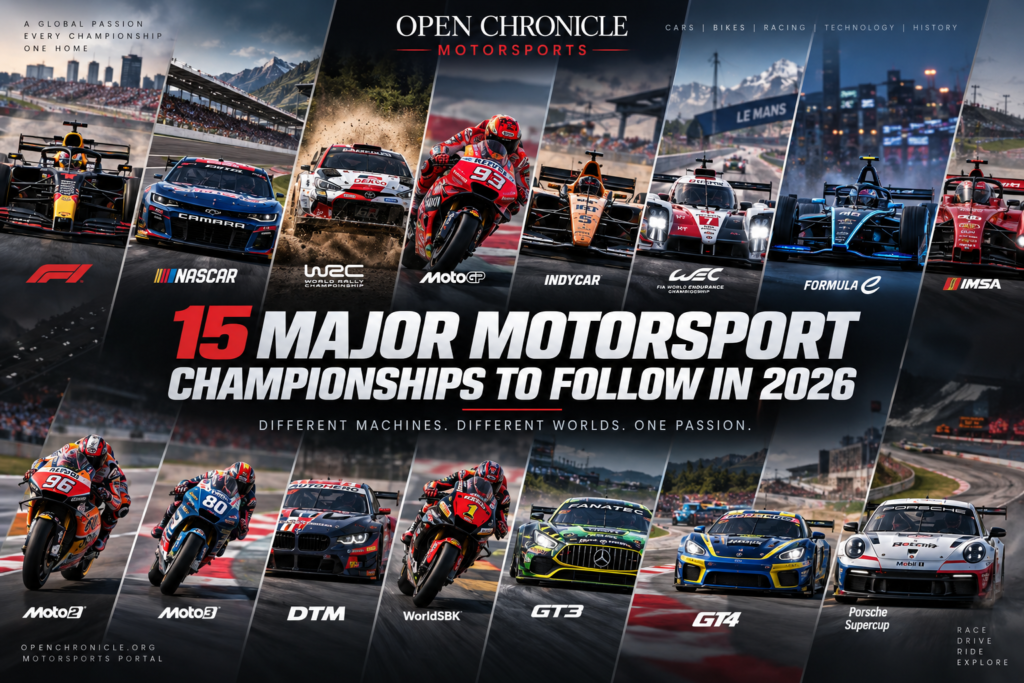
The Open Chronicle Motorsports Portal brings many of those worlds together. In 2026, our coverage is built around 15 major championships and racing categories, ranging from Formula 1 and NASCAR to MotoGP, endurance racing, rallying, GT competition and the development classes producing the stars of tomorrow.
Here is the Open Chronicle guide to them.
1. Formula 1
Formula 1 remains the pinnacle of international single-seater racing.
Created as a World Championship in 1950, F1 combines elite drivers with extraordinary levels of engineering, aerodynamics, strategy and technological development. The historical material supplied for this guide traces the championship to those first European Grands Prix and notes that the Indianapolis 500 even counted toward the early World Championship.
Modern Formula 1 is simultaneously a drivers’ contest and an engineering war. Teams develop their own cars within a tightly controlled technical framework, searching for advantages that can sometimes be measured in thousandths of a second.
Within Open Chronicle, Formula 1 has its own dedicated championship portal.
Explore Open Chronicle Formula 1 →
2. NASCAR
NASCAR represents another enormous branch of motorsport — and a racing culture fundamentally different from Formula 1.
Founded in 1948, NASCAR grew out of America’s stock-car tradition.
Its premier Cup Series is famous for high-speed oval racing, although the championship also visits road courses. Drafting, pit strategy, tyre management, restarts and close racing involving large packs of cars create challenges rarely encountered elsewhere.
NASCAR also demonstrates one of the great attractions of motorsport: there is no single formula for creating spectacular racing.
Open Chronicle maintains a dedicated NASCAR portal covering the championship as well as its cars, technology and history.
Explore Open Chronicle NASCAR →
3. World Rally Championship — WRC
The World Rally Championship removes the traditional circuit almost entirely.
Instead of competing wheel-to-wheel around a racetrack, drivers attack individually timed stages across surfaces that can include gravel, asphalt and snow.
The co-driver becomes essential, reading detailed pace notes that tell the driver what lies beyond corners and crests that may be impossible to see.
It is a discipline built around speed, precision, courage and adaptation.
WRC also has its own dedicated Open Chronicle portal.
4. MotoGP
MotoGP involves two wheels rather than four, but it belongs naturally within the wider Open Chronicle Motorsports universe.
Grand Prix motorcycle World Championship competition dates back to 1949.
MotoGP is the premier prototype class. These are not simply modified road motorcycles: they are highly specialized racing machines built to extract extraordinary performance.
The sight of riders braking at enormous speeds before leaning their motorcycles to extreme angles makes MotoGP one of motorsport’s most spectacular disciplines.
5. IndyCar
IndyCar is the premier level of American open-wheel racing.
Unlike championships concentrated primarily on conventional circuits, IndyCar asks competitors to master road courses, street circuits and ovals.
At the centre of its identity sits the Indianapolis 500, whose history stretches back to 1911.
That diversity makes IndyCar particularly demanding. A driver capable of winning on a tight temporary street circuit must also be able to compete at extraordinary speeds on an oval.
6. FIA World Endurance Championship — WEC
If Formula 1 asks how quickly a car can complete a Grand Prix, endurance racing asks a different question:
How fast can you remain for hours without breaking?
The FIA World Endurance Championship brings sophisticated prototypes and GT machinery into long-distance competition. The championship is organized around the FIA and Automobile Club de l’Ouest endurance-racing structure.
Its crown jewel is the 24 Hours of Le Mans.
Drivers share cars. Teams race through changing weather and darkness. Traffic must constantly be negotiated between different classes.
Reliability is performance.
7. Formula E
Formula E represents motorsport’s major electric single-seater championship.
The series began racing in 2014 with fully electric cars.
Rather than simply reproducing Formula 1 with different engines, Formula E developed its own identity. Street circuits, energy management and electric powertrain efficiency play central roles.
Drivers must understand not only how quickly they can race but also when and where they can deploy their available energy most effectively.
8. IMSA WeatherTech SportsCar Championship
IMSA provides one of North America’s great endurance-racing arenas.
The modern WeatherTech SportsCar Championship emerged in 2014 following the combination of two major American sports-car racing structures.
Its calendar contains some of endurance racing’s most famous events, while prototypes and GT cars compete simultaneously in different classes.
For a driver, overtaking another car does not necessarily mean gaining a position. It may simply mean negotiating slower traffic while fighting another rival somewhere else on the circuit.
That multiclass environment is part of endurance racing’s unique appeal.
9. Moto2
Moto2 is the principal intermediate step between the lower Grand Prix motorcycle categories and MotoGP.
Its importance goes well beyond the championship itself.
This is where many riders develop the racecraft, tyre management and consistency required to make the eventual transition to MotoGP.
Because machinery is more controlled than in the premier category, small differences in rider performance become particularly visible.
For Open Chronicle, Moto2 therefore serves two purposes: it is a championship worth following in its own right and a window into the next generation of MotoGP talent.
10. Moto3
Below Moto2 sits Moto3.
The lightweight Grand Prix category regularly produces extremely close racing, with large groups of riders sometimes remaining in contention deep into a race.
For young competitors, it is one of the first major international stages on the Grand Prix ladder.
Today’s Moto3 prospect can become tomorrow’s Moto2 contender — and eventually a MotoGP star.
That makes following the category partly an exercise in discovering the future before it arrives.
11. DTM
DTM is one of the great names of European motorsport.
Its historical identity is closely connected to German touring-car competition.
The championship has evolved considerably over time and today belongs to the broader modern GT racing environment.
Its appeal combines recognizable performance-car manufacturers with professional drivers, sprint-style racing and some of Europe’s best-known circuits.
12. WorldSBK
MotoGP is not the only major international motorcycle championship covered by Open Chronicle.
The Superbike World Championship has been contested since 1988.
The fundamental distinction is important.
MotoGP motorcycles are purpose-built prototypes. WorldSBK machinery has a much closer relationship with motorcycles available to the public, although extensively prepared for racing.
In simple terms, MotoGP represents the prototype philosophy; WorldSBK represents the production-derived superbike philosophy.
Both can produce extraordinary racing.
13. GT3
GT3 has become one of the most successful racing concepts in modern international motorsport.
The cars are based around high-performance road-car identities but transformed into dedicated racing machines.
Ferrari, Porsche, Mercedes-AMG, BMW, McLaren, Aston Martin and other manufacturers can consequently meet within the same competitive ecosystem.
The European championship covered by the Open Chronicle Race Centre belongs to a lineage that previously raced under names including FIA GT Series and Blancpain Sprint Series.
GT3’s greatest strength is its reach. Similar machinery can compete in championships and major endurance events around the world.
14. GT4
GT4 takes the production-car connection further.
The cars generally remain closer to their road-going origins and are less extreme — and less expensive — than GT3 machinery.
That makes GT4 an important bridge between more accessible sports-car competition and higher-level professional GT racing.
It also creates an appealing spectacle for spectators: many of the shapes on the grid remain immediately recognizable as versions of performance cars that exist beyond the racetrack.
Within Open Chronicle Motorsports, the Race Centre follows the GT4 European Series.
15. Porsche Supercup
Our final championship demonstrates what happens when motorsport deliberately removes much of the machinery advantage.
Porsche Supercup is a one-make championship.
Drivers race closely matched Porsche 911-based Cup cars, meaning the fundamental performance potential available to each competitor is similar.
When machinery becomes comparable, driver execution becomes even more visible.
Qualifying, braking, setup, tyre management and avoiding mistakes can determine the difference between victory and the midfield.
That makes Porsche Supercup both a serious international championship and an important proving ground for drivers developing careers in GT and sports-car racing.
15 Championships, One Motorsports Universe
These championships demonstrate why Open Chronicle did not want its motorsport coverage to stop with Formula 1.
They represent completely different solutions to the same fundamental idea: race faster than everyone else.
Formula 1 pushes single-seater engineering.
NASCAR emphasizes close racing and American stock-car culture.
WRC turns roads into timed stages.
MotoGP and WorldSBK place the rider at the centre of extraordinary two-wheel performance.
IndyCar demands versatility across ovals, streets and road courses.
WEC and IMSA turn reliability, traffic and endurance into competitive weapons.
Formula E explores electric racing.
GT3 and GT4 connect motorsport with performance-road-car manufacturers.
DTM carries one of Europe’s great racing traditions into the modern era.
Porsche Supercup minimizes machinery differences.
Moto2 and Moto3 reveal the riders who may define the future.
Together they form the current competitive universe of Open Chronicle Motorsports.
And this is only the beginning.
As the portal grows, other championships, disciplines, historic races, legendary machines and emerging technologies can join that ecosystem.
For now, the Open Chronicle Motorsports Race Centre provides a single starting point: latest results, podiums, upcoming races and direct access to our major championship hubs.
Fifteen championships. Different machines. Different rules. Different worlds. One passion: racing.