
By Open Chronicle with agencies
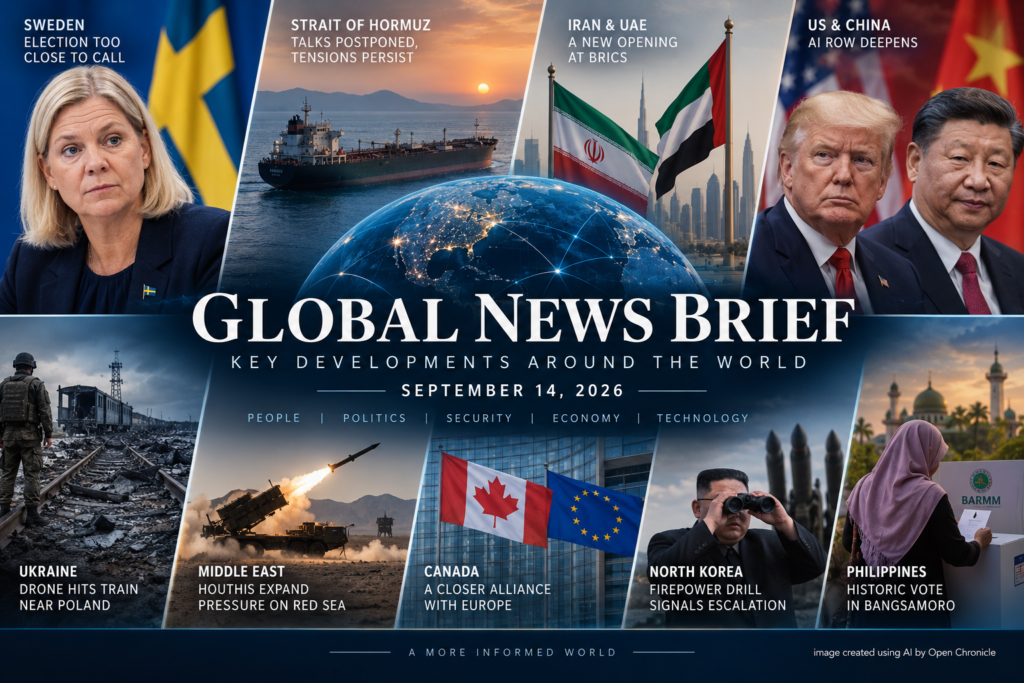
A razor thin election result in Sweden, stalled diplomacy over the Strait of Hormuz, a new opening between Iran and the United Arab Emirates, growing debate over artificial intelligence, and renewed military tensions from Ukraine to the Korean Peninsula are among the major developments shaping the international agenda on Monday, September 14.
Europe
Sweden election remains too close to call
Sweden faces an uncertain political future after a general election in which the centre left opposition emerged with only a razor thin advantage over the right wing bloc led by Prime Minister Ulf Kristersson.
The latest reports indicated that the left held a lead of only a few parliamentary seats, leaving the formation of the next government unresolved.
The result is particularly significant because Kristersson had opened the possibility of bringing the Sweden Democrats formally into government for the first time. The close result means coalition negotiations and the final allocation of seats could determine whether former prime minister Magdalena Andersson can return to power or the right retains control.
Russian drone hits train near Polish border
A Russian drone struck a train close to the Ukrainian border with Poland, reportedly shortly after visiting dignitaries had travelled through the area.
The incident occurred along a strategically important transport corridor connecting Ukraine with Poland and the rest of Europe.
EU foreign policy chief Kaja Kallas described the attack as an attempt to intimidate Western countries.
The incident adds to concerns in European capitals about the vulnerability of infrastructure and border routes used to support Ukraine.
Middle East
Hormuz talks postponed as Gulf diplomacy stalls
Planned talks in Salalah between Iran and Gulf states over navigation through the Strait of Hormuz have been postponed, delaying efforts to reduce tensions around one of the world’s most important energy corridors.
Oman confirmed the postponement, while Iranian accounts said Saudi Arabia had requested that the meeting be cancelled or delayed.
The diplomatic setback comes as commercial traffic through Hormuz has fallen dramatically amid attacks and military confrontation. Reports Monday said daily ship movements through the strait had dropped into single digits.
Oman has nevertheless sought to reassure international markets that the disruption will be temporary and that normal navigation can eventually resume.
Iran and UAE signal willingness to move forward
The BRICS summit has produced a potentially important diplomatic opening between Iran and the United Arab Emirates.
Iran and the UAE joined a BRICS declaration calling for restraint in the Middle East conflict, an indication that both governments are attempting to prevent wider regional tensions from permanently damaging relations.
The development is particularly notable against the backdrop of fighting affecting energy infrastructure and maritime routes across the Gulf and Red Sea.
Turkey says Israeli strikes in Syria are benefiting ISIS
Turkish Foreign Minister Hakan Fidan has argued that Israeli military operations in Syria are indirectly creating conditions that benefit ISIS.
The statement adds another source of friction to an already complicated regional security environment, where competing governments and armed groups are attempting to shape Syria’s future.
Houthis expand pressure on Red Sea routes
Houthi forces in Yemen are claiming further territorial gains around strategically important Red Sea islands near the Bab el Mandeb Strait, while simultaneously announcing new attacks against Saudi Arabia.
Reports indicate that the group has expanded its foothold around islands overlooking the shipping corridor.
The Houthis also claimed a large scale missile and drone attack against Saudi Arabia’s King Khalid Air Base.
The combination of instability at Bab el Mandeb and disruption in the Strait of Hormuz is placing increasing pressure on two maritime chokepoints crucial to global energy and commercial shipping.
Americas
Canada looks toward a deeper alliance with Europe
Canada is exploring what Prime Minister Mark Carney’s government has described as a potentially “unique alliance” with the European Union as tensions with the United States reshape Ottawa’s economic and strategic calculations.
The initiative comes as Canada’s relationship with Washington is strained by President Donald Trump’s trade policies.
The emerging European strategy could involve closer cooperation in trade, defence, investment and support for Ukraine.
Canada is also reportedly considering participation in a €90 billion European Union loan initiative for Ukraine.
If the shift develops into a broader strategic partnership, it could represent one of the most important changes in Canada’s foreign economic policy in decades.
Trump plays down report on Chinese assistance to Iran
President Trump has played down reports that Chinese entities provided Iran with satellite imagery before an attack on U.S. forces.
The allegations have raised questions about whether commercially available or privately supplied Chinese satellite intelligence has been used to improve Iranian targeting.
Trump’s comments appeared intended to avoid immediately escalating the issue into a direct confrontation with Beijing.
The distinction between assistance from Chinese companies and direct involvement by the Chinese government remains critical, and publicly available reporting has not established that Beijing itself directed such assistance.
Asia Pacific
Historic election underway in Bangsamoro
Voters in the Bangsamoro Autonomous Region in Muslim Mindanao are participating in a landmark election for the southern Philippines’ Muslim majority autonomous region.
The vote represents an important stage in the political process created after decades of separatist conflict and negotiations between Manila and Moro groups.
Reports described it as the region’s first parliamentary election, making the ballot an important test of the institutions created through the peace process.
Okinawa result boosts Japan’s U.S. base relocation plan
A candidate backed by Japan’s ruling party has won an important election in Okinawa, potentially strengthening Tokyo’s efforts to proceed with the controversial relocation of a U.S. military base.
The result could give the Japanese government additional political momentum as it seeks to implement its security strategy amid growing tensions in East Asia.
Okinawa hosts a disproportionately large share of the U.S. military presence in Japan, making base policy one of the island prefecture’s most persistent political disputes.
North Korea stages artillery and missile drill
North Korea says it has conducted a joint firepower exercise involving long range artillery and missile units.
Pyongyang said the exercise demonstrated what it described as the “huge destructive power” of its forces.
The exercise follows another period of heightened military activity around the Korean Peninsula and comes as the United States, South Korea and Japan deepen defence coordination.
Technology
China attacks calls to slow advanced AI development
China has sharply criticised proposals to slow the development of increasingly powerful artificial intelligence systems.
A Chinese state newspaper characterised calls associated with Anthropic chief executive Dario Amodei for greater restraint around advanced AI as resembling a Cold War strategy intended to constrain competitors.
The dispute illustrates how the debate over AI safety is becoming intertwined with strategic competition between the United States and China.
Leading technology figures have increasingly warned that rapidly improving AI capabilities require stronger safeguards. Beijing, however, is wary that restrictions promoted in the West could become mechanisms for preserving U.S. technological advantages.
The argument is therefore no longer solely about whether advanced AI poses long term risks. It is increasingly about who sets the rules governing the world’s most consequential emerging technology.
History and Intelligence
Clinton says pre 9/11 operation targeting bin Laden was abandoned
Former U.S. President Bill Clinton has disclosed new details about a CIA operation targeting Osama bin Laden before the September 11 attacks, saying an opportunity to act was ultimately abandoned.
The disclosure comes amid renewed attention to declassified intelligence concerning al Qaeda and the warnings available to U.S. administrations before 9/11. Reports Monday highlighted Clinton’s account of the abandoned operation.
The revelation is likely to intensify historical debate over whether opportunities existed to disrupt bin Laden’s network before the attacks that killed nearly 3,000 people in 2001.
As with other newly released intelligence material, however, evidence that U.S. agencies were monitoring the al Qaeda threat before 9/11 should not be interpreted as evidence that officials knew the specific plan that would ultimately be carried out.
A world shaped by overlapping crises
The developments of September 14 illustrate how several previously separate international crises are becoming increasingly interconnected.
The war in Ukraine is affecting European infrastructure and energy security. Conflict in the Middle East is disrupting the maritime arteries through which much of the world’s oil and trade moves. Canada is reconsidering the balance of its relationship with the United States and Europe. Elections in Sweden and the Philippines are testing political systems undergoing profound change.
At the same time, artificial intelligence is emerging as another arena of geopolitical rivalry, with the United States and China increasingly disagreeing not only over who will lead the technology, but also over how quickly it should advance.
From Stockholm to Hormuz, Ottawa to Okinawa and Washington to Beijing, today’s developments reflect an international system in which domestic politics, military security, technology and global trade are becoming harder to separate.