
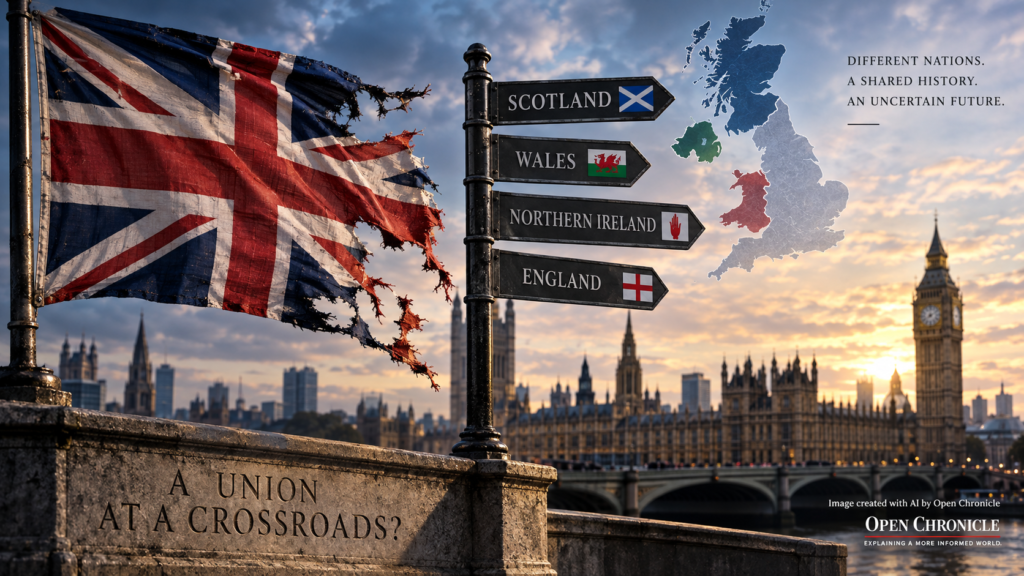
By Open Chronicle Explained
For more than three centuries, the United Kingdom has survived wars, imperial expansion and decline, industrial revolutions, two world wars, decolonisation, European integration, Brexit and repeated constitutional crises.
But its map has never been immutable.
Ireland was partitioned a century ago.
Scotland came within 10 percentage points of voting for independence in 2014.
Northern Ireland possesses a legally recognised route toward joining a united Ireland.
And Welsh independence, once a relatively marginal political proposition, has become part of mainstream constitutional debate.
Now the question has acquired new urgency.
In September 2026, nationalist leaders from Scotland, Wales and Northern Ireland gathered in Cardiff and signed a memorandum calling for Westminster to prepare for the possibility of constitutional change and to recognise the principle of national self-determination.
The declaration does not break up Britain.
It does not trigger referendums.
And it does not mean that independence is inevitable.
But it raises a much larger question.
What would actually happen if one — or several — parts of the United Kingdom decided to leave?
The consequences would reach far beyond flags and borders.
They would affect Britain’s economy, armed forces, nuclear deterrent, energy system, Parliament, international influence and perhaps even the meaning of the name “United Kingdom” itself.
First: What Exactly Is the United Kingdom?
The terminology can be confusing.
Great Britain is the island containing:
England,
Scotland,
and Wales.
The United Kingdom of Great Britain and Northern Ireland consists of those three nations plus Northern Ireland.
The UK is therefore not simply another name for England.
It is a multinational state constructed through a series of historical unions.
England and Wales developed a political union over several centuries.
England and Scotland created the Kingdom of Great Britain through the Acts of Union in 1707.
Great Britain and Ireland were united in 1801.
Most of Ireland later left the United Kingdom following the revolutionary period and Anglo-Irish Treaty, eventually becoming today’s Republic of Ireland.
Northern Ireland remained.
The modern UK is therefore already the product of one major territorial breakup.
And there is no constitutional law of nature guaranteeing that its current borders must exist forever.
The House of Commons Library describes the UK as a multinational state — sometimes called a “State of Unions” — which developed progressively rather than through one single founding constitutional document.
Could Scotland Simply Declare Independence?
No.
Scotland has a parliament and government with substantial devolved powers, but the constitutional union between Scotland and England remains a matter reserved to the UK Parliament.
That became particularly important after Brexit.
The Scottish Government attempted to establish whether Holyrood could legislate for another independence referendum without Westminster’s agreement.
In 2022, the UK Supreme Court concluded that it could not.
The constitutional status of the Union is outside the Scottish Parliament’s legislative competence.
The 2014 referendum was possible because London and Edinburgh had reached an agreement temporarily giving Holyrood the necessary authority through what became known as a Section 30 Order.
A second legally recognised referendum would therefore currently require some form of cooperation or legislative change at Westminster.
That is precisely why arguments about the “right to decide” have become so important.
Northern Ireland Is Different
Northern Ireland already has something Scotland and Wales do not.
A legal constitutional exit mechanism.
Under the 1998 Good Friday Agreement and the Northern Ireland Act, Northern Ireland remains part of the UK for as long as a majority of its population wishes it to remain so.
But if it appears likely that a majority would support Irish unification, the UK Secretary of State is legally required to call a border poll.
For Irish unity actually to occur, majorities would have to approve constitutional change in both Northern Ireland and the Republic of Ireland.
This is the principle of consent.
It means that Northern Ireland’s membership of the United Kingdom is explicitly conditional upon democratic consent.
No equivalent statutory mechanism currently exists for Scotland or Wales.
And Wales?
Wales presents another constitutional situation.
The Senedd possesses substantial devolved powers, but independence is not a devolved matter.
Like Scotland, Wales cannot simply legislate itself out of the United Kingdom.
A recognised independence process would therefore require constitutional negotiations involving Westminster.
But the political significance of Welsh nationalism has changed.
Independence is no longer merely a theoretical subject discussed on the political fringes.
It is now part of a wider debate over whether the UK should remain highly centralised, become more federal, or eventually transform into something entirely different.
So Imagine Scotland Votes to Leave
This would probably be the single most disruptive territorial change to the British state since Irish independence.
Scotland represents roughly one-third of Great Britain’s landmass.
An independent Scotland would therefore transform the physical map of Britain immediately.
England and Scotland would acquire an international land border.
But drawing a line on a map would be the easy part.
The difficult negotiations would begin afterward.
Who Gets the National Debt?
An independent Scotland would inherit assets.
But it would also face arguments over liabilities.
Britain’s national debt belongs to the UK state.
Negotiators would therefore need to determine whether Scotland assumed a proportion of that debt and, if so, how the share would be calculated.
Population?
Historical contributions?
GDP?
Government spending?
Some other negotiated formula?
Similar questions would arise over state property, government buildings, overseas assets and financial obligations.
Independence would therefore resemble an extremely complicated national divorce.
Both sides would need to decide what belonged to whom.
What Currency Would Scotland Use?
This would immediately become one of the largest economic questions.
An independent Scotland could theoretically:
continue using sterling without a formal monetary union,
negotiate a currency arrangement with the remaining UK,
or eventually establish a Scottish currency.
Each option would have consequences.
A country using another state’s currency without controlling its central bank sacrifices some monetary-policy autonomy.
Creating a new currency requires institutions, reserves and market confidence.
A formal currency union would require negotiations with London.
The debate would therefore quickly move from constitutional identity to mortgages, pensions, savings, banking and interest rates.
What Happens to the Bank of England?
The Bank of England would almost certainly remain the central bank of the continuing British state.
But negotiations would be required over Scotland’s relationship with sterling and the division of certain state assets.
An independent Scotland seeking its own monetary system would eventually need the institutional architecture of a sovereign financial state.
That could include a central bank capable of managing reserves, financial regulation and monetary stability.
Independence is therefore not simply creating a government.
It means creating — or replacing — parts of an entire state.
What Happens at the England-Scotland Border?
That depends partly on Scotland’s future relationship with the European Union.
The Scottish National Party has long argued that an independent Scotland should seek EU membership.
If Scotland eventually joined the EU while the remainder of the UK stayed outside it, the Anglo-Scottish frontier would become an external border of the European Union.
That would create difficult questions involving:
customs,
goods,
agriculture,
immigration,
regulation,
and freedom of movement.
Britain would then possess something it has not had for centuries:
a major international land border running across the island of Great Britain.
What Happens to North Sea Oil and Gas?
Geography suddenly becomes economics.
Maritime boundaries would need to be established between Scotland and the continuing UK.
That would determine control over offshore resources including oil, gas and future renewable-energy infrastructure.
North Sea petroleum is less economically dominant than it once was.
But offshore energy remains strategically significant.
Perhaps even more important in the future would be Scotland’s enormous renewable-energy potential.
Scotland already produces large quantities of electricity from wind and other renewable sources.
Its energy relationship with England would therefore remain deeply interconnected even after political separation.
Independence would not physically disconnect the electricity cables.
What Happens to Britain’s Nuclear Weapons?
This is one of the most consequential questions of all.
The United Kingdom’s nuclear deterrent is based in Scotland.
The Royal Navy’s Vanguard-class ballistic missile submarines operate from HM Naval Base Clyde at Faslane, while associated nuclear-warhead infrastructure is located nearby at Coulport.
An independent Scottish government committed to removing nuclear weapons would therefore create an enormous strategic problem for London.
The remaining UK would need either to negotiate continued access to the Scottish facilities or construct alternative infrastructure elsewhere.
Neither option would be simple.
Moving Britain’s nuclear deterrent would be one of the largest military infrastructure projects in modern British history.
Scotland’s departure could therefore reshape British defence policy for decades.
Would Scotland Stay in NATO?
That would be a decision for an independent Scottish government and NATO’s existing members.
The SNP currently supports NATO membership while opposing nuclear weapons being permanently based in Scotland.
Those two positions are not inherently incompatible — most NATO members do not possess nuclear weapons.
But negotiations would still be necessary over military facilities, personnel, intelligence arrangements and Scotland’s contribution to collective defence.
The British armed forces themselves would also need to be divided.
Scottish personnel serving in UK forces would face choices.
Bases and equipment would require negotiation.
New Scottish armed forces would need command structures and institutions.
Would the UK Lose International Power?
Almost certainly some.
Scotland’s departure would reduce the population, territory and economic size of the United Kingdom.
But Britain would remain a major state.
It would still possess:
one of the world’s largest economies,
nuclear weapons,
a major military,
global intelligence capabilities,
and extensive diplomatic networks.
It would also almost certainly seek to retain its permanent seat on the United Nations Security Council.
State continuity in international law would become extremely important.
The likely argument from London would be that the remaining state was the legal continuation of the United Kingdom rather than an entirely new country.
There is precedent for this kind of continuity following territorial changes elsewhere.
But politically, Britain’s international image would unquestionably change.
A country historically associated with one of the world’s largest empires would have experienced the departure of another constituent nation from the state itself.
Would It Still Be Called the United Kingdom?
That becomes surprisingly interesting.
If Scotland left but Wales and Northern Ireland remained, the existing title:
United Kingdom of Great Britain and Northern Ireland
would become geographically awkward.
“Great Britain” historically refers to England, Scotland and Wales together.
Without Scotland, the political meaning of that terminology would change.
Parliament might therefore eventually adopt a different official name.
Perhaps:
United Kingdom of England, Wales and Northern Ireland
Or another constitutional formulation entirely.
There is no automatic answer.
Even the country’s name could become part of the negotiations.
What If Northern Ireland Left Instead?
The consequences would be very different.
Northern Ireland would not become an independent state under the Good Friday Agreement model.
It would join the Republic of Ireland to form a united Ireland.
That would fundamentally change both countries.
The United Kingdom would lose its only territory sharing a land border with another sovereign state.
Ireland would gain approximately two million people and inherit the enormous task of integrating two political, economic, healthcare and administrative systems.
What Happens to the NHS in Northern Ireland?
This is one of the questions that demonstrates why Irish unification would involve far more than changing flags.
Northern Ireland currently operates within the UK’s public-finance system and has its own health service.
The Republic of Ireland has a different healthcare model.
A united Ireland would therefore require decisions about:
healthcare,
taxation,
welfare,
pensions,
education,
public-sector employment,
policing,
courts,
and infrastructure.
The Good Friday Agreement establishes the democratic mechanism for constitutional change.
It does not provide a detailed manual explaining how every institution would be merged afterward.
The Commons Library notes that significant questions remain unresolved, including how public services would transfer and how a united Ireland would be governed.
What Happens to British Citizens in Northern Ireland?
The Good Friday Agreement contains an unusually important identity settlement.
People born in Northern Ireland can identify as:
British,
Irish,
or both.
That principle would become central to any unification process.
A united Ireland would therefore not simply mean telling hundreds of thousands of unionists:
“You are Irish now.”
Protecting British identity, citizenship rights and cultural traditions would be one of the most politically sensitive parts of any transition.
A sustainable united Ireland would have to accommodate people who strongly wished to remain British in identity even if sovereignty changed.
What About the Union Flag?
Now the constitutional breakup becomes visible.
The Union Flag combines historical symbols associated with England, Scotland and Ireland.
Scotland is represented through the white diagonal cross of St Andrew.
If Scotland became independent, an extraordinary question would arise:
Should the Union Jack change?
Legally, there is no obvious requirement that it must.
Countries frequently retain symbols whose historical origins no longer correspond perfectly to current political geography.
But politically there would inevitably be a debate.
If Northern Ireland subsequently joined Ireland as well, the symbolism would become even more complicated.
One of the world’s most recognisable national flags could suddenly represent a union that no longer existed in its historical form.
What If Wales Became Independent?
Wales is smaller economically and demographically than Scotland.
But its departure would have enormous constitutional significance.
For the first time since the medieval and Tudor-era integration of Wales into the English state, Wales would become a sovereign country.
An international border would stretch from the Dee estuary in the north to the Severn region in the south.
Infrastructure currently functioning as domestic networks would cross an international frontier.
Roads.
Railways.
Electricity.
Water.
Pipelines.
Telecommunications.
Economic integration between England and Wales is extremely deep.
Political independence would therefore not eliminate interdependence.
It would force governments to negotiate how that interdependence should work.
Water Would Become Political
Few examples illustrate the complexity better than water.
Welsh reservoirs supply substantial quantities of water to parts of England.
Inside one state, this is principally an infrastructure issue.
Between two sovereign states, it could become an international resource agreement.
The same principle applies to electricity.
Wales contains important energy infrastructure and renewable-generation potential.
An independent Wales and England would therefore remain economically connected by physical networks even if their constitutional relationship changed.
Could All Three Leave?
Now we reach the most dramatic scenario.
Imagine:
Scotland becomes independent.
Northern Ireland votes for Irish reunification.
Wales subsequently chooses independence.
What remains?
England.
The United Kingdom, as presently constituted, would effectively cease to exist.
England contains roughly 85% of the UK’s population and the overwhelming majority of its economy.
It would therefore remain a substantial European and global power.
But politically it would represent a profound transformation.
A multinational British state would have become essentially an English state.
Would England Automatically Inherit Everything?
Probably not everything — but it would almost certainly claim legal continuity with the former UK.
International treaties.
Embassies.
Military commitments.
National debt.
Membership of international organisations.
Nuclear weapons.
UN Security Council membership.
All would have to be considered.
The precedent of the Soviet Union’s dissolution is sometimes mentioned because Russia inherited the USSR’s permanent UN Security Council seat.
But the British constitutional situation would be different.
The details would depend heavily on negotiated settlements and international recognition.
What Happens to Westminster?
Westminster could remain the parliament of the continuing state.
But its composition would change dramatically.
Scottish MPs would disappear after independence.
Northern Irish MPs would disappear after Irish reunification.
Welsh MPs would disappear following Welsh independence.
The House of Commons would become overwhelmingly — or entirely — English.
That might finally force another constitutional question Britain has repeatedly avoided:
How should England govern itself?
England currently has no national devolved parliament equivalent to Holyrood, the Senedd or Stormont.
Westminster functions simultaneously as the UK Parliament and, in many areas, England’s legislature.
If the multinational union disappeared, that ambiguity would disappear with it.
Could the UK Become Federal Instead?
And this may be the most important consequence of the current debate.
Independence is not the only possible destination.
Pressure from Scotland, Wales and Northern Ireland could instead force the United Kingdom to redesign itself.
Prime Minister Andy Burnham has already argued that deeper devolution strengthens the case for clearer constitutional principles and potentially a written constitution. The UK currently lacks a single codified constitutional document, unlike most democratic states.
A future settlement might involve:
much stronger devolved governments,
greater fiscal autonomy,
constitutional protection for devolved powers,
reform of the House of Lords,
a formal Council of the Nations,
an English governance settlement,
or even a federal constitution.
In other words, separatist pressure might not destroy the Union.
It might force the Union to reinvent itself.
Why Is Westminster So Important?
Because despite decades of devolution, the UK Parliament remains constitutionally sovereign.
Under the traditional doctrine of parliamentary sovereignty, Westminster can make or repeal any law.
The devolved institutions exercise powers granted through Acts of Parliament.
Political conventions constrain Westminster — including the principle that it does not normally legislate in devolved areas without consent — but these conventions do not create the same kind of entrenched federal sovereignty found in countries such as the United States or Germany.
That creates a fundamental tension.
Nationalists increasingly speak in the language of:
popular sovereignty — the people decide.
The traditional British constitution speaks in the language of:
parliamentary sovereignty — Parliament decides.
Much of Britain’s constitutional argument comes from the collision between those two ideas.
Would Independence Make Everyone Richer — or Poorer?
Neither outcome is automatic.
Independence supporters often emphasise the ability to design policies suited to their own country.
Opponents emphasise the benefits of sharing:
a currency,
a domestic market,
public finances,
defence,
institutions,
and fiscal risks.
Both arguments contain real economic considerations.
But the eventual outcome would depend on dozens of decisions taken after independence.
Taxation.
Trade.
Currency.
EU membership.
Government spending.
Investment.
Migration.
Energy.
Productivity.
Debt.
Independence does not mechanically create prosperity.
Nor does it mechanically create economic failure.
It changes who makes the decisions — and who bears the consequences.
Could Brexit Happen in Reverse?
In some respects, yes.
Brexit provides a useful warning about constitutional separation.
A referendum can answer a simple political question:
Leave or remain?
But it cannot answer hundreds of technical questions created by leaving.
Borders.
Trade.
Citizenship.
Regulation.
Institutions.
Assets.
Debt.
Courts.
International agreements.
Independence negotiations would face the same problem.
The ballot paper might contain one sentence.
Implementing its answer could take years.
Would People Need Passports to Cross Britain?
Not necessarily.
Britain and Ireland already demonstrate that sovereign states can maintain unusually open movement arrangements.
The Common Travel Area allows British and Irish citizens extensive movement rights across the UK and Ireland despite their being separate states.
Similar arrangements could theoretically be negotiated with an independent Scotland or Wales.
Political borders do not automatically require physical barriers.
But customs and regulatory borders are separate questions.
People might cross freely while goods face documentation or checks.
Again, much would depend on EU membership and negotiated agreements.
Could Britain Survive Scotland Leaving?
Yes.
But it would be a different Britain.
The state would remain economically powerful.
London would remain one of the world’s major cities.
Britain would retain considerable diplomatic, military, technological and financial influence.
But its strategic geography, identity and international perception would change.
The psychological impact might be as important as the economic one.
Scottish independence would demonstrate that the modern British Union was reversible.
Once one constituent nation had successfully left, arguments that constitutional change was impossible elsewhere would become much harder to sustain.
Could One Departure Trigger Another?
That is perhaps Westminster’s deepest concern.
Imagine Scotland votes for independence.
Welsh voters watch the negotiations.
Northern Irish voters observe Britain’s changing identity.
English voters begin questioning the costs and purpose of the remaining Union.
Political assumptions could shift very quickly.
Constitutional change often appears impossible until suddenly it does not.
The collapse of multinational states elsewhere in history demonstrates how rapidly political expectations can change once the permanence of existing borders is questioned.
But there is no automatic domino effect.
Each nation possesses its own identity, economy, political culture and constitutional circumstances.
Scotland is not Wales.
Wales is not Northern Ireland.
And Northern Ireland’s constitutional question is inseparable from Ireland and the Good Friday Agreement.
What Does the Cardiff Declaration Actually Change?
Immediately?
Very little legally.
It does not authorise a Scottish referendum.
It does not trigger a Northern Ireland border poll.
It does not make Wales independent.
Its significance is political.
For the first time, nationalist leaders heading all three devolved governments have publicly aligned around the principle that Westminster should prepare for the possibility that the UK’s territorial constitution may change.
That creates a new political dynamic.
Instead of three separate constitutional debates —
Scottish independence,
Welsh independence,
Irish reunification —
nationalist politicians are attempting to present them as parts of one broader question:
Who ultimately has the right to decide the future of the nations within the United Kingdom?
The Bigger Question: What Is Britain?
That may ultimately matter more than any individual referendum.
For centuries Britain could avoid defining itself constitutionally with great precision.
Its institutions evolved.
Power shifted.
Conventions accumulated.
Problems were solved pragmatically.
There is still no single document called:
The Constitution of the United Kingdom.
But devolution has created governments with their own democratic mandates.
Brexit demonstrated that different nations can make very different political choices.
Northern Ireland already possesses a formal principle of consent.
Scotland has already held one independence referendum.
Welsh nationalism is growing.
Eventually, Britain may have to answer a question it has historically preferred to leave ambiguous:
Is the United Kingdom a sovereign state containing several nations — or a voluntary union of nations whose continued membership ultimately depends on their consent?
Those two interpretations can coexist while everyone wishes to remain together.
They become much harder to reconcile when somebody wants to leave.
What? How? Why?
What could happen if Scotland became independent?
The remaining UK would lose substantial territory, population and economic output. London and Edinburgh would have to negotiate debt, assets, currency, borders, energy, military facilities and international arrangements.
What happens if Northern Ireland votes to leave?
Under the Good Friday Agreement framework, Northern Ireland could join a united Ireland if majorities approved constitutional change in both Northern Ireland and the Republic of Ireland.
Could Wales become independent?
Politically, yes. But there is currently no automatic constitutional mechanism allowing the Senedd unilaterally to organise Wales’s departure from the UK.
Would England disappear?
No. England would remain by far the largest population and economy of the present UK.
Would the United Kingdom disappear?
If all three other constituent nations left, the multinational state we currently call the United Kingdom would effectively have to be fundamentally reconstituted. Questions of legal state continuity and even its official name would then need resolution.
Could the opposite happen?
Yes. Pressure for independence could produce deeper devolution or a federal or codified constitutional settlement rather than separation.
Why does this matter now?
Because political leaders in Scotland, Wales and Northern Ireland are increasingly framing constitutional change around a common principle of self-determination — while Westminster retains ultimate constitutional authority over Scotland and Wales.
A Union Is Strongest When Nobody Questions Whether They Can Leave
For generations, the United Kingdom’s greatest constitutional strength was ambiguity.
It did not need to define exactly why Scotland, England, Wales and Northern Ireland belonged together.
They simply did.
That assumption is weakening.
The question facing Britain may therefore no longer be simply whether Scotland becomes independent, Wales follows, or Northern Ireland joins the Republic.
It may be something more fundamental:
What must the United Kingdom become if it wants all of its nations to choose to remain?
The declaration signed in Cardiff does not answer that question.
It does something potentially more important.
It asks it.
Related
Scotland, Wales and Northern Ireland Leaders Sign Landmark Declaration on Self-Determination
The political development that brought the constitutional future of the United Kingdom back to the centre of the national debate.
Read the Open Chronicle report →
https://openchronicle.org/2026/09/14/scotland-wales-and-northern-ireland-leaders-sign-landmark-declaration-on-self-determination/
Open Chronicle Explained
What? How? Why?
Understand how the world works.
Understanding the systems behind the headlines.
Explore Open Chronicle Explained →