
By Open Chronicle with agencies
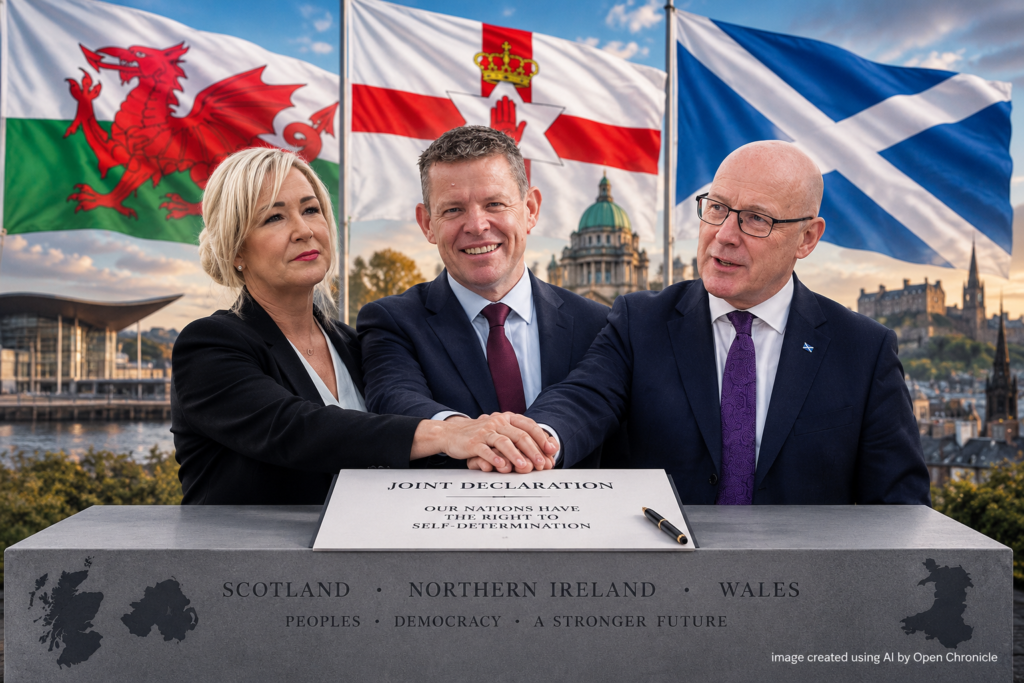
The leaders of Scotland, Wales and Northern Ireland have signed a landmark joint declaration asserting their nations’ right to determine their own constitutional futures and calling on the British government to prepare for the possibility of fundamental change to the United Kingdom.
The declaration was signed on Monday by Scottish First Minister John Swinney, Welsh First Minister Rhun ap Iorwerth and Northern Ireland First Minister Michelle O’Neill following their first face to face meeting as the nationalist leaders of the three devolved governments.
The document declares that the political landscape across the United Kingdom and Ireland is changing and argues that decisions over the future status of Scotland, Wales and Northern Ireland must ultimately rest with their populations.
“Our nations have the right to self-determination,” the declaration states.
It calls on the British government to “prepare for, plan and facilitate constitutional change in each jurisdiction,” while insisting that any such transformation should take place through democratic means and according to the wishes of voters.
Three first ministers seeking constitutional change
The meeting carries particular political significance because, according to the declaration, all three devolved administrations are now headed by leaders who favour constitutional arrangements that would take their nations out of the United Kingdom.
Swinney, leader of the Scottish National Party, supports Scottish independence. Ap Iorwerth, leader of Plaid Cymru, advocates Welsh independence, while O’Neill and Sinn Féin campaign for Irish reunification.
“Each of our nations has the right to determine its own future, through democratic means and in accordance with the wishes of its people,” the three leaders said.
They argued that no government at Westminster should be able to prevent democratic constitutional processes.
“No Westminster government has the right to block democracy or undermine” the principle that the three nations should determine their own futures, the declaration said.
The leaders went further, describing the moment as evidence of a profound transformation within the United Kingdom.
“For people watching across these islands, for people watching around the world, there could be no clearer sign that Westminster’s time is coming to an end,” they said.
The declaration represents a shared political position rather than, by itself, a change to the constitutional status of any of the three nations.
Europe becomes part of the constitutional argument
The three leaders also placed relations with the European Union at the centre of their declaration.
They said they believe the future of their nations lies within the EU and argued that Brexit has damaged their economies while restricting opportunities available to their citizens.
The governments intend to strengthen cooperation with European partners, particularly in trade, investment, culture and economic development.
“What unites us is a determination to ensure that the voices of our nations are heard, that our people have the opportunity to thrive, and that cooperation between Scotland, Wales and Ireland can be strengthened,” the declaration said.
The emphasis on Europe gives the initiative an economic and foreign policy dimension beyond the immediate constitutional debate.
The leaders also identified energy and economic cooperation as areas where Scotland, Wales and Northern Ireland could work more closely regardless of how their constitutional campaigns develop.
O’Neill says Irish unity is “on the table”
Ahead of Monday’s meeting in Wales, O’Neill said the political landscape was changing significantly and that the possibility of Irish reunification was now “very much on the table.”
Under the constitutional arrangements established by the 1998 Belfast, or Good Friday, Agreement, Northern Ireland remains part of the United Kingdom unless a majority of its population votes for Irish reunification. Constitutional change would also require approval in the Republic of Ireland.
The debate has gained additional international attention following recent comments by US President Donald Trump.
During his visit to Ireland, Trump said he would “love” to see a united Ireland. He subsequently described the integration of Ireland and Northern Ireland as “one of the naturals of all time.”
His intervention prompted criticism from unionist politicians in Northern Ireland, who stressed that the region’s constitutional future can only be decided by its people.
Scotland, Wales and Northern Ireland take different constitutional paths
Despite the language of Monday’s declaration, the three nationalist movements face very different political and legal circumstances.
Northern Ireland already has a defined mechanism for potential constitutional change through the Good Friday Agreement.
Scotland held an independence referendum in 2014, when voters chose by 55.3 percent to 44.7 percent to remain within the United Kingdom. The SNP continues to seek another referendum, arguing that circumstances have changed substantially since then, particularly because of Brexit.
Wales has historically had a smaller independence movement, although Plaid Cymru has made Welsh sovereignty a central part of its political programme.
The declaration therefore does not create a single constitutional process. Instead, it establishes a common political front around the principle that each nation should be permitted to decide its future democratically.
A new nationalist alliance
Swinney said the three parties share a belief that people in their respective nations must have the ability to shape their political futures.
“At this pivotal moment of constitutional change, we will deepen our partnership,” he said.
The agreement could also lead to more practical cooperation between the devolved governments, particularly in areas where their political and economic interests overlap.
For the British government, however, the declaration presents a potentially significant constitutional challenge. Rather than confronting separate nationalist movements individually, Westminster now faces three devolved leaders publicly coordinating around a shared principle of self-determination.
Whether that cooperation develops into a lasting political alliance remains uncertain. Public opinion, electoral results and the different constitutional rules applying to Scotland, Wales and Northern Ireland will ultimately determine how far each movement can advance.
But Monday’s declaration marks an unusual moment in the history of devolution: the leaders of Scotland, Wales and Northern Ireland have jointly declared that the constitutional future of the United Kingdom should no longer be treated as fixed.