
By Open Chronicle News Desk
The United States is facing shortages of critical weapons after months of fighting with Iran, while limitations in the American defence industrial base are complicating efforts to rebuild depleted stockpiles, according to a Pentagon inspector general report submitted to Congress.
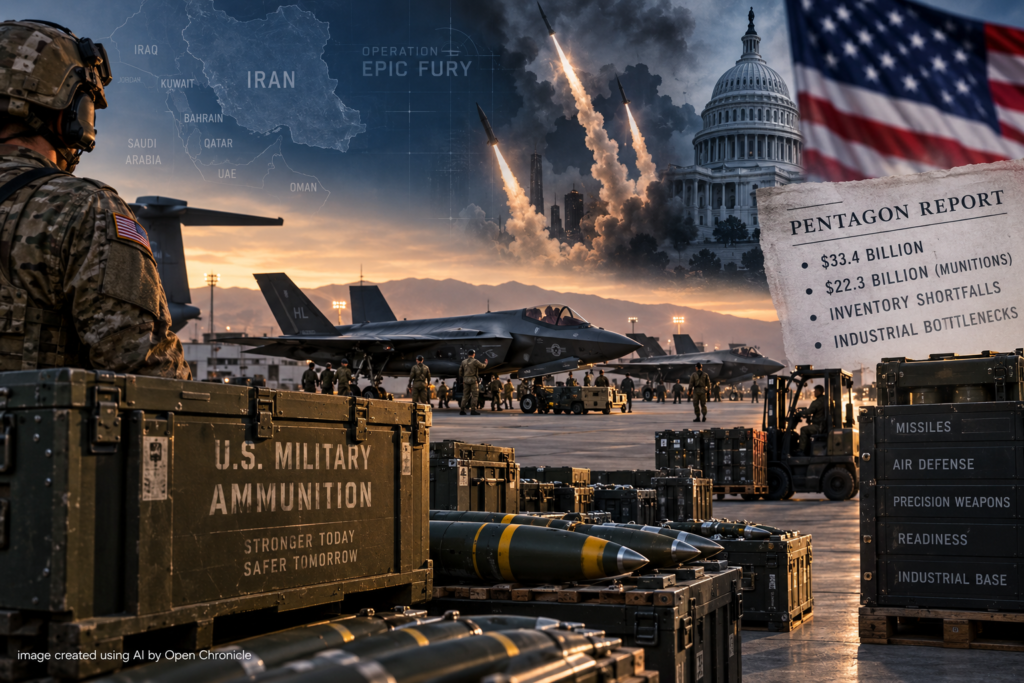
The assessment offers one of the clearest official indications yet of the strain the conflict has placed on US military inventories. It estimates that Operation Epic Fury cost approximately $33.4 billion between February 28 and June 30, with around $22.3 billion attributed to munitions expended during combat operations.
The watchdog concluded that the scale of weapons expenditure had created “strategic inventory shortfalls” while exposing bottlenecks in the industrial capacity needed to replace missiles and other sophisticated weapons.
The findings contrast with President Donald Trump’s repeated public assurances that the United States has ample ammunition available to sustain military operations.
Billions spent on munitions
The report provides an unusually detailed picture of the resources consumed during the opening months of the conflict.
Munitions account for roughly two thirds of the $33.4 billion cost identified by the inspector general during the reporting period. The figures underline how quickly a high intensity conflict involving missiles, drones and sophisticated air defence systems can consume weapons that may take months or years to replace.
According to the watchdog, the problem extends beyond the number of weapons being used. The conflict has also highlighted limitations in the American industrial base, where production capacity, specialised components, supply chains and manufacturing infrastructure can constrain how rapidly inventories can be replenished.
Those concerns could have implications beyond the Middle East. Washington must simultaneously maintain weapons reserves for its own forces while meeting commitments elsewhere and preparing for potential future crises.
Aircraft and drone losses detailed
The Pentagon report also provides figures for American aircraft damaged or destroyed during the conflict.
According to the assessment, four F-15 aircraft were destroyed, while one F-35 was damaged. Seven KC-135 aerial refuelling aircraft were also damaged.
The report says as many as 30 MQ-9 Reaper drones were destroyed.
The losses illustrate the intensity of operations across the region, where American forces have faced Iranian missile and drone attacks while conducting their own sustained air campaign.
US Central Command has said American forces attacked more than 1,000 targets during the first 24 hours of the war, an operational tempo that has not been repeated on the same scale during subsequent months.
Pressure on missile defence inventories
Among the most serious concerns is the consumption of sophisticated air defence interceptors.
Previous reporting has indicated that shortages of long range guided weapons and defensive interceptors have influenced American military planning during the conflict. Particularly significant are reported pressures on the inventory of interceptors used by the Terminal High Altitude Area Defense, or THAAD, system.
Reports have suggested that the United States may have consumed close to 80 percent of its available THAAD interceptor inventory during operations connected to the conflict.
If accurate, such depletion would be strategically important because THAAD is designed to intercept ballistic missiles during their terminal phase and represents one of the most advanced components of America’s missile defence architecture.
Replacing such weapons is considerably more complicated than replenishing conventional ammunition. Advanced interceptors require specialised manufacturing facilities, sophisticated electronics, rocket motors and other components that cannot necessarily be produced rapidly.
Trump rejects concerns over ammunition supplies
Trump has repeatedly dismissed suggestions that American weapons inventories are approaching dangerous levels.
Only weeks before the inspector general’s findings emerged, the president described US ammunition supplies as “virtually unlimited.”
On Monday, Trump again promoted the strength of the American defence industry, saying the United States was producing more advanced weapons than at any previous point in its history.
The Pentagon watchdog’s findings, however, suggest a more complicated picture. American industry continues to manufacture sophisticated weapons, but the speed at which some systems are being consumed during sustained combat may exceed the rate at which they can currently be replaced.
That difference between production capacity and battlefield expenditure has increasingly become a central question for US defence planners.
Iranian strikes damaged US bases across the Middle East
The report also documents extensive damage caused by Iranian attacks against American military installations throughout the region.
According to the inspector general, Iranian strikes damaged or destroyed hundreds of buildings and structures at US bases in Kuwait, Bahrain, Qatar, the United Arab Emirates, Saudi Arabia, Iraq, Oman and Jordan.
Those losses are not included in the $33.4 billion estimate.
The watchdog said the eventual reconstruction bill remains uncertain because decisions have yet to be made about whether every damaged facility will be rebuilt and which governments will ultimately bear the costs.
As a result, the eventual financial burden of the war could be substantially higher than the figures currently presented to Congress.
A warning for the US defence industrial base
Beyond the immediate cost of the Iran conflict, the report raises a broader strategic issue for Washington: whether the American defence industrial base can sustain prolonged high intensity warfare.
Modern conflicts increasingly depend on expensive precision guided missiles, air defence interceptors, drones, aircraft and sophisticated electronic systems. Many of these weapons require long production cycles and depend on relatively small numbers of specialised suppliers.
Expanding production therefore cannot always be accomplished simply by increasing spending.
Factories may require additional production lines, workers need specialised training, supply chains must expand and manufacturers need sufficient long term orders to justify major investments in additional capacity.
The Iran conflict is consequently becoming a test not only of America’s military strength, but also of its ability to replace what its armed forces consume.
For Pentagon planners, the challenge will be to rebuild strategic reserves while continuing current operations and maintaining sufficient inventories for contingencies elsewhere in the world.
The inspector general’s findings suggest that the margin for doing all three simultaneously may be narrower than Washington’s public messaging has sometimes implied.