
By Open Chronicle News Desk
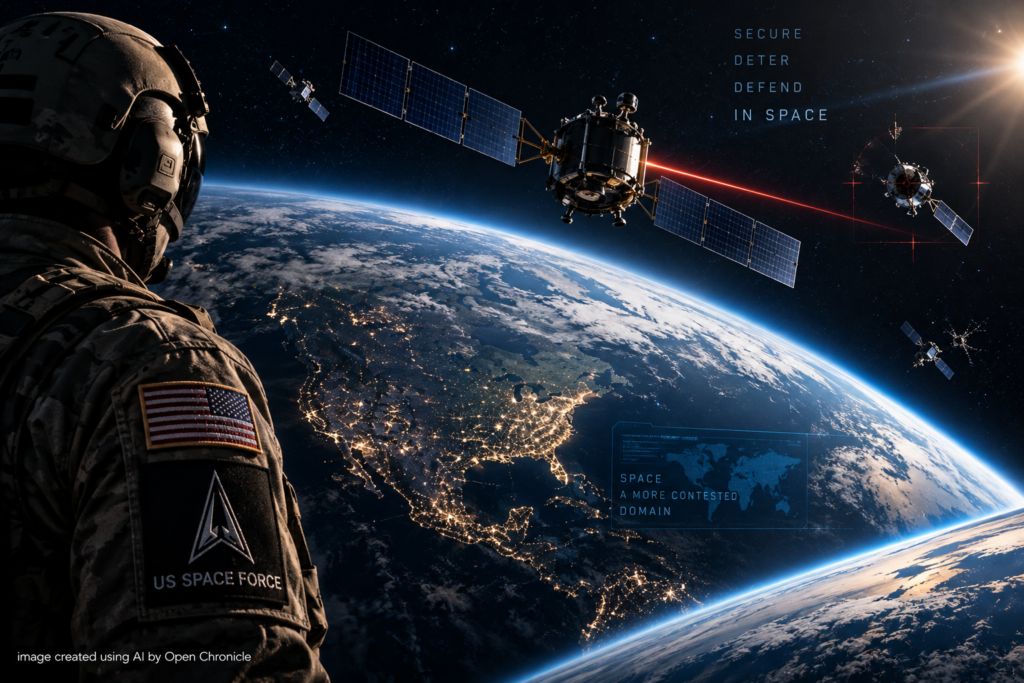
The United States has publicly confirmed for the first time that it has weapons deployed in orbit, marking a significant moment in the accelerating military competition in space.
The US Space Force said on Monday that Washington possesses orbital capabilities designed to protect American and allied forces against hostile actions in space. Officials provided few details about the systems, leaving their design, location and operational capabilities classified.
“The US has on-orbit space control weapons capable of defending the Joint Force against hostile adversary action,” a Space Force spokesperson said.
The disclosure comes as the United States, China and Russia increasingly treat space not simply as a communications and exploration environment, but as a potential battlefield critical to modern warfare.
Offensive and defensive capabilities
The Space Force described the systems as part of what it calls “space control,” a broad mission involving the ability to contest and control access to the space domain.
According to the service, these missions can involve both kinetic and non-kinetic capabilities designed to affect an adversary’s space systems.
“These capabilities can be employed for offensive and defensive purposes,” the Space Force said.
Officials did not disclose whether the newly acknowledged orbital weapons are capable of physically destroying satellites or instead use electronic warfare, directed energy, cyber capabilities or other technologies to interfere with hostile spacecraft.
That distinction is significant. A kinetic attack capable of physically destroying a satellite could create large quantities of orbital debris, potentially threatening military, commercial and civilian spacecraft belonging to multiple countries.
Non-kinetic systems could instead disrupt communications, navigation or sensors without physically destroying the target.
Satellites have become essential to modern warfare
The growing military importance of space reflects the extraordinary dependence of modern armed forces on satellites.
Space based systems provide intelligence and surveillance, missile warning, secure communications, navigation, weather information and targeting support.
The Global Positioning System, for example, is deeply integrated into American military operations, helping aircraft, ships, vehicles and precision guided weapons navigate and locate targets.
Military communications satellites allow commanders to coordinate forces across enormous distances, while reconnaissance satellites can monitor troop movements, missile deployments, naval activity and strategic infrastructure.
Losing access to those systems during a major conflict could seriously degrade the ability of US forces to operate.
Protecting them has consequently become a central mission of the Space Force, which was established in 2019 as a separate branch of the US armed forces.
China expands counterspace capabilities
Washington increasingly identifies China as its most consequential long term competitor in space.
According to the Space Force, Beijing is developing and operating both space and counterspace capabilities as part of its wider military modernisation programme.
China has developed technologies capable of potentially disrupting or destroying satellites, including electronic warfare systems and anti-satellite capabilities.
Beijing demonstrated a direct ascent anti-satellite weapon in 2007 when it destroyed one of its own weather satellites, producing thousands of pieces of orbital debris.
China has since dramatically expanded its military and civilian space programmes, deploying communications, navigation, reconnaissance and early warning satellites while developing increasingly sophisticated spacecraft.
For Washington, the concern is that some Chinese systems could be used to threaten the orbital infrastructure on which US military operations depend.
Russia views space as a warfighting domain
Russia represents another major concern.
The Space Force said Moscow regards space as a warfighting domain and considers dominance there potentially decisive in future conflicts.
Russia inherited decades of Soviet experience in military space technology and continues to operate reconnaissance, communications and missile warning satellites.
Moscow has also tested anti-satellite weapons.
In 2021, Russia destroyed one of its own defunct satellites during an anti-satellite missile test, generating a large debris field and prompting criticism from the United States and other governments.
Western officials have increasingly warned that Russia is exploring additional technologies capable of threatening satellites.
The United States, however, has now acknowledged that it too possesses weapons already operating in orbit, highlighting how rapidly the strategic environment is changing.
Military competition in space is not new
The concept of warfare beyond Earth’s atmosphere dates almost to the beginning of the space age.
After the Soviet Union launched Sputnik in 1957, both Washington and Moscow quickly recognised that satellites could transform military reconnaissance, communications and strategic warning.
Both superpowers subsequently investigated methods for attacking or disabling enemy spacecraft.
One of the greatest Cold War concerns was the possibility that nuclear weapons could be stationed permanently in orbit.
The Outer Space Treaty of 1967 established one of the most important legal barriers against such a development. It prohibits placing nuclear weapons or other weapons of mass destruction in orbit or stationing them elsewhere in outer space.
However, the treaty does not impose a comprehensive ban on conventional weapons in orbit.
That distinction has become increasingly important as military technology advances.
Anti-satellite competition spreads beyond superpowers
The ability to threaten satellites is no longer limited to the United States, Russia and China.
India demonstrated its own anti-satellite capability in 2019 when it destroyed one of its satellites using a ground launched missile.
Other countries are investing in electronic warfare, cyber operations, satellite protection and technologies capable of operating near other spacecraft.
Meanwhile, commercial companies are deploying enormous satellite constellations, further blurring the distinction between civilian and strategically important space infrastructure.
The result is an orbital environment that is becoming increasingly crowded and strategically contested.
A new stage in the military space race
The Space Force’s acknowledgement does not reveal exactly what the United States has placed in orbit, but the confirmation itself is significant.
Washington is effectively signalling that it possesses operational systems capable of contesting an adversary in space rather than relying solely on ground based counterspace capabilities.
The disclosure may also serve a deterrent purpose by warning potential adversaries that attacks against American satellites could face a response from systems already operating in orbit.
Yet it also raises questions about how quickly the military competition between the United States, China and Russia could expand beyond Earth.
Space infrastructure has become indispensable to modern economies as well as modern warfare. Communications networks, financial systems, weather forecasting, navigation, transportation and emergency services all rely heavily on satellites.
As governments develop the ability to defend, disable or destroy spacecraft, the challenge will increasingly be preventing strategic competition in orbit from becoming an uncontrolled arms race.
For decades, space was a supporting arena for military power on Earth. The latest acknowledgement from the US Space Force provides another indication that it is increasingly becoming a military domain in its own right.