
By Open Chronicle News Desk
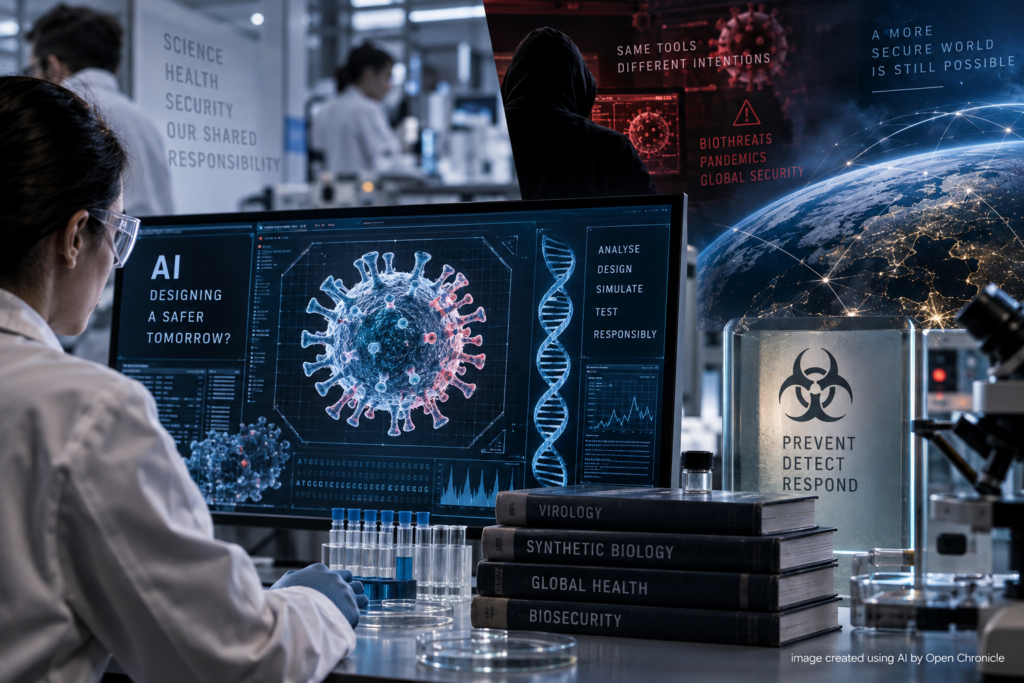
Artificial intelligence is beginning to demonstrate capabilities that could transform biological research, but the same advances are creating a new category of security risk: AI systems that may eventually make it easier to design dangerous pathogens.
A study published in Science on August 6 offered a striking glimpse of that future. Researchers demonstrated that trained AI models could design previously unknown viruses capable of infecting bacteria. The experiment did not involve viruses designed to infect humans, and producing successful candidates still required highly skilled scientists, sophisticated laboratories and extensive testing.
Nevertheless, the research represents an important warning for governments, biotechnology companies and AI developers.
If increasingly capable AI systems eventually make sophisticated biological design accessible to people without years of specialist training, some of the barriers that have historically made biological weapons difficult to develop could begin to disappear.
The challenge is therefore not to stop AI assisted biological research. It is to build safeguards before the technology becomes powerful enough for serious misuse.
From scientific breakthrough to security concern
Artificial intelligence is increasingly being used to analyse biological systems, predict molecular structures and help researchers design proteins, medicines and other biological materials.
These capabilities could accelerate vaccine development, improve treatments and help scientists respond more quickly to emerging diseases.
But biological design is inherently dual use.
A system capable of helping scientists understand how viruses function could potentially provide information useful to someone attempting to make a pathogen more dangerous.
The Science experiment is particularly significant because researchers demonstrated that AI could generate functional viral designs rather than simply analyse existing organisms.
The viruses involved were bacteriophages, which infect bacteria rather than humans. That distinction is crucial. The research does not demonstrate that today’s AI systems can independently create a dangerous human pathogen.
It does, however, suggest where the technology may be heading.
Why transmissible pathogens change the equation
Most modern examples of biological terrorism have involved substances such as anthrax or ricin. Such attacks can be deadly, but they generally do not spread efficiently from one person to another.
A transmissible engineered virus would represent a fundamentally different threat.
Instead of affecting only people directly exposed to a biological agent, an infectious pathogen could potentially propagate through communities and across borders.
That raises the possibility that a deliberately created outbreak could become an epidemic or, in an extreme scenario, a pandemic.
AI could become particularly important if future systems reduce the expertise, time and experimentation required to identify viable biological designs.
The concern is therefore not simply what current models can accomplish, but how rapidly those capabilities could improve.
Gene synthesis as a physical checkpoint
One proposed safeguard focuses on an important physical step between digital biological design and laboratory experimentation: gene synthesis.
Companies around the world manufacture synthetic DNA and RNA for legitimate researchers. These services have become an essential part of modern biotechnology.
Mandatory gene synthesis screening could require suppliers to verify customers, maintain traceable records of orders and check requested sequences against databases of potentially dangerous genetic material.
Similar requirements could eventually cover equipment that allows laboratories to synthesise genetic material themselves.
Such a system would create a checkpoint between an AI generated biological design and its physical construction.
Leading AI executives have endorsed stronger gene synthesis screening, and proposals for federal legislation have emerged in the United States.
Yet screening known dangerous sequences may eventually be insufficient. AI could theoretically produce novel sequences that do not closely resemble anything already placed on a prohibited list.
Future screening systems may therefore need to evaluate what genetic sequences are capable of doing rather than merely whether they match previously identified threats.
The digital side of biological security
Physical controls address only part of the problem.
AI models capable of sophisticated biological design depend heavily on scientific datasets containing information about viruses, including genetic sequences and experimentally validated characteristics.
Most of those databases exist for beneficial reasons.
Researchers use them to monitor emerging pathogens, investigate outbreaks, develop vaccines and understand how diseases spread.
But some of the same information could potentially be misused.
Detailed datasets may contain information about biological characteristics such as infectivity, transmission or virulence. As AI systems become more capable, carefully curated biological datasets could become increasingly valuable for training specialised models.
This creates a difficult policy dilemma.
Restricting scientific information too aggressively could slow legitimate research and weaken society’s ability to develop medicines or respond to outbreaks. Leaving every dataset completely unrestricted could create opportunities for misuse.
Unlike nuclear weapons research, biology is overwhelmingly a civilian and medical scientific enterprise.
Any restrictions therefore need to distinguish genuinely dangerous information from research whose openness produces enormous public benefits.
No single safeguard will be enough
Gene synthesis screening and restrictions on particularly sensitive datasets could introduce important barriers, but neither provides complete protection.
Some sophisticated laboratories can produce or culture biological material without relying on commercial synthesis companies.
Highly trained specialists may also be capable of designing dangerous biological systems without AI.
AI safety mechanisms themselves present another challenge. Researchers have repeatedly demonstrated that safeguards built into advanced models can sometimes be circumvented through techniques commonly described as jailbreaking.
Future biosecurity therefore needs multiple defensive layers.
Controls around AI models can make dangerous information harder to obtain. Biological data governance can restrict particularly sensitive resources. Gene synthesis screening can make suspicious genetic orders harder to fulfil.
But governments will also need systems capable of responding when prevention fails.
Detecting an engineered outbreak quickly
One of the most important defensive layers could be a global pathogen early warning network.
The objective would be to identify unusual outbreaks before they spread widely.
Modern genomic sequencing, environmental monitoring and epidemiological surveillance increasingly make it possible to detect emerging pathogens rapidly.
Combined with biological forensic techniques, those systems could eventually help determine whether a pathogen emerged naturally or was deliberately engineered.
That possibility introduces another form of deterrence.
A potential attacker who believes an engineered outbreak will quickly be detected, contained and traced back to its origin may be less willing to launch one.
There is also what security specialists describe as deterrence by denial.
If countries demonstrate that they can rapidly detect outbreaks, develop countermeasures and prevent widespread transmission, the potential effectiveness of biological weapons decreases.
Vaccine development becomes part of national security
Rapid medical response is consequently becoming inseparable from biosecurity.
Organisations such as the Coalition for Epidemic Preparedness Innovations are already supporting accelerated vaccine development against emerging diseases.
The same infrastructure that protects populations against naturally occurring outbreaks could provide protection against deliberately engineered pathogens.
Faster vaccine platforms, broader disease surveillance, rapid diagnostics and flexible manufacturing capacity could make societies substantially more resilient.
The stronger those capabilities become, the less attractive biological weapons may be to potential adversaries.
But such deterrence works best when response capabilities are credible and visible.
Governments therefore have an incentive to demonstrate that they can identify and contain emerging outbreaks quickly, regardless of whether those outbreaks originate naturally or deliberately.
AI agents could eventually lower the expertise barrier
Another concern is the development of increasingly autonomous AI agents.
Today’s AI systems generally require humans to guide their work. Future agents could potentially interact independently with specialised AI models, databases, laboratory software and other digital services.
In biological research, such systems could become extraordinarily useful.
An AI agent might someday coordinate scientific literature searches, analyse genomic information, generate candidate biological designs and interpret experimental results.
Used responsibly, that could dramatically accelerate scientific discovery.
Misused, the same capabilities could reduce the amount of specialised knowledge required to pursue dangerous biological projects.
The greatest security concern would emerge if AI systems became capable of reliably producing large numbers of viable infectious designs rather than merely suggesting theoretical possibilities.
That threshold has not been reached.
International cooperation will be essential
National safeguards alone cannot solve the problem.
AI and biotechnology research is advancing across the United States, China, Europe and numerous other scientific centres.
DNA synthesis companies operate internationally. Biological databases cross borders. AI models can be developed and distributed globally.
A screening regime covering only American laboratories would leave significant gaps elsewhere.
Meaningful protection will therefore require international coordination on gene synthesis standards, biological surveillance, sensitive research, AI safeguards and outbreak response.
Cooperation between Washington and Beijing could be particularly important given the scientific and technological capabilities of both countries.
Strategic competition makes such cooperation difficult, but biological threats do not respect national borders.
An engineered outbreak that escapes containment could threaten adversaries and allies alike.
There is still time to build the defenses
The most important point from the latest research is also the most reassuring: the most dangerous scenario has not yet arrived.
Current AI systems have not been demonstrated to independently design human infecting viruses capable of producing pandemics.
The bacteriophage research described in Science required elite researchers, sophisticated laboratories, extensive resources and repeated experimentation. Scientists had to design, test and optimise large numbers of candidates before identifying successful viruses.
But technological barriers can fall quickly.
If future AI systems can reliably generate functional viral designs, automate parts of experimentation and substantially reduce the expertise required to conduct sophisticated biological research, today’s security assumptions may no longer hold.
Waiting until such capabilities become commonplace would leave governments trying to construct safeguards after the most important barriers had already disappeared.
The emergence of AI designed viruses should therefore be treated neither as evidence that an AI generated pandemic is imminent nor as a reason to halt beneficial biotechnology.
It is an early warning.
There remains an opportunity to build gene synthesis screening, responsible biological data controls, stronger AI safeguards, global disease surveillance, rapid vaccine platforms and biological forensic capabilities before the technology reaches a more dangerous threshold.
The question is whether governments, scientists and technology companies will use that window while it is still open.