
By Open Chronicle
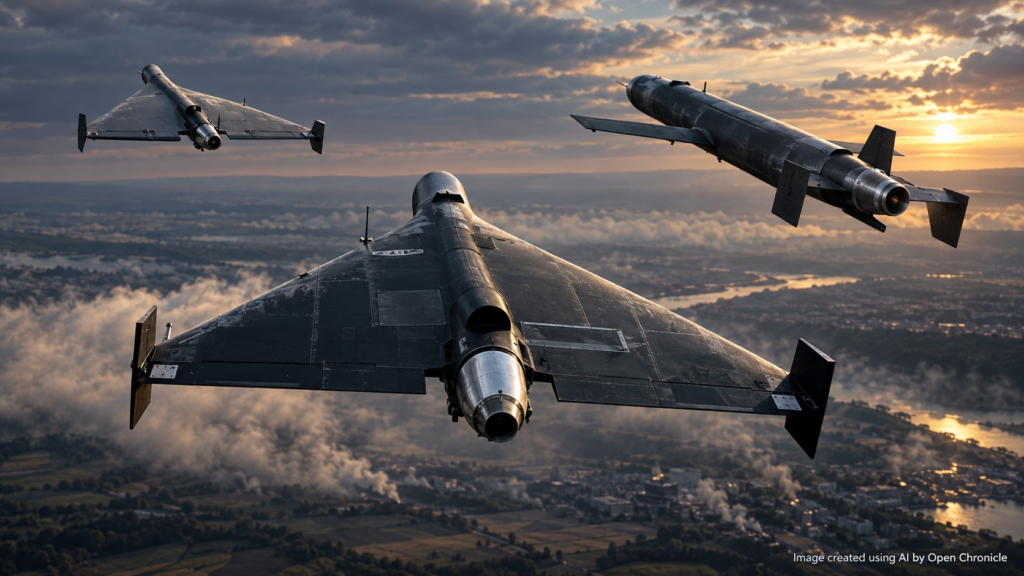
Russian jet powered drones are a developing family of unmanned aerial vehicles used by the Russian Federation primarily for long range one way attack missions during the Russia Ukraine War.
Their emergence represents an important evolution of the Shahed and Geran family of attack drones that became a major component of Russia’s long range strike campaign against Ukraine following the full scale invasion of February 2022.
Early Russian produced Geran attack drones were derived from the Iranian Shahed 136 and relied upon relatively inexpensive piston engines driving pusher propellers. These aircraft combined long range, simple construction and comparatively low production cost, allowing Russia to launch increasingly large numbers against Ukrainian targets.
Jet propulsion changes that equation.
By replacing the piston engine and propeller with a small turbojet, Russian designers have produced substantially faster unmanned aircraft capable of reducing the time available to air defence systems and interceptor drones.
By September 2026, jet powered drones were no longer an experimental curiosity. Russia was deploying them in increasingly large numbers, with Ukrainian forces reporting variants generally identified as Geran 3, Geran 4 and Geran 5.
The development has created a new technological competition between Russian strike drones and Ukrainian air defences.
Quick Facts
Type: Jet powered unmanned aerial vehicles
Primary role: Long range one way attack
Country: Russia
Principal family: Geran
Known or reported variants: Geran 3, Geran 4, Geran 5
Predecessor: Geran 2
Technological ancestry: Iranian Shahed family
Propulsion: Small turbojet engines
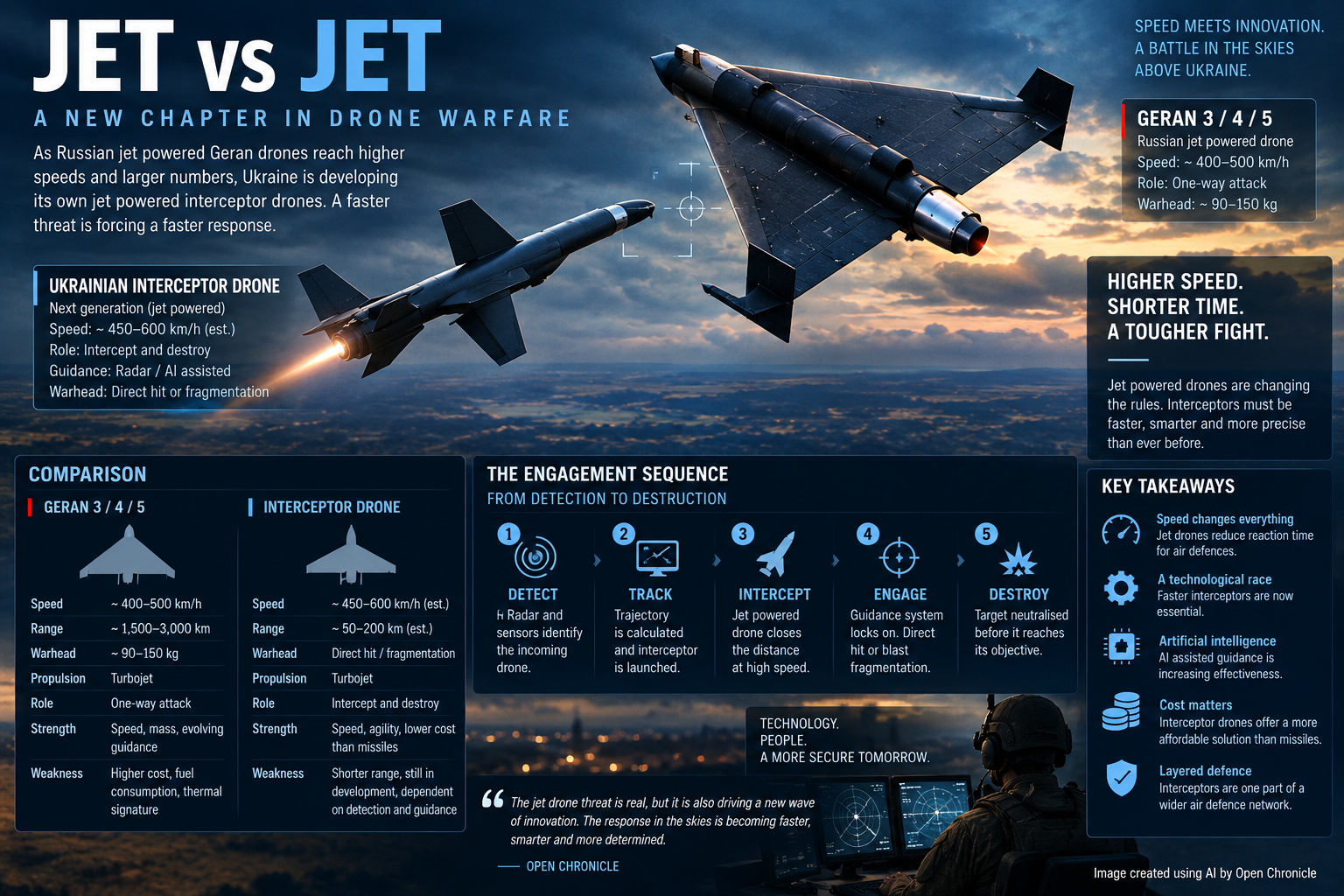
Reported operational speeds: Approximately 240 to 500 km/h across different types and flight profiles
Guidance: Multiple configurations reported, including satellite navigation, inertial navigation and more advanced terminal guidance on some versions
Warhead: Variant dependent
Operational conflict: Russia Ukraine War
Major advantage: Higher speed than conventional propeller driven Shahed and Geran aircraft
Major disadvantage: Greater cost, fuel consumption and thermal signature
Operational status: Increasing large scale deployment
Origins
The history of Russian jet powered attack drones begins with Iran’s Shahed family.
Iran developed a range of relatively inexpensive unmanned aircraft designed to attack targets at considerable distances.
The best known became the Shahed 136.
Its design was unconventional but highly economical.
A delta shaped airframe contained fuel, guidance equipment and a warhead. A small piston engine mounted at the rear drove a pusher propeller.
Rather than returning after its mission, the aircraft flew directly into its target.
This concept became known internationally as a one way attack UAV, although terms such as loitering munition and kamikaze drone are also widely used.
Russia began using Iranian supplied Shahed 136 aircraft against Ukraine in 2022.
Russian production subsequently expanded under the designation Geran 2.
The Geran 2
The Geran 2 became one of the defining weapons of the aerial campaign over Ukraine.
Its greatest strength was not exceptional performance.
It was economics.
Compared with many conventional cruise missiles, the aircraft could be produced relatively cheaply.
Large numbers could therefore be launched simultaneously.
A wave containing dozens or hundreds of drones forced Ukrainian defenders to detect, track and engage many individual targets.
Even if most were destroyed, the attack could consume interceptor missiles, ammunition and other defensive resources.
Russia progressively expanded this strategy.
By the first half of 2026, attacks containing hundreds of Shahed type aircraft had become possible.
An Institute for Science and International Security analysis based on Ukrainian Air Force reporting estimated that Russia launched 5,749 Shahed type UAVs, including decoys, during June 2026 alone. The same analysis estimated approximately 3,679 of these to have been Shahed or Geran strike aircraft.
But the Geran 2 possessed a major vulnerability.
It was relatively slow.
The Speed Problem
The conventional Geran 2 typically travels at speeds far below those of conventional cruise missiles.
That originally presented Ukraine with a difficult but manageable problem.
Expensive surface to air missiles could destroy Shaheds, but repeatedly using missiles costing hundreds of thousands or millions of dollars against comparatively inexpensive drones was economically unattractive.
Ukraine therefore developed cheaper methods.
Mobile gun teams were deployed.
Helicopters and aircraft conducted interceptions.
Electronic warfare was expanded.
Most importantly, Ukraine began developing specialised interceptor drones.
These small unmanned aircraft could pursue and destroy incoming Shahed type aircraft at substantially lower cost than conventional air defence missiles.
The economics of the battle began to change.
Russia responded by increasing speed.
From Propeller to Jet
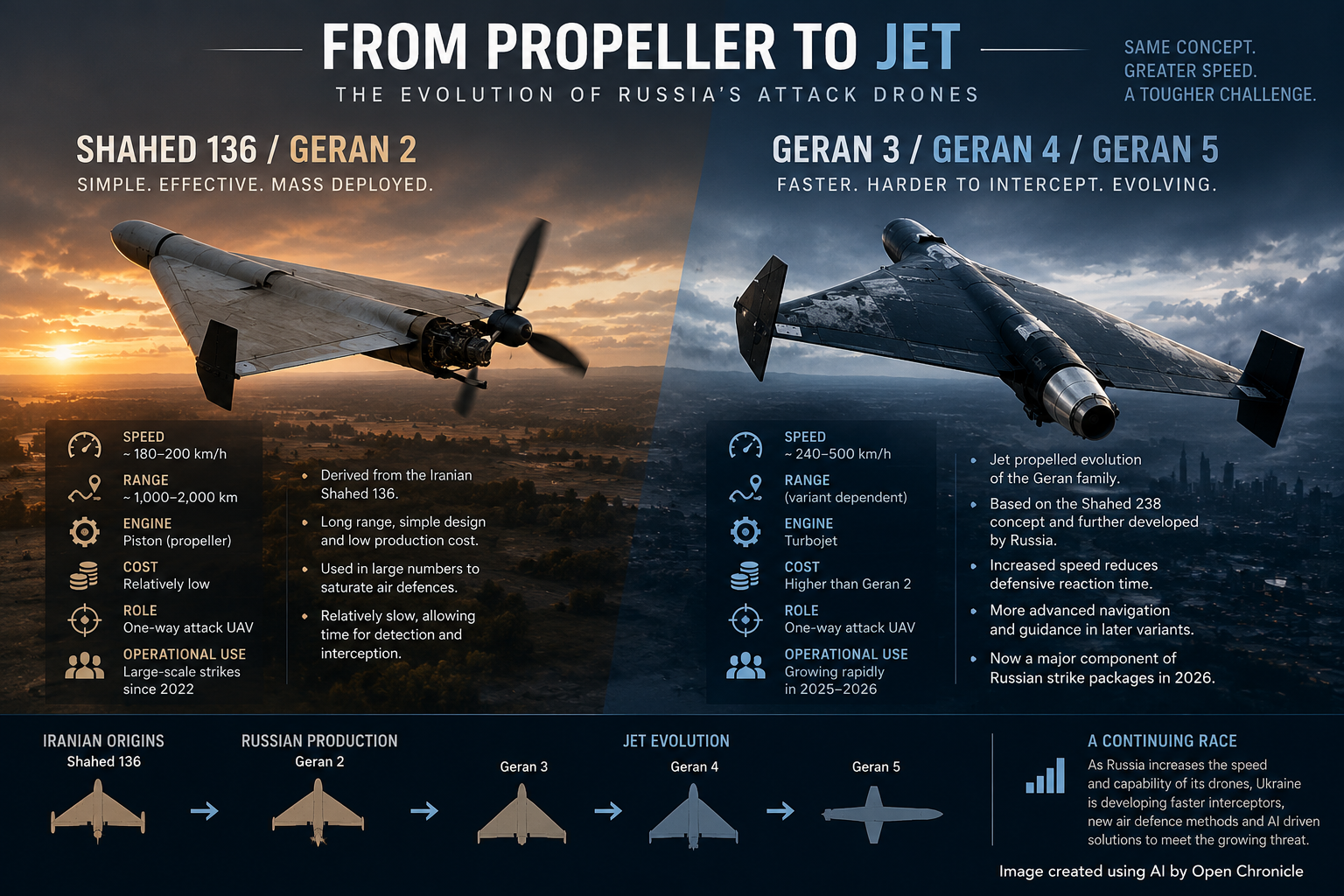
A piston engine driving a propeller is highly efficient for a relatively slow aircraft.
It also offers comparatively low cost and good endurance.
A turbojet operates differently.
Air enters the engine and is compressed.
Fuel is added and burned.
The expanding gases drive the turbine and leave the exhaust at high velocity, producing thrust.
For a one way attack drone, this provides a major advantage.
Speed.
A jet powered drone can cross the defender’s engagement zone considerably faster than a conventional Geran 2.
The consequences extend beyond simple flight time.
Detection occurs later relative to arrival.
Air defence crews have less time to react.
Interceptor drones have less time to climb.
A pursuing aircraft requires considerably greater speed.
Mobile gun teams receive shorter engagement opportunities.
A target may therefore become significantly harder to intercept even if the aircraft itself is not stealthy.
The Iranian Shahed 238
The conceptual bridge between the conventional Shahed 136 and Russia’s jet powered Geran family is closely associated with the Shahed 238.
Iran publicly revealed jet powered developments of the Shahed design after the Shahed 136 had already demonstrated the military potential of inexpensive long range attack drones.
The Shahed 238 retained the basic delta wing concept but replaced the rear piston engine and propeller with jet propulsion.
Different guidance configurations have also been reported.
The design demonstrated that the basic Shahed concept could be adapted for considerably greater speed.
Russian development subsequently followed a related technological direction.
Geran 3
The Geran 3 became one of the first widely identified Russian jet powered members of the Geran family.
Its relationship with the Iranian Shahed 238 is close enough that the two aircraft are frequently discussed together.
The basic concept remains recognisable.
A relatively compact delta wing aircraft carries fuel, guidance equipment and an explosive payload while a small turbojet provides propulsion.
The transition dramatically changes its flight characteristics.
Instead of the distinctive slow approach associated with conventional Shaheds, a Geran 3 can travel considerably faster.
This reduces interception time and increases the performance required from defensive drones.
The Geran 3 therefore represents more than an engine replacement.
It changes the defensive problem.
Geran 4
The Geran 4 represents a further stage in the development of Russia’s jet powered strike UAV family.
Open source descriptions indicate that it should not necessarily be understood as simply another Geran 2 with a jet engine.
Changes have been reported in its airframe, guidance architecture and mission equipment.
Some configurations have been associated with more sophisticated control and terminal guidance capabilities.
This reflects a broader development within Russian unmanned systems.
The original Shahed concept was essentially a relatively inexpensive autonomous weapon programmed to fly towards predetermined coordinates.
Later systems increasingly blur the distinction between simple one way attack drones and more sophisticated guided strike aircraft.
The Geran 4 appears to belong to this transition.
Geran 5
The Geran 5 is a newer and larger jet powered member of the expanding family.
Publicly available information remains less complete than for the Geran 2, and reported specifications should therefore be treated cautiously.
Its appearance nevertheless demonstrates that Russia is moving beyond merely modifying the original Shahed configuration.
The Geran family is becoming a broader technological ecosystem.
Different aircraft can optimise different combinations of range, speed, payload, guidance and production cost.
This resembles the evolution of conventional missile families, where a common operational requirement eventually produces several weapons rather than a single universal design.
A Family Rather Than a Single Aircraft
The term Russian jet powered drone can therefore be misleading if interpreted as referring to one standard aircraft.
The category includes different platforms.
Identification can also be difficult.
Aircraft may share similar silhouettes.
Components can change between production batches.
Operational modifications may appear before formal designations become publicly known.
Some recovered wreckage can be identified precisely.
Other aircraft are observed only briefly by radar, video or air defence crews.
Consequently, not every reported jet powered Geran can be assigned confidently to a particular subtype.
The distinction between confirmed characteristics, reported characteristics and analytical estimates is essential.
Propulsion
Small turbojet engines are central to the new generation.
Compared with large combat aircraft engines, these powerplants are extremely compact.
They nevertheless operate according to the same fundamental gas turbine principles.
A compressor raises the pressure of incoming air.
Fuel burns inside the combustion chamber.
The resulting hot gases drive a turbine and generate thrust through the exhaust.
The engine provides substantially more speed than the piston powerplant of a conventional Geran.
That advantage has a price.
Turbojet versus Piston Engine
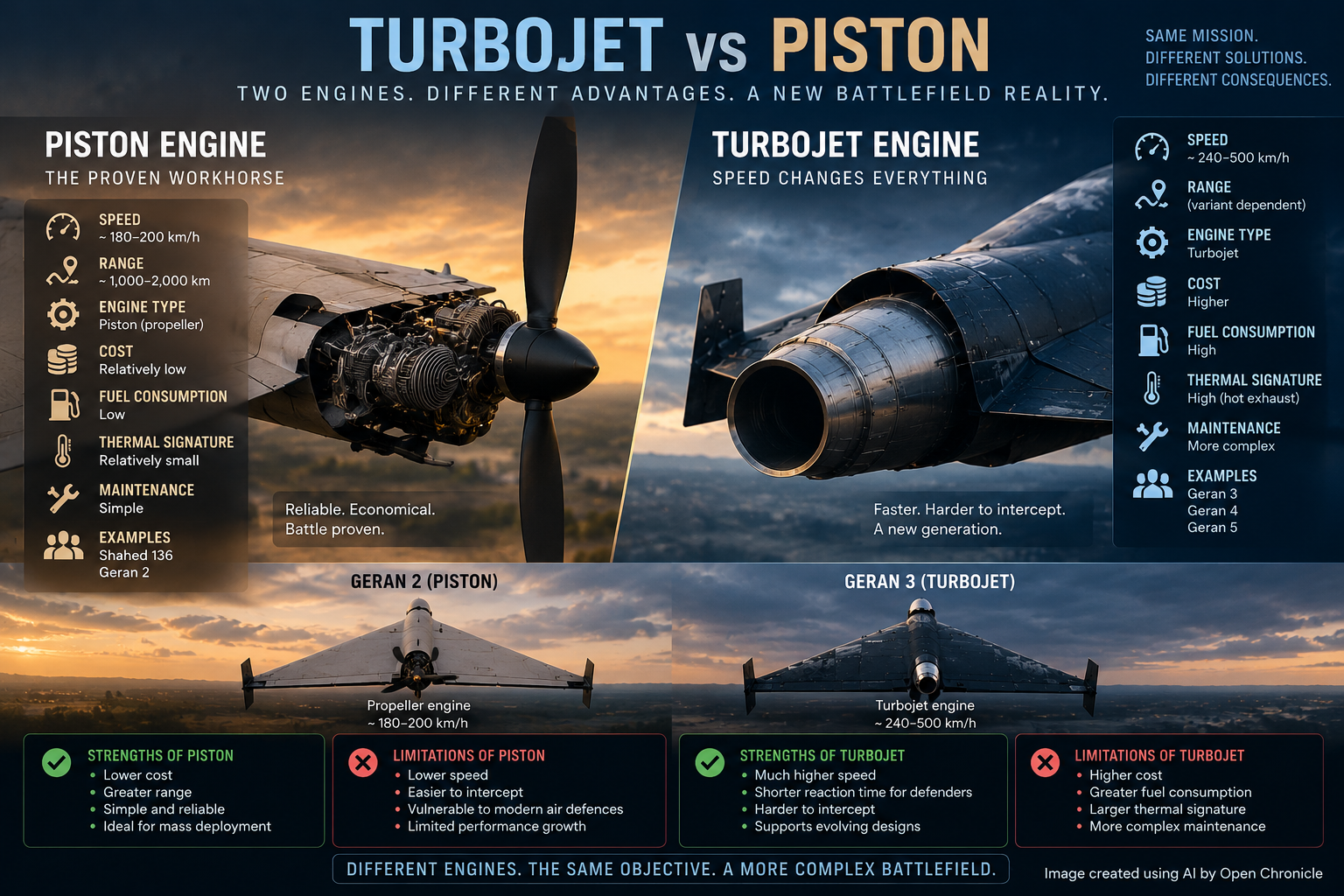
A piston engine is generally more fuel efficient at the relatively low speeds used by conventional Shahed type aircraft.
It is mechanically straightforward.
It can provide long endurance using modest quantities of fuel.
A turbojet can deliver far greater speed.
However, it consumes fuel considerably faster.
This means designers must balance speed against range.
A larger fuel load increases mass.
Additional mass may require a larger airframe.
A larger airframe may increase production cost and radar visibility.
The engine itself can also be more expensive than the simple piston engines used in conventional Geran aircraft.
Jet propulsion therefore does not automatically make the aircraft superior.
It produces a different optimisation.
Thermal Signature
Turbojets also produce a significant infrared signature.
Hot exhaust gases leave the rear of the aircraft.
This can make the drone easier for infrared sensors and heat seeking weapons to detect and track.
The faster drone is therefore simultaneously more difficult and potentially easier to intercept.
It is harder because defenders have less time.
It may be easier for some sensors because its engine produces more heat.
This illustrates a recurring principle of military technology.
An improvement in one characteristic often creates a vulnerability somewhere else.
Airframe Evolution
Increasing speed imposes new structural requirements.
Aerodynamic loads rise.
Control surfaces must function effectively at higher velocities.
Engine installation changes weight distribution.
Fuel requirements change internal volume.
Vibration and temperature environments change.
Simply installing a turbojet in an existing airframe is therefore not necessarily sufficient.
Later Geran variants appear increasingly to reflect these requirements through changes to the underlying aircraft.
This is one reason the Geran 4 and Geran 5 are better understood as part of an evolving family rather than simple engine conversions.
Guidance and Navigation
Early Shahed type aircraft primarily depended upon predetermined navigation.
A target’s coordinates were entered before launch.
The aircraft then navigated towards that location.
Satellite navigation can provide position updates.
Inertial systems can continue estimating position when satellite signals become unreliable.
Russia has progressively improved navigation systems in response to Ukrainian electronic warfare.
This contest has become one of the central technological battles of the war.
Ukraine attempts to interfere with Russian navigation.
Russia develops greater resistance to interference.
Ukraine changes its jammers.
Russia changes its navigation systems.
The cycle continues.
Terminal Guidance
More advanced Geran variants have been associated with terminal guidance capabilities.
These may allow an aircraft to identify or refine its approach to a target during the final stage of flight rather than relying exclusively upon fixed coordinates.
Electro optical sensors are particularly significant.
A camera can potentially provide imagery of the target area.
Image processing can then assist the aircraft in recognising terrain or objects.
Such capabilities would move the weapon closer to sophisticated guided missiles while retaining aspects of drone architecture.
The precise capabilities vary by configuration and remain incompletely documented.
Communications
Some newer Russian attack drones have also demonstrated communications capabilities that differ substantially from the original autonomous Shahed concept.
A communications link can potentially allow updated targeting information, remote mission changes or transmission of imagery.
This creates additional tactical possibilities.
It also introduces vulnerabilities.
A communications link can potentially be detected, jammed or exploited.
The continuing development of these systems therefore involves a balance between autonomy and connectivity.
Warheads
The Geran family has carried different explosive payloads.
Warhead design depends upon the intended target.
High explosive fragmentation can damage relatively soft infrastructure.
Other configurations can improve effects against buildings or hardened structures.
Incendiary effects may be useful against fuel, industrial or energy targets.
As the airframes evolve, payload capacity can also change.
A larger jet powered platform may potentially carry a heavier warhead, but additional payload reduces the mass available for fuel and therefore affects range.
Every design involves compromise.
Range
Range figures for individual jet powered Geran variants remain one of the least reliable areas of open source reporting.
Turbojet propulsion increases fuel consumption.
Higher speed therefore does not come without consequences.
A designer can preserve range by increasing fuel capacity, increasing aircraft size, reducing payload or improving engine efficiency.
Different Geran variants appear to make different choices.
For this reason, a single range figure should not be applied to the entire Russian jet powered drone family.
Speed
Speed is their defining characteristic.
Current reporting indicates that Russian jet powered attack drones can operate across a broad envelope, with approximately 240 to 500 km/h cited for systems encountered by Ukraine in 2026.
This remains far below the speed of many conventional cruise missiles.
However, it is substantially above that of the conventional propeller driven Shahed and Geran aircraft.
The difference is operationally significant.
A defender designed to intercept a target travelling around 180 km/h may not be able to pursue an aircraft travelling at 400 or 500 km/h.
By September 2026, Reuters reported that this performance gap had become a significant problem for Ukrainian interceptor drone units.
Why Speed Matters
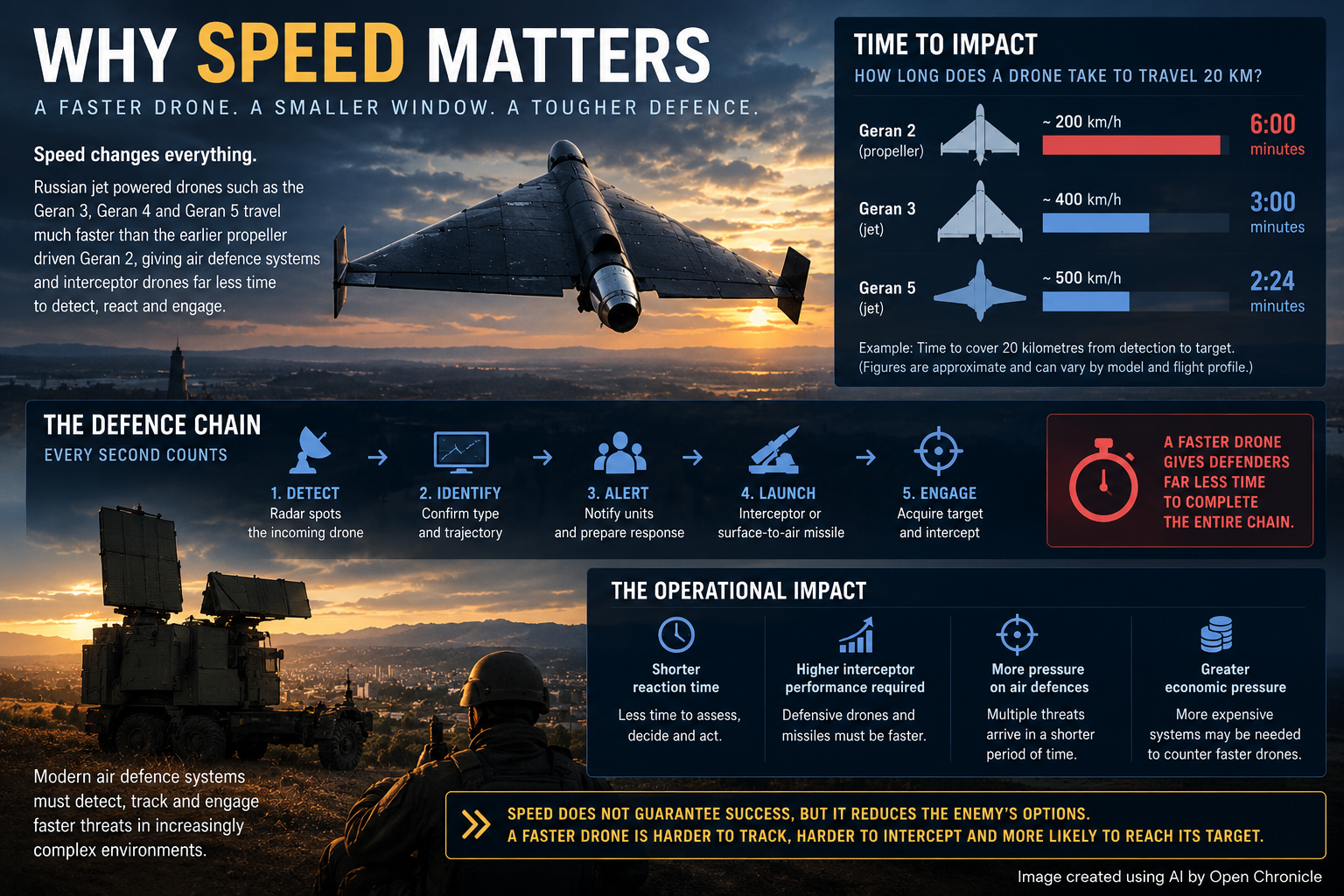
Consider a simplified example.
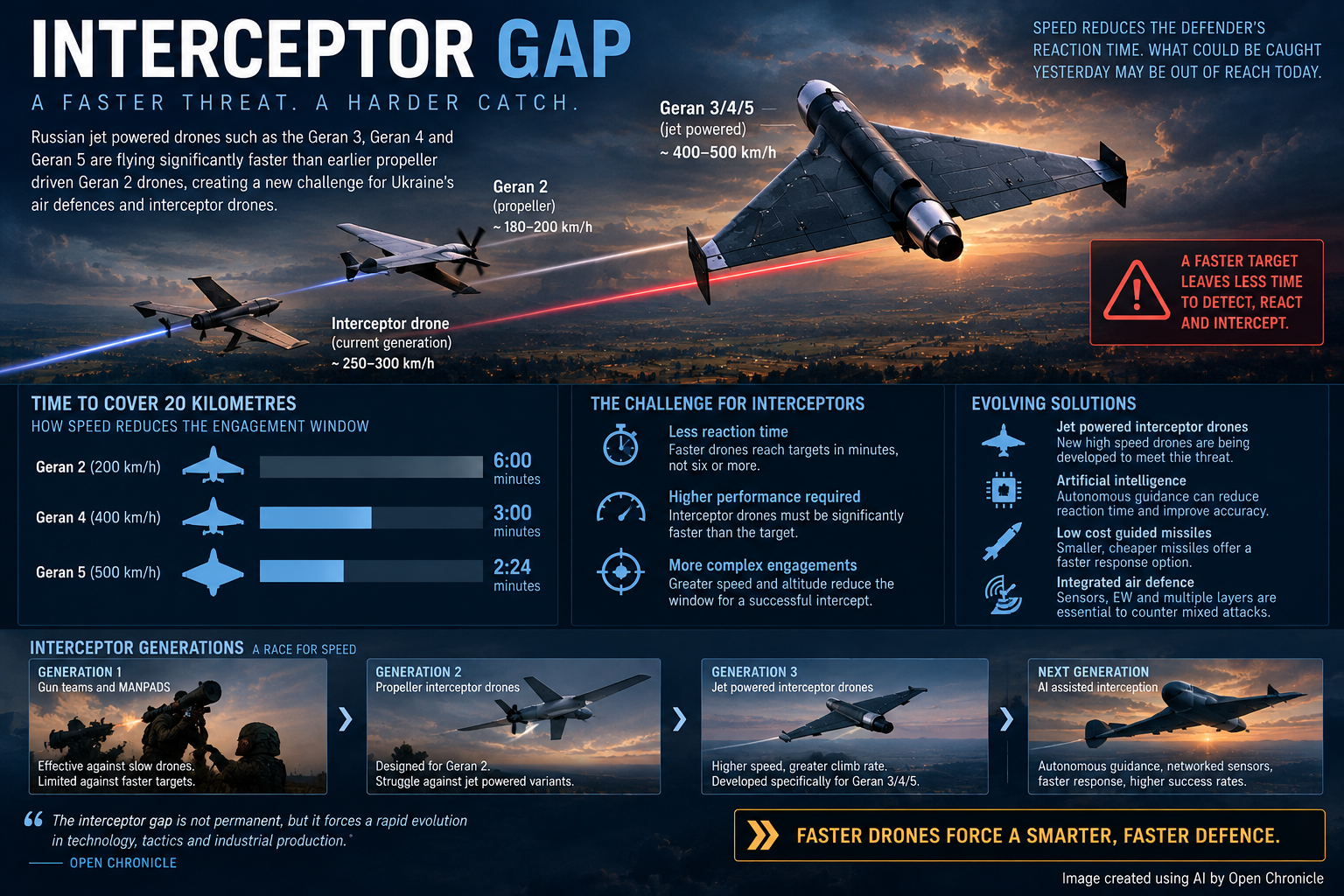
If a defender detects an incoming aircraft 20 kilometres away, a target travelling at 200 km/h requires approximately six minutes to cover that distance.
At 400 km/h, the time falls to approximately three minutes.
At 500 km/h, it falls to approximately two minutes and twenty four seconds.
During that interval the defender must detect the aircraft, classify it, determine its trajectory, alert an interception unit, launch a weapon, reach the correct altitude and position, acquire the target and complete the engagement.
Speed therefore attacks the defender’s decision time.
That may be more important than speed itself.
Launch Methods
Geran type aircraft can be launched without the extensive infrastructure required by conventional combat aircraft.
This is an important strategic advantage.
Distributed launch locations complicate efforts to destroy the system before launch.
Mobile launch arrangements can relocate.
Large numbers of aircraft can be prepared for coordinated attacks.
The relatively modest infrastructure requirements contribute directly to the scalability of the Geran concept.
Operational Employment
Jet powered variants were initially only a small component of much larger Russian attack packages.
This allowed Russia to introduce them without abandoning the economic advantages of the conventional Geran 2.
A strike could contain slower propeller driven aircraft, decoys, jet powered Gerans and conventional missiles.
Each presented a different defensive problem.
The defender could not use exactly the same interception method against every target.
This mixed approach became increasingly important during 2026.
Mixed Strike Packages
Russia frequently combines several categories of aerial weapon in the same campaign.
Conventional Gerans provide numbers.
Decoys create additional radar tracks.
Jet powered drones introduce speed.
Cruise missiles introduce greater performance and payload.
Ballistic missiles create an entirely different interception problem.
The objective is not simply to make each individual weapon difficult to destroy.
It is to make the entire attack difficult to manage.
Air defence resources must be allocated rapidly between different threats.
A missile used against a cheap decoy cannot subsequently be used against a more dangerous weapon.
A slow interceptor positioned for a conventional Geran may be ineffective against a jet powered variant.
From Experiment to Mass Deployment
During early deployments, jet powered Gerans represented only a relatively small proportion of Russian drone attacks.
That changed rapidly during 2026.
The Institute for Science and International Security assessed that Russia probably employed roughly 30 to 80 Geran 3 and Geran 4 aircraft during May, with a central estimate around 50. The organisation cautioned that available evidence did not permit a precise count.
By June, Ukrainian reporting increasingly described jet powered aircraft operating alongside conventional attack drones throughout the day and night.
The subsequent increase was dramatic.
Reuters reported on 15 September that Ukrainian data recorded approximately 450 Russian jet powered drones in June, about 1,100 in July and nearly 2,850 in August 2026.
The figures indicate a transition from specialised battlefield capability towards large scale operational employment.
Ukraine’s Interceptor Drone Revolution
Ukraine had developed interceptor drones partly in response to the enormous number of conventional Shahed type aircraft.
The economic logic was compelling.
A relatively inexpensive interceptor could potentially destroy an incoming attack drone without consuming a costly surface to air missile.
Interceptor manufacturers therefore optimised their aircraft for the known threat.
They needed enough speed to catch a conventional Geran.
They needed sufficient altitude.
They needed sensors or operator guidance capable of completing the interception.
Jet propulsion disrupted this balance.
The Interceptor Gap
An interceptor must normally possess a meaningful speed advantage over the aircraft it is pursuing.
Matching the target’s maximum speed is not enough.
The interceptor must reach the target.
If it begins behind the attacking aircraft, it has to close the distance.
If the target is climbing, the interceptor must simultaneously gain altitude.
If the engagement geometry is poor, even greater performance may be necessary.
A 500 km/h attack drone therefore creates a very different problem from a 180 km/h Geran.
Ukraine’s existing interceptor fleet was not universally designed for this performance envelope.
Jet Powered Interceptors
The logical response is another technological escalation.
Jet attacks jet.
Ukrainian companies are developing small jet powered interceptor drones specifically intended to pursue the faster Russian aircraft.
At the Farnborough International Airshow in July 2026, manufacturers displayed and discussed new high speed interception systems intended for precisely this mission.
Reuters reported that companies including Ukrainian and British Ukrainian developers were pursuing jet powered solutions as Russian deployment increased.
By September, more than 60 companies were reportedly participating in Ukraine’s wider effort to develop effective responses to the new threat.
Artificial Intelligence
Artificial intelligence may become increasingly important to interception.
At several hundred kilometres per hour, human reaction time becomes a limitation.
An autonomous or semi autonomous interceptor can potentially identify a target through onboard sensors, calculate an interception path and make rapid corrections.
Machine vision can assist terminal guidance.
Automatic target recognition can reduce operator workload.
Networked sensors can transfer target information directly to the interceptor.
The objective is to shorten the chain between detection and destruction.
Guided Anti Drone Missiles
Another emerging solution lies between conventional surface to air missiles and interceptor drones.
Small, comparatively inexpensive guided missiles can provide the speed required to engage jet powered UAVs without the extreme cost associated with sophisticated long range air defence missiles.
This creates a new category of air defence economics.
The weapon does not need to intercept a fighter aircraft hundreds of kilometres away.
It needs sufficient speed, guidance and range to destroy a relatively small unmanned target.
Designing specifically for that requirement can reduce cost.
Guns
Automatic cannon remain useful against drones that enter their engagement envelope.
A projectile travels considerably faster than the drone.
The difficulty lies in creating the firing opportunity.
A faster aircraft spends less time within range.
Tracking requirements become more demanding.
The number of rounds required to obtain a reliable kill may increase.
Gun based defence therefore benefits substantially from radar, electro optical tracking and automated fire control.
Electronic Warfare
Electronic warfare remains another layer.
If a drone depends heavily upon satellite navigation, disrupting those signals can affect its accuracy.
If it uses a communications link, that connection can potentially be attacked.
But modern Russian drones increasingly combine multiple navigation methods.
Inertial systems can continue operating without external radio signals.
More sophisticated terminal guidance can further reduce dependence upon satellite navigation during the final approach.
Electronic warfare therefore remains important but cannot be assumed to provide a universal solution.
Manned Aircraft
Ukraine has also used manned aircraft and helicopters against Russian drones.
A fighter possesses the performance required to catch even relatively fast unmanned targets.
However, this approach creates significant disadvantages.
Flight hours are expensive.
Pilots are valuable.
Aircraft may need to operate near areas threatened by Russian air defence.
Air to air missiles may cost far more than the target.
Using combat aircraft against thousands of inexpensive drones is therefore difficult to sustain as the primary defensive method.
Reuters reported in September 2026 that the increasing jet drone threat was forcing greater reliance on risky manned aircraft interception while specialised alternatives were still being developed.
The Economics of Interception
This is one of the defining problems of drone warfare.
Destroying the incoming weapon is not enough.
It must ideally be destroyed economically.
If an attacker launches a weapon costing tens of thousands of dollars and the defender repeatedly uses missiles costing hundreds of thousands or millions, the attacker can impose disproportionate economic pressure even when every drone is intercepted.
Interceptor drones changed this equation against conventional Gerans.
Jet powered Gerans are now changing it again.
The resulting competition is not merely technological.
It is industrial.
Production
The enormous increase in Russian Shahed and Geran operations has required corresponding industrial expansion.
The Alabuga Special Economic Zone in Tatarstan became the principal centre associated with Russian production of Shahed derived Geran aircraft.
Production initially depended heavily upon Iranian technology and components.
Russia progressively localised manufacture.
Factories expanded.
Supply networks developed.
Design modifications accumulated.
The resulting Geran is increasingly better understood as an evolving Russian weapons family with Iranian ancestry rather than simply an imported Iranian aircraft.
Alabuga
Alabuga demonstrates the industrial dimension of modern drone warfare.
The effectiveness of the Geran programme does not depend only upon aerodynamics or guidance technology.
Production rate matters.
Supply chains matter.
Engine availability matters.
Electronics matter.
Workers matter.
Factory floor area matters.
If a country can produce hundreds or thousands of attack aircraft every month, the resulting pressure upon an opponent’s air defence becomes strategically important even when individual aircraft remain relatively simple.
Analysis of Russian strike activity during the first half of 2026 showed continuing expansion in the broader Shahed and Geran ecosystem.
Foreign Components
Russian unmanned systems have repeatedly contained foreign manufactured electronic components.
Modern commercial technology provides processors, communications components, navigation electronics and other equipment that can be adapted for military purposes.
Small turbojet engines and their associated supply chains are particularly important to the jet powered transition.
This creates a continuing contest between sanctions, export controls, intermediary supply networks and Russian efforts to secure the components required for production.
The exact supply chain varies by aircraft and production period.
Geran 3 vs Geran 4 vs Geran 5
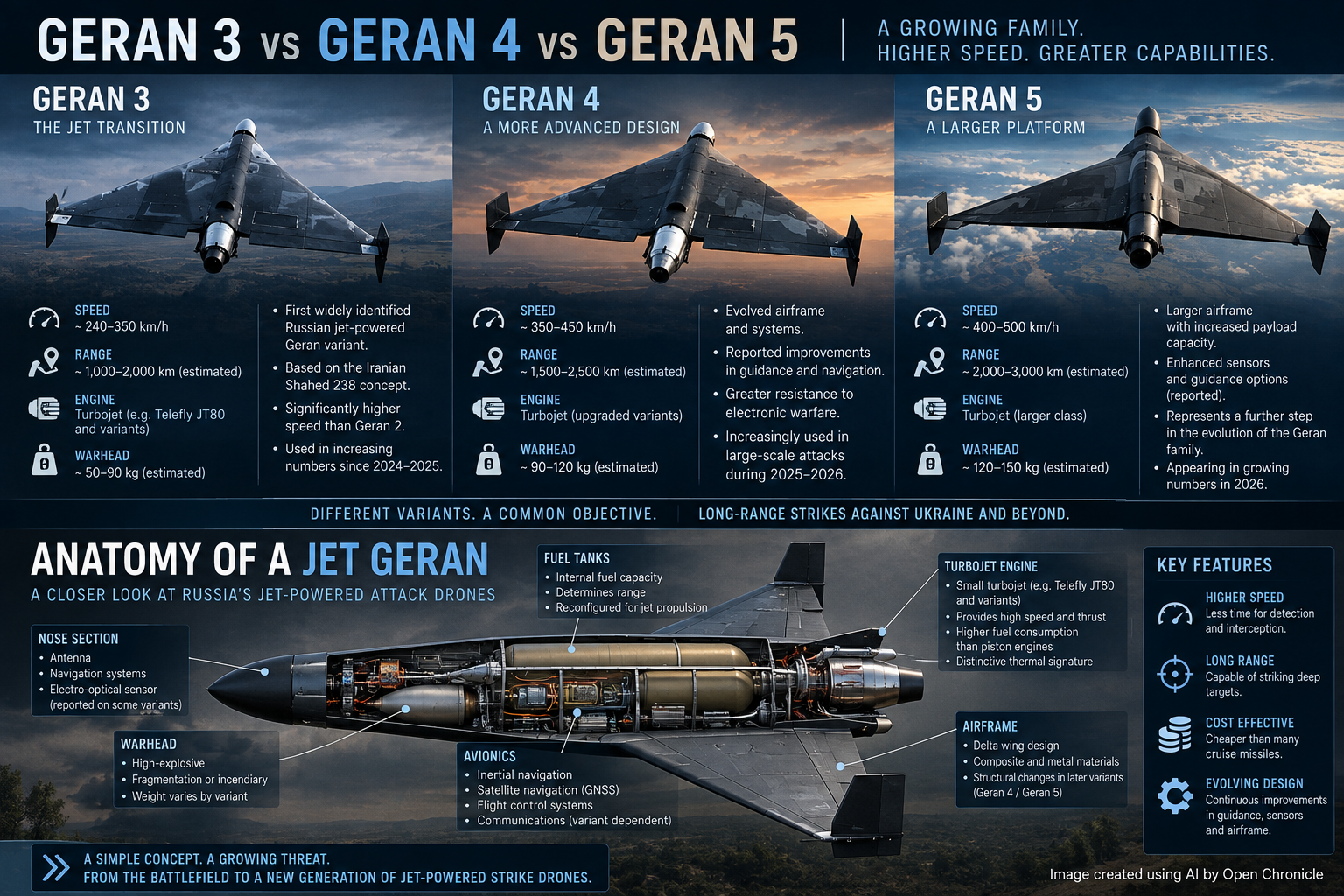
The three principal names should not be interpreted as representing a perfectly documented linear sequence.
Geran 3 is closely associated with the transition from the propeller driven Shahed architecture towards jet propulsion.
Geran 4 represents a more extensive evolution, with reported changes extending beyond propulsion into airframe and guidance architecture.
Geran 5 represents a newer and larger development that demonstrates further movement away from the original Shahed 136 configuration.
Open source specifications remain inconsistent.
Physical examination of recovered wreckage provides stronger evidence than battlefield identification based only upon radar tracks or distant imagery.
The classification will therefore continue to evolve as additional examples are recovered and analysed.
Jet Drone vs Cruise Missile
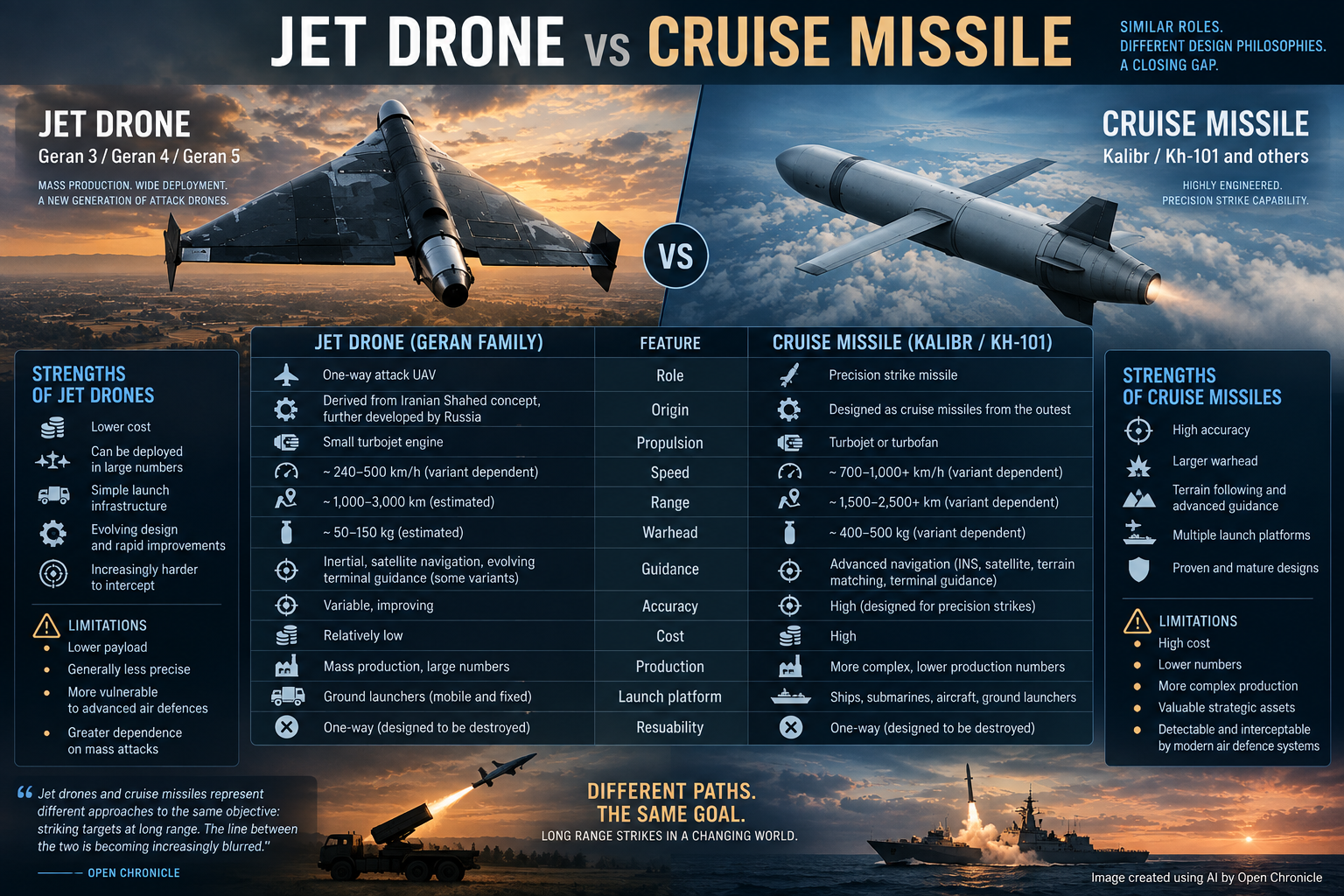
The rise of jet powered one way attack UAVs creates an interesting classification problem.
At what point does a drone become a cruise missile?
Both can use jet engines.
Both can navigate autonomously.
Both can carry explosive warheads.
Both can fly towards a predetermined target.
Both can use terminal guidance.
The distinction is increasingly technological rather than obvious.
Why They Remain Drones
The term UAV remains useful because these systems evolved directly from unmanned aircraft programmes and frequently use manufacturing philosophies associated with drones.
They may use commercial components.
They can be built with less expensive structures.
Their operational architecture can differ from traditional missile systems.
Some variants may also incorporate communications or control capabilities not normally associated with classic fire and forget cruise missiles.
Nevertheless, the boundary is becoming increasingly blurred.
Drone Missile Convergence
This convergence may prove historically significant.
Traditional military categories were relatively clear.
Aircraft returned.
Missiles did not.
Drones were remotely controlled.
Cruise missiles were autonomous.
Modern technology has broken those distinctions.
A drone can operate autonomously.
A missile can receive updated targeting data.
A drone can carry a warhead and deliberately destroy itself.
A missile can loiter.
Both can use artificial intelligence.
Both can use cameras.
Both can communicate through networks.
Russian jet powered Gerans therefore belong to a broader technological transition in which unmanned aircraft and missiles increasingly overlap.
Known and Reported Characteristics
| Characteristic | Geran 3 | Geran 4 | Geran 5 |
|---|---|---|---|
| Country | Russia | Russia | Russia |
| Family | Geran / Shahed lineage | Geran | Geran |
| Propulsion | Turbojet | Turbojet | Turbojet |
| Primary role | One way attack | One way attack | One way attack |
| Relative size | Compact | Evolved configuration | Larger platform reported |
| Speed | Substantially above Geran 2 | High | High |
| Navigation | Multiple systems reported | More advanced systems reported | Multiple systems reported |
| Terminal guidance | Configuration dependent | Advanced guidance reported | Information still developing |
| Operational use | Confirmed | Confirmed | Confirmed |
| Open source confidence | Medium to high | Medium | Medium |
| Relationship to Geran 2 | Jet transition | Deeper redesign | Newer development |
Exact performance figures should be treated cautiously because individual configurations differ and current information is derived partly from wartime intelligence, recovered wreckage and open source analysis.
Technology Spotlight: Why Speed Changes Air Defence
Air defence is fundamentally a competition involving time and geometry.
A defender must first discover the target.
Sensors then determine its direction, altitude and speed.
That information must reach the weapon.
The weapon must launch.
It must travel towards an interception point.
The target continues moving throughout the process.
A faster target compresses every stage.
This is why increasing a Geran’s speed from roughly the performance range of a propeller aircraft towards several hundred kilometres per hour can have consequences disproportionate to the numerical increase alone.
The aircraft does not need to become supersonic.
It only needs to become faster than the defence system was designed to handle economically.
Technology Spotlight: Turbojet vs Piston
Piston engine
Lower speed.
Lower fuel consumption.
Long endurance.
Comparatively simple construction.
Lower thermal signature.
Well suited to inexpensive mass attacks.
Turbojet
Higher speed.
Higher fuel consumption.
Greater thermal signature.
Greater engine cost.
Shorter defensive reaction time.
Greater demands on interceptor performance.
Neither solution is universally superior.
The conventional Geran remains extremely useful precisely because it is inexpensive.
The jet Geran complements it by presenting a different defensive problem.
Technology Spotlight: The High Low Drone Mix
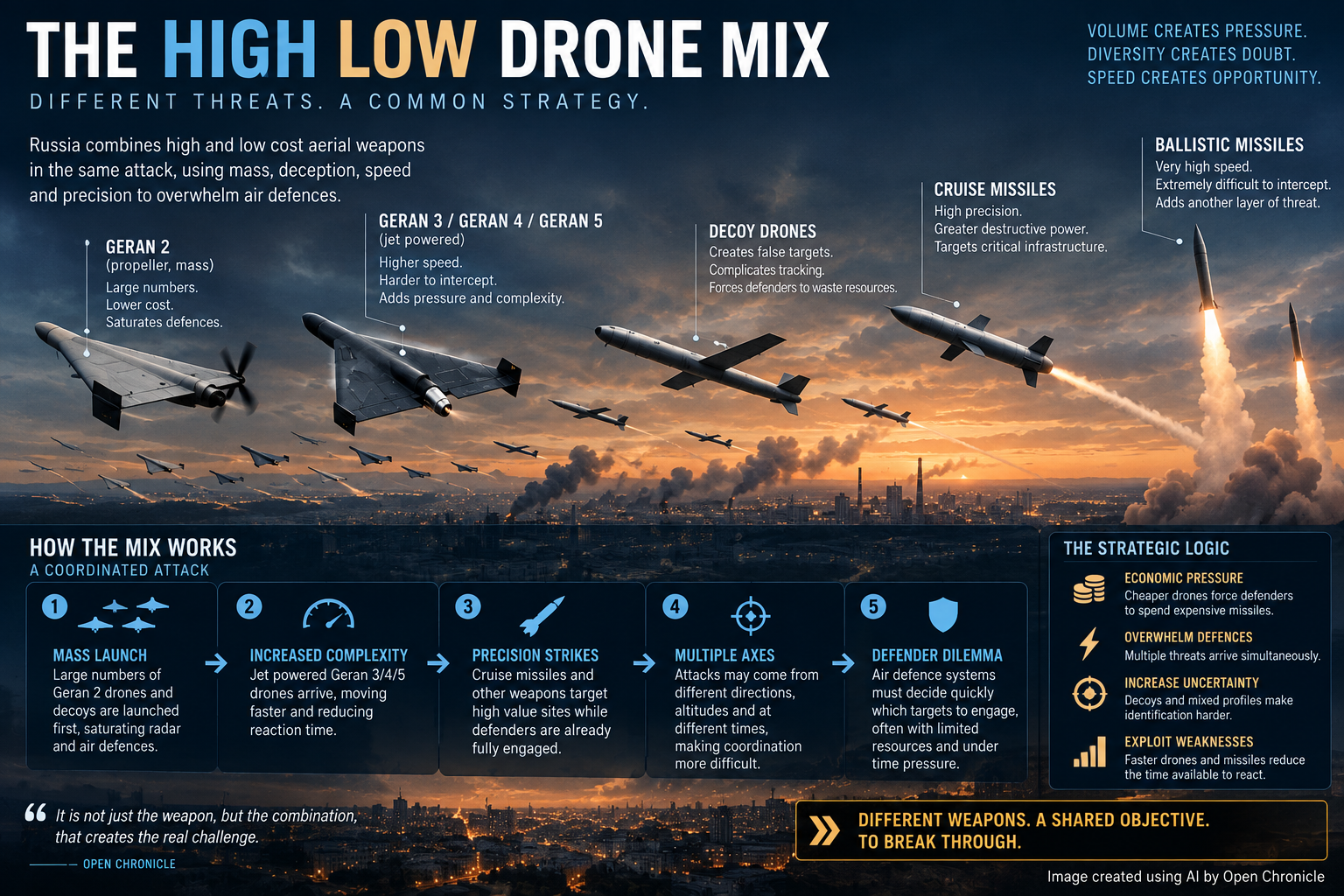
Russia does not necessarily need to replace every Geran 2 with a jet powered aircraft.
Doing so could actually undermine the economic logic of the programme.
Instead, the two categories can complement one another.
Large numbers of inexpensive propeller aircraft create volume.
Decoys create uncertainty.
Jet aircraft create speed.
Missiles create penetration and destructive power.
A defender must prepare for all of them simultaneously.
This is the unmanned equivalent of a high low force mix.
The 2026 Acceleration
The most important development of 2026 has been scale.
In May, open source analysis still described jet Gerans as a relatively small proportion of Russian Shahed operations.
By July, defence companies were publicly racing to produce faster interceptors because Russian jet powered Shaheds were appearing in growing numbers.
By September, Ukrainian data cited by Reuters indicated an extraordinary increase from approximately 450 jet drones in June to nearly 2,850 during August. Their reported speeds ranged approximately between 240 and 500 km/h.
This progression suggests that jet propulsion has moved from experimental adaptation towards an increasingly important component of Russia’s long range drone campaign.
Strategic Significance
The importance of Russian jet powered drones lies not merely in their speed.
They demonstrate how quickly wartime technology can evolve.
The original Shahed presented Ukraine with a problem.
Ukraine adapted.
Interceptor drones provided a cheaper solution.
Russia adapted again.
Jet propulsion made interception more difficult.
Ukraine is now developing jet interceptors, artificial intelligence guidance, specialised missiles and integrated defensive networks.
Russia will almost certainly attempt to counter those systems in turn.
This is technological evolution occurring not across decades but across months.
Timeline
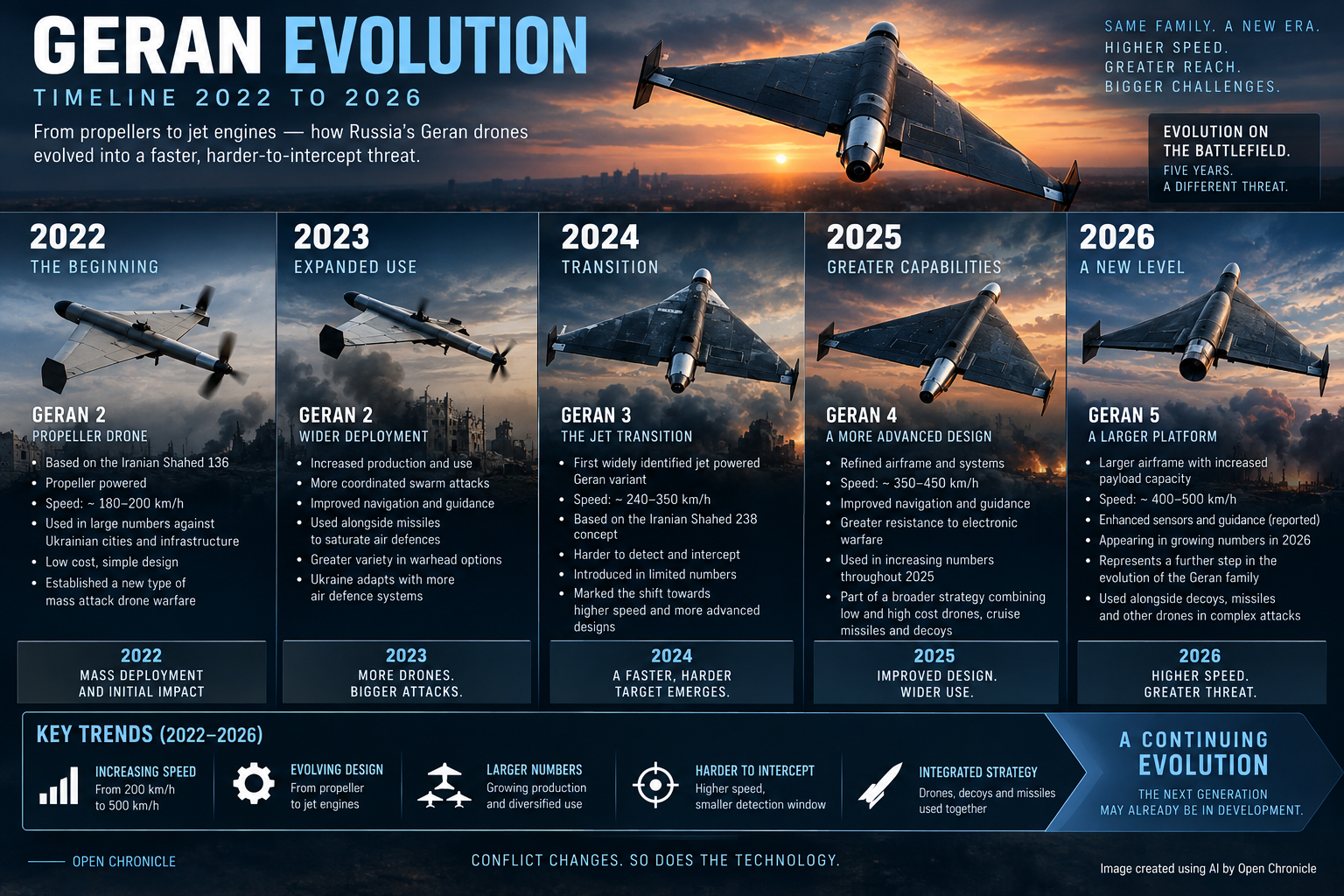
2022: Russia begins large scale use of Iranian Shahed attack drones against Ukraine.
2022 to 2023: Russian production of Shahed derived Geran aircraft expands.
2023: Iran publicly reveals jet powered Shahed developments, demonstrating the potential for substantially faster variants.
2024: Russia continues expanding and modifying the Geran ecosystem.
2025: Reports of Russian jet powered attack UAVs become increasingly significant.
Early 2026: Geran 3 and related jet powered aircraft appear more frequently in Russian attack packages.
March 2026: Ukrainian and open source reporting increasingly identifies jet powered Geran activity.
April 2026: Russia continues mixed attacks involving conventional UAVs, decoys, missiles and emerging jet powered systems.
May 2026: Geran 3 and Geran 4 aircraft are repeatedly observed. Open source estimates still place their numbers far below those of conventional Gerans.
June 2026: Ukrainian reporting increasingly describes jet powered UAVs operating alongside conventional attack drones. Approximately 450 are subsequently recorded in Ukrainian data cited by Reuters.
July 2026: The recorded number rises to approximately 1,100. Defence companies accelerate development of high speed interceptor drones.
August 2026: Ukrainian data records nearly 2,850 Russian jet powered drones, indicating a major increase in operational employment.
September 2026: Ukraine reports an urgent effort involving more than 60 companies to develop effective countermeasures against the faster aircraft.
Did You Know?
The greatest advantage of a jet powered Geran may not be additional destructive power but the reduction in the defender’s reaction time.
Jet propulsion does not automatically replace the Geran 2. The slower aircraft remains valuable because of its range and economics.
A jet powered attack drone can simultaneously be harder to intercept because of its speed and easier for infrared sensors to detect because of its hotter exhaust.
The emergence of jet Gerans has encouraged Ukraine to develop jet powered interceptor drones.
The distinction between a sophisticated one way attack UAV and a cruise missile is becoming increasingly difficult to define purely from technology.
By August 2026, Ukrainian data cited by Reuters indicated that Russia was employing jet powered drones on a scale dramatically larger than only two months earlier.
Open Chronicle Perspective
The development of Russian jet powered drones illustrates one of the central characteristics of twenty first century warfare.
The decisive weapon is not necessarily the most sophisticated weapon.
It may instead be the weapon that forces the enemy to spend more resources defeating it than were required to produce it.
The Shahed 136 demonstrated this principle.
Russia industrialised it through the Geran programme.
Ukraine then attacked the economic equation by developing inexpensive interceptor drones.
Jet propulsion represents the next move.
Russia does not need a Geran to perform like a conventional cruise missile.
It needs the aircraft to become sufficiently fast that existing inexpensive interception methods become unreliable.
That distinction is crucial.
The objective is not necessarily technological perfection.
It is to move beyond the performance envelope of the opponent’s cheapest defence.
Ukraine’s response is already visible.
Faster interceptors.
Jet propulsion.
Artificial intelligence.
Automated guidance.
Smaller missiles.
Integrated sensor networks.
The cycle will continue.
Future Russian drones may become faster, more autonomous and more resistant to electronic warfare.
Future Ukrainian interceptors may become increasingly autonomous and capable of operating in coordinated defensive networks.
Eventually, both sides may deploy large numbers of autonomous aircraft hunting one another without continuous human control.
The Russian jet powered Geran family therefore represents something larger than another development in drone warfare.
It marks the accelerating convergence of drones, missiles, artificial intelligence, mass production and networked air defence.
The skies above Ukraine have become a laboratory for that transformation.
References
Reuters, reporting on the expansion of Russian jet powered Shahed and Geran attacks and Ukrainian efforts to develop faster interceptor systems, July and September 2026.
Institute for Science and International Security, Monthly Analysis of Russian Shahed 136 Deployment Against Ukraine, including analysis of Geran 3 and Geran 4 operations and broader Russian Shahed production and employment.
Ukrainian Air Force reporting concerning Russian Shahed type and jet powered UAV operations.
Open source analysis based upon recovered Russian and Iranian UAV components, wreckage and battlefield observations.
Specialist defence reporting concerning Geran 3, Geran 4, Geran 5 and the development of high speed interceptor drones.
Explore this subject
Continue exploring related Open Chronicle Encyclopedia entries through the categories associated with this article.

Staff Writers at Open Chronicle produce trusted journalism, strategic analysis and authoritative reference content across global affairs, geopolitics, defense, science, history, technology, business, culture and sport. Their work combines accurate reporting with historical perspective and analytical depth, helping readers understand not only what is happening, but why it matters. Beyond daily news coverage, Staff Writers contribute to the Open Chronicle Encyclopedia, investigative features, original research projects and long-form reports, building a comprehensive knowledge platform designed to inform, educate and preserve reliable information for a global audience.