
By Open Chronicle with agencies
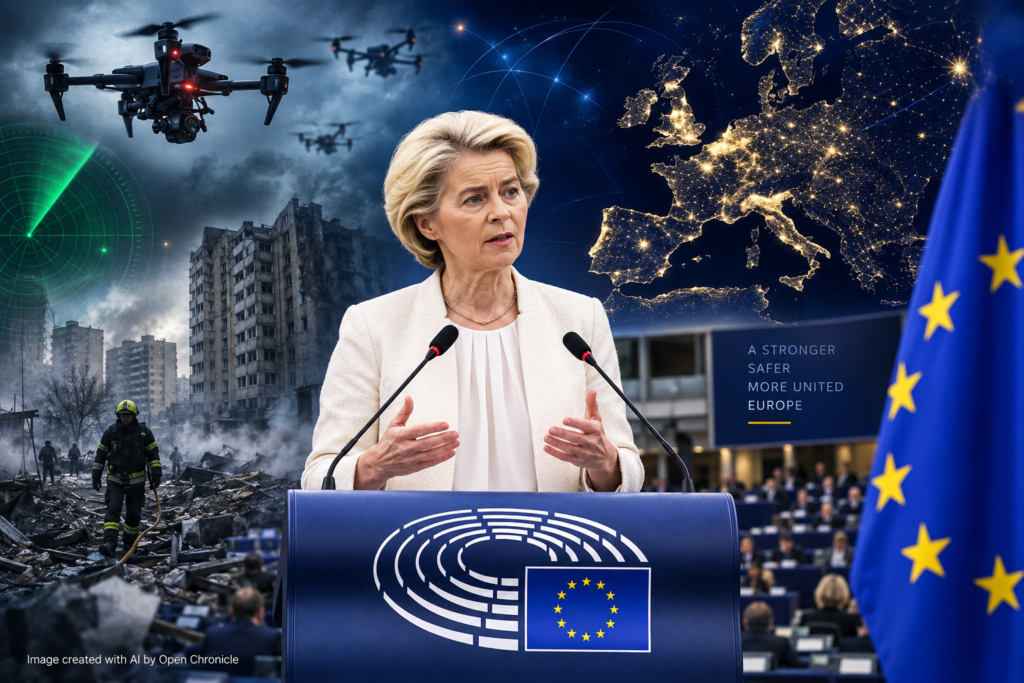
European Commission President Ursula von der Leyen has called for a stronger and more sovereign European Union, arguing that growing geopolitical instability, war, hybrid threats, economic competition and political extremism are forcing Europe to take greater responsibility for its own future.
Delivering her State of the Union address before the European Parliament in Strasbourg, von der Leyen said the EU finds itself in an unusual position: stronger in many respects than ever before, yet exposed to an increasingly unpredictable international environment.
“The state of our Union is the strongest it has ever been, but the state of our Union can also feel as precarious as ever,” she said, describing the present moment as an era of both “great possibilities and great dangers.”
Europe choosing its own path
Von der Leyen argued that Europe has responded to recent crises by becoming more independent and better equipped to protect its interests.
She pointed to efforts to reduce dependence on Russian fossil fuels, strengthen Europe’s position as a global trading power, reshape industrial policy and expand defence capabilities.
“In this world, Europe has chosen to chart its own course,” she told lawmakers.
For the Commission president, these developments demonstrate the importance of the EU as a source of collective strength for its member states.
“Europe is here for Europeans,” she said. “And in the fragility of today’s world, only Europe can provide true sovereignty to Europeans.”
Her remarks reflect a broader debate in Brussels about European strategic autonomy, particularly as governments confront security challenges, economic competition and uncertainty over the future international order.
War, hybrid threats and economic pressure
Von der Leyen presented Europe’s challenges as extending far beyond conventional military security.
She highlighted war on the European continent, intense global industrial competition, disinformation, political extremism and divisions within European societies.
Domestic pressures are also contributing to political instability, she said, with households facing concerns over the cost of living and housing while technological transformation creates both opportunities and uncertainty.
The rapid development of artificial intelligence is among the issues confronting policymakers as the EU attempts to remain technologically competitive while managing the social and economic consequences of emerging technologies.
At the same time, the Union is preparing negotiations over its next long term budget for 2028 to 2034, which will determine how many of its ambitions are financed.
A warning over Europe’s internal divisions
One of the strongest parts of von der Leyen’s address focused on the political forces she believes are seeking to weaken European unity.
She asked whether Europeans want “a strong and independent Europe” capable of defending its values, or whether divisions and dependencies will prevent the Union from moving forward.
Von der Leyen also warned about attempts by authoritarian governments to influence European democracies through political interference and disinformation.
“Whether it is the ultranationalists or the anti Europeans, whether it is Russian interference or disinformation, the names may be different, but the goal is the same,” she said. “They despise our values and want to destroy our European unity.”
She called on Europeans not simply to resist those forces, but to defend the European political project collectively.
Sovereignty at the centre of the European debate
The concept of sovereignty has increasingly become part of the EU’s political vocabulary.
For von der Leyen, European sovereignty does not mean withdrawing from international cooperation. Instead, it means reducing strategic vulnerabilities and ensuring that European governments retain the capacity to make decisions without excessive dependence on outside powers.
Energy, defence, industrial production, technology and trade have consequently become interconnected elements of the EU’s strategic agenda.
The challenge is particularly significant in defence, where European governments are attempting to strengthen their military industries and capabilities while responding to the continuing security consequences of the war in Europe.
Reducing dependence on Russian energy has meanwhile become part of a wider effort to prevent critical economic dependencies from becoming strategic vulnerabilities.
A Union facing multiple tests
Von der Leyen’s speech comes as the EU confronts several simultaneous pressures.
These include hybrid threats attributed to Russia, migration pressures, economic competition with other major powers, the development of artificial intelligence, defence requirements and negotiations over the Union’s future finances.
Her central argument was that individual European countries will find it increasingly difficult to confront such challenges alone.
The answer presented in Strasbourg was therefore a more capable European Union, one able to defend its economic interests, democratic institutions and security while giving its citizens greater control over their collective future.
The State of the Union
This was von der Leyen’s sixth State of the Union address and the second of her current Commission mandate, which began at the end of 2024 and runs until 2029.
The annual address is delivered by the European Commission president before the European Parliament during its first plenary session following the summer recess in Strasbourg.
Introduced in 2010 following the entry into force of the Lisbon Treaty, the State of the Union provides an opportunity for the Commission to review its work, outline priorities for the coming year and face debate and scrutiny from members of the European Parliament.
This year, the message was built around a central choice: whether Europe can translate its collective economic and political weight into greater strategic independence in a world that von der Leyen portrayed as increasingly dangerous and competitive.