
By Open Chronicle History Desk
On September 18, AD 96, a conspiracy reached the heart of the Roman Empire.
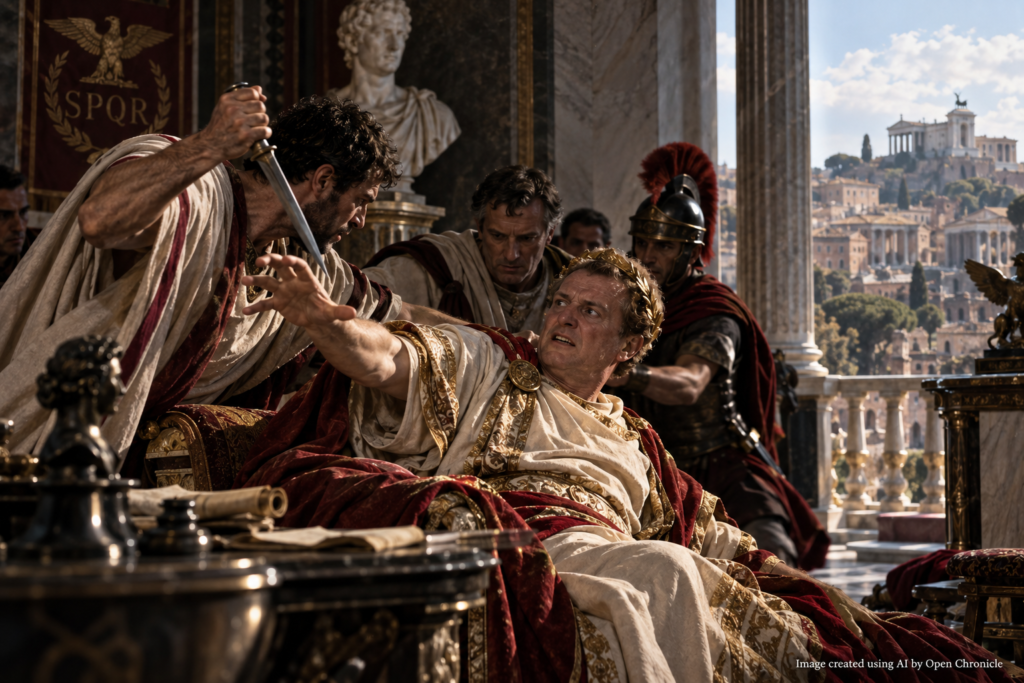
Inside the imperial palace on the Palatine Hill, Emperor Domitian, ruler of Rome for fifteen years, was attacked and killed.
He was 44 years old.
The assassination ended the Flavian dynasty, the imperial family that had ruled Rome since the civil wars of AD 69 and had given the empire three emperors: Vespasian, Titus and Domitian.
Within hours, the Roman Senate recognised an elderly senator named Marcus Cocceius Nerva as emperor.
The transition appeared almost instantaneous.
Yet behind it stood years of political tension, fear, military ambition and conflict between an increasingly autocratic emperor and sections of Rome’s aristocratic elite.
Domitian’s death also opened one of the most celebrated periods in Roman imperial history.
Nerva would reign for less than sixteen months.
But his most important political decision would transform the succession.
Rather than attempting to establish another hereditary dynasty, he adopted the powerful general Trajan as his son and heir.
Trajan would be followed by Hadrian.
Then Antoninus Pius.
Then Marcus Aurelius.
Later historians would remember these rulers collectively as the Five Good Emperors, although that label greatly simplifies a much more complicated history.
For Rome, September 18, AD 96 was therefore more than the violent death of another emperor.
It marked the end of one imperial family and the beginning of a political sequence under which the Roman Empire would reach the greatest territorial extent in its history.
The Flavian Dynasty
To understand Domitian’s death, we must return to one of Rome’s most chaotic years.
AD 69 became known as the Year of the Four Emperors.
The death of Nero in AD 68 had ended the Julio-Claudian dynasty.
Without an established mechanism for imperial succession, competing generals and political factions fought for control.
Galba became emperor.
Then Otho.
Then Vitellius.
Finally came Vespasian.
Vespasian’s forces defeated those of Vitellius, and by the end of AD 69 he had emerged as ruler of the Roman world.
Rome had survived civil war.
A new dynasty had begun.
Vespasian
Vespasian was an experienced military commander rather than a member of Rome’s oldest aristocratic elite.
His rise demonstrated something that would become increasingly important in imperial history.
An emperor did not necessarily need to emerge from Rome itself.
The support of armies could make emperors.
Vespasian restored political stability and strengthened imperial finances after the upheavals of the civil wars.
He also began one of Rome’s most famous building projects.
The Flavian Amphitheatre.
Today, the world knows it as the Colosseum.
Titus
When Vespasian died in AD 79, his elder son Titus succeeded him.
This was significant.
It represented the first successful biological father-to-son succession in the history of the Roman principate.
Titus had already distinguished himself militarily.
During the Jewish revolt, Roman forces under his command captured Jerusalem in AD 70.
The destruction of the Second Temple became one of the defining events of Jewish and Roman history.
Titus’ reign as emperor, however, was short.
It was also marked by catastrophe.
Vesuvius
In AD 79, Mount Vesuvius erupted.
Pompeii, Herculaneum and surrounding communities were devastated.
Then Rome suffered a major fire.
Disease followed.
Ancient literary accounts generally portray Titus as responding energetically to these disasters.
But in September AD 81, after only about two years as emperor, Titus died.
His younger brother was waiting.
Domitian became emperor.
Domitian
Domitian had spent much of his early life overshadowed.
Vespasian was the founder of the dynasty.
Titus was the celebrated soldier and heir.
Domitian possessed neither status.
That changed immediately when Titus died.
At approximately thirty years old, Domitian became ruler of an empire stretching from Britain to Egypt and from the Atlantic to the Middle East.
He would remain emperor for fifteen years.
That alone makes his reign significant.
Many Roman emperors lasted nowhere near that long.
An Emperor With a Reputation
Domitian became one of antiquity’s most controversial rulers.
Ancient writers such as Tacitus, Pliny the Younger and Suetonius contributed heavily to the hostile image that survived.
They described an emperor who became increasingly authoritarian, suspicious and cruel.
Executions and prosecutions of senators featured prominently in this tradition.
Domitian was portrayed as a tyrant.
But historians must approach these accounts carefully.
Many surviving literary sources were written by members of the senatorial elite or under governments that succeeded Domitian.
They had political reasons to condemn him.
The emperor’s reign was more complex than the traditional portrait suggests.
Domitian the Administrator
Modern scholarship has paid greater attention to Domitian’s effectiveness as an administrator.
He took imperial government seriously.
He monitored provincial administration.
He attempted to control corruption.
He strengthened the currency early in his reign.
He invested heavily in public construction.
He took a close interest in the army.
He also spent considerable time dealing with frontier security.
This does not mean ancient accusations of repression should simply be dismissed.
It means that Domitian could simultaneously be an effective administrator and an authoritarian ruler deeply disliked by sections of the political elite.
Roman emperors rarely fit neatly into categories of “good” and “bad.”
Rebuilding Rome
Domitian transformed the physical appearance of Rome.
The city had suffered heavily from fires and political turmoil.
His building programme included restoration and new construction across the capital.
The Temple of Jupiter Optimus Maximus on the Capitoline was rebuilt.
A vast imperial palace complex rose on the Palatine.
The architect Rabirius created what became known as the Flavian Palace, including monumental ceremonial and residential spaces.
Domitian understood architecture as political communication.
Imperial power had to be seen.
The Palace on the Palatine
The Palatine Hill had long been associated with Rome’s emperors.
Under Domitian, it became even more clearly the monumental centre of imperial authority.
His palace dominated the city.
From there, the emperor governed an empire containing tens of millions of people.
It was also there that the conspiracy of September AD 96 would reach him.
The architecture designed to express imperial security could not ultimately protect the emperor from people inside his own household.
The Army
Domitian understood the importance of the Roman military.
He increased soldiers’ pay, reportedly raising legionary salaries by approximately one-third.
This helped strengthen his popularity among the troops.
He also campaigned along Rome’s frontiers.
Operations occurred in Britain, Germany and along the Danube.
The Roman Empire remained a military state.
An emperor who ignored the army did so at enormous personal risk.
Domitian did not make that mistake.
Ironically, his successor Nerva would discover exactly how dangerous military dissatisfaction could become.
Agricola in Britain
One of the most famous generals associated with Domitian’s reign was Gnaeus Julius Agricola.
Agricola served as governor of Roman Britain and led campaigns deep into what is now Scotland.
His son-in-law, the historian Tacitus, later wrote a biography of him.
Tacitus portrayed Agricola as a virtuous commander whose achievements were viewed jealously by Domitian.
Again, historians must be cautious.
Tacitus had strong political and literary motives.
Nevertheless, Agricola’s campaigns demonstrate how active Roman expansion remained during the early part of Domitian’s reign.
Germania
Domitian also campaigned against the Chatti, a Germanic people living beyond the Rhine.
The emperor celebrated a triumph and adopted the title Germanicus.
Roman military operations contributed to the development of frontier systems between the Rhine and Danube.
Fortifications, roads and military installations increasingly organised the imperial border.
The frontier was not simply a wall separating Romans from barbarians.
It was a militarised zone through which people, goods, information and armies moved.
The Dacian Challenge
A more serious threat emerged on the Danube.
The Dacians, under King Decebalus, posed a formidable challenge.
Roman forces suffered serious reverses.
A Roman commander, Cornelius Fuscus, was defeated and killed.
Eventually, Domitian reached an agreement with Decebalus.
Rome provided subsidies and technical assistance in return for a political settlement.
Ancient critics portrayed this as humiliating.
Later events made the issue even more significant.
Trajan would return to Dacia and launch major wars of conquest.
The Senate and the Emperor
Domitian’s relationship with the Senate deteriorated.
The Roman Empire maintained republican institutions.
There were still consuls.
There was still a Senate.
Magistracies continued.
But ultimate political and military power rested with the emperor.
The system depended partly on maintaining appearances.
Earlier emperors often presented themselves as princeps, the first citizen.
Domitian appeared increasingly comfortable with a more openly monarchical conception of imperial authority.
For senators accustomed to status and privilege, this was dangerous territory.
Emperor and Autocrat
Ancient sources accused Domitian of demanding excessive honours and behaving like a master rather than a first citizen.
Suetonius famously associated his court with the language of dominus et deus, “lord and god.”
The exact extent to which Domitian formally demanded such terminology remains debated.
But the broader political development is clear.
His government became associated with a highly centralised imperial court and with an emperor less willing to preserve the fiction that senators were his political equals.
Rome had been an empire disguised in republican language.
Domitian made the disguise increasingly thin.
Fear
During the later years of his reign, political repression intensified.
Senators and other elites were prosecuted.
Some were executed.
Others were exiled.
Charges of treason could become instruments of political control.
Informers benefited from accusations.
The atmosphere described by hostile ancient authors is one of fear.
How accurately those sources reflect everyday government is difficult to determine.
But enough elite opposition existed that a conspiracy eventually formed within the imperial household itself.
The danger to Domitian no longer came primarily from the frontiers.
It came from inside the palace.
September AD 96
Ancient accounts describe Domitian as increasingly obsessed with plots against his life.
According to Suetonius, the emperor had become deeply concerned about the date and hour of his death.
Stories circulated about astrologers and predictions.
Such details may have been embellished after the assassination.
Ancient biographers often shaped an emperor’s final hours to make his death appear prophetic or morally meaningful.
But they capture something important.
By AD 96, Domitian had enemies.
And some of them were very close to him.
The Conspiracy
The precise membership of the conspiracy remains uncertain.
Ancient accounts implicate members of the imperial household.
One central figure was Parthenius, Domitian’s chamberlain.
Another was Stephanus, associated with Domitian’s niece Flavia Domitilla.
Other palace officials may have participated.
Whether Domitian’s wife Domitia Longina knew of or supported the plot remains uncertain.
Later sources connected numerous people to the assassination, but separating reliable information from retrospective storytelling is difficult.
What is clear is that the conspirators had access.
That made them extraordinarily dangerous.
Stephanus
According to the traditional account, Stephanus pretended to have suffered an injury and wore bandages around his arm for several days.
The bandages concealed a dagger.
On September 18, he approached Domitian claiming to possess information about a conspiracy.
The emperor received him privately.
Stephanus handed Domitian a document.
As the emperor read it, Stephanus attacked.
The assassination had begun.
The Emperor Fights Back
Domitian was not killed instantly.
Ancient accounts describe a violent struggle.
The wounded emperor fought Stephanus.
He called for a weapon.
But the sword he expected to find nearby had allegedly been removed.
Other conspirators entered and joined the attack.
Domitian received multiple wounds.
Stephanus was also killed during the struggle.
The details vary between ancient accounts and cannot all be independently verified.
But the result is certain.
After fifteen years in power, Emperor Domitian was dead.
September 18, AD 96
The killing of an emperor was hardly unprecedented.
Caligula had been assassinated.
Nero had been driven to suicide.
Galba had been murdered.
Vitellius had been killed during civil war.
Roman imperial government had no secure constitutional mechanism for replacing an emperor.
The death of a ruler could therefore produce chaos.
Legions might proclaim rival candidates.
Civil war could follow.
That had happened spectacularly in AD 69.
Yet in AD 96, something different occurred.
A successor appeared almost immediately.
Nerva
The Senate recognised Marcus Cocceius Nerva as emperor.
Nerva was approximately sixty-five years old.
He came from an established senatorial family and had served previous emperors.
He was experienced, respected and, crucially, had no biological son positioned to create another immediate dynasty.
Whether Nerva knew about the conspiracy before Domitian’s assassination remains unresolved.
Some historians consider it possible.
There is no conclusive evidence proving his involvement.
But his rapid elevation suggests that the conspirators or political elites had at least considered what should happen after Domitian died.
Rome could not afford a vacuum.
The Senate Reacts
Many senators celebrated Domitian’s death.
The Senate condemned his memory.
His statues were pulled down.
His name was removed from inscriptions.
Images were destroyed or altered.
This process is commonly associated with the modern term damnatio memoriae, condemnation of memory.
The phrase itself was not the standard Roman legal expression used in antiquity, but it describes a real practice.
A disgraced ruler could be symbolically removed from public memory.
There was a paradox.
The attempt to erase Domitian became one reason his name survived so prominently.
Destroying an Emperor’s Face
Roman portraiture provides striking archaeological evidence.
Statues originally depicting Domitian were sometimes recarved into portraits of later emperors.
Inscriptions show erased names.
Coins and monuments preserve traces of political transformation.
History was literally rewritten in stone.
But complete erasure was impossible.
Domitian had ruled for fifteen years.
His buildings stood across Rome.
His policies had shaped the empire.
His coins circulated through its markets.
His soldiers remembered his pay increase.
Political memory could be attacked.
Historical reality could not be deleted.
The Army Reacts Differently
The Senate’s hatred of Domitian was not universally shared.
The army remembered him more favourably.
He had increased military pay and cultivated soldiers’ loyalty.
Some troops were angered by his assassination.
This exposed a fundamental weakness in Nerva’s position.
The Senate could proclaim an emperor.
But emperors also needed the army.
Without military support, constitutional legitimacy meant little.
Nerva possessed political experience.
What he lacked was a strong personal military following.
Nerva’s Government
Nerva attempted to distance his reign from Domitian’s later repression.
Political exiles were recalled.
Some confiscated property was restored.
Measures were introduced to improve relations with the Senate.
The new regime presented itself as a restoration of liberty after tyranny.
This language became central to later accounts of the transition.
But Nerva faced practical problems.
Finances were difficult.
His authority over the army was uncertain.
And the men responsible for Domitian’s death had not satisfied soldiers demanding justice.
The Praetorian Crisis
The crisis came in AD 97.
Members of the Praetorian Guard, the elite military force stationed near Rome, turned against Nerva.
They demanded punishment of Domitian’s assassins.
The emperor was unable to stop them.
The Praetorians seized him and forced him to surrender those responsible.
Some of the conspirators were executed.
For Nerva, the episode was humiliating.
The emperor of Rome had effectively been coerced by his own guards.
His weakness was now impossible to ignore.
He needed a solution.
Choosing an Heir
Nerva had no son.
The obvious Roman response might have been to promote a relative.
Instead, he made a decision with enormous consequences.
He adopted Marcus Ulpius Traianus.
History knows him as Trajan.
Trajan was an experienced soldier and commander.
He was serving as governor of Upper Germany and possessed strong military credentials.
By adopting Trajan, Nerva achieved something his own authority could not.
He gained the support of a powerful military figure without immediately surrendering the throne.
The succession had been stabilised.
Adoption and Imperial Succession
Adoption was a familiar institution in Roman society.
Elite families used it to preserve family lines and property.
Applied to imperial succession, it offered a powerful political tool.
An emperor without a suitable biological heir could select an adult successor with proven experience.
Later generations would idealise this arrangement.
Instead of the throne passing automatically from father to son, supposedly the “best man” could be selected.
Reality was more complicated.
Family relationships continued to matter enormously.
But the adoption of Trajan created a precedent that shaped the next century.
Nerva Dies
Nerva’s reign was brief.
He died of natural causes in January AD 98.
There was no major succession crisis.
Trajan became emperor.
This peaceful transfer was itself significant.
Rome had repeatedly experienced violence when emperors died.
This time, the heir was already established.
He possessed military credibility.
The Senate accepted him.
The armies accepted him.
The empire remained stable.
The political gamble begun after Domitian’s assassination had succeeded.
Trajan
Trajan became one of Rome’s most celebrated emperors.
Born in Hispania, in the Roman province of Baetica, he represented the increasingly provincial character of the imperial elite.
Rome’s ruling class was no longer confined to families originating in Italy.
The empire itself was producing emperors.
Trajan combined military ambition with extensive building programmes and public expenditure.
Under him, Rome returned to large-scale territorial conquest.
The most famous target was Dacia.
The Dacian Wars
Domitian had fought Decebalus and accepted a negotiated settlement.
Trajan wanted a decisive outcome.
He launched campaigns across the Danube.
The Dacian Wars eventually ended with Roman victory and the death of Decebalus.
Dacia became a Roman province.
Its mineral resources, including gold, helped finance imperial projects.
The wars were immortalised on one of antiquity’s greatest historical monuments.
Trajan’s Column.
Its spiral relief depicts Roman soldiers, fortifications, battles, river crossings and the machinery of imperial conquest.
Rome at Its Greatest Extent
Trajan later campaigned against the Parthian Empire.
Roman forces advanced deep into Mesopotamia.
For a brief period, Roman territory reached its greatest geographical extent.
From Britain to the Middle East.
From the Rhine and Danube to North Africa.
The Mediterranean had effectively become a Roman sea.
The empire reached an extraordinary territorial peak.
All of this followed the political transition that began when Domitian was killed on September 18, AD 96.
Hadrian
When Trajan died in AD 117, Hadrian succeeded him.
Hadrian adopted a different strategic approach.
Rather than attempting to preserve every recent conquest, he abandoned some eastern territories and concentrated on consolidating the empire.
He travelled extensively.
He inspected armies.
He strengthened frontiers.
In Britain, his name became permanently associated with Hadrian’s Wall.
Roman imperial policy was shifting from expansion towards defence and consolidation.
Antoninus Pius
Hadrian adopted Antoninus Pius as his successor.
Antoninus became emperor in AD 138.
His long reign was comparatively stable.
He rarely left Italy.
The empire continued functioning through a sophisticated administrative system of governors, officials, cities and military commands.
Later generations remembered his reign as one of relative peace.
Yet Rome remained an imperial power whose stability depended on military force, taxation and political hierarchy.
The famous age of the “good emperors” was peaceful only from certain perspectives.
Marcus Aurelius
Antoninus was followed by Marcus Aurelius in AD 161.
Marcus became famous not only as emperor but as a Stoic philosopher.
His personal reflections survive as the Meditations.
Popular memory sometimes imagines him as a philosopher peacefully contemplating human existence.
His reign was far from peaceful.
Rome faced war against Parthia.
Germanic peoples threatened the Danube frontier.
A devastating epidemic, commonly known as the Antonine Plague, spread through the empire.
Marcus spent years campaigning.
The philosopher emperor lived much of his reign in a military world.
The Five Good Emperors
The sequence Nerva, Trajan, Hadrian, Antoninus Pius and Marcus Aurelius became famous centuries later as the era of the Five Good Emperors.
The influential political thinker Niccolò Machiavelli praised the emperors who succeeded through adoption rather than direct hereditary succession.
Edward Gibbon later presented this era in particularly glowing terms in The History of the Decline and Fall of the Roman Empire.
Gibbon famously described the period as one in which a large portion of humanity supposedly experienced exceptional prosperity.
Modern historians are more cautious.
Was It Really Rome’s Golden Age?
For many inhabitants of the empire, the second century was indeed a period of remarkable stability.
Trade flourished.
Cities expanded.
Road networks connected provinces.
Monumental construction transformed urban landscapes.
Roman law and administration reached across enormous distances.
But describing the period simply as a golden age hides other realities.
Rome was an authoritarian empire.
Slavery remained fundamental.
Conquest could be extraordinarily violent.
Provincial populations paid taxes to sustain the state and military.
Frontier warfare continued.
Political stability did not mean equality or freedom in the modern sense.
The “golden age” label reflects one historical perspective, not the entire experience of Roman society.
Was Domitian Really a Tyrant?
The same caution applies to Domitian.
For centuries, historians largely accepted the hostile portrait created by ancient senatorial writers.
Domitian became a classic Roman villain.
Modern scholarship has complicated that image.
His administration could be efficient.
His financial policies were often serious.
His military reforms mattered.
His building programme transformed Rome.
Provincial administration functioned effectively.
The question is not whether Domitian was secretly a benevolent ruler.
It is whether hostile literary traditions exaggerated some aspects of his government while minimising others.
The answer is almost certainly yes.
Who Writes Imperial History?
This raises a larger historical question.
Most ordinary inhabitants of the Roman Empire left no literary histories.
The texts surviving from antiquity were disproportionately written by educated elites.
Senators.
Officials.
Wealthy intellectuals.
Their experiences mattered.
But they were not representative of everyone.
An emperor hated by senators could still be popular with soldiers.
An emperor praised by aristocratic writers could still impose heavy burdens on provincial communities.
Roman history therefore requires historians to compare literature with inscriptions, coins, archaeology, papyri and other evidence.
Domitian is an excellent example of why.
Coins Tell Another Story
Roman coins were powerful instruments of political communication.
Domitian’s coins presented imperial victories, religious authority and dynastic legitimacy.
After his death, Nerva’s coinage promoted a different message.
Concord.
Liberty.
Justice.
Political stability.
Coins circulated imperial ideology through markets, military camps and cities.
For people who would never see the emperor, his portrait on a coin might be one of their most frequent encounters with imperial power.
A regime change could therefore appear in people’s hands.
The Senate’s Victory?
At first glance, Domitian’s assassination appears to have been a victory for the Senate.
A hated emperor was dead.
A respected senator became ruler.
Political exiles returned.
The rhetoric of liberty reappeared.
But the events of AD 97 demonstrated the limits of senatorial power.
When the Praetorian Guard challenged Nerva, the Senate could not protect him.
The Roman Empire was not a restored republic.
Imperial authority remained dependent on military power.
Nerva’s solution was not to reduce that reality.
It was to select an heir who could command it.
The Real Lesson of AD 96
The transition therefore revealed the central political problem of the Roman Empire.
There was no formal hereditary monarchy.
There was no modern constitutional succession.
There was no election determining the emperor.
Instead, succession depended upon a combination of factors.
Family.
Adoption.
Senatorial approval.
Praetorian support.
Military loyalty.
Political reputation.
And sometimes assassination.
When those elements aligned, succession could be peaceful.
When they did not, Rome could descend into civil war.
From Nerva to Marcus Aurelius
The political system created after Domitian’s death worked unusually well for several generations.
Nerva selected Trajan.
Hadrian followed Trajan.
Antoninus Pius followed Hadrian.
Marcus Aurelius followed Antoninus.
The empire experienced decades of relative political continuity.
This helped create the later impression that adoption itself had solved the succession problem.
But there was another explanation.
Several of these emperors simply lacked surviving biological sons when their succession was arranged.
Then Marcus Aurelius had a son.
His name was Commodus.
Commodus
When Marcus Aurelius died in AD 180, Commodus became sole emperor.
The adoption sequence ended.
Later historians contrasted Commodus sharply with his predecessors.
His reign became associated with political instability, court intrigue and increasingly erratic imperial behaviour in ancient accounts.
In AD 192, Commodus was assassinated.
Another succession crisis followed.
The empire soon entered the Year of the Five Emperors.
The supposedly perfect system of the second century had not solved Rome’s fundamental succession problem permanently.
It had postponed it.
An Empire Without a Constitution
This was one of the great weaknesses of Roman imperial government.
Rome possessed law.
It possessed administrative institutions.
It possessed deeply rooted political traditions.
But it never developed a universally accepted constitutional method for choosing the next emperor.
The ruler might nominate an heir.
The Senate might approve him.
The army might proclaim him.
The Praetorian Guard might intervene.
A rival general might challenge him.
The system worked when everyone accepted the same candidate.
When they did not, armies decided.
The Palatine After Domitian
The palace where Domitian died did not disappear.
Later emperors continued using and modifying the vast imperial complex.
Its ruins remain on the Palatine Hill today.
Visitors walking among them can still see traces of the spaces from which emperors governed the Roman world.
The remains are enormous.
That scale makes the circumstances of Domitian’s death especially striking.
He possessed palaces.
Armies.
Officials.
Guards.
Wealth beyond imagination.
Yet the threat that killed him came from within his own household.
Roman emperors could command provinces.
They could not always control the people standing beside them.
Damnatio Memoriae Failed
Domitian’s enemies attempted to destroy his public memory.
They failed.
We know his name.
We study his reign.
His palace survives.
His coins survive.
Inscriptions preserve evidence of his government.
Ancient authors who hated him preserved detailed accounts precisely because they wanted future generations to remember him negatively.
This is one of history’s great ironies.
Condemnation preserved memory.
Domitian became impossible to erase because his enemies wrote so much about why he deserved to be forgotten.
Why September 18 Matters
September 18, AD 96 matters because it illustrates how fragile Roman imperial power could be.
Domitian had ruled for fifteen years.
He commanded one of the world’s greatest military systems.
His image appeared throughout the empire.
His palace towered above Rome.
His decisions affected territories stretching thousands of kilometres.
And then, within minutes, he was dead.
The empire immediately needed another emperor.
Nerva took the throne.
His reign would be short.
But his solution to the succession crisis, adopting Trajan, helped establish a chain of rulers under whom Rome experienced one of the most stable and prosperous periods of its imperial history.
The assassination therefore became a hinge between two eras.
September 18, AD 96
Imagine the Palatine Hill that morning.
Rome spreads below.
Temples dominate the skyline.
The Circus Maximus lies beside the imperial palace.
Merchants conduct business.
Slaves carry goods.
Senators move through the capital.
Soldiers stand guard.
Across the Mediterranean, governors administer provinces in the emperor’s name.
Along the Rhine and Danube, legions defend the frontiers.
In Britain, Roman authority extends far beyond London.
In Egypt, grain ships prepare supplies that help feed the capital.
Across an empire of enormous scale, Domitian is emperor.
Then the doors of a palace room close.
A trusted member of the imperial household approaches.
A concealed blade appears.
There is a struggle.
Other conspirators enter.
And suddenly Rome has no emperor.
Within hours, the Senate recognises Nerva.
Statues of Domitian begin to fall.
His name is attacked.
His enemies celebrate.
His soldiers are furious.
Nobody yet knows whether another civil war is about to begin.
Instead, the elderly Nerva eventually makes one of the most consequential choices in Roman imperial history.
He selects Trajan.
From that decision emerges a succession that will lead Rome through the age of Hadrian, Antoninus Pius and Marcus Aurelius.
An assassination inside a palace has changed the direction of an empire.
That is the significance of September 18, AD 96.
A dynasty ended in blood.
Another age of Rome began.