
By Open Chronicle News Desk
September 18, 2026
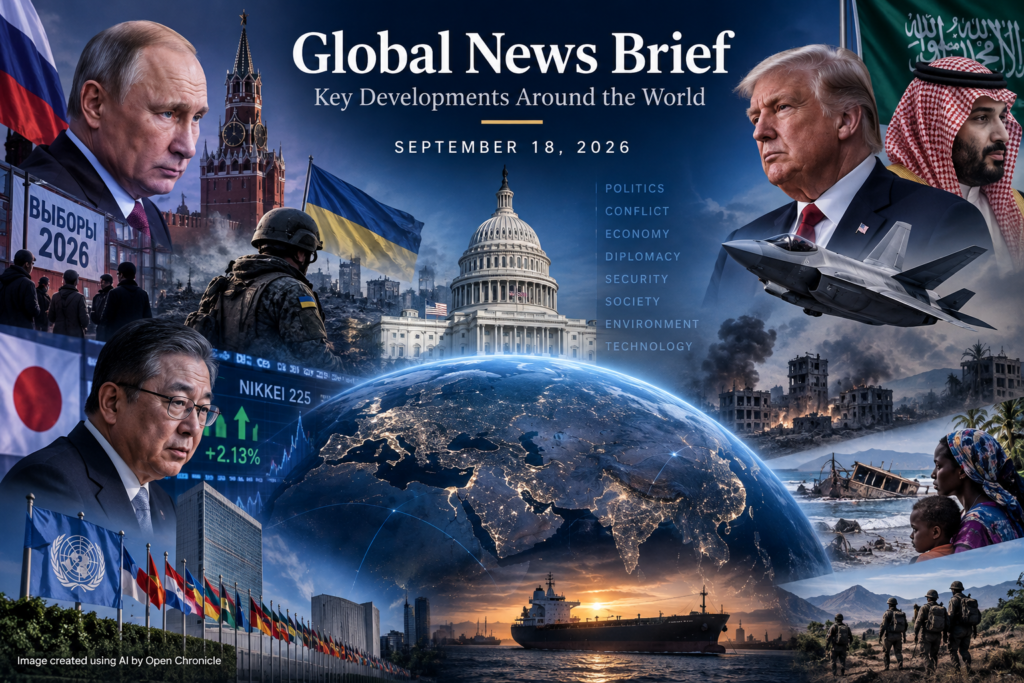
Russia has begun its first parliamentary election since the full-scale invasion of Ukraine, South Korea has ruled out joining the Iran war, Washington has cleared a $24.3 billion F-35 sale to Saudi Arabia, and Japan has raised interest rates to their highest level in 31 years.
Elsewhere, Russia and China have blocked a U.S.-backed attempt to maintain United Nations monitoring of sanctions on Iran, Fiji has declared a national HIV emergency, Malaysia’s former prime minister Najib Razak has been granted house arrest, and Vanuatu has ended the search for dozens of people missing after a deadly ferry disaster.
Here are some of the key developments shaping the world on September 18.
Russia begins wartime parliamentary election
Voting has begun across Russia in the country’s first parliamentary election since Moscow launched its full-scale invasion of Ukraine in February 2022.
Polls opened Friday for three days of voting to elect the 450 members of the State Duma. The political environment has changed substantially since the previous parliamentary election, with most meaningful opposition to the Kremlin eliminated, exiled or imprisoned.
United Russia, the party associated with President Vladimir Putin, enters the election as the dominant political force. The liberal Yabloko party, which had openly called for diplomacy and an end to the war, was removed from the ballot by Russia’s Supreme Court in August.
Voting is also being organised by Moscow in Russian-controlled areas of Ukraine, a process rejected by Kyiv.
The election comes as Russia’s wartime economy faces growing pressure from high military expenditure, sanctions, labour shortages and slower growth, although elevated oil revenues continue to provide the government with significant financial resources.
South Korea rules out joining Iran war
South Korean President Lee Jae Myung has ruled out deploying troops or military assets in a way that would involve his country directly in the ongoing war involving Iran.
“There will be no deployment that involves or intervenes in the war,” Lee said during a televised press conference on Friday.
Seoul is nevertheless examining measures to protect South Korean merchant vessels, citizens and energy supplies travelling through the Strait of Hormuz. That could include strengthening the activities of the Cheonghae naval unit already operating in the region.
The distinction is important for South Korea, which is heavily dependent on imported energy passing through the strategic waterway.
Lee said Seoul would continue its policy of non-involvement while undertaking the minimum measures necessary to protect South Korean interests.
US clears $24.3 billion F-35 sale to Saudi Arabia
The U.S. State Department has approved the potential sale of 48 F-35 Lightning II stealth fighters to Saudi Arabia in a package valued at approximately $24.3 billion.
The proposed agreement includes 49 Pratt & Whitney engines, communications systems, spare parts and logistical support.
The transaction still requires congressional approval.
If completed, the agreement would represent a major change in Middle Eastern air power. Israel is currently the only country in the region operating the F-35, and U.S. arms policy has traditionally sought to preserve Israel’s “qualitative military edge.”
The proposal is also likely to face scrutiny over Saudi Arabia’s defence and technological relationship with China and the security of sensitive American military technology.
Russia and China veto UN monitoring of Iran sanctions
Russia and China have vetoed a U.S.-backed United Nations Security Council resolution that would have extended the mandate of independent experts monitoring sanctions against Iran.
The proposal received 11 votes in favour, with Russia and China voting against and Pakistan and Somalia abstaining.
The veto does not remove the underlying UN sanctions. Instead, it ends the mandate of the expert panel responsible for independently monitoring their implementation.
Moscow has argued that the reimposition of sanctions through the 2015 nuclear agreement’s “snapback” mechanism was legally invalid. Washington and its European allies reject that interpretation.
The vote comes amid continuing uncertainty surrounding Iran’s nuclear programme and the broader war involving Iran, Israel and the United States.
Washington allows Iranian leaders to attend UN General Assembly
Despite the continuing conflict, the Trump administration will allow a core Iranian delegation to attend next week’s United Nations General Assembly in New York.
Iranian President Masoud Pezeshkian and Foreign Minister Abbas Araqchi are expected to receive visas.
The State Department said the decision was consistent with U.S. obligations as host of the United Nations, although the Iranian delegation will face strict restrictions on its movements and purchases while in the United States.
The decision creates the possibility of significant diplomatic activity in New York as international efforts continue to find a path out of the Iran conflict.
The 81st UN General Assembly will also bring together leaders dealing with the wars in Ukraine and the Middle East, artificial intelligence governance, climate change and the approaching selection of a successor to UN Secretary-General António Guterres.
Bank of Japan raises rates to 31-year high
The Bank of Japan has raised its policy interest rate from 1 percent to 1.25 percent, its highest level in 31 years.
The decision passed by seven votes to two, with board members Toichiro Asada and Ayano Sato opposing the increase.
Rather than strengthening after the announcement, the yen weakened sharply. It fell as much as 0.8 percent to around 157.15 against the dollar as investors focused on the dissenting votes and the absence of a more aggressive signal about future tightening.
Governor Kazuo Ueda said the central bank would make future decisions meeting by meeting rather than follow a predetermined timetable.
Japan is confronting persistent inflationary pressure, intensified by higher global energy costs. Ueda said the central bank’s policy focus was increasingly shifting from trying to raise underlying inflation toward preventing it from significantly exceeding its 2 percent target.
Fiji declares national HIV emergency
Fiji has declared a national HIV emergency as the Pacific island nation confronts an extraordinary rise in infections.
Around one in every 60 adults in Fiji is now estimated to be living with HIV. UNAIDS estimated approximately 9,000 people were living with the virus in 2025, while fewer than half knew their status and only about 22 percent were receiving treatment.
The government is expanding free testing, treatment, preventative medication and harm reduction programmes.
Health authorities have identified sexual transmission and injecting drug use among the factors contributing to the increase.
The figures have transformed HIV from a serious public health problem into one of Fiji’s most pressing national emergencies.
Malaysia allows Najib Razak to serve sentence at home
Malaysia’s former prime minister Najib Razak will serve the remainder of his prison sentence under house arrest following a decision by the country’s Pardons Board.
Najib was imprisoned after being convicted of corruption offences connected with the multibillion-dollar 1Malaysia Development Berhad, or 1MDB, scandal.
The Malaysian government’s legal affairs division confirmed that he will remain under house arrest until August 23, 2028.
Najib served as Malaysia’s prime minister from 2009 until his coalition lost power in 2018.
The decision is likely to reopen political debate surrounding one of the most consequential corruption scandals in Malaysian history.
Vanuatu ends search after deadly ferry sinking
Authorities in Vanuatu have ended the search for 37 people still missing after the MV Matui sank in rough seas on September 11.
Officials now presume 39 people died in the disaster.
Fourteen people survived, while two bodies were recovered. Uncertainty over the ferry’s passenger manifest initially made it difficult for authorities to establish exactly how many people had been aboard.
Authorities have filed criminal complaints against the ferry’s owners, management and captain over alleged maritime law violations.
Prime Minister Jotham Napat cancelled his planned trip to the UN General Assembly to remain in the country following the disaster, and an independent investigation has been promised.
US F-16 crashes during Michigan training mission
A U.S. Air Force F-16 Fighting Falcon has crashed during a training mission in Michigan.
The aircraft belonged to the Texas Air National Guard’s 149th Fighter Wing and was participating in a training exercise when it crashed on September 17.
The pilot successfully ejected and was taken to hospital in stable condition. No other injuries were reported.
Authorities secured the crash area while military officials began investigating the cause.
Indonesia receives its first aircraft carrier
Indonesia is preparing to formally welcome its first aircraft carrier, the former Italian Navy vessel Giuseppe Garibaldi.
The ship entered Indonesian waters after travelling from Italy via Sri Lanka and is scheduled to arrive in Jakarta on September 18.
The Indonesian Navy says the vessel has been renamed KRI Sriwijaya and will become the country’s first aircraft carrier. Indonesian frigates were deployed to escort it toward Jakarta.
The acquisition represents a significant step in Indonesia’s naval modernisation and comes as Southeast Asian countries increasingly invest in maritime capabilities amid growing strategic competition across the Indo-Pacific.
A world defined by overlapping crises
The developments of September 18 illustrate how security, economics and diplomacy are becoming increasingly interconnected.
Russia is asking its population to vote while the war in Ukraine continues into another year. South Korea is attempting to protect its energy lifelines without becoming a combatant in the Iran war. Saudi Arabia is moving closer to acquiring one of America’s most advanced weapons systems. China and Russia are challenging Western policy toward Iran at the United Nations.
At the same time, central banks are confronting renewed inflationary pressure, Pacific states are dealing with public health and maritime emergencies, and governments across Asia are reshaping their defence capabilities.
The individual crises may be geographically distant, but the connections between energy, military security, trade, alliances and political stability are becoming increasingly difficult to separate.