
By Open Chronicle with agencies
The U.S. House of Representatives has approved a major sanctions and tariff package aimed at increasing economic pressure on Russia over its war in Ukraine, sending one of the most consequential pieces of Ukraine related legislation of President Donald Trump’s second term to the White House.
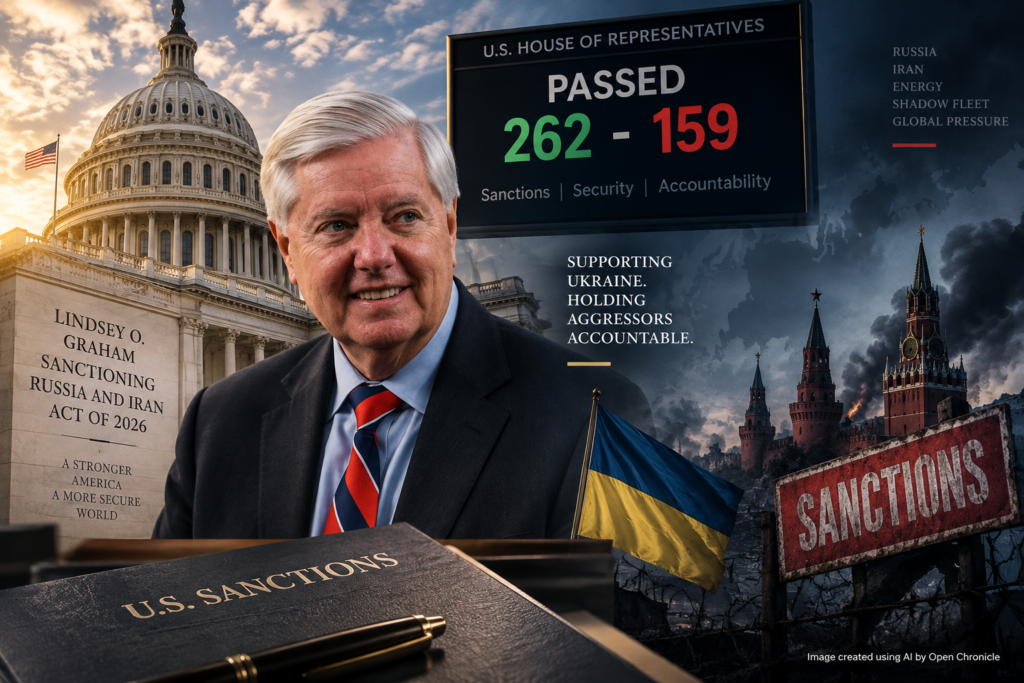
The House passed the Lindsey O. Graham Sanctioning Russia and Iran Act of 2026 on Wednesday by 262 votes to 159. The Senate approved the legislation last month by 86 to 11, meaning the measure has now cleared Congress and awaits Trump’s signature.
Named in honour of the late Republican Senator Lindsey Graham of South Carolina, who spent more than a year championing the legislation, the bill targets Russian energy and defence interests, sanctions evasion networks and the tankers commonly described as Moscow’s “shadow fleet.”
It also gives the president authority to impose tariffs of up to 100 percent on countries that continue significant purchases of Russian oil and gas, potentially affecting major economies including China and India.
A major escalation of economic pressure on Moscow
The legislation is designed to attack one of the central pillars supporting Russia’s war economy: energy revenues.
Despite successive rounds of Western sanctions since Russia launched its full scale invasion of Ukraine in February 2022, Moscow has continued selling large quantities of oil and gas internationally.
Russia has also relied on a network of tankers, intermediaries and financial structures intended to reduce the effectiveness of Western restrictions.
The new legislation seeks to close some of those gaps while creating another source of pressure by targeting countries that continue buying substantial quantities of Russian energy.
House Ways and Means Committee Chairman Jason Smith said the legislation combined additional tariff authority with sanctions intended to prevent Russia from circumventing existing restrictions.
Supporters argue that forcing major energy importers to consider their access to the American market could reduce Russia’s ability to finance the war.
China and India could face tariffs
The bill’s secondary tariff provisions are among its most significant and controversial elements.
Trump would be authorised to impose tariffs of up to 100 percent on imports from countries that continue purchasing significant quantities of Russian oil and gas.
China and India are particularly important because both have become major buyers of Russian energy since Western governments imposed extensive sanctions following the invasion of Ukraine.
China has consistently rejected unilateral sanctions that lack United Nations Security Council authorisation and has opposed what Beijing describes as American “long arm jurisdiction.” The Chinese government maintains that its normal economic and energy cooperation with Russia is lawful.
The tariff authority is discretionary rather than an automatic 100 percent levy on every country purchasing Russian energy. That presidential discretion became one of the central points of disagreement during congressional debate.
Democrats divided over Trump’s new tariff powers
The House vote revealed an unusual political divide.
All but seven Republicans supported the legislation, while 58 Democrats broke with their party leadership and voted for it, producing the 262 to 159 final tally.
Some Democrats opposed the measure despite supporting tougher sanctions on Russia because they argued it granted Trump excessive authority over tariffs.
Representative Rick Larsen of Washington said Trump already possessed significant powers to impose sanctions on Russian officials and companies and argued that Congress did not need to provide the administration with additional tariff authority.
Representative Jennifer McClellan of Virginia similarly said she supported sanctions against Russia but opposed expanding presidential tariff powers at a time when Americans were facing higher living costs.
Other opponents argued that the legislation contains broad national interest provisions that could allow the president to decline to impose some of the economic measures.
The dispute therefore was not simply over whether Russia should face additional economic pressure. It also reflected a broader congressional debate over how much authority the executive branch should have to use tariffs as an instrument of foreign policy.
Zelenskyy pushed Congress to act
Ukrainian President Volodymyr Zelenskyy strongly supported the legislation and personally encouraged lawmakers to approve it.
During the Senate phase of the debate, Zelenskyy met lawmakers and watched a procedural vote from inside the chamber, an unusual demonstration of the importance Kyiv attached to the measure.
He renewed his support this week, arguing that economic pressure could help change Moscow’s calculations.
The legislation represents the most significant Ukraine related measure passed by Congress since Trump returned to the White House in January 2025, according to Reuters.
It also comes as the conflict continues to expand into attacks on energy, transportation and other infrastructure.
On September 17, Russia launched another large wave of missile and drone attacks against Kyiv and other Ukrainian cities. More than 20 people were reported injured, while energy and communications infrastructure was damaged. Poland scrambled fighter aircraft as a precaution, although Polish authorities reported no violation of their airspace.
Legislation renamed for Lindsey Graham
The bill also carries considerable symbolic significance in Washington.
Graham and dozens of senators originally introduced the sanctions initiative in April 2025. The South Carolina Republican became one of its most persistent advocates, arguing that countries purchasing Russian energy were indirectly helping finance Moscow’s war.
The legislation was subsequently renamed the Lindsey O. Graham Sanctioning Russia and Iran Act of 2026 following his death in July.
Michael McCaul, the Republican former chairman of the House Foreign Affairs Committee and one of the legislation’s principal House sponsors, described its passage as another step toward achieving Graham’s goal of increasing economic leverage against Russia.
The Senate had already given the legislation overwhelming bipartisan support before Wednesday’s House vote.
Iran sanctions included
Although much of the debate has focused on Russia and Ukraine, the legislation also expands restrictions connected with Iran.
Congressional supporters say the provisions are intended to restrict financing for Iran’s energy and weapons sectors alongside the measures directed at Moscow.
The Iran provisions broaden the geopolitical scope of legislation that began primarily as an attempt to impose secondary economic pressure on countries purchasing Russian energy.
That combination helped attract some lawmakers while creating additional concerns for others about the breadth of the legislation and the powers it grants the president.
Trump has preferred control over tariffs
The bill also presents an interesting development in Trump’s relationship with Congress.
Since returning to office in January 2025, Trump has generally preferred to maintain executive control over tariffs and sanctions, which have become central instruments of his foreign and economic policy.
The Graham legislation spent more than a year navigating political resistance before Republican leaders ultimately brought it forward.
Trump’s eventual support was important to its progress through the Republican controlled Congress. The legislation nevertheless preserves significant presidential discretion over how some of its most powerful provisions are implemented.
That means the practical impact of the law, assuming Trump signs it, will depend substantially on how aggressively the administration uses the authorities Congress has provided.
Moscow warns sanctions could undermine diplomacy
Russia has condemned the legislation.
Kremlin spokesman Dmitry Peskov said Thursday that additional U.S. sanctions would be regarded as hostile measures and warned that they could make efforts to negotiate an end to the war more difficult.
The Kremlin’s position is that additional economic punishment will complicate rather than encourage diplomacy.
Supporters of the legislation take the opposite view. They argue that negotiations are unlikely to produce meaningful results unless Russia faces greater economic costs for continuing the war.
That disagreement goes to the heart of the sanctions debate: whether additional pressure will encourage compromise or deepen confrontation.
The next decision belongs to Trump
With both chambers of Congress having approved the legislation, attention now turns to the White House.
If Trump signs the bill, Washington will gain a new package of sanctions and tariff authorities with potentially significant consequences not only for Russia but also for countries that continue buying Russian energy.
How those powers are implemented will be critical.
A restrained approach could leave much of the legislation’s economic potential unused. Aggressive implementation, particularly against major trading partners such as China or India, could have much wider consequences for global trade, energy markets and U.S. diplomatic relations.
For Ukraine, supporters of the legislation see the measure as evidence that substantial bipartisan support for increasing economic pressure on Moscow remains inside Congress.
For Russia, China, India and other major energy importers, the more important question now is how President Trump chooses to use the powers lawmakers have placed on his desk.