
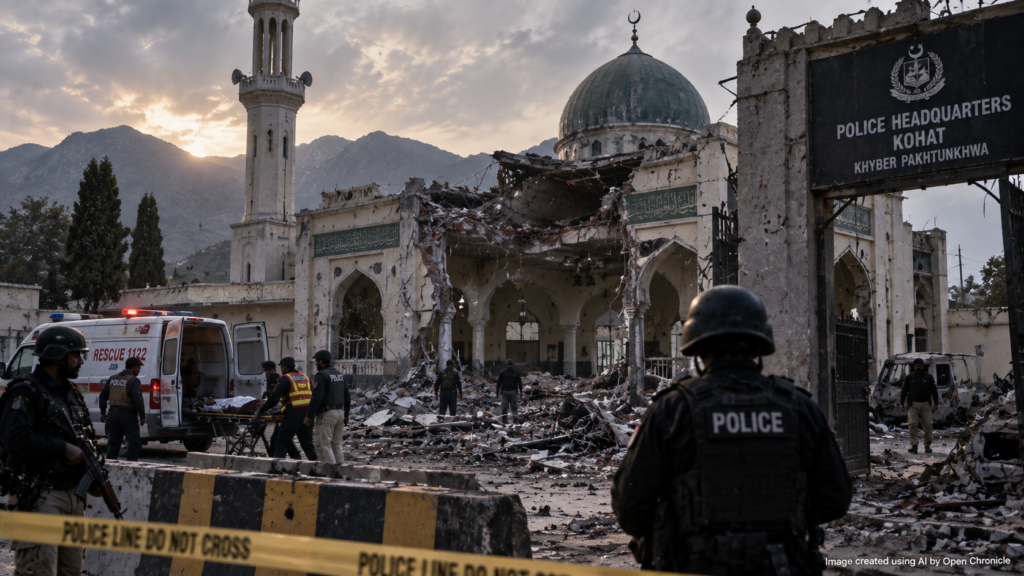
A suicide bomber struck a mosque inside a police headquarters in northwestern Pakistan during Friday prayers, killing at least 31 people and injuring dozens more. A faction linked to the Pakistani Taliban has claimed responsibility for the attack.
By Open Chronicle with agencies | September 19, 2026
At least 31 people, including 16 police personnel, were killed in a suicide bombing at a mosque inside a police headquarters in Kohat, in Pakistan’s northwestern Khyber Pakhtunkhwa province, on Friday.
The attack occurred as worshippers gathered for Friday prayers. According to local authorities, an explosives-laden vehicle was driven into the entrance of the mosque, triggering a powerful explosion that severely damaged the building and caused part of the police compound’s outer wall to collapse.
The bombing was followed by a gun battle after armed attackers attempted to enter the police headquarters. Security personnel exchanged fire with the assailants, killing at least six of them, according to Al Jazeera.
Dozens of people were injured, with reports indicating that the number of wounded could exceed 75.
The attack is the latest in a series of deadly incidents targeting Pakistani security forces and comes amid continuing tensions between Islamabad and neighboring Afghanistan.
Pakistani Taliban faction claims responsibility
Ittehadul Mujahideen, a militant faction linked to Taliban commander Hafiz Gul Bahadur, claimed responsibility for the suicide bombing.
The group is associated with the Tehreek-e-Taliban Pakistan (TTP), commonly known as the Pakistani Taliban, which has carried out numerous attacks against Pakistani security forces and government institutions.
Provincial police chief Zulfikar Hameed confirmed that the explosion was a suicide attack.
The TTP is organizationally separate from the Afghan Taliban, which returned to power in Afghanistan in August 2021, although the two movements maintain longstanding ideological and operational ties.
Pakistani authorities have repeatedly accused militant groups operating near the Afghan border of using territory inside Afghanistan to organize attacks against Pakistan.
The Afghan Taliban government denies providing sanctuary to groups responsible for cross-border violence.
Mosque severely damaged as rescue teams search for survivors
The explosion caused extensive damage to the mosque and surrounding police facilities.
Residents reported hearing the blast from a considerable distance, while emergency services rushed to the compound to recover victims and transport the wounded to nearby hospitals.
Dr. Tahir Shah told the German news agency dpa that at least 15 bodies and more than 50 injured people had been brought to hospital following the attack.
Other reports placed the number of wounded at approximately 75.
Senior rescue official Bilal Faizi said most of those injured were worshippers attending Friday prayers.
The attack struck a place of worship inside a heavily guarded police facility, highlighting the continuing vulnerability of security installations in areas affected by militant violence.
Attack follows deadly bombing of Pakistani soldiers
The Kohat bombing occurred just one day after a roadside explosion killed six Pakistani soldiers traveling in a security forces convoy in the neighboring Hangu district.
On Thursday, Pakistani military and police authorities also reported killing 10 suspected Taliban fighters during security operations in the region.
Kohat occupies a strategically important position in northwestern Pakistan, connecting several districts affected by militant activity, including North Waziristan, Bannu and Dera Ismail Khan.
The region has experienced repeated attacks against security personnel, government facilities and civilian communities.
Al Jazeera correspondent Kamal Hyder noted that the area has witnessed a series of deadly incidents in recent months, reflecting the persistent security challenges facing Pakistan’s northwestern provinces.
Pakistan and Afghanistan face continuing tensions
The bombing comes against the backdrop of deteriorating relations between Pakistan and Afghanistan, with both countries accusing each other of responsibility for cross-border security threats.
Islamabad maintains that the Afghan Taliban has failed to prevent Pakistani militant organizations from operating on Afghan territory.
Authorities in Kabul reject these accusations and insist that Afghanistan should not be held responsible for Pakistan’s internal security problems.
The dispute has contributed to intermittent military confrontations along the border, further complicating relations between the neighboring countries.
Michael Semple, a visiting professor at Queen’s University Belfast and a former European Union representative in Afghanistan, told Al Jazeera that attacks of this scale require extensive planning, logistics and training.
He argued that the Kohat bombing appeared consistent with a broader pattern of militant organizations attempting to destabilize the Pakistani government.
His assessment reflects concerns about the operational capabilities of armed groups in the border region, although the precise circumstances surrounding the planning and preparation of the Kohat attack have not been independently established.
Prime Minister condemns attack and orders emergency response
Pakistani Prime Minister Shehbaz Sharif condemned the bombing and instructed authorities to accelerate rescue operations and ensure that those injured received medical assistance.
The Interior Ministry also denounced the attack, declaring that militant violence would not weaken the country’s determination to confront armed groups.
Security forces continued their response following the explosion and subsequent gun battle.
The attack underscores the security challenges facing Pakistan as authorities attempt to contain militant violence while managing an increasingly difficult relationship with Afghanistan.
For communities in Khyber Pakhtunkhwa, the bombing represents another devastating episode in a conflict that continues to claim the lives of civilians and security personnel alike.