
By Open Chronicle with agencies
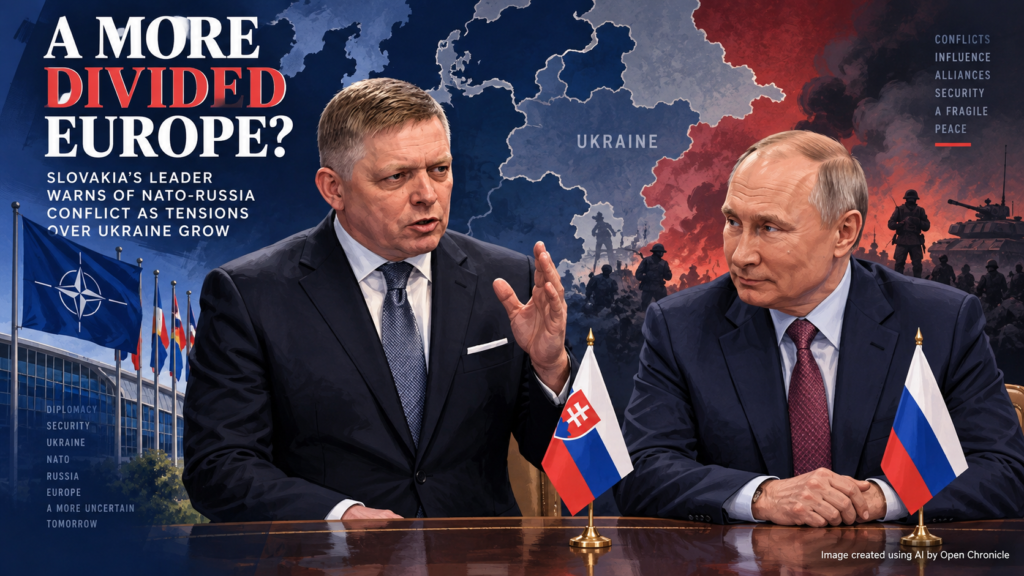
Slovak Prime Minister Robert Fico has warned that Europe is moving closer to a direct military confrontation between NATO and Russia, accusing some Western politicians of seeking to escalate the war in Ukraine after failing to achieve their objectives through military support for Kyiv.
The Slovak leader’s comments highlight continuing disagreements within Europe over the risks of escalation, military assistance to Ukraine and the response to alleged Russian hybrid attacks against NATO member states.
In a video message published on Saturday, Fico argued that the conflict in Ukraine was creating an increasingly dangerous security environment for Europe. His warning came as Polish and French leaders raised concerns about Russian military activity and the possibility of attacks against countries supporting Ukraine.
WHAT DIDN’T MAKE IT INTO THE PRESS CONFERENCE LXIX.
We have our own experience with Munich in 1938, when the powers bound to us by treaty deceived us, betrayed us and served us up to Hitler like a roasted chicken.
Why is there immediately such an outcry when I take a sober view… pic.twitter.com/nQOAmWDHjf
— Robert Fico 🇸🇰 (@RobertFicoSVK) September 19, 2026
Fico warns of a wider European conflict
Fico claimed that some Western politicians were considering a direct confrontation between NATO and Russia because their strategy of supporting Ukraine had failed to defeat Moscow.
He described the situation as a mortal danger for Europe and accused Western governments of increasing the risk of escalation through their continued involvement in the conflict.
According to the Slovak prime minister, some politicians believe that if Russia cannot be defeated through Ukrainian military operations and Western assistance, a direct confrontation between NATO and Moscow could become the next stage of the conflict.
Fico did not present publicly verifiable evidence that NATO governments were deliberately seeking such a confrontation.
His remarks reflect his longstanding opposition to providing military assistance to Ukraine and his preference for a negotiated settlement.
Slovakia remains a member of NATO and the European Union, but Fico has pursued a different approach to relations with Moscow from that of several other European leaders.
His government has opposed supplying weapons from Slovak state military stocks to Ukraine, while maintaining diplomatic contacts with Russia.
Slovakia will not send troops to Ukraine, Fico says
The Slovak prime minister reiterated that the war in Ukraine was neither Slovakia’s war nor NATO’s war.
He warned that a military incident involving drones or missiles could create circumstances in which NATO’s collective defence provisions might be invoked, potentially drawing additional countries into the conflict.
Fico said Slovakia would not send soldiers into combat on the basis of what he described as a fabricated justification for war.
His comments followed growing concern about the possibility of military incidents affecting NATO territory, particularly in countries bordering Ukraine.
Under Article 5 of the North Atlantic Treaty, an armed attack against one member can be considered an attack against all members. However, the provision does not automatically require every member state to deploy troops or take identical military action.
The nature of any collective response would depend on consultations among NATO members and the circumstances of the incident.
Fico cites Polish prime minister over Ukrainian military losses
During his video address, Fico referred to remarks he attributed to Polish Prime Minister Donald Tusk concerning Ukrainian military casualties.
Fico claimed that Tusk had received information from Ukrainian officials indicating that 27,000 Ukrainian soldiers had been killed in a single month.
The Slovak leader said he had no reason to question the figure but suggested that presenting exceptionally high casualty numbers could influence Western governments to increase military and financial assistance to Kyiv.
The figure cited by Fico has not been independently verified in the information available for this report.
Ukraine and Russia have released limited and often disputed information about their military casualties throughout the war, making independently establishing monthly losses particularly difficult.
Fico’s interpretation of the reported casualty figure should therefore be distinguished from any confirmed assessment of Ukrainian military losses.
Poland warns of possible Russian attacks against Ukraine’s allies
Fico’s comments came as Polish Prime Minister Donald Tusk warned that Russia could be preparing hybrid attacks involving drones and missiles against countries providing assistance to Ukraine.
According to the account of Tusk’s remarks published by Polish Radio , the Polish leader cited intelligence assessments suggesting that Moscow could attempt to present such incidents as accidental.
Tusk argued that these operations could be intended to test NATO’s response and undermine confidence in the alliance’s collective defence commitments.
The Polish prime minister’s warning reflects Warsaw’s concerns about the security implications of Russia’s war against Ukraine, particularly for countries along NATO’s eastern flank.
Poland has consistently supported military assistance to Kyiv and has advocated strengthening NATO’s defensive capabilities.
The intelligence assessments referenced by Tusk have not been made publicly available in full, leaving the precise nature and timing of the alleged Russian plans unclear.
Macron raises concerns over Russian hybrid operations
French President Emmanuel Macron has also warned about what he described as an intensification of Russian hybrid operations against European countries.
Speaking on Friday, Macron cited an attempted drone attack at Leipzig airport in Germany in August, which German authorities attributed to Moscow.
The French president presented the incident as an example of the evolving security challenges facing Europe, including threats involving drones, sabotage and other operations that may fall below the threshold of conventional warfare.
European governments have increasingly focused on protecting critical infrastructure, transport networks and military facilities against these types of threats.
Russia has repeatedly denied responsibility for various alleged sabotage and hybrid operations attributed to it by Western governments.
The competing accounts illustrate a central disagreement between Fico and several other European leaders.
While the Slovak prime minister emphasizes the danger that continued Western involvement in Ukraine could contribute to a wider conflict, Poland and France have focused on the risks they attribute to Russian military activity and operations against European countries.
NATO faces competing concerns over escalation and deterrence
The debate comes at a time when European governments are seeking to balance military support for Ukraine, the protection of NATO territory and the need to prevent the conflict from expanding beyond Ukraine’s borders.
NATO maintains that its assistance to Ukraine is intended to support the country’s defence against Russia’s invasion and strengthen European security.
The alliance has also emphasized that it is not seeking a direct war with Russia.
Fico, however, continues to question whether the current approach to supporting Ukraine is reducing the risk of a broader confrontation.
His position differs from that of governments such as Poland and France, which argue that maintaining credible defensive capabilities and supporting Ukraine are necessary responses to Russia’s military actions.
The disagreement extends beyond the immediate question of military assistance. It concerns how European governments assess the risks of escalation, the credibility of NATO’s collective defence commitments and the conditions under which diplomatic efforts might produce an end to the war.
For Slovakia, which shares a border with Ukraine, these questions carry direct implications for national security and its responsibilities as a NATO member.
As the war continues, European leaders face the challenge of responding to military threats while maintaining communication and coordination within an alliance whose members do not always agree on how best to manage the risks of a wider conflict.