
OPEN CHRONICLE HISTORY | TODAY IN HISTORY
How a seemingly simple children’s adventure introduced Middle-earth, brought Bilbo Baggins into the world and laid the foundations for one of the most influential literary universes ever created.
On September 21, 1937, a children’s fantasy novel appeared in British bookshops.
By Open Chronicle History Desk
Its title was The Hobbit, or There and Back Again.
Its author was John Ronald Reuel Tolkien, an Oxford professor whose academic career centred on ancient languages, medieval literature and the history of words.
The book told the story of Bilbo Baggins, a comfort-loving hobbit who reluctantly leaves his peaceful home to join a company of dwarves on a dangerous journey towards a distant mountain guarded by a dragon.
It was a story of adventure, courage, friendship, greed and the unexpected abilities of an apparently ordinary individual.
But neither its publisher nor its first readers could have fully anticipated what would follow.
The novel would become a major success, introduce readers to Middle-earth and lead Tolkien to write The Lord of the Rings, one of the most influential works of twentieth-century literature.
Decades later, Tolkien’s imagined world would inspire generations of authors, artists, filmmakers, musicians and game designers.
Its influence would extend far beyond children’s literature, helping shape the modern fantasy genre and the way fictional worlds are constructed.
The publication of The Hobbit on September 21, 1937, therefore marks more than the appearance of a successful novel.
It marks the beginning of a literary phenomenon that would transform popular culture.
1. The World Before The Hobbit
Fantasy literature did not begin with Tolkien.
Stories of supernatural beings, heroic quests, magical objects and imaginary kingdoms had existed for thousands of years.
Ancient mythologies contained gods, monsters, enchanted weapons and journeys into unfamiliar worlds.
Medieval literature developed elaborate traditions of heroic adventure.
The Norse sagas, the Anglo-Saxon poem Beowulf and Arthurian romances all contributed elements that would later become familiar in fantasy fiction.
During the nineteenth century, writers such as George MacDonald and William Morris created influential works involving imaginary worlds and supernatural adventures.
In the early twentieth century, Lord Dunsany published stories set in elaborate mythological landscapes.
Tolkien inherited these traditions.
His achievement was not the invention of fantasy itself, but the creation of a particularly detailed fictional world in which languages, histories, geography, mythology and individual stories formed parts of a larger imagined reality.
To understand how he achieved this, we must begin with his own life.
2. J. R. R. Tolkien: The Scholar Behind Middle-earth
John Ronald Reuel Tolkien
1892 to 1973
English writer, philologist and Oxford professor whose fascination with languages and medieval literature helped shape the mythology of Middle-earth.
Tolkien was born on January 3, 1892, in Bloemfontein, in what was then the Orange Free State in southern Africa.
His family later returned to England.
His father died when Tolkien was young, and his mother died in 1904.
These early losses shaped his childhood, which was spent partly in and around Birmingham.
Tolkien developed a remarkable interest in languages.
He studied Latin and Greek, explored Gothic and other historical languages, and became fascinated by the relationship between language, culture and mythology.
His academic interests eventually led him to Oxford University.
But his imagination was also shaped by another defining experience of his generation.
The First World War.
3. Tolkien and the First World War
Tolkien served in the British Army during the First World War.
In 1916, he participated in the Battle of the Somme, one of the deadliest campaigns of the conflict.
He witnessed the destruction of industrial warfare and lost several close friends.
He later became seriously ill with trench fever and was evacuated from the front.
Tolkien’s experiences during the war have often been connected with the darkness, loss and moral complexity of his later fiction.
However, it would be misleading to interpret The Hobbit or The Lord of the Rings as straightforward allegories of the First World War.
Tolkien explicitly resisted simple allegorical interpretations of his work.
His fiction drew upon a much wider range of influences, including medieval literature, language, religious belief, mythology and his personal experiences.
Nevertheless, the war formed part of the historical world in which his imagination developed.
4. The Creation of Middle-earth
Long before The Hobbit appeared, Tolkien had begun developing an elaborate mythology.
He invented languages and imagined the peoples who might speak them.
His linguistic creations gradually acquired histories, legends and geographical settings.
The early stories that eventually contributed to The Silmarillion began taking shape during the First World War and the years that followed.
These writings explored an imagined ancient world of elves, human kingdoms, divine powers and conflicts over extraordinary jewels known as the Silmarils.
Tolkien’s fictional universe was therefore already developing before Bilbo Baggins appeared.
But The Hobbit would provide a new and more accessible entry point into that world.
5. In a Hole in the Ground There Lived a Hobbit
The origins of The Hobbit have become part of literary history.
Tolkien later recalled that while marking examination papers, he encountered a blank page and spontaneously wrote the opening sentence of a story about a hobbit.
He did not initially know exactly what a hobbit was.
The idea gradually developed into a narrative about an ordinary individual drawn into an extraordinary adventure.
Bilbo Baggins lived in a comfortable underground home called Bag End.
He enjoyed food, domestic routines and the predictable pleasures of everyday life.
Adventure was not something he actively sought.
Then Gandalf arrived.
The wizard introduced Bilbo to a company of thirteen dwarves led by Thorin Oakenshield.
Their objective was to recover treasure and reclaim their ancestral home beneath the Lonely Mountain, which had been occupied by the dragon Smaug.
Bilbo was recruited as their burglar.
The journey would transform him.
6. The World of Bilbo Baggins
The story introduced readers to a remarkable collection of places and characters.
The Shire represented comfort, familiarity and rural domestic life.
The journey beyond it led Bilbo through increasingly dangerous and unfamiliar environments.
He encountered trolls, goblins, elves, giant spiders and a dragon.
The company travelled through Rivendell, crossed the Misty Mountains, entered Mirkwood and eventually reached the Lonely Mountain.
Each location possessed its own atmosphere, inhabitants and history.
Tolkien’s descriptions gave readers the impression that Bilbo was travelling through a world extending far beyond the immediate requirements of the plot.
This sense of depth became one of the defining characteristics of his fiction.
7. Gollum and the Discovery of the Ring
One of the most consequential episodes occurs beneath the Misty Mountains.
Separated from his companions, Bilbo finds a mysterious ring.
He subsequently encounters Gollum, a strange creature living beside an underground lake.
The two engage in a contest of riddles.
Bilbo eventually discovers that the ring can make its wearer invisible.
In the original 1937 version of The Hobbit, the encounter differed significantly from the version familiar to many modern readers.
Gollum was initially portrayed as more willing to offer the ring as a prize in the riddle contest.
After developing the ring’s central importance in The Lord of the Rings, Tolkien revised the chapter for the 1951 edition of The Hobbit.
The revised version made Gollum’s possessiveness and the circumstances of Bilbo’s escape consistent with the later story.
This change illustrates how Tolkien’s fictional universe evolved over time.
An object introduced in a children’s adventure became central to an epic narrative about power, temptation and the struggle against domination.
8. Smaug: The Dragon Beneath the Mountain
Smaug became one of the most memorable dragons in modern fantasy literature.
He was intelligent, dangerous, arrogant and fiercely possessive of his treasure.
The dragon had driven the dwarves from their ancestral kingdom and occupied the Lonely Mountain.
His presence transformed the surrounding region.
The ruined city of Dale and the abandoned dwarven halls represented the consequences of his destruction.
Tolkien drew upon older traditions of dragon literature, including the dragon in Beowulf and the figure of Fáfnir in Norse mythology.
Yet Smaug possessed a distinctive personality.
He was not simply a monster guarding treasure.
His conversations with Bilbo revealed a creature capable of manipulation, suspicion and calculated cruelty.
The dragon also embodied one of the novel’s recurring themes.
The destructive power of greed.
9. A Children’s Story With Deeper Themes
At first glance, The Hobbit appears to be a relatively straightforward adventure.
A reluctant hero leaves home, encounters danger, discovers courage and eventually returns.
But the story explores several deeper questions.
Bilbo’s development challenges conventional ideas of heroism.
He is not a great warrior.
He does not possess extraordinary physical strength.
His most important qualities include intelligence, compassion, restraint and the ability to act courageously despite fear.
The novel also examines the relationship between wealth and moral judgment.
Thorin’s desire to reclaim his ancestral treasure gradually becomes entangled with pride and possessiveness.
The conflict surrounding the treasure of the Lonely Mountain demonstrates how the pursuit of wealth can destroy alliances and obscure more important values.
Bilbo’s willingness to sacrifice personal gain in an attempt to prevent conflict becomes one of the story’s central moral decisions.
10. How The Hobbit Reached a Publisher
olkien did not initially write The Hobbit as part of a planned commercial fantasy series.
The manuscript developed from stories he told and wrote for his children.
It eventually reached the London publishing house George Allen & Unwin.
The publisher’s chairman, Stanley Unwin, asked his young son Rayner to read the manuscript and provide an opinion.
Rayner, who was ten years old, produced a favourable report.
The story impressed him sufficiently for the publisher to proceed.
The episode became one of the most famous examples of a child’s reading report influencing a major literary publication.
Tolkien’s manuscript was accepted.
The book was prepared for publication in 1937.
11. September 21, 1937: The Hobbit Is Published
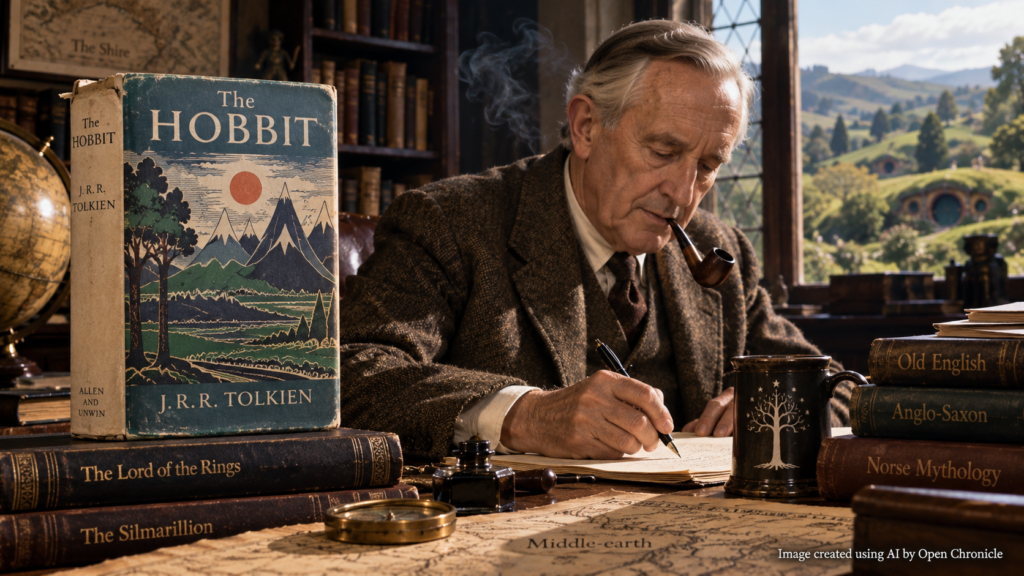
On September 21, 1937, George Allen & Unwin published The Hobbit, or There and Back Again in Britain.
The first printing consisted of approximately 1,500 copies.
Tolkien contributed illustrations and designed the distinctive dust jacket.
The book received favourable reviews.
Readers responded to its combination of humour, adventure, memorable characters and imaginative worldbuilding.
The initial printing sold out before the end of the year.
Its success encouraged the publisher to request another story involving hobbits.
Tolkien began working on a sequel.
That project would become far larger and more complex than the original children’s novel.
12. From The Hobbit to The Lord of the Rings
After the success of The Hobbit, Tolkien began writing a continuation.
At first, the new story retained elements of the earlier book’s lighter tone.
But as the narrative developed, it became increasingly connected to the mythology Tolkien had been constructing for decades.
The ring Bilbo had discovered acquired a far more dangerous significance.
The new story expanded to include the history of Sauron, the struggle against the Dark Lord, the kingdoms of Gondor and Rohan, and the fate of the peoples of Middle-earth.
The manuscript grew enormously.
Tolkien worked on it for more than a decade.
The Lord of the Rings was eventually published in three volumes between 1954 and 1955.
The books transformed Tolkien’s literary reputation.
What began as a sequel to a children’s adventure became a monumental work of modern fantasy.
13. The Second World War and Tolkien’s Writing
The development of The Lord of the Rings overlapped with the Second World War.
Tolkien wrote much of the novel during a period marked by international conflict, destruction and political upheaval.
Readers have often interpreted the struggle against Sauron in relation to the wars and totalitarian regimes of the twentieth century.
Tolkien rejected the idea that his story should be understood as a direct allegory of contemporary events.
He distinguished between allegory, in which characters and events correspond to specific external meanings, and applicability, through which readers may find different meanings relevant to their own experiences.
This distinction remains important.
Tolkien’s fiction can illuminate questions about power, war, industrialisation and moral responsibility without being reduced to a coded account of particular historical events.
14. Tolkien and the Birth of Modern Fantasy
Tolkien’s influence on modern fantasy literature was enormous.
His works helped establish expectations that became familiar to generations of readers.
Elaborate imaginary worlds.
Detailed maps.
Invented languages.
Ancient histories.
Distinct peoples with their own cultures and traditions.
Quests involving ordinary individuals caught in conflicts of enormous consequence.
Later authors developed these elements in different directions.
Some drew heavily upon Tolkien’s example.
Others deliberately challenged or rejected aspects of his approach.
The fantasy genre became increasingly diverse, incorporating different cultural traditions, political perspectives, literary styles and narrative structures.
Tolkien did not create all the elements associated with modern fantasy.
But the extraordinary popularity of his work helped establish the genre as a major part of contemporary publishing.
15. Middle-earth Beyond Literature
The influence of The Hobbit and The Lord of the Rings extended beyond novels.
Tolkien’s world inspired visual artists, musicians, game designers and filmmakers.
The development of modern tabletop roleplaying games drew upon a wide range of fantasy traditions, including elements popularised by Tolkien.
Fantasy video games subsequently adopted many conventions associated with imaginary worlds populated by elves, dwarves, dragons and other supernatural beings.
Peter Jackson’s film adaptations brought Middle-earth to a new international audience during the early twenty-first century.
The Lord of the Rings film trilogy was released between 2001 and 2003.
A film trilogy based on The Hobbit followed between 2012 and 2014.
These adaptations generated enormous commercial and cultural interest, while also producing debates among readers about changes to Tolkien’s original narratives.
The fictional world introduced to a wider public in 1937 had become a global cultural phenomenon.
16. The Importance of Tolkien’s Languages
One of the most distinctive aspects of Tolkien’s fictional world was his approach to language.
For Tolkien, invented languages were not merely decorative collections of unfamiliar words.
They were central to the creation of imaginary cultures.
He developed elaborate linguistic systems, including Quenya and Sindarin, associated with the Elves.
These languages possessed grammatical structures, historical development and relationships with one another.
Tolkien also drew upon his knowledge of Old English, Old Norse, Finnish, Welsh and other languages when developing names, linguistic patterns and cultural traditions.
His scholarly background allowed him to construct a fictional world with an unusual sense of historical depth.
Middle-earth appeared to possess a past extending far beyond the events described in any single book.
That quality helped distinguish Tolkien’s work from many earlier adventure stories.
17. The Hobbit and the Meaning of Heroism
Bilbo Baggins remains central to the novel’s enduring appeal.
He begins as a character who values comfort and avoids uncertainty.
He does not seek glory.
He does not dream of conquering kingdoms or defeating powerful enemies.
Yet the journey reveals qualities that neither he nor his companions initially recognise.
He becomes resourceful.
He learns to act independently.
He develops courage.
He demonstrates compassion towards others, including individuals who may appear dangerous or undeserving.
His decisions increasingly reflect moral judgment rather than personal advantage.
By the end of the story, Bilbo has changed.
But he has not abandoned the values that made him distinctive.
He returns home with a deeper understanding of the world and his own abilities.
The novel suggests that heroism need not depend upon physical power, social status or a desire for recognition.
Sometimes it emerges from an ordinary person making difficult choices under extraordinary circumstances.
18. Why September 21 Matters
The publication of The Hobbit on September 21, 1937, marked an important turning point in the history of fantasy literature.
Tolkien brought together his academic knowledge, linguistic imagination, interest in mythology and gift for storytelling to create a fictional world that would eventually become one of the most widely recognised in modern culture.
The book’s initial success encouraged the development of The Lord of the Rings.
Together, the works influenced generations of writers and helped expand the audience for fantasy literature.
Their cultural impact reached cinema, music, gaming and visual art.
But the significance of The Hobbit also lies in the story itself.
It offered readers a protagonist whose courage emerged gradually, whose compassion mattered as much as his cleverness, and whose greatest achievement was not the acquisition of treasure but the discovery of his own character.
Nearly ninety years after its first publication, Bilbo’s journey continues to attract new generations of readers.
September 21, 1937: An Unexpected Literary Beginning
Imagine a London bookshop in September 1937.
Europe is living through a period of mounting political tension.
The Spanish Civil War is underway.
The threat of another major European conflict is growing.
Newspapers carry reports of diplomatic crises and international uncertainty.
Among the books appearing on the shelves is a new children’s novel by an Oxford professor.
Its cover depicts mountains, trees and a distant landscape.
Its title is The Hobbit.
A reader opens the book and encounters an unfamiliar creature living in a comfortable underground home.
Soon, a wizard arrives.
Then thirteen dwarves.
An unexpected journey begins.
There are mountains to cross, riddles to solve and a dragon waiting beneath a distant mountain.
The reader has no way of knowing that the ring discovered during this adventure will eventually become the centre of a much larger literary work.
Nor can anyone foresee that Tolkien’s imagined world will inspire generations of authors, filmmakers and artists.
For the moment, it is simply a new book.
A story about a hobbit who leaves home and discovers that the world is far larger than he imagined.
On September 21, 1937, The Hobbit enters the world.
Middle-earth will never be the same.
And neither will the history of fantasy literature.
Historical sources and further reading
The Tolkien Society: Biography of J. R. R. Tolkien
Tolkien’s life, academic career and literary development.
Encyclopaedia Britannica: The Hobbit
Publication history, narrative and literary significance.
Encyclopaedia Britannica: J. R. R. Tolkien
Biographical context and Tolkien’s contribution to modern literature.
John D. Rateliff, The History of The Hobbit
A detailed study of the manuscript, the development of the story and its relationship with Tolkien’s wider mythology.