
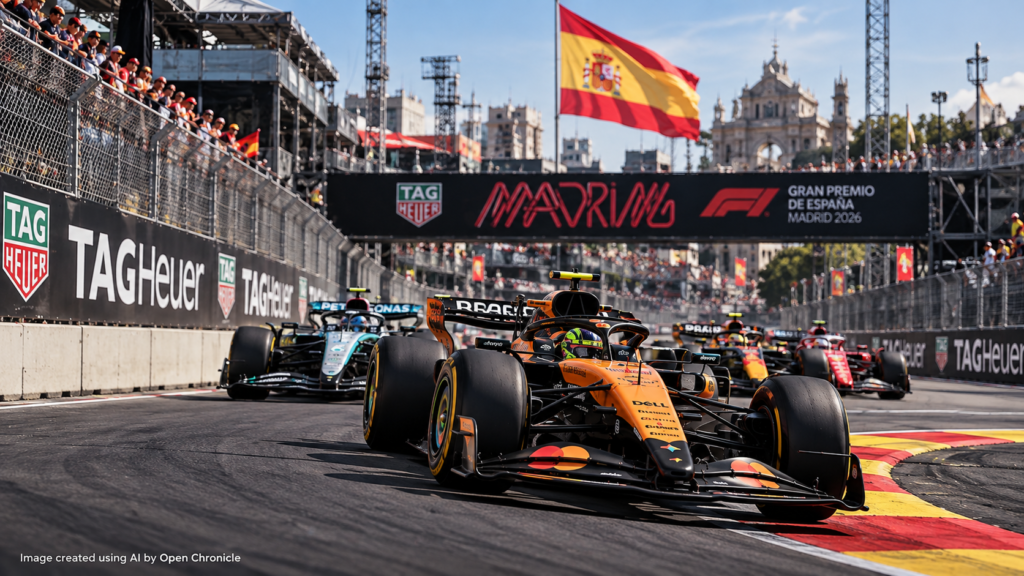
Formula 1 is preparing to reduce Grand Prix distances from 305 kilometres to 290 kilometres in 2027, as the sport adjusts its race format to accommodate changes to its power unit regulations.
By Open Chronicle Sports | Formula One Magazine
Formula 1 is set to introduce shorter Grand Prix races from the 2027 season after the F1 Commission approved a reduction in the minimum race distance during its latest meeting in London.
Under the proposed regulations, the standard Grand Prix distance will fall from 305 kilometres to 290 kilometres, a change equivalent to approximately two or three laps at most circuits.
The decision forms part of a broader package of regulatory adjustments designed to accommodate changes to Formula 1’s power units, improve race scheduling and provide greater flexibility when sessions are interrupted.
Although the proposal has received approval from the F1 Commission, it must still be formally ratified by the FIA World Motor Sport Council before becoming part of the 2027 regulations.
Why Formula 1 is shortening its races
The proposed reduction in race distance is directly connected to changes in Formula 1’s power unit regulations.
The sport’s current generation of hybrid power units was designed around a near equal contribution from internal combustion and electrical energy.
However, the technical regulations are being adjusted to rebalance the relationship between the two energy sources.
From 2027, the planned distribution will move towards approximately 58% combustion power and 42% electrical energy. Further adjustments are expected in 2028, when the balance is scheduled to reach 60% combustion and 40% electrical power.
These changes will be accompanied by an increase in permitted fuel flow rates.
Reducing the overall race distance is intended to accommodate the revised energy requirements while allowing teams and drivers to operate within the updated technical framework.
In its statement following the F1 Commission meeting, the FIA confirmed that the shorter race distance had been approved in conjunction with the planned changes to fuel flow regulations.
The governing body indicated that the reduction would generally correspond to two or three fewer laps, depending on the length of the circuit.
What will change for Grand Prix weekends?
The reduction from 305 kilometres to 290 kilometres represents a decrease of approximately 4.9% in the standard Grand Prix distance.
Although the adjustment may appear relatively modest, it could have implications for several aspects of race preparation and execution.
Teams will need to account for the shorter distance when developing their fuel consumption models, tyre strategies and energy management programmes.
The changes to fuel flow regulations will also influence how engineers approach race simulations and the balance between combustion and electrical power throughout a Grand Prix.
However, a shorter race will not necessarily produce a proportional reduction in total race duration.
Circuit characteristics, weather conditions, Safety Car interventions and other interruptions will continue to influence how long each event takes to complete.
The precise number of laps removed will also vary according to the individual circuit configuration.
New rules for interrupted races
The F1 Commission has also approved changes to the regulations governing races affected by rain or other disruptions.
Under the proposed framework, a hard stop time will be introduced for racing activities affected by interruptions.
At the same time, the existing three hour limit on the total duration of a Grand Prix, including interruptions, will be removed.
The maximum permitted duration of actual racing will remain two hours.
The distinction is important.
Under the revised approach, the time available to complete a race and the amount of actual racing permitted will be governed by separate provisions.
The FIA explained that the changes are intended to improve the possibility of completing a race when unexpected disruptions affect the original schedule.
The new framework is designed to give race officials greater flexibility in managing interruptions while maintaining the existing limit on actual racing time.
The detailed implementation of the hard stop provision will be established through the final regulatory framework.
Greater flexibility for free practice sessions
The regulatory package also includes changes to the management of free practice sessions.
Greater flexibility to extend practice sessions following interruptions has been approved, potentially allowing teams and drivers to recover some of the track time lost to red flags or other disruptions.
This could be particularly relevant during race weekends affected by severe weather, accidents or technical problems at a circuit.
Free practice sessions provide teams with essential opportunities to evaluate car performance, collect telemetry, assess tyre behaviour and prepare race strategies.
When interruptions significantly reduce available running time, teams may enter qualifying or the Grand Prix with less information than originally planned.
The proposed changes would give race officials additional flexibility to manage such situations.
Gearbox homologation requirements to be removed
Another technical adjustment approved by the F1 Commission concerns gearbox development.
The existing gearbox homologation requirements will be removed for 2027, giving suppliers greater freedom to develop their transmission systems.
Homologation rules generally establish technical specifications that must be approved and maintained within defined regulatory limits.
Removing these requirements will provide manufacturers and suppliers with additional flexibility as they continue developing their cars under the new technical regulations.
The FIA stated that the change is intended to preserve development freedom for gearbox suppliers.
The precise competitive implications will depend on the final regulations and the development programmes adopted by individual teams.
What happens next?
The proposals approved by the F1 Commission must now proceed through the FIA’s formal regulatory approval process.
The World Motor Sport Council will be responsible for ratifying the changes before they are incorporated into the regulations governing the 2027 Formula 1 season.
If formally approved, the reduction in Grand Prix distance will mark a significant adjustment to the sport’s traditional race format.
The decision also illustrates how Formula 1’s evolving power unit regulations are influencing areas beyond engine development, including race distance, energy management and the operational structure of Grand Prix weekends.
For teams, the next challenge will be adapting their technical and strategic preparations to the revised regulations.
For spectators, the changes will mean slightly shorter races, alongside a new framework intended to provide greater flexibility when weather or other disruptions threaten the completion of a Grand Prix.
The 2027 season is therefore set to introduce changes not only to how Formula 1 cars generate and deploy power, but also to the distance over which they compete.