
OPEN CHRONICLE HISTORY | TODAY IN HISTORY
How a presidential declaration transformed the American Civil War into an explicit struggle against slavery and helped reshape the future of the United States.
By Open Chronicle History Desk
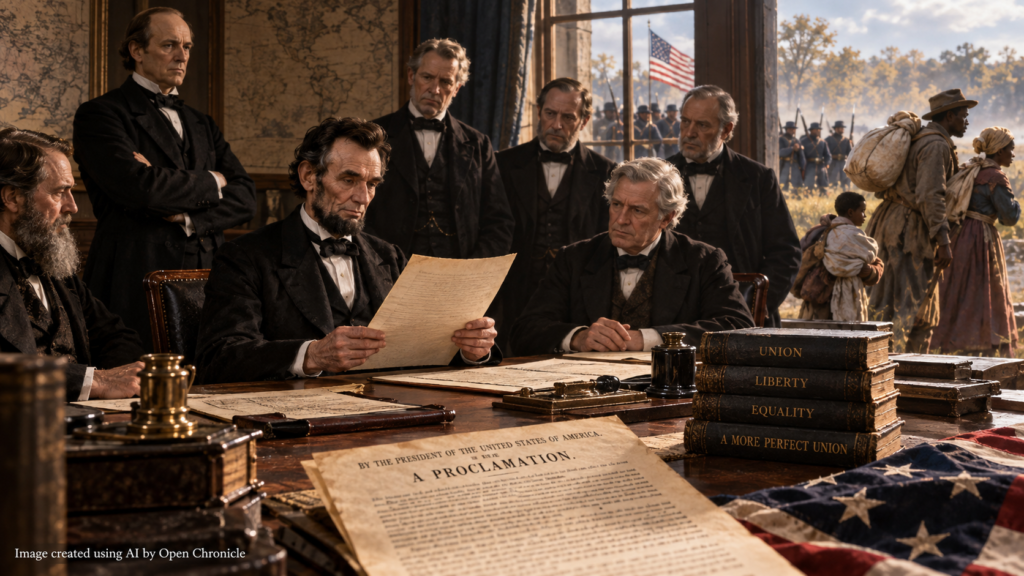
On September 22, 1862, President Abraham Lincoln gathered his cabinet in Washington and announced a decision that would fundamentally alter the course of the American Civil War.
Five days earlier, Union and Confederate armies had fought at Antietam, Maryland, in the bloodiest single day of battle in American military history.
The Confederate invasion of Maryland had been halted, giving Lincoln the opportunity he had been waiting for.
Now he was ready to take a step that would redefine the conflict.
Lincoln issued the Preliminary Emancipation Proclamation, declaring that enslaved people in states or parts of states still in rebellion against the United States on January 1, 1863, would be declared free.
The announcement did not immediately abolish slavery throughout the country.
It did not free every enslaved person in the United States.
And it did not end the Civil War.
But it changed the meaning of the struggle.
A war that had begun with the federal government’s determination to preserve the Union now included the destruction of slavery in the rebellious states as an explicit military and political objective.
The proclamation also created a pathway towards the enlistment of Black soldiers in the Union armed forces, strengthened the connection between Union victory and emancipation, and altered the international significance of the conflict.
Its importance extended far beyond the battlefield.
It helped set the United States on the path towards the constitutional abolition of slavery in 1865.
September 22, 1862, became one of the defining dates in the history of American freedom.
1. The United States Before the Civil War
To understand the significance of Lincoln’s declaration, it is necessary to understand the central place slavery occupied in the United States before 1861.
By the middle of the nineteenth century, approximately four million enslaved people lived in the country.
Most were held in the Southern states, where slavery formed a central part of agricultural production and the political and social order.
Cotton cultivation was particularly important.
Enslaved labour produced enormous quantities of cotton for domestic and international markets, including the textile industries of Britain and continental Europe.
Slavery was not simply an economic institution.
It was a system of legally enforced human bondage in which enslaved people could be bought, sold, separated from their families and subjected to violence.
Their labour was extracted without their consent.
Their freedom of movement, legal rights and ability to control their own lives were severely restricted.
Yet slavery existed within a republic whose founding political language emphasised liberty and equality.
This contradiction became increasingly difficult to reconcile as the United States expanded westward.
2. The Political Crisis Over Slavery
During the decades before the Civil War, American politics became increasingly divided over slavery’s expansion into new territories.
Southern slaveholding interests sought to preserve the institution and protect its political influence.
Opponents of slavery’s expansion argued that new territories should remain free of the institution.
The Missouri Compromise of 1820, the Compromise of 1850 and the Kansas Nebraska Act of 1854 reflected repeated attempts to manage these conflicts.
None produced a lasting settlement.
The Supreme Court’s 1857 decision in Dred Scott v. Sandford further intensified the crisis by denying federal citizenship to people of African descent under the Court’s interpretation and restricting Congress’s authority to prohibit slavery in federal territories.
The political system became increasingly polarised.
Violence erupted in Kansas.
Abolitionist movements expanded.
Southern political leaders feared that the growing strength of antislavery politics threatened the future of their slaveholding society.
The presidential election of 1860 brought these tensions to a breaking point.
3. Abraham Lincoln and the Election of 1860
Abraham Lincoln won the presidential election of November 1860 as the candidate of the Republican Party.
He opposed the expansion of slavery into new federal territories, although he did not initially propose using federal power to abolish it in states where it already existed.
His election nevertheless triggered a secession crisis.
South Carolina announced its secession in December 1860.
Other Southern states followed.
Their declarations and accompanying political statements identified the protection of slavery as a central reason for leaving the Union.
In February 1861, the Confederate States of America was established.
Lincoln entered office the following month facing the most serious constitutional crisis in American history.
The conflict became a shooting war in April 1861, when Confederate forces attacked Fort Sumter in Charleston Harbor.
The Civil War had begun.
4. A War to Preserve the Union
At the beginning of the conflict, Lincoln’s publicly stated central objective was the preservation of the United States.
His administration initially avoided declaring a general policy of emancipation.
Several factors shaped this approach.
Four slaveholding states, Delaware, Maryland, Kentucky and Missouri, remained within the Union.
Their continued loyalty was strategically important.
Lincoln also faced constitutional questions concerning the federal government’s authority to interfere with slavery inside individual states.
At the same time, the conflict itself was changing the political and military situation.
Enslaved people began escaping from Confederate territory and seeking refuge behind Union lines.
Their actions forced federal commanders and political leaders to confront slavery as an immediate military issue.
The institution was no longer merely the subject of political debate.
It was directly connected to the conduct of the war.
5. Enslaved People Begin Liberating Themselves
As Union armies entered Confederate territory, enslaved people sought opportunities to escape.
Some fled plantations and travelled considerable distances to reach federal forces.
Others provided intelligence, labour or assistance to Union soldiers.
Their actions weakened the Confederate labour system while increasing pressure on the Lincoln administration to establish a consistent policy towards people escaping slavery.
In May 1861, Union General Benjamin Butler refused to return three enslaved men who had escaped to Fort Monroe, Virginia.
He treated them as contraband of war because their labour had been used to support Confederate military operations.
The policy developed into a broader practice of providing refuge to people escaping slavery.
Congress subsequently adopted legislation addressing confiscation and emancipation in connection with the rebellion.
The First Confiscation Act of August 1861 authorised the seizure of certain property used to support the Confederate war effort and provided that enslaved people used for such purposes would no longer be subject to the claims of their enslavers.
The Second Confiscation Act of July 1862 expanded federal measures against slavery connected with the rebellion.
These developments demonstrated that emancipation was emerging through the combined effects of military necessity, congressional legislation and the actions of enslaved people themselves.
Lincoln’s proclamation would become a decisive part of that process.
6. Lincoln Moves Towards Emancipation
By the summer of 1862, Lincoln had concluded that emancipation could serve both a military and a political purpose.
Slavery supplied the Confederacy with agricultural labour and other forms of economic support.
Ending slavery in rebellious territory could weaken the Confederate war effort.
It could also discourage foreign governments from supporting the Confederacy.
Lincoln prepared a draft proclamation and presented it to his cabinet on July 22, 1862.
The cabinet discussed the proposal.
Secretary of State William H. Seward suggested that Lincoln wait until the Union achieved a significant military success before making the announcement.
Otherwise, the proclamation might appear to be an act of desperation by a government struggling to win the war.
Lincoln accepted the recommendation.
The declaration was temporarily withheld.
The administration waited for a suitable military moment.
That opportunity came in September.
7. The Battle of Antietam
In September 1862, Confederate General Robert E. Lee led the Army of Northern Virginia into Maryland.
The invasion followed a series of Confederate military successes.
Lee hoped to carry the war into Union territory, obtain supplies and potentially influence Northern political opinion.
Union forces under Major General George B. McClellan moved to confront him.
On September 17, the two armies fought near Sharpsburg, Maryland, along Antietam Creek.
The battle produced approximately 23,000 casualties, including those killed, wounded and missing.
It remains the bloodiest single day of battle in American military history.
The fighting ended without a decisive destruction of either army.
But Lee withdrew his forces back into Virginia.
The Confederate invasion of Maryland had failed.
For Lincoln, this provided the military opportunity needed to announce the emancipation policy.
Five days later, he acted.
8. September 22, 1862: The Preliminary Emancipation Proclamation
On September 22, Lincoln met with his cabinet and presented the Preliminary Emancipation Proclamation.
The document announced that enslaved people in states or designated parts of states still in rebellion on January 1, 1863, would be declared free.
The proclamation also stated that the federal government would recognise and maintain their freedom.
It gave Confederate states approximately one hundred days to end their rebellion before the emancipation provision took effect.
The declaration represented a significant transformation in federal policy.
Lincoln was now publicly committing the Union government to emancipation in rebellious territory.
The president grounded the measure in his authority as commander in chief during an armed rebellion.
Emancipation was presented as a necessary and appropriate military measure for suppressing the rebellion.
The announcement also declared that the administration would continue recommending compensated emancipation to loyal slaveholding states.
The document therefore combined a far-reaching emancipation policy in Confederate territory with a more gradual approach towards slavery in states remaining loyal to the Union.
9. What the Proclamation Actually Declared
The preliminary proclamation did not immediately free every enslaved person.
Its central provision applied to states or parts of states that would remain in rebellion on January 1, 1863.
The distinction was fundamental.
Slavery remained legal in the loyal border states.
The preliminary document also left open the possibility that Confederate states could avoid the announced emancipation measure by returning to the Union before the deadline.
The proclamation was therefore both a military measure and a political ultimatum.
Its immediate practical effect was limited in areas where Confederate authorities retained control.
Nevertheless, it established a federal commitment to emancipation that would become increasingly significant as Union armies advanced.
It also changed the political expectations of enslaved people, abolitionists, Union soldiers and foreign observers.
The federal government had announced that the continuation of the rebellion would lead to a declaration of freedom for enslaved people within the designated Confederate territories.
10. The Final Emancipation Proclamation
The Confederate states did not return to the Union before the deadline.
On January 1, 1863, Lincoln issued the final Emancipation Proclamation.
The document identified the states and designated areas to which emancipation would apply.
It declared enslaved people in those areas free and committed the federal government to recognising and maintaining their freedom.
Certain areas under Union control were exempted, as were the loyal slaveholding states.
The proclamation therefore did not abolish slavery everywhere in the United States.
But its practical reach expanded as Union forces occupied additional Confederate territory.
The final document also authorised the reception of suitable Black men into the armed services of the United States.
That provision would have major consequences for the Union war effort.
11. Black Soldiers and the Union War Effort
The Emancipation Proclamation helped accelerate the recruitment of Black soldiers into the Union Army and Navy.
Approximately 180,000 Black men served in the United States Colored Troops and other Union Army formations during the Civil War.
Thousands more served in the Union Navy.
Their participation strengthened federal military manpower and demonstrated the determination of Black Americans to secure their own freedom and the future of their communities.
Black soldiers faced serious discrimination.
They were initially paid less than white soldiers in many circumstances.
They also faced particular dangers if captured by Confederate forces.
Nevertheless, their military service became an essential part of the Union war effort.
Units such as the 54th Massachusetts Volunteer Infantry became prominent examples of Black military participation.
The regiment’s assault on Fort Wagner in July 1863 became one of the best-known episodes of the war.
The connection between military service, emancipation and citizenship would become increasingly important during the final years of the conflict and the Reconstruction period.
12. The International Consequences
The proclamation also affected the diplomatic context of the Civil War.
Britain and France had important commercial relationships with the American South.
British textile manufacturing, in particular, had relied heavily upon Southern cotton before the conflict.
Confederate leaders hoped that European economic interests might encourage diplomatic recognition or intervention.
But slavery was deeply unpopular among large sections of British public opinion.
Britain had abolished slavery in most of its empire in the 1830s, and abolitionist movements remained influential.
By making emancipation an explicit Union war objective, Lincoln strengthened the political obstacles facing any European government considering formal support for the Confederacy.
The proclamation did not single-handedly determine British or French policy.
Military developments, economic conditions and wider diplomatic considerations also mattered.
Nevertheless, it changed the international interpretation of the war.
The Union cause was now explicitly connected to the destruction of slavery in rebellious territory.
13. The Reaction in the United States
The proclamation generated sharply divided reactions.
Abolitionists welcomed the announcement as a major step towards the destruction of slavery.
Frederick Douglass, the formerly enslaved abolitionist, writer and orator, had long argued that the war could not be separated from the institution that lay at the centre of the national crisis.
The announcement strengthened the position of those who believed emancipation was essential to Union victory.
Other Northerners opposed the policy.
Some feared that emancipation would transform the war into a broader social revolution.
Racist opposition to Black freedom and equality remained widespread, including within Union states.
Democratic opponents of Lincoln criticised the proclamation during the 1862 congressional election campaign.
Confederate leaders condemned the measure and rejected its authority.
The announcement therefore intensified political conflict even as it established a new federal policy.
Emancipation had become an explicit objective of the Union war effort, but its implementation remained contested.
14. Why the Proclamation Did Not End Slavery Immediately
The Emancipation Proclamation was an executive wartime measure.
It did not amend the Constitution.
It did not eliminate slavery in every state.
Its application depended partly upon military developments.
As Union armies advanced, more enslaved people gained freedom.
Others escaped independently or secured their liberation through the changing conditions of war.
But slavery remained legal in some areas outside the proclamation’s scope.
Lincoln and other political leaders increasingly recognised that a constitutional amendment was necessary to abolish slavery throughout the United States and secure the change beyond the immediate circumstances of the war.
The result was the Thirteenth Amendment.
15. The Thirteenth Amendment and the Abolition of Slavery
In January 1865, the House of Representatives approved the Thirteenth Amendment after the Senate had passed it the previous year.
The amendment prohibited slavery and involuntary servitude, except as punishment for a crime following a lawful conviction.
It was ratified on December 6, 1865.
The amendment established a nationwide constitutional prohibition on slavery.
Its adoption represented the culmination of a process in which enslaved people’s resistance, abolitionist activism, congressional legislation, military developments and presidential action all played important roles.
The Emancipation Proclamation was a major turning point within that process.
But the constitutional amendment provided the broader legal foundation for nationwide abolition.
16. Emancipation Did Not Mean Immediate Equality
The abolition of slavery did not automatically establish equal rights or equal opportunities for formerly enslaved people.
After the Civil War, the United States entered the Reconstruction period.
Federal authorities and newly established political institutions attempted to address the status of millions of formerly enslaved people.
The Fourteenth Amendment established constitutional principles concerning citizenship and equal protection.
The Fifteenth Amendment prohibited denying voting rights on the basis of race, colour or previous condition of servitude.
But these changes faced violent resistance.
White supremacist organisations used intimidation and terror to undermine Black political participation.
Discriminatory laws and practices subsequently restricted the rights of African Americans across much of the country.
The history of emancipation therefore extends far beyond the declaration of 1862.
The proclamation helped transform the legal status of enslaved people, but the struggle over the meaning and practical consequences of freedom continued for generations.
17. The Role of Enslaved People in Their Own Liberation
One of the most important developments in modern Civil War scholarship has been the recognition that emancipation was not simply a gift bestowed by the president.
Enslaved people actively pursued their freedom.
They escaped plantations.
They sought refuge with Union armies.
They provided intelligence and labour.
They enlisted in the armed forces.
They helped undermine the Confederate system from within.
Their actions influenced military policy and created circumstances in which federal authorities increasingly recognised emancipation as a central part of the war.
Lincoln’s proclamation was a decisive act of presidential leadership.
But it emerged within a much larger process shaped by the actions of enslaved people themselves.
Understanding that wider history provides a fuller account of how emancipation occurred.
18. The Historical Legacy of September 22
The Preliminary Emancipation Proclamation stands among the most consequential presidential declarations in American history.
Its importance lies not in the immediate liberation of every enslaved person, which it did not accomplish, but in the transformation of federal wartime policy.
Lincoln announced that the Union government would use its military authority to strike directly at slavery in rebellious territory.
The final proclamation of January 1863 put that policy into effect.
As the Union advanced, emancipation became increasingly extensive.
Black military participation strengthened the federal war effort.
International opposition to slavery influenced the diplomatic environment.
The eventual adoption of the Thirteenth Amendment established nationwide constitutional abolition.
The preliminary declaration was therefore an essential stage in a transformation that extended from the battlefield to the Constitution.
September 22, 1862: A Decision That Changed the War
Imagine Washington on September 22, 1862.
The country has been at war for seventeen months.
Thousands of soldiers have died.
Union and Confederate armies have fought across a vast territory.
Only five days earlier, the fields around Antietam Creek witnessed extraordinary bloodshed.
The Confederate invasion of Maryland has been halted, but the war remains far from over.
Inside the White House, Abraham Lincoln meets with his cabinet.
He has been considering emancipation for months.
He knows the decision will provoke opposition.
He knows it will change the political meaning of the war.
He also knows that slavery provides labour and economic support to the rebellion.
The time has come to announce his decision.
The preliminary proclamation declares that enslaved people in states or designated parts of states remaining in rebellion on January 1, 1863, will be free.
The document does not end slavery that day.
It does not bring peace.
It does not resolve the future of the United States.
But it establishes a new direction.
The Union is no longer fighting solely to restore the country as it existed before the rebellion.
The continuation of the war will now carry the declared consequence of emancipation in rebellious territory.
Across the South, millions of enslaved people have a new reason to hope that the destruction of the Confederate rebellion will bring the end of their bondage.
Across the North, the meaning of Union victory begins to change.
And across the Atlantic, foreign governments must confront the fact that the American conflict now explicitly involves the future of slavery.
On September 22, 1862, Abraham Lincoln takes a step that will help reshape the United States.
The Civil War continues.
The struggle for freedom is far from over.
But the road towards nationwide abolition has reached a defining turning point.
Historical sources and further reading
National Archives: Emancipation Proclamation
The historical document, its constitutional context and the distinction between the preliminary and final proclamations.
Library of Congress: Lincoln as Commander in Chief
Lincoln’s wartime leadership and the development of federal emancipation policy.
National Park Service: Antietam National Battlefield
The September 1862 battle and its historical significance.
National Archives: The Thirteenth Amendment
The constitutional abolition of slavery in the United States.