
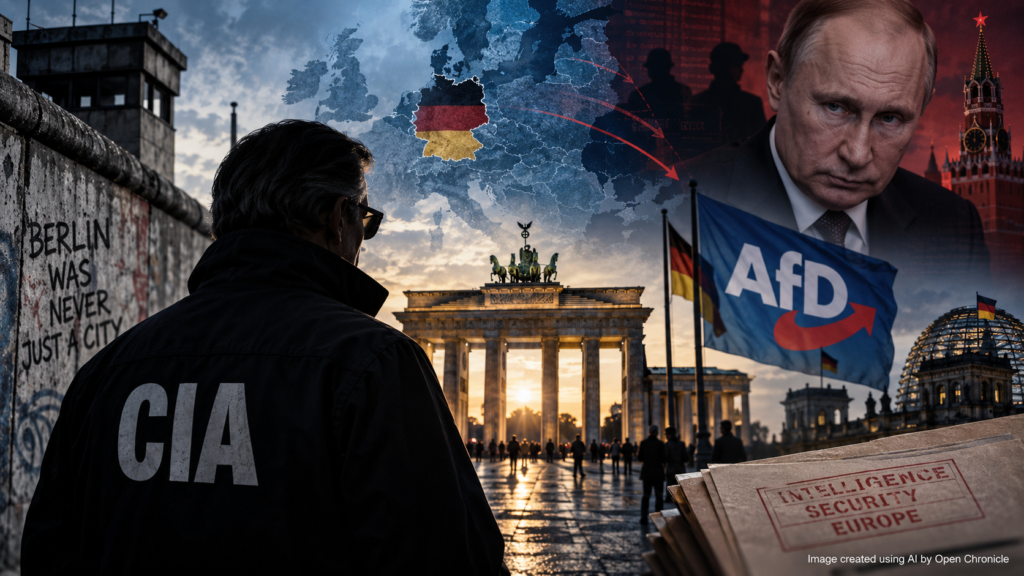
Former CIA Berlin station chief Joseph Wippl warns that the growing political influence of Germany’s Alternative for Germany party could raise concerns over intelligence security, while arguing that Russia’s covert operations across Europe may ultimately undermine Moscow’s own strategic objectives.
By Open Chronicle with agencies
BERLIN, September 22, 2026. Joseph Wippl spent much of his intelligence career confronting Soviet espionage during the Cold War. Now, more than three decades after German reunification, the former CIA station chief in Berlin believes the country faces a new set of security challenges involving Russian intelligence operations, domestic political divisions and the future of cooperation between Western intelligence agencies.
In an interview with British newspaper The i Paper, Wippl, 82, expressed concern about the growing political influence of the Alternative for Germany (AfD) party, particularly its position on relations with Moscow and the implications that its participation in regional governments could have for intelligence sharing.
His warnings follow the AfD’s recent electoral successes in eastern Germany, where the party secured first place in state elections in Saxony-Anhalt on September 6 and Mecklenburg-Western Pomerania on September 20.
Despite these results, other major parties have continued to rule out forming governing coalitions with the AfD, limiting its immediate prospects of taking control of regional administrations.
For Wippl, the central concern extends beyond electoral politics. It involves the security of sensitive intelligence and the possibility that political changes at regional level could affect cooperation between German security institutions and their international partners.
From the Cold War to a new era of intelligence confrontation
Wippl joined the CIA in 1972 and served in West Germany during a period when Soviet intelligence agencies maintained extensive espionage networks across Europe.
Stationed in Bonn, then the capital of West Germany, he monitored Soviet intelligence activities and networks of individuals sympathetic to Moscow.
The political and military division of Germany placed the country at the centre of the confrontation between NATO and the Warsaw Pact.
The fall of the Berlin Wall in 1989 and German reunification the following year fundamentally transformed the European security environment.
Wippl later returned to Germany as the CIA’s chief of station in Berlin, serving between 2001 and 2003.
Today, as a professor of international relations at Boston University, he continues to follow developments in Germany and regularly visits the country.
His experience informs his concerns about the current security environment, particularly the relationship between Russia’s intelligence activities and political developments within European democracies.
The AfD’s electoral gains raise questions about intelligence security
The AfD has consolidated its position in eastern Germany, securing the largest share of votes in two regional elections in September.
The party’s political programme includes stricter immigration controls, renewed economic relations with Russia and the restoration of Russian energy supplies to Germany.
Its electoral success has increased pressure on Chancellor Friedrich Merz and Germany’s established political parties, while raising questions about future coalition arrangements at regional and federal levels.
Wippl believes the possibility of AfD participation in a regional government deserves particular attention because of Germany’s decentralised intelligence structure.
Germany maintains separate federal and state intelligence institutions, creating a system in which regional governments have responsibilities for domestic intelligence operations.
At the federal level, the Federal Intelligence Service, known as the BND, is responsible primarily for foreign intelligence.
The Federal Office for the Protection of the Constitution, or BfV, focuses on domestic threats to Germany’s constitutional order.
Each of Germany’s 16 federal states also maintains its own domestic intelligence authority, generally known as the LfV.
These regional institutions cooperate with federal agencies and exchange information concerning espionage, extremism and other security threats.
Wippl fears that political interference in a regional intelligence service could create difficulties for this system of cooperation.
His concern is that if a political party whose members or associates are suspected of maintaining inappropriate relationships with foreign intelligence services gains authority over a regional security institution, other agencies could become reluctant to share sensitive information.
Such a situation could also affect the confidence of international intelligence partners.
However, the existence of political contacts between AfD representatives and Russian officials does not, by itself, establish espionage or unauthorised intelligence disclosure.
Wippl’s assessment represents a warning about a potential security vulnerability rather than evidence that a regional intelligence agency has already been compromised.
Germany’s intelligence services and the debate over the AfD
The AfD’s relationship with Germany’s domestic intelligence authorities has been the subject of political and legal disputes for several years.
Regional branches of the party have faced scrutiny over allegations of right-wing extremism, while federal intelligence authorities have raised concerns about statements and positions attributed to party officials.
In Saxony-Anhalt, the regional domestic intelligence service has classified the state branch of the AfD as right-wing extremist.
The party has rejected accusations of extremism and has challenged intelligence assessments that it considers politically motivated.
These disputes have implications for the relationship between elected representatives and the security institutions responsible for protecting Germany’s constitutional order.
Defence Minister Boris Pistorius has previously argued that sensitive military information, including details concerning military installations and training areas, must be protected from unauthorised disclosure.
AfD representatives in Thuringia have also faced accusations that parliamentary questions concerning sensitive security matters could benefit Russian intelligence.
The party has rejected those allegations.
Wippl considers the prospect of an AfD-led regional administration particularly sensitive because a government may exercise administrative authority over institutions responsible for monitoring threats to the constitutional order.
The legal and operational consequences would depend on the relevant state legislation, safeguards governing classified information and the precise responsibilities of the officials involved.
Russia’s relationship with the AfD comes under renewed scrutiny
The AfD’s position on relations with Moscow has become an increasingly prominent issue in German political debate.
The party has advocated renewed diplomatic engagement with Russia and the restoration of Russian gas imports, arguing that cheaper energy could help German households and businesses.
On September 18, Reuters reported that representatives of the AfD and Russian President Vladimir Putin’s senior economic envoy were preparing discussions for 2027 concerning the possible resumption of Russian gas supplies to Germany.
According to two people familiar with the preparations, the proposed meeting would examine the possibility of reopening the Nord Stream pipeline system.
The AfD does not currently control the German federal government and therefore cannot independently authorise a resumption of Russian gas imports.
On September 22, the Kremlin welcomed the AfD’s willingness to pursue dialogue with Moscow, contrasting the party’s approach with that of Chancellor Merz.
Kremlin spokesman Dmitry Peskov said he was unaware of the specific preparations for the reported gas discussions but welcomed the prospect of improved relations with a significant German political force.
For Wippl, these developments raise concerns about the potential intersection of foreign policy, domestic political influence and intelligence security.
He suspects that Russian intelligence services may seek to cultivate relationships within political organisations whose positions are favourable to Moscow.
His suspicions concerning possible Russian intelligence activity within the AfD remain allegations and should not be treated as proof that the party, its leadership or its supporters are acting on behalf of Russian intelligence.
Hybrid warfare and Russia’s operations across Europe
Beyond German domestic politics, Wippl is concerned about the wider pattern of covert operations attributed to Russia across Europe.
European governments and intelligence agencies have reported suspected Russian involvement in sabotage, espionage, cyber operations and attempts to disrupt critical infrastructure.
These activities are frequently described as hybrid warfare because they combine military, intelligence, technological and political instruments while remaining below the threshold of conventional armed conflict.
Recent European security assessments have highlighted suspected sabotage operations, drone incidents and attacks involving facilities connected to defence and logistics.
Germany has accused Russia of involvement in espionage and covert operations targeting infrastructure, including a reported attempted drone attack at Leipzig/Halle Airport.
Moscow has repeatedly denied allegations of conducting hostile operations against European countries.
The broader security concerns have intensified since Russia’s full-scale invasion of Ukraine in February 2022, as European governments have expanded military assistance to Kyiv and strengthened their defence arrangements.
Wippl argues that covert operations attributed to Moscow may produce consequences different from those intended by Russian authorities.
In his assessment, repeated incidents involving sabotage, espionage and intimidation could reinforce perceptions of Russia as a security threat, encouraging European governments to invest further in intelligence cooperation and protective measures.
This is Wippl’s assessment of the possible strategic consequences of Russian activity, rather than an established outcome.
Could Russia’s covert operations strengthen European security cooperation?
European governments have been reviewing their security arrangements in response to the changing threat environment.
Germany has increased attention to the protection of critical infrastructure, counterintelligence capabilities and the security of military facilities.
Wippl has welcomed efforts by German ministers to strengthen the country’s intelligence and security institutions.
He believes that continued covert activity attributed to Russia could encourage closer cooperation among European security services, rather than weaken their collective response.
However, the effectiveness of these measures depends on several factors, including intelligence coordination, national legislation, institutional resources and the willingness of governments to exchange sensitive information.
The debate over regional intelligence security in Germany illustrates one of the challenges facing European countries.
Domestic intelligence institutions must operate within democratic systems while protecting sensitive information from foreign interference.
Maintaining that balance requires safeguards against unauthorised access and political interference, alongside appropriate oversight of intelligence agencies.
Economic pressures and the AfD’s growing political support
Wippl also acknowledges that the AfD’s electoral success cannot be understood solely through the country’s relationship with Russia.
Economic concerns, rising living costs, immigration and dissatisfaction with established political parties have contributed to changes in German voting patterns.
In eastern Germany, the economic and social consequences of reunification continue to influence political attitudes.
Some voters believe their regions have not benefited equally from Germany’s economic development, while others express dissatisfaction with public services, employment opportunities and energy costs.
The AfD has sought to address these concerns through proposals involving immigration restrictions, lower energy prices and a different approach to relations with Russia.
Its support has increased particularly in regions where economic grievances and dissatisfaction with the federal government have become prominent electoral issues.
Recent regional election results also showed gains for the Left Party, indicating that dissatisfaction with established political forces has benefited parties with substantially different economic and foreign policy positions.
Wippl places these developments within a wider international context of public dissatisfaction with traditional political institutions.
He draws comparisons with political movements in the United States, Britain and France, while emphasising the importance of Germany’s particular historical and economic circumstances.
Germany’s political future and the 2029 federal election
Germany’s next regular federal election is scheduled for 2029, leaving time for the country’s political parties to address the economic and security issues shaping public debate.
Wippl believes the period before that election will be important for Germany’s domestic political environment and its response to the war in Ukraine.
He has also expressed hope that the conflict might end or enter a sustained ceasefire before Germans return to the polls at federal level.
Nevertheless, he acknowledges that the course of the war remains uncertain.
The AfD’s recent regional election results have demonstrated its growing electoral support, but forming a government requires more than securing the largest share of votes.
Coalition negotiations, parliamentary majorities and the positions of other political parties remain central to Germany’s political system.
For the country’s intelligence institutions, the immediate challenge is to maintain operational independence and secure cooperation regardless of changes in the political environment.
Intelligence security at the centre of Europe’s changing political landscape
Joseph Wippl’s concerns highlight the relationship between domestic politics, foreign intelligence activity and international security cooperation.
Germany occupies a central position in European defence and intelligence networks, making the security of its institutions important to its allies.
The country’s decentralised intelligence system provides regional authorities with responsibilities that must be coordinated with federal institutions and international partners.
Political developments that affect access to classified information or the independence of intelligence services could therefore have consequences beyond Germany’s borders.
At the same time, allegations of foreign influence require evidence, and political positions favouring diplomatic engagement with Russia must be distinguished from espionage or unauthorised intelligence activity.
As European governments respond to suspected Russian covert operations and the continuing war in Ukraine, the protection of intelligence networks remains an important element of their collective security arrangements.
For Wippl, the experience of the Cold War offers a reminder that intelligence operations, political developments and international relations are closely connected, even as the security challenges facing Europe continue to evolve.