
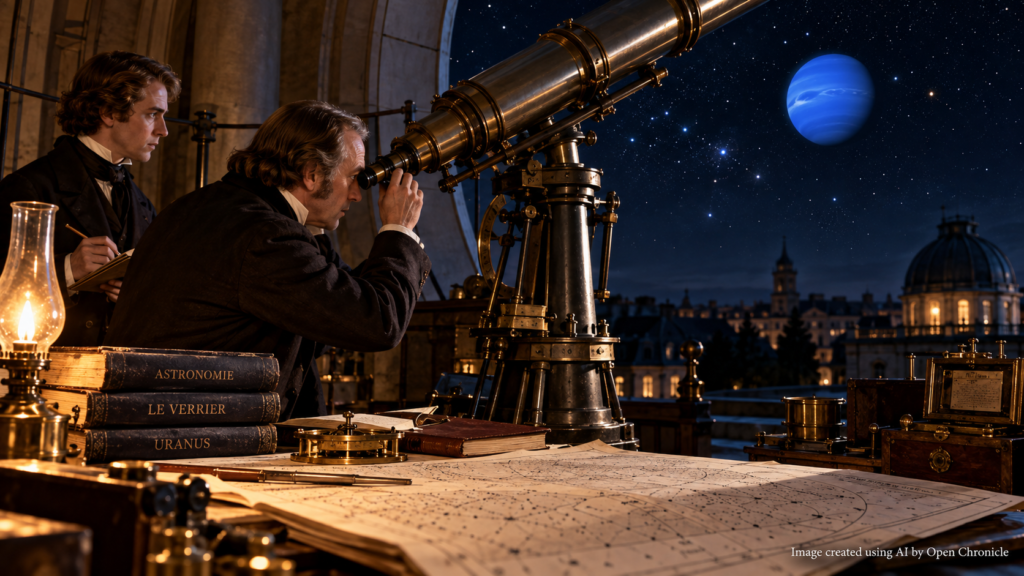
How an unexplained disturbance in Uranus’s orbit led astronomers to discover an unseen world, transforming the history of astronomy and demonstrating the predictive power of Newtonian physics.
By Open Chronicle History Desk
On the night of September 23, 1846, astronomer Johann Gottfried Galle pointed a telescope towards a carefully selected region of the night sky at the Berlin Observatory.
He was searching for a planet that no human being had yet positively identified as a planet.
The object had no confirmed position in astronomical catalogues. Its existence had been inferred from the behaviour of another planet, Uranus, whose orbit did not entirely match the predictions of Newtonian gravitational theory when the gravitational influence of the known planets was taken into account.
For years, astronomers had struggled to explain the discrepancy.
Some suspected that an unknown planet, orbiting far beyond Uranus, was exerting a gravitational influence upon it.
The challenge was extraordinary.
Could mathematics reveal the position of an object that nobody had yet identified through a telescope?
On September 23, 1846, the answer arrived.
Galle and his assistant, Heinrich Louis d’Arrest, identified an object close to the position calculated by the French mathematician Urbain Le Verrier.
The object was Neptune, the eighth planet of the Solar System.
The discovery represented a major achievement in nineteenth-century astronomy. It demonstrated that the gravitational effects of an unseen celestial body could be used to predict its location.
It also transformed humanity’s understanding of the scale and structure of the Solar System.
The known planetary frontier had moved farther into space.
And mathematics had helped astronomers find it.
1. The Solar System Before Neptune
At the beginning of the nineteenth century, astronomers recognised seven major planets orbiting the Sun.
Mercury, Venus, Mars, Jupiter and Saturn had been known since antiquity.
Earth’s status as a planet had become established through the development of heliocentric astronomy.
Uranus had been discovered in 1781 by the German-born British astronomer William Herschel.
Its discovery was an extraordinary event.
For thousands of years, Saturn had represented the outer boundary of the known planetary system.
Uranus demonstrated that additional planets existed beyond the limits visible to the unaided human eye.
Its orbit also raised new questions.
Astronomers began calculating its movement using the gravitational laws developed by Isaac Newton.
Those calculations would eventually lead to one of the most remarkable discoveries in the history of science.
2. Uranus: The Planet That Refused to Follow Predictions
After the discovery of Uranus, astronomers examined earlier observations and calculated its expected orbital motion.
Newton’s law of universal gravitation provided a mathematical framework for predicting the movements of celestial bodies.
The gravitational attraction of the Sun largely determined the orbit of each planet.
But planets also exerted gravitational forces upon one another.
Jupiter and Saturn, for example, could produce measurable disturbances in the motion of other planets.
These effects were known as gravitational perturbations.
Astronomers incorporated them into increasingly sophisticated calculations.
Yet Uranus presented a problem.
Its observed positions did not consistently match the positions predicted by existing orbital models.
The differences were small, but they were significant enough to demand an explanation.
Were the observations inaccurate?
Were the calculations incomplete?
Or was an unknown object influencing the planet’s movement?
The third possibility would eventually lead to Neptune.
3. Newton’s Theory Faces a New Test
English mathematician and physicist whose laws of motion and universal gravitation provided the theoretical foundation for predicting planetary orbits.
Newton’s Philosophiæ Naturalis Principia Mathematica, published in 1687, had transformed the scientific understanding of motion and gravity.
The same gravitational principles could explain the movement of falling objects on Earth and the orbital motion of celestial bodies.
By the nineteenth century, Newtonian mechanics had become an essential foundation of mathematical astronomy.
The irregularities in Uranus’s orbit therefore presented an important challenge.
If the known gravitational influences were insufficient to explain the planet’s movement, astronomers needed to identify the missing factor.
One possibility was that Newtonian theory required modification.
Another was that an additional planet existed beyond Uranus.
The second explanation offered a testable hypothesis.
If an unknown planet was responsible for the disturbances, its gravitational influence could potentially reveal its approximate mass, orbit and position.
The task was to work backwards from the observed effects to the unseen cause.
4. The Mathematical Search for an Invisible Planet
The problem was extraordinarily difficult.
Astronomers normally calculated how a planet would move when its position, mass and orbital characteristics were known.
The Uranus problem required the opposite approach.
They had to use irregularities in a known planet’s motion to estimate the characteristics of an unknown object.
This was an inverse problem.
The calculations involved gravitational forces, orbital geometry and observations accumulated over many years.
The available measurements were imperfect, and the unknown planet’s properties could not be determined uniquely from the data.
Nevertheless, two mathematicians working independently made remarkable progress.
One was John Couch Adams in Britain.
The other was Urbain Le Verrier in France.
Their work would become central to the discovery of Neptune and to a subsequent international controversy over scientific credit.
5. John Couch Adams: The British Mathematician
John Couch Adams was born in Cornwall, England, in 1819.
He studied mathematics at the University of Cambridge and developed an interest in the unexplained irregularities in Uranus’s orbit.
By 1845, Adams had calculated a possible orbit and position for a hypothetical planet beyond Uranus.
He communicated aspects of his work to astronomers associated with Cambridge and the Royal Observatory at Greenwich.
However, his predictions did not immediately result in a confirmed discovery.
Communication difficulties, uncertainties in the calculations and the absence of a sufficiently prompt observational search contributed to the delay.
James Challis, director of the Cambridge Observatory, eventually began searching for the predicted planet in the summer of 1846.
His observations included Neptune, but he did not recognise it as the sought-after planet before the Berlin discovery.
Adams’s work would later become the subject of intense debate concerning the relative contributions of British and French astronomers.
6. Urbain Le Verrier: Calculating the Unknown
Urbain Le Verrier was born in Saint-Lô, France, in 1811.
He studied mathematics and developed a distinguished career in celestial mechanics.
During the 1840s, he began investigating the irregularities in Uranus’s orbit.
Le Verrier examined whether the known planets could account for the observed discrepancies.
He concluded that an additional planet beyond Uranus offered a plausible explanation.
Using mathematical analysis, he estimated the unknown planet’s orbital characteristics and predicted its position in the sky.
In 1846, he published his findings and sought observational confirmation.
His calculations attracted attention, but obtaining telescope time for the search proved difficult.
Eventually, Le Verrier contacted Johann Gottfried Galle at the Berlin Observatory.
The letter would lead directly to the discovery.
7. September 23, 1846: The Search Begins in Berlin
On September 23, 1846, Galle received Le Verrier’s request to search for the predicted planet.
Galle was an astronomer at the Berlin Observatory, which possessed a powerful refracting telescope suitable for the task.
He began the search that evening with the assistance of Heinrich Louis d’Arrest, a young astronomy student.
The two men had access to a recently prepared star chart covering the relevant region of the sky.
This chart was particularly valuable because it allowed them to compare the objects visible through the telescope with previously recorded stars.
If an object appeared that was not included on the chart, it could be a candidate for the unknown planet.
The astronomers directed the telescope towards the position predicted by Le Verrier.
They began comparing the sky with the chart.
Soon, they encountered an object that did not match the recorded stars.
The discovery was within reach.
8. The Moment Neptune Was Identified
The object was found less than one degree from Le Verrier’s predicted position.
This was a remarkable agreement between mathematical prediction and observation.
Galle and d’Arrest examined the unfamiliar object and compared its position with the available chart.
Further observations established that it was moving relative to the background stars.
The object was not an ordinary fixed star.
It was the planet astronomers had been searching for.
Neptune had been identified.
The discovery occurred during the night of September 23 to 24, 1846, with September 23 conventionally recognised as the discovery date.
The result was communicated to Le Verrier, confirming that his calculations had successfully directed observers towards a previously unidentified planet.
For the first time, a major planet had been discovered through a targeted observational search guided by a mathematical prediction of its gravitational influence.
9. Who Discovered Neptune?
The discovery immediately raised questions about scientific credit.
Le Verrier’s calculations had led directly to the successful Berlin observation.
Galle and d’Arrest had identified the planet through the telescope.
Adams had independently worked on the same mathematical problem and produced earlier predictions.
British astronomers argued that Adams deserved recognition alongside Le Verrier.
French astronomers emphasised that Le Verrier’s published calculations and direct communication with Berlin had produced the actual discovery.
The controversy continued for decades.
Modern historical scholarship has examined the surviving correspondence, calculations and observational records to clarify the sequence of events.
The contributions can be distinguished without reducing the discovery to a single individual.
Adams independently investigated the unknown planet mathematically.
Le Verrier developed and communicated the prediction that directly guided the successful search.
Galle and d’Arrest carried out the observations that identified Neptune.
The discovery emerged from the interaction of mathematical theory, astronomical observation and scientific communication.
10. Had Neptune Been Observed Before 1846?
Neptune had appeared in astronomical observations before its formal discovery.
The most famous earlier observations were made by Galileo Galilei.
In December 1612 and January 1613, Galileo recorded an object near Jupiter that modern astronomical analysis identifies as Neptune.
At the time, the planet was close to Jupiter in the sky.
Galileo apparently treated it as a background star rather than recognising it as a planet.
The distinction is important.
Observing an object is not necessarily the same as identifying its nature.
Neptune was too distant and faint to be readily recognised as a planet with the observational methods available to Galileo.
Its planetary identity was established only in 1846.
The earlier observations nevertheless demonstrate that the planet had been visible through telescopes for more than two centuries before its discovery was formally announced.
11. Why the Name Neptune?
The newly discovered planet required a name.
Several proposals circulated, including names associated with the astronomers involved in the discovery.
Le Verrier initially supported the name Neptune before briefly advocating a name derived from his own surname.
The name Neptune ultimately prevailed.
It followed the established convention of naming planets after figures from classical mythology.
Neptune was the Roman god of the sea, corresponding broadly to the Greek god Poseidon.
The name also became associated with the planet’s distant, mysterious character.
Its modern blue appearance, however, was not known to nineteenth-century astronomers in the detail revealed by later spacecraft.
The planet’s colour and atmospheric characteristics would become subjects of scientific investigation during the twentieth century.
12. How Far Away Is Neptune?
Neptune: Essential planetary facts
|
Position |
Eighth planet from the Sun |
|
Average distance from the Sun |
Approximately 4.5 billion kilometres |
|
Orbital period |
Approximately 164.8 Earth years |
|
Diameter |
Approximately 49,244 kilometres |
|
Planetary classification |
Ice giant |
|
Discovery |
September 23, 1846 |
Rounded planetary measurements based on established astronomical reference values.
Neptune orbits the Sun at an average distance of approximately 30 astronomical units.
One astronomical unit corresponds to the average distance between Earth and the Sun.
Sunlight takes more than four hours to reach Neptune.
The planet is so distant that it requires almost 165 Earth years to complete a single orbit.
This extraordinary orbital period produced an unusual historical milestone.
Neptune completed its first full orbit around the Sun since its discovery in July 2011.
The planet had been known to humanity for more than a century and a half before returning to approximately the same orbital position it occupied in September 1846.
13. Neptune Is Not a Solid Blue World
Neptune is classified as an ice giant, along with Uranus.
It does not possess a solid surface comparable to Earth’s.
Its atmosphere consists primarily of hydrogen and helium, with methane and other trace constituents.
Methane absorbs red wavelengths of sunlight and contributes to the planet’s blue appearance.
Beneath the visible atmosphere, Neptune is believed to contain dense layers of fluid material under extreme pressure.
Its internal structure remains an active subject of planetary science.
The term ice giant refers to the importance of heavier volatile substances, including water, ammonia and methane, in models of the planet’s composition.
It does not mean that Neptune is simply a frozen sphere of ordinary ice.
The conditions deep inside the planet are radically different from those found on Earth.
14. A Planet of Powerful Winds and Storms
Neptune possesses one of the most dynamic atmospheres in the Solar System.
Its winds can reach extremely high speeds, exceeding those commonly observed in Earth’s atmosphere.
The planet also develops large storm systems.
In 1989, NASA’s Voyager 2 spacecraft observed a vast atmospheric feature known as the Great Dark Spot.
The storm was comparable in scale to Earth.
Later observations showed that Neptune’s dark atmospheric features can evolve, disappear and form in different regions.
The planet receives only a small fraction of the solar energy reaching Earth.
Nevertheless, its atmosphere remains remarkably active.
Neptune emits more energy than it receives from the Sun, indicating that internal heat contributes to its atmospheric dynamics.
Understanding the origin and distribution of that energy remains important for explaining the behaviour of distant giant planets.
15. Voyager 2: Humanity’s First Close Encounter With Neptune
For more than 140 years after Neptune’s discovery, astronomers studied the planet from Earth.
Telescopes revealed its position, orbital characteristics and some atmospheric properties.
But its enormous distance made detailed observation difficult.
That changed in August 1989.
NASA’s Voyager 2 spacecraft flew past Neptune, becoming the first spacecraft to visit the planet.
The encounter revealed atmospheric storms, faint planetary rings and previously unknown details of Neptune’s moons.
Voyager 2 also photographed Triton, Neptune’s largest moon.
The spacecraft’s observations transformed scientific understanding of the distant planet.
A world first identified through nineteenth-century mathematics was now being examined directly by a robotic spacecraft.
The contrast illustrated the extraordinary development of astronomy and space exploration across less than a century and a half.
16. Triton: Neptune’s Extraordinary Moon
Triton was discovered by British astronomer William Lassell in October 1846, only weeks after Neptune itself was identified.
It is Neptune’s largest moon.
Triton possesses an unusual retrograde orbit, meaning that it travels around Neptune in the opposite direction to the planet’s rotation.
This orbital characteristic suggests that Triton was probably captured by Neptune’s gravity rather than forming in its present orbit alongside the planet.
Voyager 2 revealed an icy surface with complex geological features.
The spacecraft also observed evidence of active nitrogen geysers or plume-like eruptions.
Triton is therefore not simply an inert frozen satellite.
Its unusual orbit, composition and geological activity make it an important object for understanding the history of the outer Solar System.
17. Neptune’s Discovery and the Limits of Newtonian Physics
The discovery of Neptune became a celebrated example of the predictive power of Newtonian gravitation.
The unexplained motion of Uranus had suggested that an additional gravitational influence might exist.
Mathematical calculations indicated where astronomers should search.
The predicted object was then identified.
But the history of astronomy also demonstrates that successful theories can have limits.
During the nineteenth century, Le Verrier investigated an apparent discrepancy in the orbit of Mercury.
He considered whether another unknown planet, sometimes called Vulcan, might explain the problem.
No such planet was confirmed.
Mercury’s anomalous orbital precession was later explained by Albert Einstein’s general theory of relativity.
The comparison illustrates an important principle of scientific investigation.
An unexplained observation may indicate a missing object, an incomplete model, an observational error or the need for a deeper theoretical framework.
Neptune’s discovery demonstrated one possible outcome.
Mercury’s orbit eventually demonstrated another.
18. The Search for Planet Nine
The discovery of Neptune continues to influence astronomical research.
Scientists have investigated whether the orbital patterns of some distant trans-Neptunian objects could indicate the gravitational influence of an additional, undiscovered planet.
The hypothetical object is commonly called Planet Nine.
Its existence has not been confirmed.
Researchers have proposed alternative explanations for the observed orbital patterns, including observational selection effects and the collective influence of smaller bodies.
The historical parallel with Neptune is scientifically interesting, but it does not establish that another planet must exist.
Neptune was discovered after a specific prediction led to successful observational identification.
Planet Nine remains a hypothesis requiring direct or otherwise compelling observational confirmation.
The distinction reflects the continuing importance of testing mathematical predictions against evidence.
19. Why September 23 Matters
The discovery of Neptune represents a defining moment in the history of astronomy.
It showed that an unseen planet could be located through its gravitational effects upon another celestial body.
The achievement combined theoretical physics, mathematical calculation, careful observation and international scientific communication.
It expanded the known Solar System and strengthened confidence in the ability of mathematical models to predict natural phenomena.
It also demonstrated the importance of collaboration between scientists working in different countries.
The discovery was not the product of a single observation or a single calculation.
It emerged from years of research and the combined contributions of several astronomers.
Its legacy extends into modern planetary science, where researchers continue to use gravitational effects to investigate objects that cannot be observed directly.
From the search for distant planets to the study of exoplanets orbiting other stars, the relationship between mathematical prediction and astronomical observation remains fundamental.
September 23, 1846: The Night Mathematics Found a Planet
Imagine Berlin on the evening of September 23, 1846.
The observatory is preparing for another night of astronomical observations.
Johann Gottfried Galle has received a letter from Paris.
Its author, Urbain Le Verrier, believes that a planet exists beyond Uranus.
He has calculated where it should appear in the sky.
The prediction is precise enough to test.
Galle and Heinrich Louis d’Arrest turn their telescope towards the indicated region.
They examine the stars.
They compare their observations with a recently prepared chart.
Then they notice something unusual.
An object appears where the chart records no corresponding star.
They examine it more carefully.
Its position is remarkably close to the one predicted by Le Verrier.
The object is Neptune.
For centuries, astronomers had discovered celestial bodies by observing the heavens and attempting to understand what they saw.
On this night, the process has been reversed.
Mathematics has indicated where an unknown world should be found.
A telescope has confirmed its existence.
The discovery does not mean that mathematics alone can replace observation.
It demonstrates something more profound.
A physical theory can reveal the existence of an object before that object has been directly identified.
The movement of Uranus has carried a hidden message.
Astronomers have learned how to interpret it.
On September 23, 1846, the known Solar System expands.
Neptune enters the catalogue of recognised planets.
And the history of astronomy acquires one of its most remarkable examples of scientific prediction.
Historical Sources and Further Reading
Explore the historical records, scientific research and institutional resources behind this article.
Neptune: Facts
Planetary characteristics, orbital measurements, atmosphere, moons and the history of Neptune’s discovery.
Neptune: Discovery and Physical Characteristics
Historical context of the mathematical predictions, the Berlin observations and the planet’s physical properties.
Voyager 2
The spacecraft mission that conducted humanity’s first close exploration of Neptune in August 1989.
The Discovery of Neptune
Historical research into the calculations of Adams and Le Verrier, the observational work of Galle and d’Arrest, and the subsequent controversy over scientific credit.
Nicholas Kollerstrom,
Neptune’s Discovery: The British Case for Co-Prediction
(2006).
Open Chronicle History draws upon historical scholarship, scientific research and institutional records to provide context for the events, discoveries and individuals that shaped our understanding of the world.