
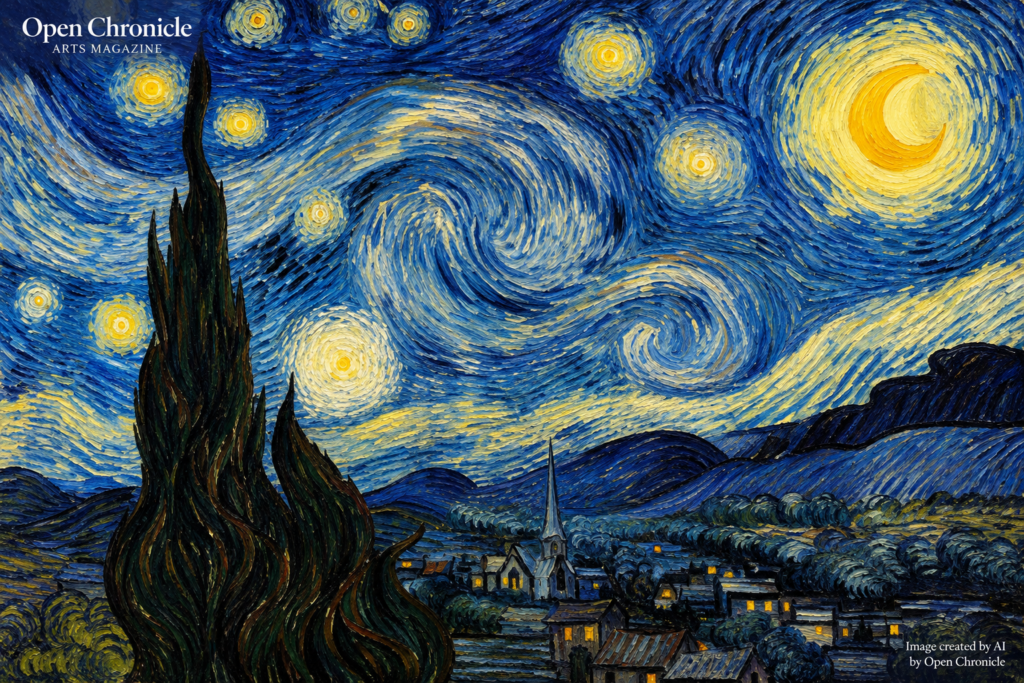
By Open Chronicle Arts Magazine
Painted in 1889 during his stay at Saint Rémy de Provence, Vincent van Gogh’s The Starry Night transformed an ordinary landscape into an extraordinary vision of movement, colour and imagination. More than a century later, the painting continues to challenge the way we understand the relationship between art, nature and human perception.
A night unlike any other
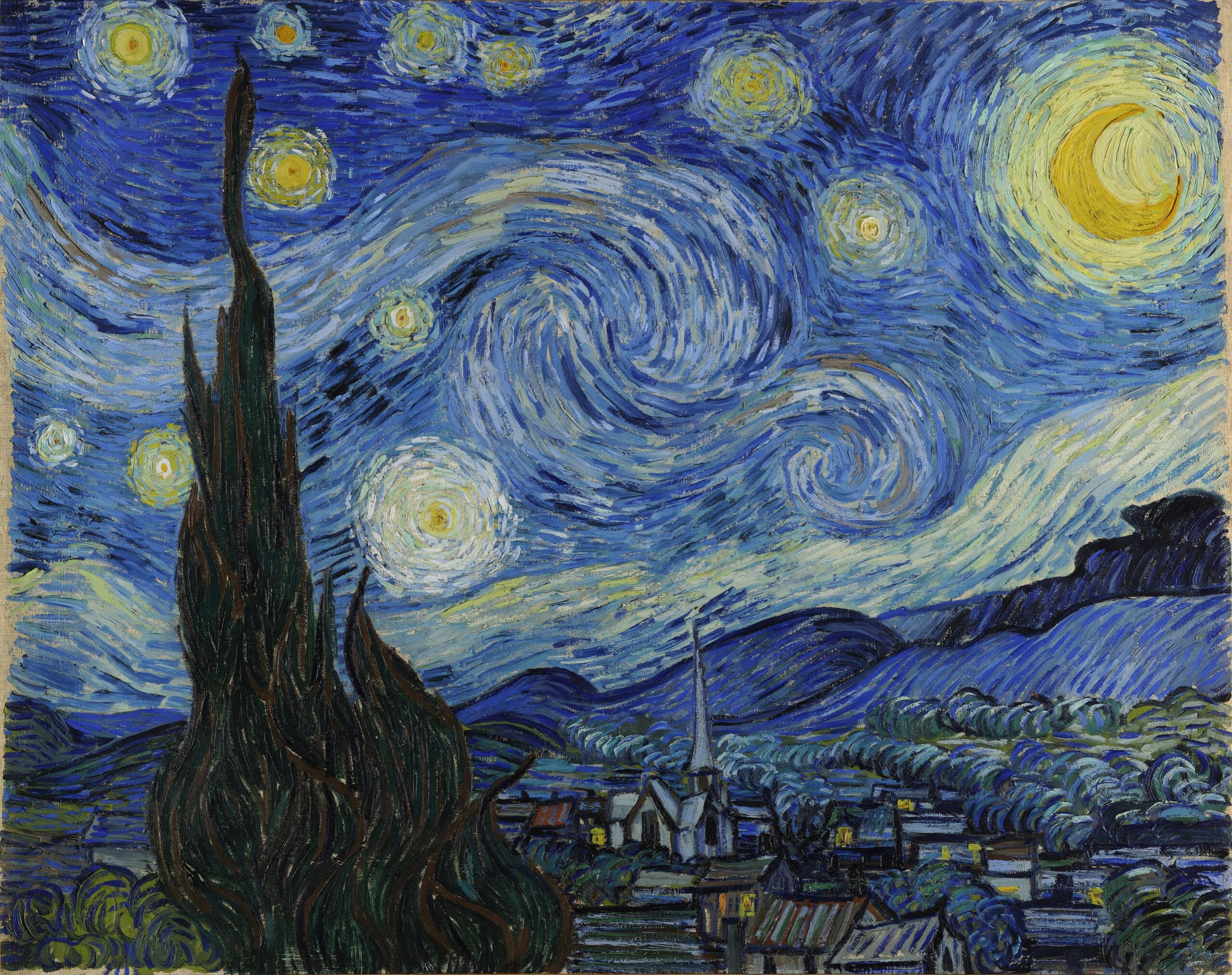
A dark cypress rises from the foreground, its twisting branches reaching towards a sky filled with luminous stars. Above a quiet village, great waves of blue and white seem to move across the heavens. A brilliant crescent moon illuminates the landscape, while the distant hills appear to echo the rhythms of the sky.
At first glance, Vincent van Gogh’s The Starry Night appears to depict a peaceful village beneath the night sky. Yet almost every element of the painting suggests movement.
The stars radiate light in concentric circles. The clouds curl and flow across the canvas. The cypress seems to connect the earth with the heavens.
Rather than presenting the night as a static landscape, Van Gogh created a composition in which colour, movement and expressive brushwork transform the natural world.
Painted in June 1889, the work is now part of the collection of the Museum of Modern Art in New York, where it has become one of the most widely recognised paintings in modern art.
Its enduring appeal lies partly in a remarkable contradiction: the painting depicts a world that appears familiar, yet its visual language makes that world seem extraordinary.
The historical setting: Saint Rémy, 1889
In May 1889, Van Gogh voluntarily entered the Saint Paul de Mausole asylum in Saint Rémy de Provence, in southern France.
His arrival followed a difficult period in Arles, where his relationship with fellow painter Paul Gauguin had deteriorated and he had experienced a serious mental health crisis.
At Saint Rémy, Van Gogh continued to work intensively, producing landscapes, studies of trees and plants, portraits and paintings inspired by the surrounding countryside.
His room offered a view towards the landscape and the Alpilles hills. The changing light, vegetation and distant mountains became recurring elements in his work.
It was within this setting that he developed the composition of The Starry Night.
The painting was not simply a transcription of the view outside his window.
According to the Museum of Modern Art, Van Gogh combined elements drawn from observation with alterations introduced through memory and imagination. The village was not visible from his window, while the cypress appears much closer than it was in the actual landscape.
Although the scene depicts the night, Van Gogh worked on the painting during daylight hours, developing the composition across several sessions.
These details are essential to understanding the work.
The painting is not a photographic representation of a particular moment. It is a carefully constructed image in which the artist reorganised the landscape to create a distinctive visual experience.
The sky that dominates the painting
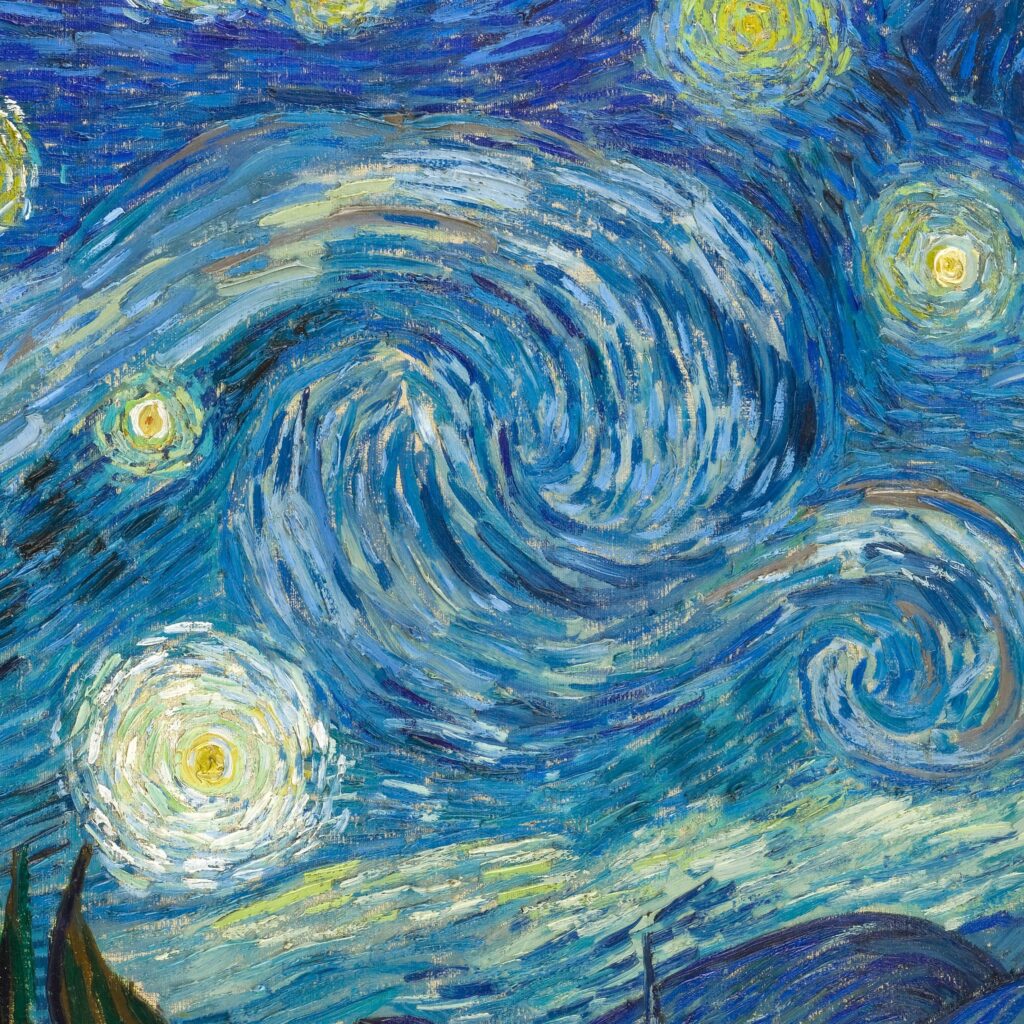
The most striking feature of The Starry Night is the extraordinary prominence of its sky.
It occupies approximately three quarters of the canvas, leaving the village and surrounding countryside comparatively small beneath it.
The sky is dominated by sweeping curves, luminous circles and contrasting shades of blue, white and yellow.
Instead of using colour simply to reproduce the appearance of the atmosphere, Van Gogh employed it to establish rhythm, intensity and visual movement.
The great swirling formation near the centre of the painting creates the impression of a sky in motion.
Its curves are echoed by the contours of the hills, while the vertical shape of the cypress introduces a contrasting movement that draws the viewer’s attention upwards.
The result is a composition in which the sky, landscape and vegetation appear connected through the same visual language.
Van Gogh’s treatment of the heavens reflects his broader interest in the expressive possibilities of colour and brushwork, which became central to his mature painting style.
Observation, imagination and the morning star
One of the most fascinating aspects of The Starry Night is the relationship between the painted sky and the actual heavens above Saint Rémy.
In correspondence with his brother Theo, Van Gogh described observing the countryside before sunrise and noticing the unusually bright morning star.
The Museum of Modern Art identifies Venus in the painting, positioned to the left of the central area of the sky, while the crescent moon appears towards the right.
These astronomical references demonstrate that the painting contains elements derived from direct observation.
Nevertheless, the work should not be understood as an exact astronomical record.
Van Gogh modified the shapes and positions of elements within the composition and exaggerated the radiance of the celestial bodies.
The painting therefore occupies a space between observation and artistic invention.
The real night sky provided the starting point, but Van Gogh’s imagination determined how that sky would appear on the canvas.
The cypress: A bridge between earth and sky
Rising dramatically from the lower left of the composition, the cypress is one of the painting’s most distinctive features.
Its dark, flame shaped silhouette contrasts with the luminous sky, while its upward movement connects the foreground with the celestial forms above.
Cypress trees were traditionally associated with cemeteries and mourning in parts of European culture.
This association has encouraged interpretations of the tree as a symbol of mortality or a connection between earthly life and the heavens.
The Museum of Modern Art discusses these possible symbolic meanings, while also emphasising the cypress’s important compositional role.
However, no single interpretation of the tree can be established as Van Gogh’s definitive intention.
What is visually clear is that the cypress provides a powerful counterweight to the horizontal arrangement of the village and hills.
Without it, the composition would lose much of the tension between the quiet landscape below and the restless sky above.
The village that did not exist outside his window
Beneath the enormous sky lies a small village, its houses arranged around a church with a tall, pointed steeple.
The buildings appear quiet and orderly, contrasting with the movement of the heavens.
Yet the village was not part of the view from Van Gogh’s asylum window.
The Museum of Modern Art notes that the church steeple resembles forms associated with the artist’s native Netherlands rather than the architecture of southern France.
This detail offers another example of the way Van Gogh combined visual observation with remembered forms.
The village can be understood as an imaginative construction, bringing together elements of different places within a single landscape.
Its relatively small scale also reinforces the visual dominance of the sky.
The houses and church provide a recognisable human environment, but the natural world occupies most of the painting.
This contrast invites the viewer to consider the relationship between human life and the vastness of the surrounding universe, without requiring a single symbolic explanation.
Colour, movement and the physical surface of paint
The emotional intensity of The Starry Night is inseparable from the techniques Van Gogh used to construct the image.
The painting is an oil on canvas measuring 73.7 by 92.1 centimetres.
Its surface contains energetic, visible brushstrokes and areas of thickly applied paint.
This technique, commonly associated with impasto, gives the painted surface a physical presence.
Rather than concealing the process of painting, Van Gogh allowed the direction and texture of his brushstrokes to become essential elements of the composition.
Short, curved strokes create the luminous circles surrounding the stars.
Longer, flowing marks establish the movement of the sky.
In the foreground, darker and more vertical strokes define the cypress.
Colour is equally important.
Deep blues establish the nocturnal atmosphere, while yellows and whites give the stars and moon their remarkable intensity.
The contrast between these colours creates the impression of radiance without relying on a strictly naturalistic representation of light.
Van Gogh’s painting demonstrates how colour and the physical application of paint can communicate an experience of nature that goes beyond its visible appearance.
The Starry Night and the birth of modern artistic expression
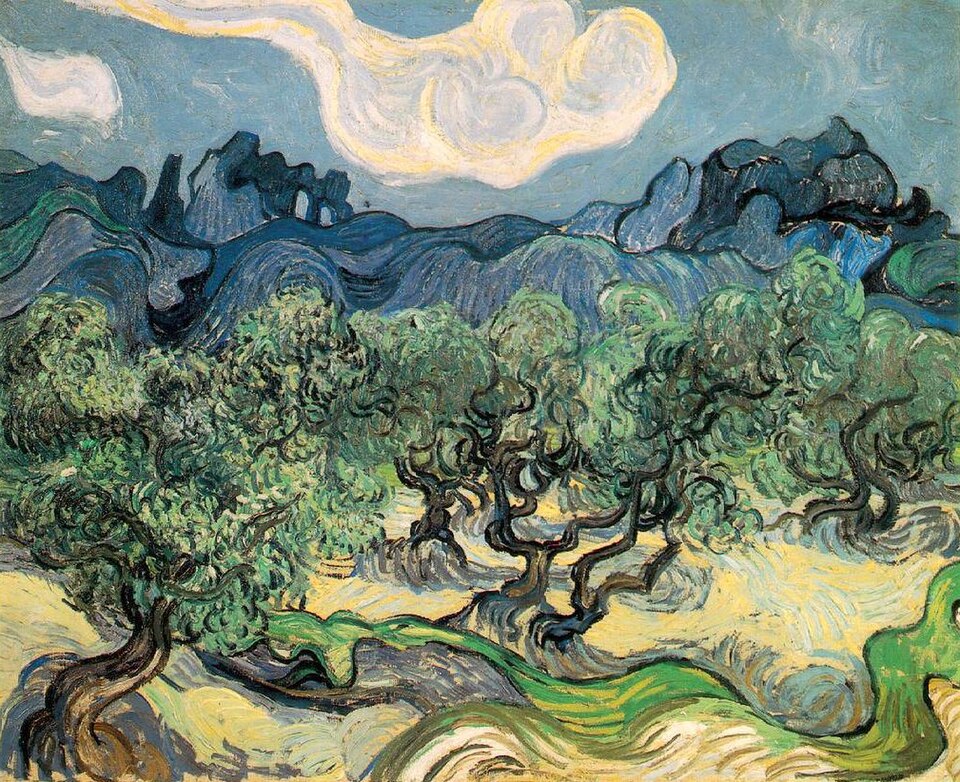
The Starry Night belongs to a period in which Van Gogh was developing an increasingly expressive approach to landscape painting.
His work was informed by his earlier encounters with Impressionism and Neo Impressionism, particularly their experiments with colour, light and visible brushwork.
Yet Van Gogh moved beyond the observation of fleeting atmospheric effects.
He used colour and line to communicate his personal response to the world.
The Museum of Modern Art identifies The Olive Trees, another painting produced at Saint Rémy in 1889, as a companion to The Starry Night.
Together, the works explore related visual ideas through contrasting representations of daylight and night.
In both paintings, the landscape becomes a setting for experiments with colour, rhythm and the expressive possibilities of painting.
These characteristics place Van Gogh within the development of Post Impressionism, a broad artistic category associated with painters who extended and transformed the visual language of Impressionism.
His work helped establish possibilities that would become increasingly important to later modern artists: the freedom to alter natural appearances, the use of colour for expressive purposes and the recognition of the painted surface as an essential part of the artwork itself.
From Saint Rémy to the Museum of Modern Art
The journey of The Starry Night from Van Gogh’s studio to its present location in New York is part of the painting’s history.
According to the provenance documented by the Museum of Modern Art, the painting passed from Vincent van Gogh to his brother Theo in 1889.
Following Theo’s death, it became part of the collection inherited by his widow, Johanna van Gogh Bonger, in trust for their son.
Over the following decades, the painting passed through several private collections and art dealers.
In 1941, the Museum of Modern Art acquired The Starry Night through the Paul Rosenberg Gallery, using funds associated with the Lillie P. Bliss Bequest.
Its place in the museum’s collection has contributed to its visibility and its status as a widely recognised image of modern painting.
Today, the work can be studied both as a historical object and as an example of Van Gogh’s distinctive artistic language.
Why The Starry Night continues to fascinate
More than a century after its creation, The Starry Night remains a painting that invites repeated examination.
Its composition is immediately recognisable, yet its individual elements continue to generate questions.
Is the sky intended to communicate the movement of nature, the artist’s emotional response to the landscape or a more symbolic relationship between the earth and the heavens?
The painting does not provide a definitive answer.
Its visual power comes partly from the coexistence of these possibilities.
The landscape contains recognisable elements, but their arrangement and treatment transform the scene into something that cannot be reduced to a single location or moment.
The painting also challenges the assumption that an artist’s achievement should be measured primarily by the accuracy of representation.
Van Gogh’s sky is not remarkable because it reproduces the night with photographic precision.
It is remarkable because its colours, forms and movements create a coherent artistic vision.
The work demonstrates that painting can communicate not only what the artist sees, but also how the artist chooses to interpret and transform that experience.
A masterpiece beyond the night
The Starry Night began with a view of the countryside from a room in southern France.
Through the deliberate arrangement of colour, form and movement, Van Gogh transformed that view into a painting that continues to resonate with audiences across generations.
The quiet village, towering cypress and luminous sky remain connected by a visual rhythm that makes the landscape appear both familiar and extraordinary.
The painting’s significance does not depend on resolving every question about its symbolism or the artist’s intentions.
Its achievement lies in demonstrating how an observed landscape can become an independent artistic vision.
In The Starry Night, Vincent van Gogh did more than paint the night sky.
He created a new way of experiencing it.
OPEN CHRONICLE ARTS MAGAZINE
THE MASTERPIECE
Artwork Information
VINCENT VAN GOGH | 1889
The Starry Night
Artist:
Vincent van Gogh (1853–1890)
Date:
June 1889
Location of creation:
Saint Rémy de Provence, France
Medium:
Oil on canvas
Dimensions:
73.7 × 92.1 cm
Collection:
The Museum of Modern Art, New York
Acquisition:
1941
Artwork details verified against the official
Museum of Modern Art collection record.
OPEN CHRONICLE ARTS MAGAZINE
RESEARCH & REFERENCES
Sources and Further Reading
Explore the original artwork records,
historical research and museum documentation
behind Vincent van Gogh’s The Starry Night.
01 | MUSEUM OF MODERN ART
Vincent van Gogh:
The Starry Night
Official collection record, historical context,
provenance and detailed information about
Van Gogh’s celebrated 1889 painting.
02 | MUSEUM OF MODERN ART
Vincent van Gogh:
The Olive Trees
Explore Van Gogh’s The Olive Trees,
painted at Saint Rémy in 1889,
and its artistic relationship with
The Starry Night.
03 | MUSEUM OF MODERN ART
Vincent van Gogh:
Artist Profile
Discover Van Gogh’s artistic development,
his expressive use of colour and brushwork,
and his contribution to the history
of modern painting.
Open Chronicle Arts Magazine
Explore the world of art, creativity and culture. Discover extraordinary artists, timeless masterpieces, contemporary movements and the stories behind the works that shape our world.
Back to Arts Magazine